You've checked your ad platform dashboards. The numbers look decent. But when you cross-reference against your CRM, the conversion counts don't match. Some deals have no attributed source. Your ROAS figures seem too good to be true. And yet, you're supposed to make budget decisions based on this data.
This is the reality for a large share of B2B SaaS marketing teams running paid campaigns today. The conversion data coming back from ad platforms is often incomplete, inflated, or simply wrong. And when you can't trust your data, every optimization decision becomes a guess dressed up as strategy.
Ad conversion tracking issues have become more widespread, not less, as the internet has shifted toward privacy-first defaults. Browser restrictions, cookie limitations, and platform-level changes have quietly eroded the reliability of the tracking infrastructure most marketers built their workflows around. The tools haven't kept pace, and the gap between reported performance and actual performance has widened.
This article breaks down exactly why conversion data breaks down, what the most common failure points look like, how browser privacy changes have accelerated the problem, and what a modern, reliable tracking foundation actually looks like. No fluff, just the technical clarity you need to fix it.
Why Your Conversion Numbers Do Not Add Up
The gap between conversions reported in your ad platform and conversions recorded in your CRM is one of the most common frustrations in paid media. Many marketers assume it's a configuration edge case, something unique to their setup. It isn't. It's a structural problem baked into how most conversion tracking systems work.
There are two directions this gap can go, and both are damaging. Over-reporting happens when the same conversion event is counted multiple times. A form submission fires a pixel twice. A purchase confirmation page is visited more than once. A tag manager rule triggers on every page load instead of once per transaction. The result is inflated conversion counts that make campaigns look more effective than they are, leading you to scale spend on the wrong things.
Under-reporting is the opposite problem and often the more dangerous one. Events don't fire because a user has an ad blocker installed. A cookie is blocked before it can record the session. A cross-device journey breaks the attribution chain. Conversions happen, but the platform never knows about them. You end up defunding campaigns that are actually working because the data says they aren't. This is what inaccurate conversion tracking looks like in practice, and it's more common than most teams realize.
Browser-based pixels are the root of much of this. They were designed in an era when cookies worked reliably across sessions and devices, ad blockers were rare, and browsers didn't aggressively restrict tracking scripts. That era is over. Safari's Intelligent Tracking Prevention, Firefox's Enhanced Tracking Protection, and the growing prevalence of ad blockers among technical audiences, particularly in B2B, have turned browser pixels into leaky measurement tools.
Attribution window mismatches between platforms compound the problem further. Meta might claim a conversion within its 7-day click window. Google claims the same conversion within its own attribution window. Both platforms report it as a win. Your actual CRM shows one deal. The result is double-counted revenue, inflated ROAS figures, and a distorted picture of which channel actually drove the outcome. When you're trying to make budget allocation decisions based on this data, you're working with numbers that don't reflect reality.
The Most Common Ad Conversion Tracking Issues Marketers Face
Understanding the categories of failure makes it easier to diagnose what's broken in your own setup. Most ad conversion tracking issues fall into a handful of recurring patterns, and recognizing them is the first step toward fixing them.
Pixel misfires and duplicate event firing: This happens when a conversion pixel fires more than once for a single user action. A form submission should fire exactly one conversion event. But in single-page applications, traditional page-load triggers don't behave the way you'd expect. When a user navigates between routes in a React or Vue app, the browser doesn't reload the page, so triggers configured on "page view" can fire repeatedly without an actual new page load. Tag manager misconfigurations can cause similar problems, where a trigger condition is too broad and fires on multiple interactions. Multiple pixel installations, sometimes from legacy implementations that were never cleaned up, are another common culprit. Understanding how a tracking pixel works at a technical level helps you catch these misfires before they distort your data. The outcome is always the same: inflated conversion counts that distort optimization signals.
Missing or broken UTM parameters: UTM parameters are the connective tissue between your ad spend and your attribution data. When they break, source attribution collapses. Traffic that originated from a paid LinkedIn campaign shows up as direct. A Google Ads click gets attributed to organic. The causes are varied: redirects that strip query strings, URL shorteners that don't preserve parameters, landing page builders that rewrite URLs, or simply campaigns that were launched without UTM tags appended. A solid understanding of UTM tracking and how it helps marketing is essential before you can reliably diagnose where parameters are breaking down. The damage is quiet and cumulative. Over time, your "direct" channel becomes a catch-all for misattributed paid traffic, and your paid channel performance looks worse than it actually is.
Cross-device journey gaps: In B2B SaaS, a buyer's journey rarely happens on a single device. A prospect might see a LinkedIn ad on their phone during a commute, research your product on a work laptop later that week, and convert through a Google search on a different browser. Cookie-based tracking systems are device and browser-specific. Without a persistent identity layer that can connect these sessions, the conversion appears unattributed or is credited only to the last touchpoint. This is one of the most underappreciated sources of lost attribution data in B2B funnels, and it's especially acute for companies with longer sales cycles where the gap between first touch and conversion spans weeks.
Each of these issues individually can skew your data meaningfully. Together, they create a picture of ad performance that bears little resemblance to what's actually happening in your pipeline.
How Browser Privacy Changes Made Tracking Harder
The privacy shift in browsers isn't a future concern. It has been actively degrading tracking accuracy for years, and the pace is accelerating.
Safari's Intelligent Tracking Prevention has been in place since 2017 and has grown more restrictive with each iteration. As documented by WebKit, ITP limits JavaScript-set first-party cookies to 7 days and effectively blocks third-party cookies entirely, capping their lifespan at 24 hours. For B2B SaaS companies where a prospect might click an ad today and not convert for several weeks, this is a serious problem. The cookie that would have connected that initial click to the eventual conversion expires long before the deal closes. The attribution chain breaks, and the ad that started the journey gets no credit.
Firefox's Enhanced Tracking Protection operates on similar principles, blocking known tracking scripts and limiting cross-site data sharing. The combined effect of Safari and Firefox restrictions means a substantial portion of your web traffic is already being tracked with degraded accuracy, regardless of how well your pixel is implemented. Preparing for ongoing changes like iOS link tracking restrictions is no longer optional for teams that depend on accurate attribution.
Apple's App Tracking Transparency framework, introduced with iOS 14.5, required explicit user permission for cross-app tracking. The opt-in rate for this permission has been low across most audiences, which significantly reduced the identifiable signal available to platforms like Meta. The practical consequence is that Meta and other platforms now rely more heavily on modeled conversions and probabilistic matching to fill the gaps. The numbers you see in your dashboard are not all deterministic measurements. A portion of them are estimates generated by the platform's own models. This isn't inherently wrong, but it's important to understand that reported conversions are not the same as verified conversions.
Google has been moving toward third-party cookie deprecation in Chrome for several years. The timeline has shifted, but the direction is clear. Client-side, cookie-dependent tracking is being phased out as a reliable foundation. Marketers who haven't begun transitioning to server-side tracking and first-party data strategies are building on infrastructure that will continue to degrade. The question isn't whether to make this transition, it's how quickly you can do it without losing measurement continuity.
Server-Side Tracking and Conversion APIs: The Modern Fix
If browser-based pixels are the problem, server-side tracking is the structural solution. The core idea is straightforward: instead of relying on a script in the user's browser to fire a conversion event, you fire it from your own server. The event bypasses ad blockers, browser restrictions, and cookie limitations entirely. You control the data, you control the timing, and you control what gets sent to the ad platform.
This matters because server-side events are not subject to the same interception points that degrade pixel data. An ad blocker cannot block a request that originates from your server. ITP cannot limit a cookie that is set server-side via HTTP headers rather than JavaScript. The signal quality improves significantly, and you get a more complete picture of what's actually happening in your funnel. The reasons server-side tracking is more accurate than browser-based alternatives come down to this fundamental architectural difference.
Conversion APIs are the mechanism through which server-side data reaches the ad platforms. Meta's Conversions API (CAPI) allows you to send conversion events directly from your server to Meta, supplementing or replacing what the browser pixel would have sent. Google Enhanced Conversions works similarly, allowing you to send hashed first-party data alongside standard conversion events to improve match rates and fill gaps left by browser restrictions. Both platforms recommend running server-side and browser-side tracking in parallel to maximize coverage, particularly during the transition period.
There is one critical technical requirement when running both a browser pixel and a server-side CAPI simultaneously: event deduplication. Without deduplication, the same conversion event gets reported twice, once from the browser and once from the server. This over-reports conversions to the platform and sends distorted optimization signals to the algorithm. Proper deduplication requires passing a consistent event ID with both the browser and server events so the platform can recognize and discard the duplicate. Following a detailed Conversion API implementation tutorial is the most reliable way to get deduplication right from the start. Meta's documentation is explicit about this requirement, and it's a step that's frequently missed in rushed implementations.
Platforms like Cometly support server-side event tracking and Conversion API integration natively, making it possible to send enriched, first-party conversion data back to Meta and Google without building custom server infrastructure from scratch. This is how modern attribution closes the gap between what ad platforms report and what actually happens in your CRM.
Multi-Touch Attribution: Seeing the Full Customer Journey
Even with technically sound conversion tracking in place, there's a second layer of distortion that affects how credit is assigned across your campaigns. Attribution models determine which touchpoints get credit for a conversion, and the default model used by most ad platforms systematically misrepresents how B2B buyers actually behave.
Last-click attribution assigns all conversion credit to the final touchpoint before the conversion event. It's simple, it's easy to implement, and it's wrong for most B2B use cases. A prospect who clicked a LinkedIn awareness ad three weeks ago, downloaded a case study from a retargeting ad two weeks ago, and then converted through a branded Google search gets the conversion credited entirely to Google. The LinkedIn and retargeting campaigns that built the relationship and created the intent get nothing. Over time, this leads to budget decisions that defund the channels doing the early work, because the data makes them look unproductive.
Multi-touch attribution models distribute credit across all touchpoints in the customer journey. Linear models give equal credit to every interaction. Time-decay models weight recent touchpoints more heavily. Position-based models give more credit to the first and last touch with the middle shared among other interactions. Data-driven models use statistical analysis to assign credit based on how much each touchpoint actually contributed to conversion outcomes. Each has trade-offs, but all of them provide a more accurate picture than last-click alone. Understanding conversion window attribution is a prerequisite for choosing the right model for your sales cycle.
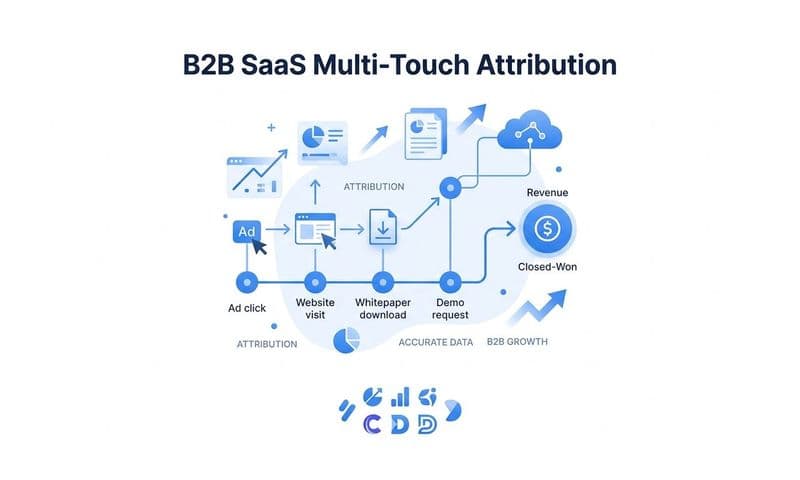
For B2B SaaS companies, the case for multi-touch attribution is particularly strong. Sales cycles often span weeks or months, involve multiple stakeholders, and include a mix of paid, organic, and direct touchpoints. A 7-day click attribution window, which is standard in many platforms, misses the majority of the journey for deals that take longer to close. Connecting ad spend to pipeline and closed-won revenue requires attribution that spans the full sales cycle, not just the last interaction before a form fill.
This is where integrating your CRM data with your ad platform data becomes essential. When you can see that a campaign influenced five opportunities that closed over the following two months, you understand its true contribution to revenue, even if it didn't drive the final click. Without that connection, you're optimizing for the wrong signal.
Building a Reliable Conversion Tracking Foundation
Fixing ad conversion tracking issues isn't a one-time task. It requires building a foundation that is structurally sound and then maintaining it as your tech stack and the privacy landscape evolve. Here's how to approach it systematically.
Start with an audit of your current setup: Verify that each conversion event fires exactly once per user action. Use your tag manager's preview mode or a browser extension to observe event firing in real time as you move through your funnel. Check that UTM parameters persist from ad click through to form submission and that they are being captured correctly in your CRM. Then compare your CRM conversion counts against what your ad platforms report for the same time period. The size of the gap tells you how much tracking work you have ahead of you. A structured conversion tracking setup process ensures you're not missing critical configuration steps during this audit.
Implement a first-party data strategy: This means capturing user identity at the point of conversion, such as a form submission or a login event, and passing that data server-side. When a user submits a form, you have their email address. That email can be hashed and used as a persistent identity signal that survives browser restrictions and connects sessions across devices. This is the foundation of reliable cross-device attribution and the backbone of effective CAPI implementation. First-party data collected with user consent is the most durable signal available in the current privacy environment.
Consolidate into a single source of truth: One of the most persistent sources of confusion in conversion tracking is having data spread across multiple disconnected systems. Your ad platforms each report their own version of performance. Your CRM has its own records. Your website analytics shows a third picture. A unified marketing attribution platform pulls all of this together, connecting ad spend data from Meta, Google, and other channels with CRM events and website behavior into one consistent view.
Cometly is built specifically for this purpose. It connects your ad platforms, CRM, and website to track the full customer journey in real time, supports server-side event tracking and Conversion API integration, and provides multi-touch attribution across every channel. Instead of reconciling conflicting reports from five different tools, you get a single, accurate picture of which ads and campaigns are actually driving pipeline and revenue. For B2B SaaS teams managing complex funnels and longer sales cycles, that clarity is the difference between confident scaling and expensive guessing.
The Bottom Line on Getting Your Tracking Right
Ad conversion tracking issues are not a minor inconvenience you can defer until next quarter. They are a strategic liability. When your conversion data is wrong, every downstream decision is wrong: which campaigns to scale, which channels to cut, which creative is working, and where to allocate next month's budget. You're optimizing against a distorted signal and wondering why results aren't improving.
The path forward is clear, even if the implementation takes effort. Fix the technical foundation by moving to server-side tracking and implementing Conversion APIs with proper deduplication. Adopt multi-touch attribution so you can see the full customer journey, not just the last click. Capture first-party data at key conversion points to create an identity layer that survives browser restrictions. And consolidate everything into a single source of truth that connects ad spend directly to pipeline and closed-won revenue.
These aren't theoretical best practices. They are the practical requirements for accurate measurement in a privacy-first world. The marketers who build this foundation now will have a durable competitive advantage as tracking continues to get harder for everyone relying on legacy pixel-based approaches.
Cometly is built to solve exactly this problem for B2B SaaS teams. It captures every touchpoint from ad click to CRM event, feeds enriched conversion data back to Meta and Google to improve platform AI, and gives you the attribution clarity you need to make confident budget decisions. If your conversion data doesn't add up today, that's the starting point. Get your free demo and see what accurate attribution actually looks like for your campaigns.