

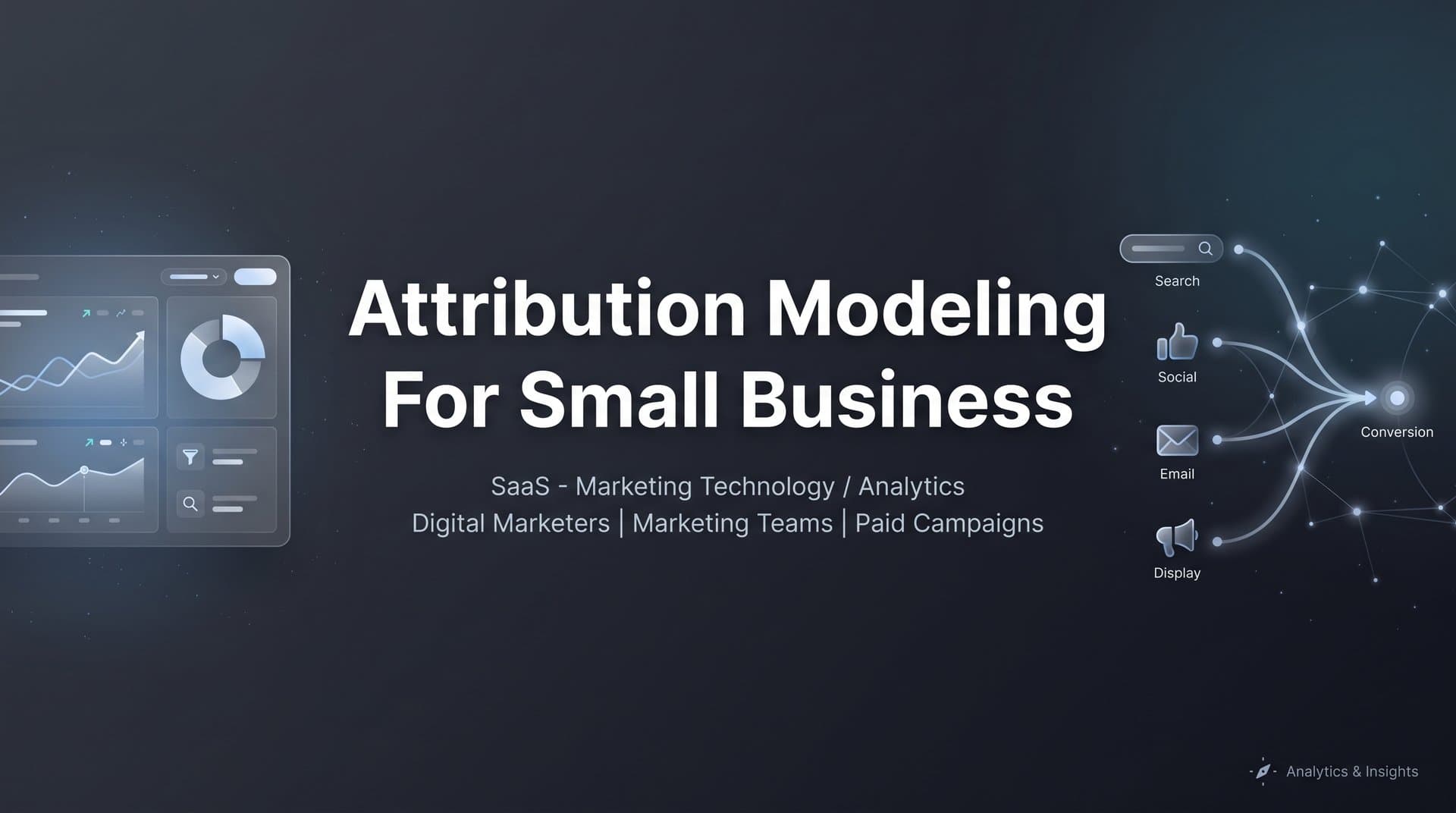
You're running Google Ads, boosting posts on Meta, sending weekly email campaigns, and posting consistently on social media. Traffic is coming in. Sales are happening. But here's the question that keeps you up at night: which of these efforts is actually working?
You check your Google Ads dashboard and see clicks. You look at Meta and see engagement. Your email platform shows opens and clicks. But when a customer buys, you have no idea which touchpoint deserves the credit. Was it the Facebook ad they saw last week? The Google search they did yesterday? The email that landed in their inbox this morning?
This isn't just frustrating. It's expensive. Without knowing what drives revenue, you're essentially throwing darts in the dark, hoping something sticks. Attribution modeling changes that. It connects every marketing touchpoint to actual sales, showing you exactly how customers find you and what convinces them to buy. And here's the good news: you don't need an enterprise budget or a data science team to make it work. This guide will show you how to implement attribution modeling in your small business, turning marketing guesswork into confident, data-driven decisions.
Why Your Marketing Feels Like a Guessing Game (And How Attribution Fixes It)
The fundamental problem is simple but critical: your customers don't buy after a single interaction. They see your ad, visit your website, leave, come back through a Google search, read some reviews, get an email from you, and then finally make a purchase. That's five touchpoints, but most small businesses only see the last one.
This is the "last-click" trap. Your analytics platform tells you the sale came from email because that's what the customer clicked right before buying. So you think email is your star performer and pour more budget into it. Meanwhile, the Facebook ad that introduced the customer to your brand in the first place gets zero credit. You might even cut that ad budget, thinking it's not working.
Attribution modeling solves this by tracking the entire customer journey. It follows each person from their first interaction with your brand through every touchpoint until they convert. Think of it like a GPS for your marketing: instead of only knowing the final destination, you see the complete route customers take to reach you. For a deeper dive into how this works, explore marketing attribution for small businesses.
Here's what that looks like in practice. A potential customer sees your Facebook ad on Monday. They don't click, but they remember your brand. On Wednesday, they Google your product category and click your ad. They browse your site but don't buy. On Friday, they get your email newsletter with a customer story that resonates. They click through, add items to their cart, but still hesitate. On Sunday, they search your brand name directly, land on your site, and complete the purchase.
Without attribution modeling, you'd credit that sale to the branded Google search. With attribution, you see the full story: Facebook created awareness, your generic Google ad captured consideration, email built trust, and the branded search closed the deal. Each channel played a role, and now you know exactly what that role was.
The real cost of not knowing this goes beyond confusion. You waste money scaling channels that look good in isolation but don't actually drive revenue. You cut budgets on awareness channels because they don't show direct conversions, even though they're essential to your funnel. You miss opportunities to optimize your customer journey because you can't see where people drop off or what sequence of touchpoints works best.
Attribution modeling transforms this chaos into clarity. It shows you which channels introduce customers to your brand, which ones nurture consideration, and which ones close sales. Armed with this knowledge, you can allocate your budget based on actual performance rather than platform-reported metrics that only show part of the picture.
The Four Attribution Models Every Small Business Should Know
Attribution models are frameworks for assigning credit to different touchpoints in the customer journey. Each model tells a different story about your marketing performance, and understanding these perspectives helps you make smarter decisions. Let's break down the four most valuable models for small businesses.
First-Touch Attribution: This model gives 100% of the credit to the first interaction a customer has with your brand. If someone sees your Facebook ad, then later clicks a Google ad, then buys after getting an email, first-touch attribution credits the entire sale to Facebook.
This model is particularly useful for understanding what drives brand awareness and top-of-funnel performance. It answers the question: "What's introducing new customers to my business?" If you're focused on growth and customer acquisition, first-touch helps you identify which channels are best at getting your brand in front of fresh audiences.
The limitation? It completely ignores everything that happened after that first interaction. The nurturing emails, the retargeting ads, the content that built trust—none of that gets credit. For businesses with longer sales cycles or multiple touchpoints before purchase, first-touch alone doesn't tell the full story. If you're new to these concepts, our guide on attribution modeling for beginners provides a solid foundation.
Last-Touch Attribution: This is the opposite approach. Last-touch gives all the credit to the final interaction before conversion. If a customer's journey includes five different touchpoints, only the last one counts.
Most analytics platforms use last-touch by default, which is why it feels familiar. It's straightforward and answers a specific question: "What convinced this customer to buy right now?" For businesses with very short sales cycles—think impulse purchases or low-consideration products—last-touch can provide useful insights about what closes deals.
The problem is that last-touch systematically undervalues everything that came before the final click. Your awareness campaigns look like they're failing because they rarely get credit for conversions, even though they're essential to filling your funnel. Branded search and email often dominate last-touch reports, not because they're your best channels, but because customers frequently use them as the final step before purchasing.
Linear Attribution: Linear models distribute credit equally across all touchpoints in the customer journey. If someone interacts with your brand five times before buying, each interaction gets 20% of the credit.
This approach provides a more balanced view of your marketing ecosystem. It acknowledges that multiple channels work together to drive conversions, and it prevents any single touchpoint from dominating your analysis. Linear attribution is particularly valuable when you want to understand the full scope of your marketing efforts without making assumptions about which touchpoints matter most.
The trade-off is that linear attribution treats all touchpoints as equally important, which isn't always true. The ad that introduced a customer to your brand might deserve more credit than the fifth retargeting impression they saw. Similarly, the touchpoint that directly led to purchase might be more valuable than a mid-journey interaction.
Position-Based Attribution: Also called U-shaped attribution, this model assigns more credit to the first and last touchpoints while still acknowledging the middle interactions. A common distribution is 40% to first touch, 40% to last touch, and the remaining 20% split among everything in between.
Position-based models recognize that awareness and conversion moments are often the most critical points in the customer journey, while still giving credit to the nurturing that happens in the middle. This makes it particularly useful for businesses with moderate-to-long sales cycles where both discovery and closing matter significantly.
The flexibility of position-based attribution is both a strength and a potential complication. You can adjust the percentages to match your business reality, but that requires some understanding of your customer journey to set up effectively.
Choosing the Right Model for Your Business Type
The best attribution model for your business depends on how your customers actually buy. There's no universal "correct" choice. Instead, you need to match the model to your sales cycle, product type, and customer behavior. Understanding how to navigate this decision is essential for choosing the right attribution model for your business.
Short Sales Cycles and Impulse Purchases: If you sell products that customers buy quickly—think ecommerce items under $50, consumables, or trendy products—simpler models often work well. Last-touch attribution can provide useful insights because the purchase decision happens close to the final touchpoint. When someone sees your ad for a $30 phone case and buys it that same day, the last interaction genuinely played the biggest role.
That said, even with short sales cycles, first-touch attribution offers valuable perspective. It shows you which channels are best at capturing attention and driving initial interest. If you're running acquisition campaigns, knowing what brings new customers into your world matters just as much as knowing what closes the sale.
Longer Consideration Periods: For service businesses, high-ticket items, or complex products, customers take their time. They research, compare, read reviews, and interact with your brand multiple times before deciding. A business consultant might have prospects who engage with content for weeks or months before booking a call. An online course creator might see students interact with free resources, webinars, and email sequences before enrolling.
In these scenarios, multi-touch models reveal insights that single-touch models miss entirely. Linear or position-based attribution shows you how different channels work together throughout the consideration journey. You might discover that blog content drives awareness, retargeting ads keep you top-of-mind, and case study emails push prospects over the finish line. Each plays a distinct role, and multi-touch attribution models capture that reality.
The Case for Comparing Multiple Models: Here's the approach that works best for most small businesses: don't pick just one model. Instead, compare two or three models side by side to understand different perspectives on your marketing performance.
Run both first-touch and last-touch attribution on the same data. When you see the differences, you gain insight into which channels drive awareness versus which ones close sales. Add a position-based or linear model to see how the full journey looks. This multi-model approach prevents you from making decisions based on a single, potentially misleading perspective.
Think of it like looking at your business from different angles. First-touch shows you the top of your funnel. Last-touch reveals your closing mechanisms. Multi-touch models expose the nurturing process in between. Together, they create a complete picture of how your marketing actually works.
Setting Up Attribution Without Enterprise Resources
The good news about modern attribution modeling: you don't need a development team or a six-figure budget to implement it. The challenge is connecting your scattered data sources into a unified view. Here's how to build that foundation without enterprise resources.
Start With Your Tracking Infrastructure: Attribution only works if you can follow customers across touchpoints, which means you need proper tracking in place. At minimum, you need to connect three core systems: your ad platforms, your website analytics, and your sales or CRM data.
Most small businesses already have pieces of this puzzle. You're running pixels on your website for Facebook and Google. You have Google Analytics installed. You're tracking sales through Shopify, WooCommerce, or your CRM. The problem is that these systems don't talk to each other automatically. A customer who clicks your Facebook ad, visits your site, and later buys through a Google search appears as three separate people across three different platforms. Finding the right attribution software for small business can solve this fragmentation.
The solution is implementing a tracking system that creates a unified customer identity. When someone visits your site, you need to capture that visit and connect it to their subsequent actions, regardless of which channel they came from. Modern attribution platforms handle this automatically by dropping a tracking identifier that follows users across sessions and devices.
Why Server-Side Tracking Matters: Traditional browser-based tracking has become increasingly unreliable. iOS privacy changes, cookie restrictions, and ad blockers mean that relying solely on pixels and browser cookies misses a significant portion of your conversions. Some estimates suggest that browser-based tracking only captures 60-70% of actual conversions.
Server-side tracking solves this by sending conversion data directly from your server to your analytics platform and ad networks, bypassing browser restrictions. Instead of relying on a pixel that might get blocked, your server communicates directly with platforms like Meta and Google when a conversion happens.
This isn't as technical as it sounds. Modern attribution tools handle server-side implementation through simple integrations with your ecommerce platform or CRM. You connect your Shopify store or HubSpot account, and the platform automatically sends conversion data server-side. No coding required. Teams with limited resources can benefit from attribution software designed for small teams.
Practical First Steps for Small Teams: Don't try to connect everything at once. Start with your top two or three marketing channels—the ones where you spend the most money or see the most traffic. Get those connected and tracking properly before adding more complexity.
Set up your tracking to capture the essential data points: which channel introduced the customer, which touchpoints they interacted with, and what they ultimately purchased. Make sure you can see this information in one place rather than jumping between five different dashboards.
Test your tracking before making any budget decisions based on the data. Run a small campaign, complete a test purchase yourself, and verify that you can see the full journey in your attribution reports. This validation step prevents you from optimizing based on incomplete or inaccurate data.
Turning Attribution Data Into Smarter Budget Decisions
Having attribution data is one thing. Using it to make better marketing decisions is another. Here's how to read your attribution reports and translate insights into action.
Identifying Channel Roles: Your attribution reports will show you that different channels play different roles in your customer journey. Some channels excel at awareness—they introduce new people to your brand but don't directly drive conversions. Other channels are closers—they get credit for final conversions but rarely bring in new customers.
Look at your first-touch attribution report. Which channels show up most frequently as the initial interaction? These are your awareness drivers. They might not look impressive in a last-touch report, but they're filling your funnel with new potential customers. Cutting these channels because they don't show direct conversions would be like firing your sales team's lead generation specialists because they don't personally close deals. Understanding attribution modeling for paid ads helps you see the true value of each channel.
Now check your last-touch report. Email, branded search, and retargeting often dominate here. That's not because they're your best channels overall—it's because customers use them as final steps before purchasing. These are your closers, and they're important, but they depend on other channels to fill the pipeline.
Reallocating Spend Based on True ROI: Platform-reported metrics are designed to make each platform look good. Facebook wants you to think Facebook drives all your sales. Google wants you to credit Google. Both platforms use last-click attribution by default, which means they both claim credit for the same conversions.
Your attribution model shows you the real story. You might discover that Facebook is actually your top awareness channel, driving 40% of new customer introductions, but Google Search closes more deals. Or you might find that your email sequences are essential to conversions, even though they rarely get last-click credit. Platforms focused on revenue tracking give you this complete picture.
Testing and Scaling With Confidence: Attribution modeling makes testing new channels less risky. You can see exactly how a new channel fits into your existing customer journey, even if it doesn't immediately drive conversions.
Launch a new awareness campaign and track how it performs in your first-touch attribution. You might not see immediate sales, but if you see new customer introductions that later convert through other channels, you know the campaign is working. This prevents you from killing effective awareness campaigns too early just because they don't show direct ROI in the first week.
When you find a winning combination—a sequence of touchpoints that consistently leads to conversions—you can scale it with confidence. If you see that customers who engage with Facebook ads, then visit through organic search, then receive a specific email sequence convert at 3x your average rate, you know exactly what to amplify.
Your Attribution Action Plan: Starting Small and Building Smart
Week One - Foundation: Focus on connecting your top two marketing channels to a unified tracking system. If you spend the most on Google and Meta, start there. Make sure you can see when someone clicks an ad on either platform and track their journey through to conversion. Verify that your tracking is working by completing test purchases and checking that the data appears correctly.
Month One - Baseline: Let your attribution system collect data for 30 days without making major changes. You need enough data to see patterns before you start optimizing. During this month, familiarize yourself with your attribution reports. Compare first-touch and last-touch models to understand which channels drive awareness versus conversions. If you're running campaigns across multiple platforms, understanding cross-platform attribution tracking becomes essential.
Month Two - Optimization: Now you have enough data to make informed decisions. Identify one clear insight from your attribution reports and act on it. Maybe you discover that a channel you thought was underperforming actually drives significant first-touch interactions. Test increasing that budget by 20% and watch what happens to your overall conversion volume.
Ongoing - Refinement: Attribution isn't a set-and-forget system. Customer behavior changes. New channels emerge. Your marketing mix evolves. Review your attribution reports monthly, looking for shifts in how customers discover and buy from you. Add new touchpoints to your tracking as you expand to new channels. Continuously refine your understanding of what works and why.
Remember that attribution modeling is a tool for better decision-making, not a crystal ball that provides perfect answers. Use it to reduce guesswork, test hypotheses, and gradually improve your marketing efficiency. Even small improvements in budget allocation compound over time into significant gains in overall performance.
Making Every Marketing Dollar Count
Attribution modeling transforms marketing from an expensive guessing game into a measurable, improvable system. You move from wondering which channels work to knowing exactly how customers find you and what convinces them to buy. That clarity changes everything.
Small businesses no longer need enterprise budgets or technical teams to access these insights. Modern attribution tools integrate directly with the platforms you already use, capturing the complete customer journey without requiring developer support. The same multi-touch attribution that Fortune 500 companies rely on is now accessible to businesses of every size.
What matters most is taking that first step. Connect your top channels. Start tracking the full customer journey. Compare different attribution models to understand how your marketing actually performs. Each insight you gain makes your next dollar of ad spend more effective than the last.
The businesses that win in today's multi-channel marketing environment aren't the ones with the biggest budgets. They're the ones who understand their customer journey well enough to invest strategically, scale what works, and cut what doesn't. Attribution modeling gives you that understanding.
Ready to elevate your marketing game with precision and confidence? Discover how Cometly's AI-driven recommendations can transform your ad strategy—Get your free demo today and start capturing every touchpoint to maximize your conversions.


