
If you've ever spent a Friday afternoon manually redistributing ad budgets across campaigns, only to discover on Monday that the wrong channels got the money, you already understand the core problem. Manual budget management in paid advertising is exhausting, slow, and almost always reactive. By the time you act on last week's data, the performance landscape has already shifted.
For B2B SaaS marketing teams running campaigns across Meta, Google, LinkedIn, and beyond, this problem compounds fast. You're not just managing one channel. You're juggling multiple platforms, multiple audience segments, and a sales cycle long enough that a bad budget decision in January might not show up as a pipeline problem until March.
Automated budget allocation ads represent a fundamentally different approach: letting real-time performance signals, rather than gut instinct or stale reports, drive where your spend goes. But automation is not a set-it-and-forget-it solution. Done right, it is a powerful lever for scaling what works. Done wrong, it quietly concentrates spend in the wrong places while you're focused elsewhere.
This article breaks down exactly how automated budget allocation works, what signals power it, where platform-native tools fall short for B2B teams, and how to build the attribution foundation that makes automation genuinely trustworthy.
The Problem With Manual Budget Decisions
Manual budget management has a fundamental timing problem. Most marketers review campaign performance weekly, sometimes bi-weekly, and make budget adjustments based on what already happened. By the time you identify that one campaign is outperforming and shift spend toward it, the window of peak performance may have already passed.
This backward-looking approach creates a constant lag between what is actually happening in your campaigns and where your money is going. In fast-moving paid channels where audience saturation, bid competition, and creative fatigue can shift within days, a weekly review cycle is simply not fast enough to keep pace.
The problem deepens when you factor in siloed channel data. Most B2B teams run campaigns across multiple platforms, but each platform reports performance in isolation. Meta tells you about Meta conversions. Google reports Google conversions. LinkedIn shows LinkedIn results. When you're making budget decisions inside each platform separately, you're missing the cross-channel picture entirely. You might be pulling budget from LinkedIn because its platform-reported cost per lead looks high, without realizing that LinkedIn touchpoints are consistently appearing early in the journeys of your highest-value closed deals.
This siloed view creates real blind spots. Spend decisions get made without understanding which touchpoints are actually contributing to pipeline, and channels that play a critical role in nurturing B2B buyers through long consideration cycles get systematically underfunded.
For B2B SaaS specifically, the opportunity cost of misallocated spend is particularly significant. Unlike B2C, where a bad budget week might show up quickly in sales data, B2B sales cycles can stretch across months. A budget decision made in Q1 based on incomplete data might not reveal its downstream consequences until Q2 or Q3. By then, you've potentially wasted a substantial portion of a quarter's budget on channels or campaigns that were never converting to revenue, while underinvesting in the ones that were.
The compounding nature of this problem is what makes it so costly. Misallocated spend is not just a one-time loss. It is a recurring drain that quietly erodes marketing efficiency over time, often without anyone noticing until the pipeline review raises uncomfortable questions.
This is the gap that automated budget allocation is designed to close: replacing slow, backward-looking manual decisions with real-time, signal-driven spend management that responds to what is happening in your campaigns right now.
What Automated Budget Allocation Actually Does
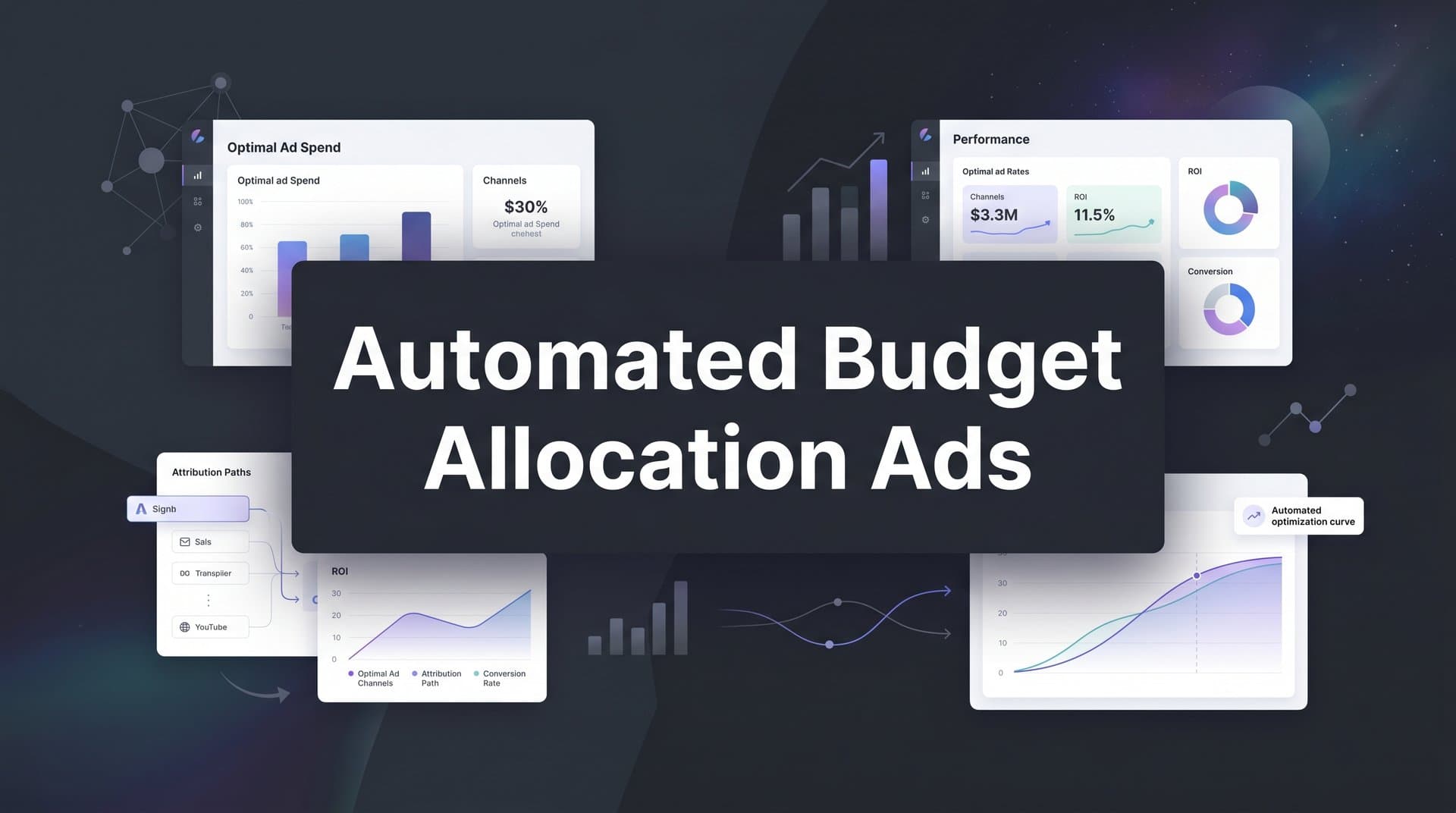
At its core, automated budget allocation is a process where algorithmic or AI-driven systems dynamically shift ad spend toward higher-performing campaigns, ad sets, or channels based on real-time performance signals. Instead of a marketer manually moving budget from one campaign to another, the system does it continuously and automatically based on predefined rules or machine learning models.
There are two primary forms of this automation, and understanding the difference matters a great deal for how you build your strategy.
Platform-native automation refers to tools built directly into ad platforms. Meta's Advantage Campaign Budget consolidates your total campaign budget and distributes it dynamically across ad sets based on which ones are showing the strongest performance signals. Google's Smart Bidding adjusts bids in real time based on conversion likelihood, and Performance Max campaigns take this further by automatically allocating spend across Google's entire inventory based on machine learning signals. These tools are powerful within their respective ecosystems and relatively easy to activate.
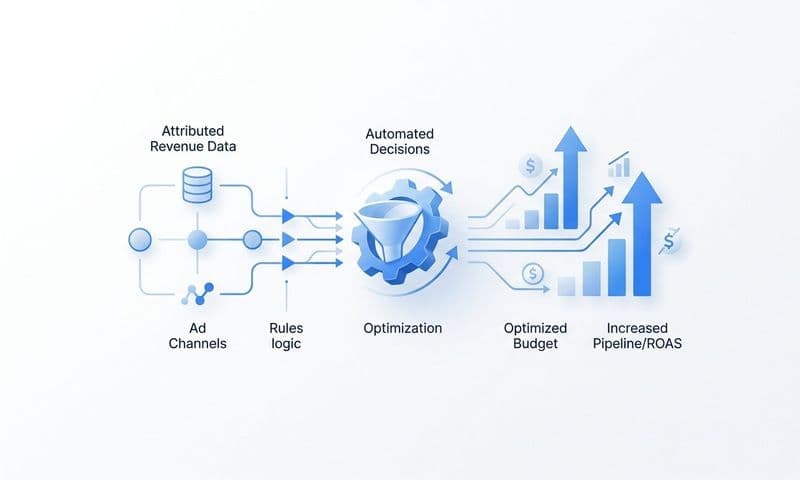
Attribution-driven automation takes a different approach. Instead of relying on a single platform's internal signals, it uses a unified data layer that aggregates performance data across all channels and makes budget recommendations or triggers reallocations based on cross-channel contribution to revenue. This type of automation requires an external attribution platform but gives marketers a view and a level of control that no single ad platform can provide.
Both types rely on a core set of inputs to function. The quality and completeness of these inputs directly determines how well automation performs.
Conversion signals tell the system what a successful outcome looks like. These can range from a simple form submission to a qualified opportunity or closed-won deal, and the specificity of this signal dramatically affects optimization quality.
Cost per result allows the system to compare efficiency across campaigns and shift spend toward those delivering the most value per dollar.
Audience saturation signals help automation recognize when a particular audience segment is becoming exhausted and redistribute spend before performance degrades.
Bid competition data informs real-time bidding adjustments based on what other advertisers are paying for the same audiences at any given moment.
Revenue attribution data is the most powerful input, and the one most B2B teams are not yet feeding into their automation. When automation knows not just that a lead converted but that a specific campaign contributed to a deal that closed at a specific contract value, budget decisions become genuinely revenue-aligned rather than lead-volume-aligned.
How Attribution Data Powers Smarter Automated Decisions
Here is the part of automated budget allocation that most platform documentation glosses over: automation is only as smart as the data it receives. If you feed a platform weak or incomplete conversion signals, it will optimize for those weak signals with remarkable efficiency. The result is a system that is very good at doing the wrong thing.
For B2B SaaS teams, this is not a theoretical concern. It is a common and costly reality. Many teams set up their ad platforms to optimize for lead form submissions because that is the easiest conversion event to track. The platform then learns to find more people who will fill out forms, which is not the same as finding people who will become qualified opportunities or closed customers. Budget flows toward high lead volume, not high revenue potential.
The solution is to send richer, more meaningful conversion signals to your ad platforms. This means moving beyond browser-based pixel tracking and implementing server-side event tracking and Conversion API integrations. Server-side tracking sends conversion data directly from your server to the ad platform, bypassing browser privacy restrictions, ad blockers, and cookie limitations that increasingly degrade the quality of client-side data.
With server-side tracking in place, you can pass CRM events back to your ad platforms: not just "lead submitted" but "lead became MQL," "opportunity created," or "deal closed at $X." This enriched signal quality transforms how platform automation behaves. Instead of concentrating spend on campaigns that drive form fills, it shifts toward campaigns that drive qualified pipeline and revenue.
Multi-touch attribution adds another critical layer. Platform-native automation operates within a single platform's ecosystem and naturally attributes value to its own touchpoints. This creates an attribution bias where each platform overstates its own contribution and under-represents the role other channels played. For B2B buyers who typically engage with multiple touchpoints across multiple channels before making a decision, this single-platform view is systematically misleading.
A multi-touch attribution model, whether linear, time decay, or data-driven, distributes credit across every touchpoint in the customer journey. This gives you a cross-channel view of which campaigns and channels are actually contributing to pipeline at each stage of the funnel. When this data informs your budget decisions, you stop systematically underfunding top-of-funnel channels that introduce your brand to future buyers and over-crediting the last-touch channels that close deals you would have won anyway.
Platforms like Cometly are built specifically to provide this attribution layer. By connecting your ad platforms, CRM, and website tracking into a single data environment, Cometly captures every touchpoint from first ad click to closed-won revenue, giving your automation the complete, enriched conversion signals it needs to make genuinely revenue-aligned budget decisions.
Platform-Native vs. Attribution-Led Budget Automation
Understanding the practical difference between these two approaches is essential before you decide how to structure your automation strategy.
Platform-native tools like Meta's Advantage Campaign Budget and Google's Performance Max are genuinely impressive within their own ecosystems. They process enormous volumes of real-time signals, adjust bids and budgets faster than any human could, and continuously learn from conversion data to improve performance over time. For teams running campaigns primarily on a single platform, they deliver real value with relatively low setup complexity.
But for B2B SaaS teams running multi-channel campaigns, platform-native automation has a structural limitation that no amount of in-platform optimization can solve: the walled garden problem. Each platform's automation only sees what happens inside that platform. Meta does not know what Google is doing. Google does not know what LinkedIn contributed. Each platform optimizes for its own metrics using its own data, with no visibility into how its performance fits into the broader cross-channel picture.
This creates a situation where you might have three platforms each confidently optimizing their own budgets, each claiming credit for the same conversions, and none of them making decisions based on actual cross-channel revenue contribution. The aggregate result is not an optimized marketing mix. It is three separate optimizations that may be working at cross-purposes.
Attribution-led automation addresses this by sitting above the individual platforms. Using a unified data layer that aggregates performance data across all channels, it can identify which campaigns and channels are genuinely driving pipeline and revenue, regardless of which platform they run on. Budget recommendations or automated reallocations are based on cross-channel contribution rather than platform-specific metrics.
The practical difference plays out clearly in how each approach handles a common B2B scenario. Imagine a buyer who first encounters your brand through a LinkedIn thought leadership ad, later clicks a Google Search ad when actively researching solutions, and finally converts through a Meta retargeting ad. Platform-native automation in each channel would optimize toward its own touchpoint. Attribution-led automation would recognize the contribution of all three touchpoints and inform budget decisions accordingly, ensuring that LinkedIn's top-of-funnel role is not defunded just because it does not show direct conversions in its own reporting.
For B2B SaaS teams with complex, multi-channel buyer journeys, attribution-led automation is not a luxury. It is the only approach that aligns budget decisions with actual revenue outcomes. Understanding how LinkedIn ads fit into your SaaS funnel is a useful starting point for thinking through this cross-channel complexity.
Setting Up Automated Budget Allocation to Work for B2B SaaS
Activating automation without a thoughtful setup is one of the most common and costly mistakes in paid advertising. The mechanics of automation are straightforward. Making it work well for B2B SaaS requires deliberate configuration at every step.
Define the right optimization goal first. Before you turn on any automation, decide what you are asking it to optimize for. For B2B SaaS, this should be revenue or qualified pipeline events, not leads or clicks. If your CRM tracks opportunity creation, SQL status, or closed-won deals, those events should be your conversion signals. Feeding automation a lead form submission as the primary signal will produce lead volume optimization, not revenue optimization. The goal definition step is where most B2B teams make their most consequential mistake.
Establish minimum data thresholds before trusting automation. Ad platforms typically require a minimum number of conversion events within a given time window before their machine learning models can exit the learning phase and make reliable optimization decisions. For many B2B SaaS companies with lower conversion volumes, this threshold can be difficult to reach quickly, especially when optimizing for deeper funnel events like opportunities or closed deals. If your conversion volume is thin, consider a staged approach: start by optimizing for a higher-volume event like MQL or demo request, then transition to revenue-level events as data accumulates. Relying on automation before sufficient data exists leads to erratic, unpredictable budget shifts.
Layer human oversight on top of automation. Automation is not a replacement for strategic judgment. Set budget caps at the campaign level to prevent automation from concentrating an outsized share of your total budget on a single campaign, even if that campaign is currently performing well. Establish spend guardrails that prevent any channel from dropping below a minimum threshold, protecting top-of-funnel investment that attribution data shows contributes to long-term pipeline even when direct conversion signals are sparse. Schedule regular budget utilization reviews, at least weekly, to verify that automated budget shifts are correlating with the outcomes you actually care about.
Ensure your tracking infrastructure is solid before scaling. Automated budget allocation amplifies whatever signal quality you have. If your conversion tracking is incomplete, duplicated, or delayed, automation will amplify those problems at scale. Implement server-side tracking and Conversion API integrations before relying on automation for significant budget decisions. The quality of your data infrastructure is the ceiling on how well your automation can perform.
Measuring Whether Your Budget Automation Is Actually Working
Turning on automated budget allocation is not the end of the process. It is the beginning of a new measurement discipline. Without consistent monitoring, automation can drift in directions that look fine inside individual platform dashboards while quietly degrading your actual marketing performance.
The primary metric to track is revenue attribution by channel over time. As automation shifts budget, you should see a corresponding improvement in pipeline quality and a reduction in customer acquisition cost. If budget is concentrating in a particular channel or campaign but pipeline quality is not improving, that is a signal that automation is optimizing for the wrong thing, likely because the conversion signals it is receiving do not accurately reflect revenue outcomes.
Watch for specific automation failure signals that indicate the system is moving in the wrong direction. Declining conversion quality, where lead volume holds steady but opportunity creation or close rates fall, suggests optimization is chasing quantity over quality. Over-reliance on a single channel, where one platform gradually absorbs a disproportionate share of total budget, can indicate that automation is exploiting a short-term performance signal rather than reflecting genuine long-term channel contribution. Spend concentrating in low-intent audience segments, often visible through rising click volume but falling engagement quality, is another warning sign worth monitoring.
The most important tool for this measurement work is a marketing attribution platform that sits above individual ad platform reports. Platform-reported metrics are inherently biased toward each platform's own contribution. A unified attribution view, one that connects ad spend data to CRM pipeline and revenue outcomes, gives you a single source of truth that reflects actual business results rather than platform-reported performance.
Cometly provides exactly this kind of unified attribution layer. By connecting your ad platforms, CRM data, and website tracking into a single environment, it lets you measure whether automated budget shifts are actually moving the metrics that matter: qualified pipeline, revenue attributed by channel, and customer acquisition cost against actual contract value. This visibility is what separates marketers who use automation confidently from those who use it and hope for the best.
Putting It All Together
Automated budget allocation is one of the most powerful tools available to B2B SaaS marketing teams, but its value is entirely dependent on the quality of the data and strategy behind it. Automation built on incomplete conversion signals will optimize efficiently toward the wrong outcomes. Automation running without human oversight will drift toward over-concentration and blind spots. Automation operating inside platform silos will never reflect the true cross-channel contribution of your campaigns.
The path to making automation genuinely work runs through attribution. When your ad platforms receive enriched, revenue-level conversion signals through server-side tracking, when you have a multi-touch attribution model that reveals the full contribution of every channel, and when a unified attribution platform gives you a cross-channel view above the noise of individual platform reports, automated budget allocation becomes a real competitive advantage.
You move from reactive spend management, shuffling budgets based on last week's numbers, to proactive, signal-driven allocation that continuously moves money toward what is actually driving pipeline and revenue.
Cometly is built to be that attribution layer. It captures every touchpoint from first ad click to closed-won revenue, feeds enriched conversion signals back to Meta, Google, and other platforms, and gives you the cross-channel visibility to make confident budget decisions. If you're ready to make your automation trustworthy, Get your free demo and see how Cometly connects your ad spend directly to the revenue outcomes that actually matter.