Facebook ads can drive significant pipeline for B2B SaaS companies, but only if you know which campaigns are actually converting. The challenge is that conversion tracking on Facebook has become increasingly complex in recent years.
Browser privacy changes, iOS updates, and multi-touch customer journeys mean that the default pixel setup most marketers rely on is leaving critical data gaps. When your tracking is broken or incomplete, Facebook's algorithm optimizes toward the wrong signals, your reported ROAS becomes unreliable, and budget decisions get made on bad data.
This article covers seven of the best conversion tracking strategies for Facebook ads, from foundational pixel setup to advanced server-side tracking and multi-touch attribution. Whether you are running lead generation campaigns or trying to connect ad spend directly to closed revenue, these strategies will help you build a tracking foundation that is accurate, durable, and built for modern B2B marketing.
Each strategy addresses a specific gap in how most teams track Facebook conversions today. Together, they form a complete measurement system that gives your team and Facebook's algorithm the data quality needed to optimize and scale with confidence.
1. Set Up the Meta Pixel Correctly From the Start
The Challenge It Solves
A poorly installed pixel is one of the most common and costly mistakes in Facebook advertising. Conversion events fire on the wrong pages, miss critical actions entirely, or fire multiple times for a single user interaction. Any of these errors corrupts your campaign data and sends Facebook's algorithm misleading optimization signals from day one.
The Strategy Explained
The Meta Pixel is a JavaScript snippet that fires browser-based events when users take specific actions on your website. For B2B SaaS companies, the key events to map include form submissions, demo requests, free trial signups, and pricing page views. These funnel stages represent real buying intent, and each one should correspond to a properly configured standard event.
Start by verifying your pixel fires correctly using the Meta Pixel Helper Chrome extension. This tool shows you exactly which events are firing, on which pages, and whether they contain the right parameters. Pay particular attention to single-page applications, which often miss events due to how page navigation is handled without full page reloads.
Implementation Steps
1. Install the base pixel code in the header of every page on your website, either directly or via a tag manager like Google Tag Manager.
2. Map your key B2B funnel actions to Meta standard events: use Lead for form submissions, CompleteRegistration for trial signups, and PageView for high-intent pages like pricing.
3. Use the Meta Pixel Helper extension to confirm each event fires once per user action, on the correct pages, without duplicate triggers.
4. Test your setup in Meta Events Manager under the Test Events tab to see real-time event data before launching campaigns.
Pro Tips
Avoid placing conversion events on pages that load before a user actually completes an action. For example, a "thank you" page event should only fire after a confirmed form submission, not on page load regardless of how the user arrived. This distinction alone can dramatically clean up inflated conversion counts. Understanding Facebook pixel tracking best practices will help you avoid the most common setup errors that corrupt campaign data from the start.
2. Implement the Meta Conversions API for Server-Side Tracking
The Challenge It Solves
Browser-based tracking has a fundamental vulnerability: it depends on the user's browser cooperating. Ad blockers prevent pixel fires. Apple's App Tracking Transparency framework limits data collection on iOS devices. Safari's Intelligent Tracking Prevention restricts cookie lifespans. The result is a growing gap between conversions that actually happen and conversions that your pixel reports.
The Strategy Explained
The Meta Conversions API (CAPI) sends conversion events directly from your server to Meta's servers, bypassing the browser entirely. This makes it far more resilient to the privacy restrictions and ad blockers that degrade browser-based tracking. Meta officially recommends running CAPI alongside your pixel in a redundant setup, which means both methods send the same events, and Meta reconciles them using deduplication logic.
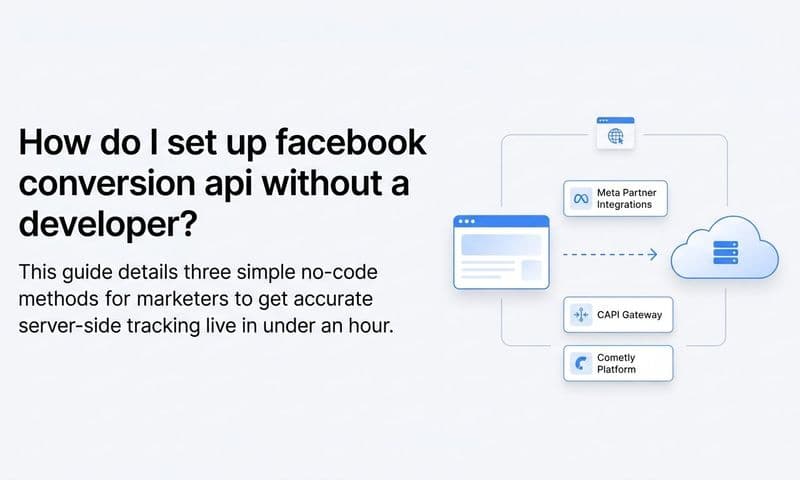
CAPI is available through direct API integration, Meta's partner integrations, or through attribution platforms like Cometly that handle the server-side connection automatically without requiring custom engineering work. For most B2B SaaS teams, using a platform that manages CAPI is the fastest and most reliable path to implementation.
Implementation Steps
1. Choose your CAPI implementation method: direct API integration, a Meta partner integration, or a dedicated attribution platform that includes server-side tracking.
2. Configure CAPI to send the same standard events as your browser pixel, including Lead, CompleteRegistration, and any custom conversion events relevant to your funnel.
3. Verify CAPI events are appearing in Meta Events Manager alongside your pixel events, and confirm that both sources are sending data for the same conversion actions.
4. Enable deduplication using the event_id parameter (covered in detail in Strategy 4) to prevent double-counting between your pixel and CAPI.
Pro Tips
Server-side tracking via CAPI is widely considered the modern standard for Facebook conversion tracking. If you are only running the browser pixel, you are operating with an incomplete data foundation. Following a detailed Conversion API implementation tutorial can help you recover lost attribution data and get your campaigns optimizing on accurate signals from day one.
3. Prioritize Event Match Quality to Improve Signal Accuracy
The Challenge It Solves
Sending conversion events to Meta is only half the equation. Meta also needs to match those events to actual Facebook users to attribute them to specific ads and optimize campaigns effectively. If your events cannot be matched to users, they contribute little to algorithm optimization, regardless of how accurately they are tracked.
The Strategy Explained
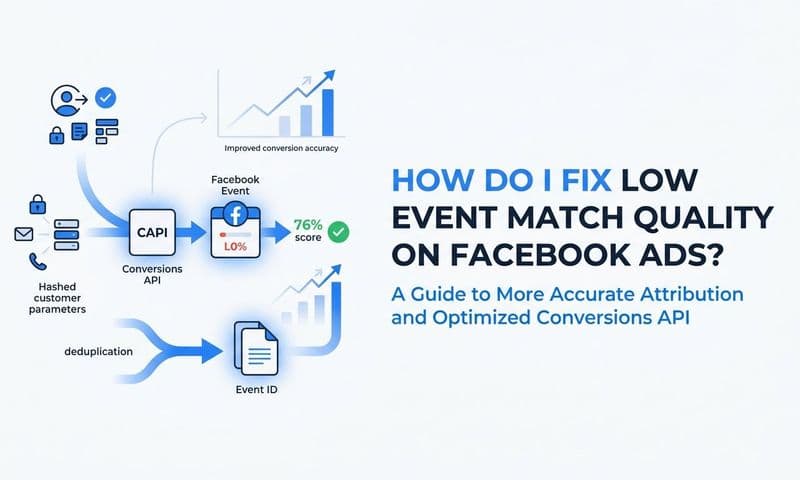
Meta's Event Match Quality (EMQ) score, visible in Events Manager, measures how effectively Meta can match a conversion event to a Facebook user. Higher EMQ scores lead to better attribution and stronger algorithm optimization because Meta can connect more conversions to the specific users and ad exposures that drove them.
The way to raise your EMQ score is to send hashed customer data parameters alongside your conversion events. These parameters include email address, phone number, first name, last name, date of birth, city, state, zip code, and external ID. All parameters are hashed before being sent to Meta, preserving user privacy. Sending these via CAPI is more reliable than browser-based methods because server-side calls are not affected by browser restrictions.
Implementation Steps
1. Check your current EMQ score in Meta Events Manager for each of your key conversion events. A score below 6 out of 10 typically indicates missing customer data parameters.
2. Identify which customer data parameters you can collect at conversion points. Email address is the single most impactful parameter for improving match quality.
3. Hash all customer data parameters using SHA-256 before sending them to Meta via CAPI. Most platforms and API libraries handle this automatically.
4. Send as many parameters as you have available for each event. Each additional parameter improves match quality incrementally.
Pro Tips
For B2B SaaS lead generation, you typically collect an email address on form submission. Make sure that email is being passed through your CAPI payload for every Lead event. This single step often produces a meaningful improvement in EMQ score and, by extension, in how effectively Facebook can optimize your campaigns toward high-quality leads. Reviewing best practices for tracking conversions accurately will give you a broader framework for ensuring every signal you send to Meta is as complete as possible.
4. Implement Event Deduplication to Prevent Double-Counting
The Challenge It Solves
Running both the Meta Pixel and CAPI simultaneously is the right approach, but it creates a specific technical risk: the same conversion event gets reported to Meta twice. Without deduplication, a single form submission becomes two conversions in Ads Manager, inflating your reported conversion counts and distorting your ROAS in ways that can lead to significant budget misallocation.
The Strategy Explained
Meta uses the event_id parameter to deduplicate events. When the same event_id appears in both a browser pixel event and a CAPI event within a short time window, Meta counts it as a single conversion. This means your pixel and CAPI can both send the same event without inflating your numbers, as long as they share the same unique event_id for that specific conversion instance.
Proper deduplication requires generating a unique event_id for each conversion and passing it consistently through both the pixel payload and the CAPI payload. This is a technical requirement that many teams overlook when first setting up CAPI, and it is one of the most common sources of Facebook ads reporting discrepancies that undermine budget decisions in Ads Manager.
Implementation Steps
1. Generate a unique event_id for each conversion event at the moment it occurs. This can be a UUID or any unique string tied to that specific conversion instance.
2. Pass the event_id in your browser pixel event using the Meta Pixel's eventID parameter in the event options object.
3. Pass the same event_id in your CAPI payload for the corresponding server-side event.
4. Verify deduplication is working by checking Meta Events Manager. Properly deduplicated events will show a single count rather than doubled counts when both pixel and CAPI are active.
Pro Tips
If you are using an attribution platform that manages both your pixel and CAPI, deduplication is often handled automatically. Confirm this with your platform provider before assuming it is configured correctly. Checking your Events Manager for unexpected spikes in conversion volume after enabling CAPI is a quick way to spot deduplication issues.
5. Track Offline and CRM Conversions to Connect Ads to Revenue
The Challenge It Solves
For B2B SaaS companies, a form fill is rarely the conversion that matters most. What matters is whether that lead became a qualified opportunity, moved through the pipeline, and ultimately closed as a paying customer. Without connecting your CRM data to Facebook, you are optimizing campaigns toward lead volume rather than revenue, and those two metrics often point in very different directions.
The Strategy Explained
Offline conversions allow you to sync CRM pipeline and closed-won data back to Meta, associating revenue outcomes with the original ad click that started the journey. When this data is connected, Facebook's algorithm can learn which types of users actually become customers and optimize future campaigns toward similar audiences. This is sometimes called revenue-based optimization or downstream event optimization.
This approach is particularly powerful for B2B SaaS companies with longer sales cycles. Rather than letting the algorithm chase form fills, you are teaching it to chase the characteristics of users who convert to paid customers. Platforms like Cometly make this connection between ad data and CRM events straightforward, giving you visibility into how Facebook campaigns contribute to pipeline and closed revenue without manual data exports.
Implementation Steps
1. Identify the CRM events that represent meaningful downstream conversions: SQL qualification, opportunity creation, and closed-won are the most valuable for optimization purposes.
2. Set up a method to sync these CRM events back to Meta, either via Meta's Offline Conversions API, a CRM integration, or an attribution platform that handles this connection natively.
3. Create custom conversions in Meta Ads Manager for your downstream CRM events so you can use them as campaign optimization objectives and track them in reporting.
4. Monitor how your lead-to-opportunity and lead-to-close rates vary by campaign and audience to identify which Facebook campaigns are actually generating revenue-quality pipeline.
Pro Tips
Start by uploading historical closed-won data to Meta before optimizing toward it. This gives the algorithm a larger training set of revenue-generating users to learn from, which typically accelerates the time it takes to see optimization improvements from downstream event data. The best marketing attribution tools for B2B SaaS companies are specifically designed to bridge this gap between ad platform data and CRM revenue outcomes.
6. Use Multi-Touch Attribution to Understand the Full Conversion Path
The Challenge It Solves
Facebook Ads Manager reports conversions using its own attribution model, which tends to assign credit to Facebook touchpoints in ways that overstate the platform's contribution. In B2B buying cycles that span multiple weeks and involve touchpoints across Google, LinkedIn, organic search, and email, relying solely on Facebook's self-reported data gives you a fundamentally distorted view of what is actually driving revenue.
The Strategy Explained
Multi-touch attribution distributes conversion credit across all touchpoints in the customer journey rather than assigning it entirely to one channel. Models like linear attribution, time decay, position-based, and data-driven attribution each offer a different perspective on how credit should be allocated based on when and how touchpoints occurred.
The key advantage of multi-touch attribution for Facebook advertisers is context. You can see how Facebook ads interact with other channels, whether they tend to initiate journeys, assist in the middle, or close deals at the end. This cross-channel view is only possible through an external attribution platform, since Facebook Ads Manager only shows Facebook's self-reported data. Cometly's multi-touch attribution capabilities give B2B SaaS teams exactly this kind of cross-channel visibility, connecting Facebook ad performance to the full customer journey in one place.
Implementation Steps
1. Implement a tracking system that captures all marketing touchpoints across channels, not just Facebook clicks. This requires UTM parameters, consistent tracking across your website, and CRM integration.
2. Choose an attribution model that reflects your sales cycle. For longer B2B cycles, linear or time decay models often provide more balanced credit distribution than last-click. Understanding which attribution model is best for optimizing ad campaigns will help you select the right approach for your specific sales motion.
3. Compare Facebook's self-reported conversion data against your multi-touch attribution data to understand how much Facebook is over or under-reporting its contribution.
4. Use multi-touch insights to make budget allocation decisions across channels, rather than relying on each platform's self-reported ROAS figures.
Pro Tips
Do not try to find the "perfect" attribution model. Instead, use multiple models in parallel to understand different perspectives on channel contribution. The goal is directional accuracy and better decisions, not a single definitive number that every stakeholder agrees on.
7. Build a Unified Tracking System That Connects Ad Data to Pipeline
The Challenge It Solves
Many B2B SaaS marketing teams operate with fragmented data scattered across Facebook Ads Manager, Google Analytics, and their CRM. Each platform uses different attribution logic, different conversion windows, and different data sources. The result is conflicting numbers, no clear source of truth, and marketing decisions made by whoever argues most convincingly rather than whoever has the most accurate data.
The Strategy Explained
A unified attribution platform aggregates data from ad platforms, website tracking, and CRM systems to provide consistent, cross-channel reporting in a single dashboard. For Facebook ads specifically, this means being able to see how Facebook campaigns contribute to pipeline velocity, customer acquisition cost, and closed revenue, not just click-through rates and platform-reported ROAS.
This is the layer that makes all the previous strategies actionable at scale. Your pixel, CAPI, event deduplication, CRM sync, and multi-touch attribution data all flow into one system, giving your team a clear and honest view of what Facebook ads are actually driving. Cometly is built specifically for this use case, connecting Facebook ad data, CRM events, and multi-touch attribution into one real-time dashboard so you always know where your revenue is coming from. With 70+ native integrations, it connects your ad platforms, CRM, and website without requiring custom engineering work.
Implementation Steps
1. Audit your current data sources: list every platform generating marketing data, including ad platforms, your website analytics tool, and your CRM, and identify where data conflicts exist today.
2. Select a unified attribution platform that integrates natively with your existing stack and can ingest both ad platform data and CRM pipeline data. Reviewing the best software for tracking marketing attribution will help you evaluate which platforms offer the integrations and reporting depth your team actually needs.
3. Establish consistent UTM parameter conventions across all campaigns so that traffic sources are tracked uniformly across every channel and touchpoint.
4. Define the metrics that matter most for your team: pipeline generated, cost per opportunity, revenue attributed, and CAC by channel. Configure your attribution platform to report on these metrics consistently.
Pro Tips
The biggest barrier to unified attribution is usually messy historical data, not technology. Before onboarding a new platform, spend time standardizing your UTM conventions and cleaning up your CRM pipeline stages. A clean data foundation makes attribution outputs far more reliable from day one.
Putting It All Together
Accurate Facebook conversion tracking is not a one-time setup task. It is an ongoing system that requires the right foundation, the right data signals, and the right attribution framework to produce reliable insights.
Start with a verified pixel and CAPI implementation, then layer in event deduplication and high-quality match parameters. From there, connect your CRM data so you can optimize toward revenue rather than just leads. Finally, bring everything together in a unified attribution platform that gives your team a clear, honest view of what Facebook ads are actually driving.
Here is a prioritized implementation sequence to get you started:
Phase 1 - Foundation: Verify your Meta Pixel installation using Pixel Helper, then implement CAPI alongside your pixel with deduplication enabled using consistent event_id parameters.
Phase 2 - Signal Quality: Audit your Event Match Quality scores in Events Manager and add hashed customer data parameters, starting with email address, to your CAPI payloads for all key conversion events.
Phase 3 - Revenue Connection: Sync your CRM pipeline and closed-won data back to Meta so the algorithm can optimize toward revenue-generating users rather than form fills.
Phase 4 - Full Attribution: Implement multi-touch attribution and connect all your data sources into a unified platform that gives your team a single, consistent view of how Facebook campaigns contribute to pipeline and revenue.
For B2B SaaS marketing teams, the goal is not just better reporting. It is better decisions. When you know which campaigns generate pipeline and which ones generate noise, you can scale with confidence. Cometly is built specifically for this use case, connecting your Facebook ad data, CRM events, and multi-touch attribution into one real-time dashboard so you always know where your revenue is coming from.
Ready to build a tracking system that connects every Facebook ad click to real revenue? Get your free demo today and start capturing every touchpoint to maximize your conversions.