Most marketing teams can tell you which channels are active. They can pull a report showing impressions, clicks, and even form submissions. What they struggle to answer is a deceptively simple question: how did this prospect actually become a customer?
That gap between individual touchpoint data and the full path to revenue is where B2B SaaS marketing budgets quietly bleed out. When buying cycles stretch across weeks or months, involve multiple stakeholders, and span paid ads, organic search, email sequences, and sales calls, no single data point tells the real story. You end up optimizing for what you can measure rather than what actually drives growth.
Consumer journey analysis is the discipline that closes this gap. It moves beyond session-level reporting and isolated channel metrics to map, track, and interpret every interaction a prospect has with your brand, from the first ad impression to the moment a deal closes in your CRM. For B2B SaaS teams specifically, this level of visibility is not a nice-to-have. It is the foundation of every smart budget decision, every channel investment, and every conversation with leadership about marketing ROI.
This article will walk you through what consumer journey analysis actually measures, why standard analytics tools consistently miss the full picture, how to build a framework that holds up against the complexity of modern B2B buying behavior, and how to turn journey data into decisions that compound over time.
What Consumer Journey Analysis Actually Measures
Consumer journey analysis is the practice of mapping, tracking, and interpreting every interaction a prospect has with your brand across every channel, from first touch to conversion and beyond. That definition sounds straightforward, but it is meaningfully different from the tools most teams already have in place.
Funnel tracking tells you how many prospects moved from one stage to the next. Session analytics tells you what someone did on your website during a single visit. Consumer journey analysis connects those sessions across time, ties them to ad interactions that happened before the first website visit, and links them to CRM events that happen after the last click. It answers not just "what did this person do?" but "what sequence of experiences led them to become a customer?"
The data inputs that feed this kind of analysis are broader than most teams realize. You need ad clicks from every platform, organic search visits, direct traffic, form submissions, email opens and clicks, CRM stage changes, sales call logs, and even offline events like conference interactions or inbound phone calls. Each of these represents a moment of intent. Miss any of them and your picture of the journey has gaps that will distort every conclusion you draw.
This is where the linear journey assumption creates real problems. Many analytics setups implicitly treat the buying process as a straight line: someone sees an ad, visits the site, fills out a form, and converts. In practice, B2B buyers rarely behave this way. A prospect might encounter your brand through a LinkedIn ad, do nothing for two weeks, then find a blog post through organic search, download a guide, receive a nurture email, attend a webinar three weeks later, and finally book a demo after a direct outreach from a sales rep. That journey spans multiple sessions, multiple devices, and multiple channels over a period that could easily exceed a month.
Consumer journey analysis is built for this nonlinear reality. It treats each interaction as a node in a connected graph rather than a step in a linear sequence. When you analyze journeys this way, you start to see which combinations of touchpoints consistently precede high-value conversions, which channels initiate journeys versus which ones close them, and where prospects are dropping off before they ever reach a sales conversation.
The output is not just a prettier report. It is a fundamentally more accurate model of how your marketing actually creates revenue, which changes every downstream decision about where to invest and what to cut.
The Five Stages Every B2B Journey Passes Through
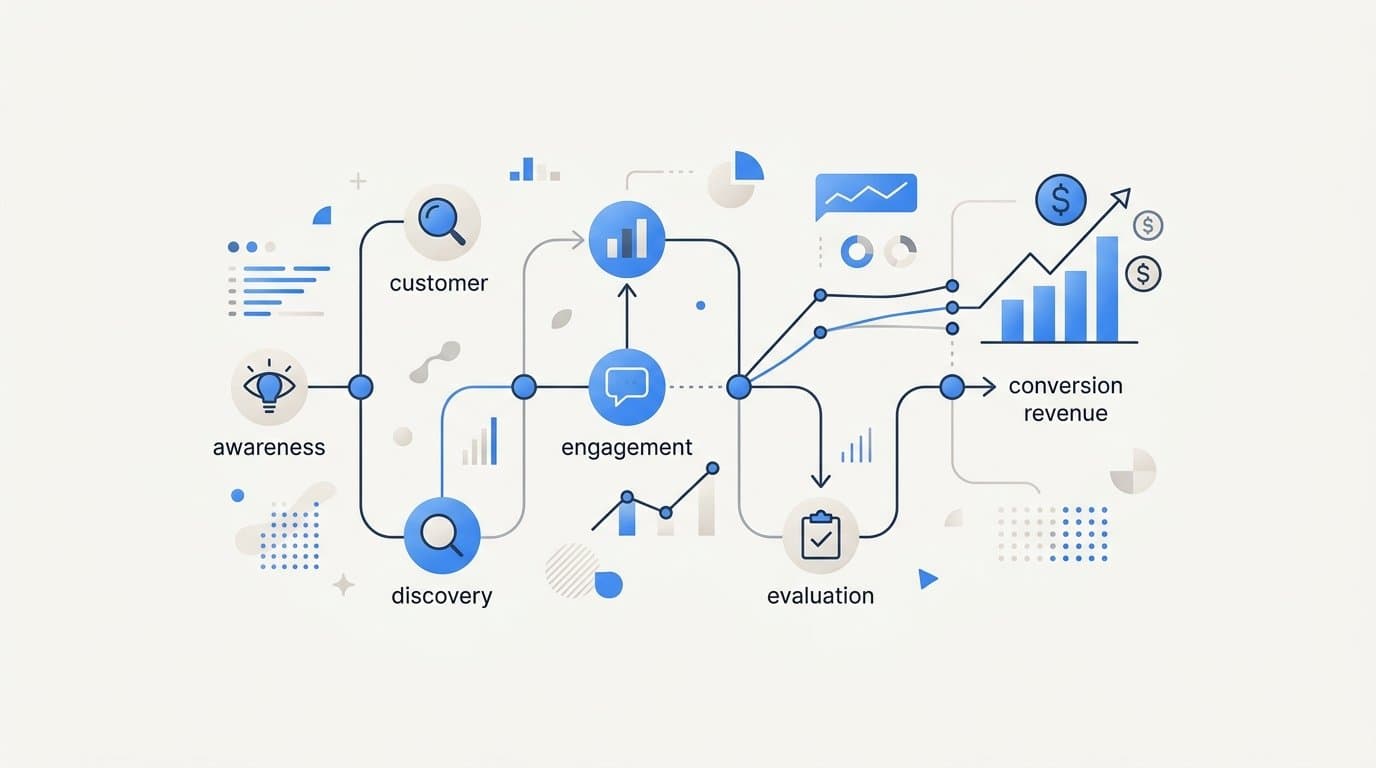
While every buyer's path is unique, B2B journeys tend to follow a recognizable arc. Understanding these five stages gives you a framework for deciding which touchpoints to track, which conversion events to define, and which attribution models apply at each phase.
Awareness: This is the moment a prospect first encounters your brand. In B2B SaaS, awareness typically comes through paid social ads on LinkedIn or Meta, organic search results, industry content, podcast mentions, or word of mouth. The prospect is not yet actively evaluating solutions; they are recognizing that a problem exists or that a category of tools might be relevant to them. Touchpoints here are often anonymous and hard to track, which is exactly why many teams undercount the contribution of top-of-funnel channels.
Consideration: The prospect is now actively researching. They are reading blog posts, watching explainer videos, comparing categories, and forming opinions about what a solution should look like. Micro-conversions in this stage include content downloads, newsletter signups, and multiple return visits to key pages like your pricing or features sections. These signals matter because they indicate intent long before a form gets filled out.
Evaluation: Here the prospect is comparing specific vendors. They are reading reviews on G2 or Capterra, requesting demos, attending webinars, and involving other stakeholders in the process. Deal size and audience segment significantly affect how long this stage lasts. An enterprise buyer evaluating a six-figure annual contract will spend far more time here than a startup founder buying a self-serve plan. A one-size-fits-all attribution model fails to account for this variation.
Decision: The prospect is ready to commit. They are negotiating terms, completing security reviews, or simply clicking a signup button. The touchpoints that appear here, a final retargeting ad, a case study shared by a sales rep, a personalized email sequence, tend to get disproportionate attribution credit in last-click models. But they rarely deserve it. The decision was shaped by everything that came before.
Post-Purchase Retention: For B2B SaaS, the journey does not end at conversion. Onboarding emails, product usage events, support interactions, and renewal touchpoints all belong in a complete journey analysis. Retention-stage data tells you which early engagement patterns predict long-term customers versus those likely to churn, which has direct implications for how you optimize your acquisition funnel.
Micro-conversions are the connective tissue across all five stages. Tracking only the final conversion event, whether that is a demo booked, a trial started, or a deal closed, misses the leading indicators that signal where a prospect is in their journey and how likely they are to advance. Building micro-conversion tracking into your framework from the start gives your analysis far more predictive power.
Why Standard Analytics Tools Miss the Full Picture
If standard analytics tools were sufficient for consumer journey analysis, this would be a much shorter article. The reality is that the most common measurement setups have structural blind spots that systematically distort your understanding of what is driving pipeline and revenue.
Last-click attribution is the most pervasive example. When a prospect clicks a Google search ad immediately before booking a demo, last-click models assign 100 percent of the credit for that conversion to that ad. Every touchpoint that preceded it, the LinkedIn campaign that created initial awareness, the organic blog post that explained your value proposition, the nurture email that brought the prospect back after a two-week gap, receives zero credit. Over time, this creates a feedback loop where top-of-funnel and mid-funnel channels appear to contribute nothing, budgets get shifted toward bottom-of-funnel channels, and the pipeline eventually dries up because awareness and consideration are being starved of investment.
Session-based analytics compounds this problem by treating each website visit as an isolated event. When a prospect visits your site on a Monday through an organic search, returns on Wednesday via a direct URL they bookmarked, and then converts on Friday after clicking a retargeting ad, session-based tools often see three separate, unconnected visits rather than a single continuous journey. The ability to stitch those sessions together into a coherent path is fundamental to journey analysis, and most out-of-the-box analytics setups do not do it.
Cross-device behavior creates another layer of complexity. A B2B buyer might research on their phone during a commute, continue on a work laptop during the day, and convert on a home computer in the evening. Without identity resolution across devices, these look like three different users rather than one prospect moving through a journey.
Browser-based pixel tracking has also become significantly less reliable in recent years. iOS privacy changes limit the data that ad platforms receive from Safari users, ad blockers prevent pixels from firing entirely, and browser-level restrictions on third-party cookies continue to expand across major platforms. Teams that rely exclusively on pixel-based measurement are working with an increasingly incomplete data set, and they often do not know how much they are missing.
The business consequence of all these gaps is not just inaccurate reports. It is bad budget decisions made with confidence. Teams cut channels that were genuinely contributing to pipeline because those channels do not appear to convert in last-click models. They double down on bottom-of-funnel tactics that look efficient in isolation but are actually parasitic on the awareness and nurture work happening upstream. Consumer journey analysis built on complete, accurate data prevents this from happening.
How to Build a Consumer Journey Analysis Framework
Building a consumer journey analysis framework is not a single project. It is a set of foundational decisions that determine the quality of every insight you generate afterward. Getting these foundations right matters more than any specific tool or tactic you layer on top.
Step 1: Unify your data sources. Your journey data currently lives in at least three separate places: your ad platforms (Google Ads, LinkedIn, Meta), your CRM (HubSpot, Salesforce, or similar), and your website analytics. These systems do not naturally talk to each other, which means the connections between a paid click, a website session, a lead record, and a closed deal exist nowhere by default. Unifying these sources into a single data environment is the prerequisite for everything else. Without it, you are always analyzing fragments rather than journeys.
Step 2: Define the conversion events that matter at each stage. Not all conversions are equal, and not all of them happen at the bottom of the funnel. Map out the micro-conversions that signal meaningful intent at each stage of the journey: content downloads at the consideration stage, pricing page visits and demo requests at the evaluation stage, trial signups and sales-qualified lead status changes at the decision stage. Each of these should be a defined, tracked event in your framework.
Step 3: Choose an attribution model that fits your buying cycle. Different models answer different questions. First-touch attribution tells you which channels are best at creating initial awareness. Last-touch tells you which channels close deals. Linear attribution distributes credit equally across all touchpoints and gives you a broad view of channel contribution. Time-decay attribution weights recent touchpoints more heavily, which suits shorter sales cycles. Position-based models give extra credit to the first and last touchpoints while distributing the remainder across the middle. Data-driven attribution uses historical patterns to assign credit algorithmically based on actual conversion behavior. For most B2B SaaS teams with complex, multi-touch journeys, data-driven or position-based models tend to tell the most useful story.
Step 4: Implement server-side tracking and Conversion API integrations. This is the technical step that separates robust journey analysis from fragile, pixel-dependent measurement. Server-side tracking sends conversion events directly from your server to ad platforms and analytics tools, bypassing the browser entirely. This means ad blockers, iOS restrictions, and cookie limitations do not degrade your data. Conversion API (CAPI) integrations with Meta and Google ensure that the events you are optimizing against are complete and accurate, which also improves the performance of algorithmic bidding on those platforms. First-party data collected this way is more durable and more reliable than anything a browser pixel can capture.
Step 5: Establish a reporting cadence. Journey analysis is not a one-time audit. Define how often you will review journey data, who owns the analysis, and what decisions it should inform. Weekly reviews of micro-conversion trends, monthly reviews of channel contribution across the full journey, and quarterly reviews of attribution model performance give you a rhythm that keeps the framework active and actionable.
Turning Journey Data Into Actionable Marketing Decisions
Data without decisions is just storage. The real value of consumer journey analysis emerges when you use it to change how you allocate budget, create content, and optimize campaigns. Here is how that works in practice.
Journey analysis reveals a distinction that most channel-level reporting obscures: the difference between channels that initiate high-value journeys and channels that close them. In many B2B SaaS companies, paid social and organic content tend to be strong journey initiators, creating the first interaction that eventually leads to pipeline. Branded search and direct traffic tend to be strong journey closers, appearing at the final touchpoint before conversion. Both are essential, but they serve different functions. When you can see this distinction clearly, you stop penalizing awareness channels for not driving last-click conversions and start investing in the full funnel with intention.
AI-driven analysis of journey data takes this further by surfacing patterns that would be invisible to manual review. When you have thousands of customer journeys in your data set, a human analyst cannot realistically identify which specific sequences of touchpoints consistently precede high-value conversions. An AI model can. It might reveal that prospects who engage with a particular piece of content early in their journey convert at a significantly higher rate, or that a specific sequence of ad exposure followed by an organic blog visit followed by a direct return visit is a reliable predictor of a qualified demo request. These patterns become the basis for content strategy, ad sequencing, and nurture design.
Feeding enriched journey data back to ad platforms through Conversion API creates a compounding improvement loop. When Meta or Google receive complete, accurate conversion signals, including the downstream revenue value associated with each conversion, their algorithms can optimize for the outcomes that actually matter to your business rather than surface-level events like form fills. Over time, this improves targeting precision, reduces wasted spend, and increases the quality of leads generated by paid campaigns. The better your data, the better the algorithm performs, which generates more data, which further improves performance.
This is also where revenue attribution becomes the most powerful output of journey analysis. Connecting marketing touchpoints all the way to closed-won revenue in your CRM, not just to leads or trials, allows you to calculate true marketing ROI by channel and by campaign. When you can show leadership that a specific LinkedIn campaign initiated journeys that eventually generated a measurable amount of closed revenue, the conversation about marketing investment changes fundamentally. You are no longer defending spend based on impressions or clicks. You are demonstrating return.
Putting Journey Analysis Into Practice With the Right Tools
Choosing the right platform for consumer journey analysis is not just a technical decision. It is a strategic one. The wrong tool creates more data silos rather than fewer, and a platform that cannot connect your ad stack to your CRM to your website events will leave you with the same fragmented picture you started with.
When evaluating a consumer journey analysis platform, look for these capabilities. First, native integrations with your existing ad platforms and CRM are non-negotiable. Manual data exports and spreadsheet stitching are not a sustainable foundation for ongoing analysis. Second, support for server-side tracking and Conversion API integrations is now a baseline requirement, not an advanced feature. Any platform that relies exclusively on browser-based pixels will produce increasingly unreliable data as privacy restrictions continue to expand. Third, multi-touch attribution modeling should be built in, with the flexibility to compare models and understand what each one reveals about your specific buying cycle. Fourth, real-time reporting allows you to act on journey insights quickly rather than waiting for weekly or monthly batch reports that are already stale by the time they reach you.
Cometly is built specifically for B2B SaaS teams who need all of these capabilities in a single platform. It connects your ad platforms, CRM data, and website events into a unified view of every customer journey, with AI-powered recommendations that surface which channels, campaigns, and touchpoint sequences are actually driving pipeline and revenue. Server-side tracking and Conversion API integrations ensure that your data is complete and accurate even as browser-based tracking becomes less reliable. And because Cometly connects ad spend directly to closed-won revenue through CRM integration, you get the kind of revenue attribution that makes marketing ROI conversations with leadership straightforward rather than speculative.
The practical starting point is simpler than most teams expect. Identify your highest-value conversion event, whether that is a demo booked, a trial started, or a deal closed. Then map the touchpoints that most frequently precede that event in your existing data. That mapping is the seed of your consumer journey analysis framework. From there, you add data sources, refine your attribution model, and build out micro-conversion tracking as your understanding of the journey deepens. You do not need a perfect framework on day one. You need a real one that improves over time.
The Bottom Line on Consumer Journey Analysis
Consumer journey analysis is not a one-time project you complete and move on from. It is a practice that compounds in value as more data accumulates, as your attribution model matures, and as your team develops the habit of making decisions based on full-journey evidence rather than isolated metrics.
The core mindset shift it requires is moving from measuring touchpoints to understanding paths. Individual data points tell you what happened. Journey analysis tells you why it happened and what combination of experiences led a prospect to become a customer. That difference is the foundation of marketing that scales with confidence rather than hope.
For B2B SaaS teams navigating long buying cycles, multiple stakeholders, and an increasingly complex tracking environment, consumer journey analysis is the discipline that connects marketing activity to revenue in a way that last-click attribution and session analytics never can. The teams that build this infrastructure now, with server-side tracking, multi-touch attribution, and CRM-connected revenue data, will have a durable advantage as the measurement landscape continues to evolve.
If you are ready to stop guessing which channels are driving your pipeline and start seeing the complete picture, Get your free demo of Cometly today and see how it maps every touchpoint in your customer journey to the revenue that matters.