
Most marketing teams believe they have a conversion tracking problem. What they actually have is a data transmission problem. The conversions are happening. Trials are being activated, demos are being booked, deals are closing. But the ad platforms running your campaigns have no idea any of it occurred.
This creates a dangerous situation. You are spending real budget on Meta, Google, and LinkedIn campaigns while those platforms optimize based on a partial, distorted picture of your actual results. Their machine learning models are doing their best with the signals they receive. The problem is that the signals are incomplete.
Conversion sync is the mechanism that fixes this. It is the process of taking conversion data from your own systems and sending it back to ad platforms so their algorithms can optimize toward what actually matters: leads that become customers, trials that convert to paid, deals that close. For B2B SaaS teams managing significant ad budgets, understanding how conversion sync works is not optional. It is foundational to running efficient, scalable campaigns.
This article breaks down exactly what conversion sync is, how it works at a technical level, what types of events you should be syncing, and how it directly impacts attribution accuracy and ROAS. By the end, you will have a clear picture of why this matters and how to put it into practice.
The Data Gap That's Costing You Ad Performance
Here is the core problem. When someone clicks your ad and converts on your website, the traditional way that conversion gets reported back to the ad platform is through a browser-based pixel. A small piece of JavaScript fires in the user's browser, sends a signal to Meta or Google, and the platform records a conversion. Simple enough in theory.
In practice, this system breaks down constantly. Ad blockers prevent pixels from firing. Apple's Intelligent Tracking Prevention and App Tracking Transparency changes restrict how browsers pass data across sessions and apps. Users browse on mobile and convert on desktop, creating cross-device journeys that cookie-based tracking cannot follow. The result is that a meaningful portion of your actual conversions simply never get reported back to the platforms that need to know about them.
The downstream consequences are significant. Ad platforms like Meta and Google rely on conversion signals to train their bidding and targeting algorithms. When those signals are incomplete, the algorithm does not just operate with less data. It actively optimizes in the wrong direction. It identifies audience segments that appear to convert based on the partial data it has, but those segments may not reflect your actual best customers. CPAs rise. Budget gets allocated toward traffic that looks good on paper but underperforms in your CRM.
For B2B SaaS companies specifically, this problem is compounded by longer sales cycles. A lead that fills out a form today might not become a paying customer for weeks or months. If the only conversion signal you send back to the ad platform is the form fill, the algorithm learns to optimize toward form fillers, not toward the subset of form fillers who actually close. That is a fundamentally different audience, and optimizing for the wrong one has real budget implications.
Conversion sync addresses this at the source. Instead of relying on a browser pixel to capture and transmit conversion events, conversion sync uses your own server and first-party data to send accurate, complete conversion signals directly to ad platforms via their APIs. The data gap closes. The algorithm gets what it needs. And your campaigns start optimizing toward outcomes that actually matter to your business. Teams looking to go deeper on fixing conversion tracking gaps will find that server-side transmission is consistently the most effective starting point.
What Conversion Sync Actually Does
Conversion sync is the process of sending conversion events from your own systems directly back to ad platforms, typically in real time or near real time. Those systems might include your website backend, your CRM, your payment processor, or any other tool that captures meaningful customer actions. The destination is the ad platform's ingestion API: Meta's Conversion API, Google Enhanced Conversions, TikTok's Events API, or similar endpoints.
To understand why this matters, it helps to distinguish between two fundamentally different tracking approaches.
Client-side tracking: A JavaScript pixel fires in the user's browser when they complete an action. The browser sends the event data to the ad platform. This approach depends entirely on the browser cooperating, which, as described above, it increasingly does not.
Server-side conversion sync: Your server captures the event independently of what happens in the browser, then sends that event directly to the ad platform via an API call. The browser's behavior becomes irrelevant. Ad blockers cannot intercept a server-to-server API call. iOS privacy restrictions do not apply. The event gets recorded regardless of what device the user is on or what browser settings they have enabled.
Server-side conversion sync is more reliable because it removes the browser as a dependency. It is also more privacy-resilient because the data transmission happens between servers, not in a user's browser environment where it can be blocked or restricted. Understanding what the Conversion API actually is helps clarify why this server-to-server approach has become the industry standard for accurate event transmission.
The technical mechanism that makes accurate attribution possible within conversion sync is the use of matching keys. When a user converts, your system captures first-party identifiers associated with that event: an email address, a phone number, an external customer ID. These identifiers are hashed before transmission, meaning they are converted into an anonymized string that cannot be reverse-engineered into personal data. The ad platform receives the hashed identifier and uses it to match the conversion event back to the original ad click or impression that preceded it.
This matching process is what allows conversion sync to work without relying on cookies. Instead of following a user via a tracking cookie across sessions, the platform uses a privacy-safe identifier to connect the conversion back to the ad exposure. The quality of this matching depends on how much first-party data your system captures at the point of conversion. The more identifiers you collect, the higher your match rate, and the more accurately conversions get attributed to the campaigns that drove them.
How Conversion Sync Works Step by Step
Walking through the actual flow makes the concept concrete. Here is what happens from click to conversion sync in plain language.
1. A user sees your ad on Meta or Google and clicks through to your website. The ad platform records the click and associates it with a click ID, a unique identifier tied to that specific ad interaction.
2. The user lands on your website. Your site captures the click ID from the URL parameter and stores it, typically in a first-party cookie or your own database. This is the link between the ad click and everything that happens next.
3. The user completes an action: fills out a demo request form, signs up for a free trial, or makes a purchase. At this moment, your server captures the event along with the user's identifiers (email, phone, external ID) and the stored click ID.
4. Your server sends this event data to the ad platform via API. The payload includes the event type, a timestamp, the hashed user identifiers, and a unique event ID. The ad platform receives the event, matches it to the original click using the click ID and hashed identifiers, and records the conversion.
5. The ad platform's algorithm now has an accurate conversion signal. It updates its model of which audience segments, placements, and creative variations are driving real outcomes, and adjusts bidding and targeting accordingly.
One important technical detail in this flow is event deduplication. In many setups, both a browser pixel and a server-side event fire for the same conversion. Without deduplication, the ad platform would count that as two separate conversions, inflating your reported results. To prevent this, both the pixel and the server event include the same unique event ID. The platform uses this shared ID to identify duplicates and count the conversion only once. This keeps your data clean and your reporting accurate. Following best practices for tracking conversions accurately ensures deduplication is handled correctly from the start.
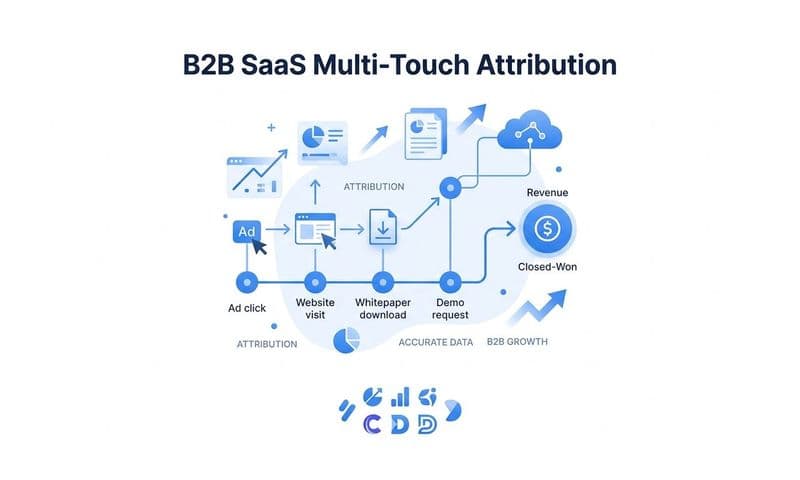
For B2B SaaS teams, the most powerful application of conversion sync extends beyond the initial form fill. Offline conversion syncing allows you to take CRM milestones and send them back to ad platforms as conversion events. When a lead becomes a sales-qualified lead, that event can be synced. When an opportunity is created, that event can be synced. When a deal closes, the closed-won revenue can be synced back to the original ad click that started the journey. This connects ad spend to pipeline stages that happen days, weeks, or even months after the initial click, giving ad platforms the downstream signals they need to optimize toward revenue rather than just lead volume.
What Gets Synced and When It Matters Most
Not all conversion events carry equal weight. For B2B SaaS teams, the choice of which events to sync and when has a direct impact on how well ad platform algorithms perform.
The full spectrum of events worth syncing typically includes:
Lead form submissions: The top-of-funnel signal. Useful as a baseline, but insufficient on its own for B2B optimization.
Trial activations: A stronger signal than a form fill. A user who activates a trial has demonstrated intent beyond curiosity.
Demo bookings: High-intent events that indicate a user is actively evaluating your product. Worth syncing as a distinct conversion event.
Product qualified leads: Users who have reached meaningful engagement thresholds inside your product. These signals tell ad platforms that certain users are not just signing up but actually using what they signed up for.
Pipeline stage progressions: SQL status, opportunity created, proposal sent. Each of these CRM milestones represents a step closer to revenue and a more valuable optimization signal than a raw lead count.
Closed-won revenue: The most valuable signal of all. When ad platforms receive closed-won events tied to actual revenue figures, they can optimize toward the users most likely to generate revenue, not just the users most likely to fill out a form.
The reason syncing downstream funnel events matters more than syncing top-of-funnel leads comes down to signal quality. Ad platform algorithms are only as good as the outcomes they are optimizing toward. If you only sync form fills, the algorithm learns to find more people who fill out forms. Many of those people will never become customers. If you sync closed-won revenue, the algorithm learns to find people who actually buy. That is a fundamentally different and far more valuable optimization target.
Timing also matters in two distinct ways. Real-time syncing of conversion events improves in-flight campaign optimization. When the algorithm receives conversion signals quickly, it can adjust bids and targeting within active campaigns while they are still running, improving performance before the campaign ends. Historical offline conversion tracking, where you send batches of CRM data back to ad platforms on a regular cadence, improves audience modeling and bid strategy over time by giving the algorithm a richer, more accurate picture of who your best customers actually are.
The Attribution Impact of Accurate Conversion Sync
Conversion sync and attribution accuracy are deeply connected. Attribution models, whether first-touch, last-touch, or multi-touch, require complete data to produce reliable results. If a significant portion of your conversions are never captured because browser pixels failed to fire, your attribution model is working with a distorted dataset. The credit distribution it produces will reflect the gaps in your tracking, not the reality of your customer journeys.
When conversion sync is implemented correctly, every conversion event is captured and transmitted regardless of browser behavior, device, or privacy settings. Attribution models now have complete data to work with. The picture they produce is accurate rather than approximate.
This matters especially for multi-touch conversion value, which attempts to distribute credit across all the touchpoints in a customer journey. Multi-touch models are only as reliable as the touchpoint data feeding them. If touchpoints are missing because pixels failed or cross-device journeys broke the tracking chain, the model will systematically undervalue certain channels and overvalue others. Accurate conversion sync closes those gaps and gives multi-touch attribution the complete dataset it needs to function correctly.
Conversion sync also addresses a persistent problem in cross-channel attribution: platform self-reporting. When each ad platform measures its own conversions using its own pixel, every platform tends to claim credit for the same conversions. Meta says it drove the conversion. Google says it drove the conversion. LinkedIn says it drove the conversion. The numbers never reconcile, and growth teams have no reliable way to understand actual channel contribution.
When conversion sync routes all conversion data through a single first-party source, every platform is measured against the same dataset. The attribution model compares channel performance using consistent, unified data rather than each platform's self-reported numbers. This makes cross-channel budget decisions far more defensible. Understanding what attributed conversions actually represent across channels is essential for making those budget calls with confidence.
There is also a compounding benefit that plays out over time. When ad platforms receive accurate, enriched conversion signals via sync, their machine learning models improve. Better conversion data trains better targeting algorithms. Better targeting algorithms drive lower CPAs and higher ROAS. The feedback loop between accurate conversion sync and improved ad platform performance is one of the clearest examples of how data quality translates directly into business outcomes.
Putting Conversion Sync Into Practice With Cometly
Understanding conversion sync conceptually is one thing. Implementing it across multiple ad platforms, a CRM, and a payment processor is another challenge entirely. This is where having the right infrastructure in place makes the difference between conversion sync as a theory and conversion sync as a functioning system.
Cometly handles conversion sync end to end. It captures every touchpoint from the initial ad click through to CRM events, enriches that conversion data with first-party identifiers, and sends server-side events back to Meta, Google, and other ad platforms via their respective APIs. The result is a complete, accurate conversion data stream that ad platforms can actually use to optimize performance. Teams evaluating their options can review the leading conversion sync tools to understand how different solutions approach this infrastructure challenge.
One of the most impactful capabilities Cometly offers for B2B SaaS teams is the integration between Stripe revenue data and ad data. When a deal closes and revenue is recorded in Stripe, Cometly can sync that closed-won revenue back to the original ad campaigns that drove the journey. This enables true revenue attribution rather than lead-level attribution. Instead of measuring campaigns by how many form fills they generated, you can measure them by how much revenue they produced. That shift in measurement changes how you allocate budget, how you evaluate creative, and how you think about campaign performance overall.
Cometly also connects to your CRM, which means pipeline stage progressions can be synced back to ad platforms as offline conversion events. When a lead becomes an SQL or an opportunity moves to closed-won, those milestones flow back into the attribution model and back to the ad platforms that need them. Ad platform algorithms receive the downstream signals that actually reflect business outcomes, not just surface-level engagement metrics.
Once accurate conversion sync is feeding clean, enriched data into the platform, Cometly's AI layer can do its job effectively. It identifies which ads and campaigns are driving pipeline and revenue across every channel, surfaces recommendations for scaling what is working, and helps teams make budget decisions based on actual performance rather than incomplete reporting. The AI also feeds enriched conversion events back to Meta, Google, and other platforms, improving their targeting and optimization over time.
With over 70 native integrations and a purpose-built architecture for B2B SaaS companies, Cometly is designed to connect the entire stack: ad platforms, website, CRM, and payment processor, into a single source of truth for marketing performance.
The Bottom Line on Conversion Sync
Conversion sync is not a technical nicety reserved for enterprise teams with dedicated data engineering resources. It is the foundation of accurate ad measurement and efficient spend for any B2B SaaS company running paid campaigns at meaningful scale.
Without it, ad platforms optimize on incomplete signals. Attribution models produce misleading results. Growth teams make budget decisions based on data that does not reflect what is actually happening in the business. The campaigns that look best in platform dashboards may not be the ones driving revenue. The channels that appear to underperform may actually be doing more than the data suggests.
Conversion sync closes the loop. It ensures that every conversion, from a trial activation to a closed-won deal, is captured, attributed, and transmitted back to the platforms that need it. The result is better optimization, more reliable attribution, and budget allocation decisions you can actually trust.
If your team is ready to move from incomplete conversion data to a complete, accurate picture of what your ad spend is producing, Cometly is built to get you there. Get your free demo today and start capturing every touchpoint to connect every conversion event to actual pipeline and revenue.