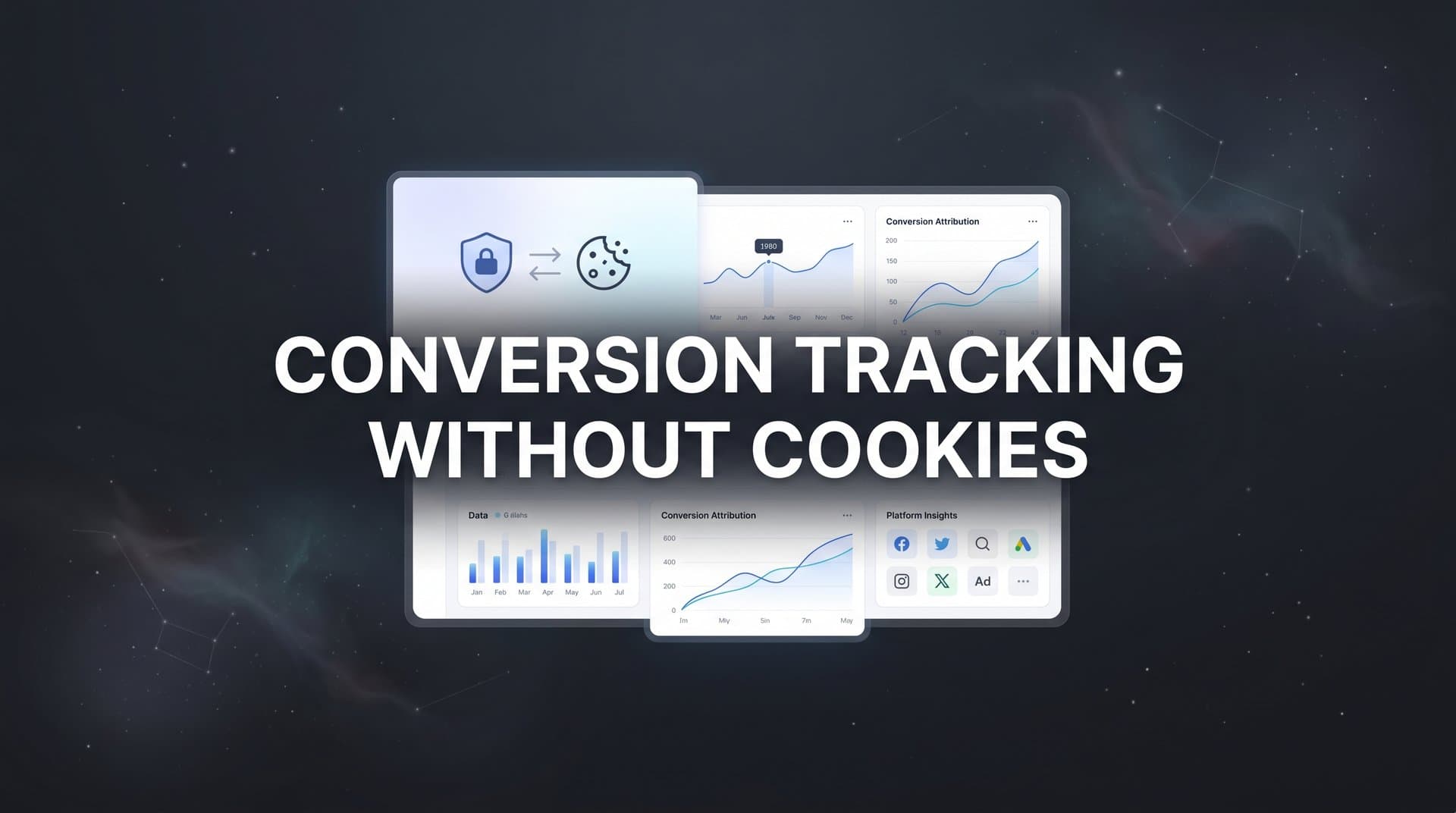
The era of cookie-based conversion tracking is not ending gradually. For a significant portion of your web traffic, it has already ended. Safari and Firefox block third-party cookies by default. Ad blockers are widespread. Privacy regulations across the US and Europe have made consent-based tracking the legal standard in many regions. And even first-party cookies face restrictions that limit how long they persist on certain browsers.
For marketers who built their measurement strategies on pixels and cookies, the result is a growing blind spot. Conversions go unrecorded. Attribution models report incomplete data. Ad platforms optimize on bad signals and deliver worse results. The feedback loop that once made paid advertising so efficient starts working against you.
Here is the important reframe: conversion tracking without cookies is not a compromise. Done right, it is actually more accurate than what most advertisers had before. Server-side tracking, first-party data strategies, and AI-powered attribution give you a cleaner, more complete picture of what is actually driving revenue. This article walks through why cookies are disappearing, what the real cost of broken tracking looks like, and how to build a measurement stack that works in a privacy-first world.
Why the Cookie Crumbled: The Forces Killing Traditional Tracking
To understand where tracking is going, it helps to understand how it worked for so long. Third-party cookies were the backbone of digital advertising measurement for decades. When a user clicked an ad and landed on your site, an ad platform like Meta or Google would drop a small file in the browser. When that user converted, a pixel on your thank-you page would fire, read the cookie, and report the conversion back to the platform. Simple, scalable, and nearly invisible to users.
The problem is that this system relied on cross-site data sharing, and that is exactly what modern browsers, regulators, and users have decided to restrict.
Browser Privacy Updates: Safari introduced Intelligent Tracking Prevention (ITP) years ago and has been tightening it ever since. Third-party cookies are blocked entirely. First-party cookies set via JavaScript are capped at seven days of expiration in many scenarios, and cookies tied to known tracking domains through link decoration can be limited to 24 hours. Firefox's Enhanced Tracking Protection (ETP) follows a similar approach. Google Chrome, the dominant browser by market share, introduced its Privacy Sandbox and has shifted to a user-choice model for third-party cookies rather than a blanket ban. The net effect is that a large and growing share of web traffic simply cannot be tracked via traditional cookie methods.
Regulatory Pressure: GDPR in Europe established a legal framework requiring explicit consent for tracking. In the United States, state-level privacy laws including California's CPRA, Virginia's VCDPA, and laws in Colorado, Connecticut, and others have added further requirements. When users are asked for consent and decline, cookies that are technically available become legally off-limits. Consent rejection rates are meaningful, particularly in markets with higher privacy awareness.
User Behavior: Ad blocker adoption is widespread across desktop and mobile. Many ad blockers also block tracking pixels, not just ads, which means conversion events fired client-side are silently dropped. Users who do not use ad blockers may still use private browsing modes, clear cookies regularly, or simply decline cookie banners. Understanding why tracking conversions after iOS updates became so difficult illustrates just how disruptive these changes have been.
The distinction between first-party and third-party cookies matters here. Third-party cookies are set by a domain other than the one the user is visiting, which is how ad platforms tracked users across sites. First-party cookies are set by the site itself and are generally considered more privacy-respecting. But as Safari's ITP demonstrates, even first-party cookies face real limitations. A seven-day expiration window means any customer who takes longer than a week to convert after their first click is invisible to cookie-based attribution. For considered purchases, B2B sales cycles, or subscription products, that gap is significant.
The Real Cost of Broken Tracking for Paid Advertisers
When tracking breaks, the damage is not always obvious at first. You do not get an error message. Your dashboards still show numbers. But those numbers are increasingly disconnected from reality, and the downstream effects compound over time.
The most immediate problem is underreported conversions. When pixels miss events due to ad blockers, cookie restrictions, or browser-side timing issues, your ad platforms see fewer conversions than actually occurred. This directly inflates your reported cost per acquisition. A campaign that is actually profitable looks unprofitable because a meaningful share of its conversions are invisible to the platform. If you have ever wondered why your conversion tracking numbers are wrong, this is often the root cause.
Misattributed Revenue: When some conversions are tracked and others are not, attribution models skew toward the touchpoints that happen to be trackable. Channels that rely heavily on cookie-based tracking appear weaker than they are. Channels with more direct tracking signals look stronger. You end up making budget decisions based on which tracking method survived, not which channel actually drove results.
Broken Lookalike Audiences: Ad platforms build lookalike audiences by analyzing the characteristics of your converters. When conversion data is incomplete, the audience signal degrades. Your lookalike audiences are built from a partial, biased sample of your actual customers, which reduces their effectiveness and increases wasted spend.
Here is where the feedback loop problem becomes critical. Platforms like Meta and Google use machine learning to optimize campaign delivery. They need accurate conversion signals to learn which users, placements, and creative combinations produce results. When you feed them incomplete data, their algorithms make poor optimization decisions. They shift budget toward users who converted in ways that were trackable, not necessarily users who are most likely to convert in reality.
The compounding effect is what makes this dangerous. Bad data leads to bad optimization decisions. You might pause a campaign that was actually performing well because its conversions were being undercounted. You might scale a campaign that looks strong because its tracking method happened to survive browser restrictions. Over weeks and months, this erodes ROAS and makes it harder to identify what is actually working.
The marketers who feel this most acutely are those running multi-channel campaigns where the customer journey spans multiple sessions and days. A user who sees a Facebook ad, clicks away, comes back via Google search three days later, and converts on day ten is nearly impossible to attribute accurately with cookie-based tracking. Effectively tracking conversions across multiple touchpoints requires a fundamentally different approach. The data gaps are not random noise. They are systematic blind spots that distort your entire measurement picture.
Five Cookieless Tracking Methods That Actually Work
The good news is that the industry has developed robust alternatives to cookie-based tracking. Some are mature and widely adopted. Others are emerging. The strongest tracking stacks combine several of these approaches.
Server-Side Tracking: This is the most powerful method available today and the foundation of any serious cookieless strategy. Instead of relying on browser-based pixels to fire conversion events, server-side tracking sends data from your server directly to ad platform APIs. Meta's Conversions API (CAPI), Google's Enhanced Conversions, and TikTok's Events API all support this approach. Because the data transmission happens server-to-server, it is completely unaffected by ad blockers, browser cookie restrictions, or page load timing issues. Understanding what conversion API tracking is is essential for any marketer building a modern measurement stack. We will cover this in depth in the next section.
First-Party Data and Identity Resolution: When users log in, submit forms, make purchases, or interact with your CRM, they generate first-party data that belongs to you. Email addresses (typically hashed before transmission), phone numbers, and customer IDs can be used to match conversion events to specific users without relying on cookies. UTM parameters passed through your URL structure help stitch together the journey from ad click to conversion. When you combine CRM records with ad platform data, you can reconstruct customer journeys with much higher accuracy than cookie matching ever provided. A deeper dive into first-party data tracking explains how to build this foundation effectively.
Probabilistic Modeling and Statistical Attribution: When individual-level tracking is not possible, statistical methods can fill gaps. Probabilistic models use aggregated signals, such as device type, browser, location, and timing, to estimate attribution. Media mix modeling (MMM) analyzes the relationship between ad spend and revenue at an aggregate level to estimate channel contribution without user-level tracking. These approaches are less precise at the individual conversion level but provide valuable directional insight for budget allocation.
Google's Privacy Sandbox APIs: Google's Privacy Sandbox includes the Attribution Reporting API, which is designed to measure conversions without cross-site tracking by processing attribution data within the browser and reporting aggregated results. The Topics API provides interest-based signals for targeting without third-party cookies. These APIs are still evolving, and adoption varies across the industry, but they represent the direction browser-native measurement is heading.
Contextual Signals Combined with Conversion Data: Contextual targeting uses signals from the content a user is consuming rather than their cross-site browsing history. When combined with server-side conversion data and first-party identity signals, contextual approaches can maintain meaningful measurement accuracy even in cookieless environments. This is particularly relevant for display and programmatic advertising where cookie-based audience targeting is most affected.
Server-Side Tracking: The Foundation of Cookieless Measurement
Server-side tracking deserves a deeper look because it solves the core problem that makes cookieless tracking difficult: getting reliable conversion data to ad platforms when the browser can no longer be trusted to deliver it.
Here is how it works at a practical level. When a user converts on your website, instead of (or in addition to) a browser pixel firing, your server captures the conversion event. Your server then processes and enriches that event with additional data, such as the customer's email address, order value, or CRM identifiers. It then sends that enriched event directly to the ad platform's API. The entire data transmission happens outside the browser, which means ad blockers cannot intercept it and browser cookie restrictions do not apply.
The accuracy improvement over pixel-based tracking is substantial for several reasons. Browser pixels depend on the page fully loading, JavaScript executing correctly, and no ad blockers or privacy tools interfering. Any of these can cause a pixel to miss a conversion silently. Server-side events are sent programmatically and reliably. The comparison between server-side tracking vs pixel tracking makes the reliability gap clear. They also capture conversions that happen in environments where pixels never work, such as in-app browsers, certain mobile configurations, and privacy-focused browsers.
Enriched conversion data is particularly valuable for ad platform optimization. When you send a conversion event that includes a hashed email address, the platform can match it against its own user graph and confirm which specific user converted. This match improves the quality of the signal fed to the platform's machine learning algorithms. Better signals mean better optimization, which means your campaigns find the right users more efficiently.
From a practical infrastructure standpoint, implementing server-side tracking requires a few components. You need a server or cloud function that can receive conversion events from your website or CRM. You need to connect that server to the APIs of each ad platform you use. And you need a way to pass click identifiers, such as Meta's fbclid or Google's gclid, from the ad click through to the conversion event so the platform can attribute the conversion to the correct campaign. Exploring the full range of server-side conversion tracking benefits helps justify the implementation investment.
This is where a platform like Cometly becomes valuable. Cometly's server-side tracking infrastructure handles the connection between your website, CRM, and ad platforms, capturing every conversion event and syncing enriched data back to Meta, Google, and other channels. Its Conversion Sync feature feeds this data back into ad platform algorithms so they can optimize on complete, accurate signals rather than the partial picture that browser pixels provide. You get better attribution and better campaign performance from the same ad spend.
Building a Cookieless Tracking Stack: A Step-by-Step Framework
Knowing that cookieless tracking methods exist is one thing. Building a functional stack that captures the full customer journey is another. Here is a practical framework for getting there.
Step 1: Audit Your Current Tracking Setup
Before you can fix the gaps, you need to see them clearly. Start by comparing your ad platform-reported conversions against your CRM-confirmed conversions for the same time period. If your platforms are reporting significantly fewer conversions than your CRM shows, you have a tracking gap. The size of that gap tells you how much revenue is being misattributed or missed entirely.
Next, map out every place in your current setup where you rely on browser-based pixels or third-party cookies. This includes your Meta Pixel, Google Ads conversion tags, and any other platform-specific pixels. Identify which of these have server-side alternatives available. Assess your UTM tracking and attribution coverage: are click identifiers being captured consistently and passed through to your CRM?
This audit gives you a baseline and helps you prioritize where to focus first. Typically, the highest-impact fix is wherever your largest revenue channels have the biggest tracking gaps.
Step 2: Implement Server-Side Tracking and Unify Your Data Pipeline
With your gaps identified, the next step is to implement server-side tracking for your primary ad platforms. Set up the Meta Conversions API, Google Enhanced Conversions, and any other platform APIs relevant to your channel mix. Configure your server to receive conversion events from your website and CRM, enrich them with first-party identifiers, and transmit them to each platform's API.
Simultaneously, connect your ad platforms, website analytics, and CRM into a unified data pipeline. This means ensuring that UTM parameters and click IDs are captured at the first touchpoint and persisted through to the conversion event. When every touchpoint from the first ad click to the final sale is captured in a single connected system, you can see the full customer journey rather than isolated snapshots. Reviewing the best revenue attribution tracking tools can help you evaluate what fits your stack.
Cometly is built specifically for this kind of unified tracking. It connects your ad platforms, website, and CRM to track every touchpoint in real time, giving you a complete view of the customer journey without relying on third-party cookies or browser pixels alone.
Step 3: Adopt Multi-Touch Attribution and Let AI Optimize
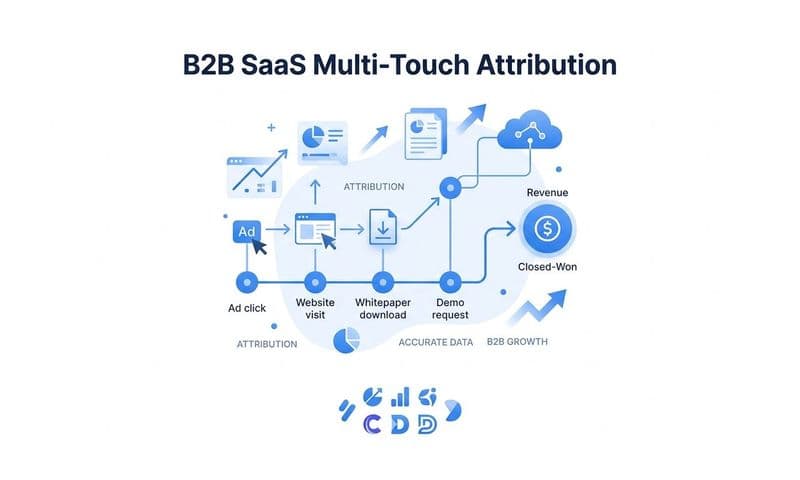
Once your data pipeline is capturing complete conversion data, replace last-click attribution with a multi-touch model that reflects how customers actually make decisions. Most conversions involve multiple touchpoints across multiple channels and sessions. A customer might discover you through a social ad, research via organic search, return through a retargeting ad, and convert through email. Last-click attribution gives all the credit to email and tells you nothing useful about the role the other channels played.
Multi-touch attribution distributes credit across the journey, giving you a more accurate picture of which channels and ads are truly driving revenue. Combined with AI-powered analysis, you can identify which campaigns are genuinely performing, which are being overvalued by incomplete tracking, and where to allocate budget for the highest return. Effective tracking conversions across multiple channels is the key to unlocking this level of insight. Cometly's AI analyzes performance across every channel and surfaces recommendations so you can scale winning campaigns with confidence rather than guesswork.
Tracking Smarter in a Privacy-First World
The shift away from cookies is not a problem to be solved and forgotten. It is a permanent change in how the web handles user data, and the marketers who adapt now will have a durable competitive advantage over those who keep patching their old pixel-based setups.
Cookieless conversion tracking, done properly, is actually more accurate than what most advertisers had before. Server-side tracking captures conversions that browser pixels routinely miss. First-party data creates more reliable customer identity than cookie matching ever provided. Multi-touch attribution reflects the real customer journey rather than crediting the last click. The result is a measurement foundation you can trust, and decisions you can make with confidence.
The marketers who adapt now gain something beyond just better data. They gain better optimization because their ad platforms receive complete, enriched conversion signals. They gain better budget allocation because their attribution models reflect reality. And they gain resilience because their tracking does not break every time a browser updates its privacy policies.
The transition starts with understanding where your current tracking gaps are and taking deliberate steps to close them. Implement server-side tracking. Connect your CRM and ad platforms into a unified pipeline. Move beyond last-click attribution to models that capture the full journey.
Cometly makes this transition practical. It brings together server-side tracking, multi-touch attribution, AI-powered analysis, and conversion sync into a single platform built for marketers who need accurate data across every channel. Get your free demo today and start capturing every touchpoint so you can measure what matters, optimize with confidence, and scale the campaigns that are actually driving revenue.