

Marketing teams are making six-figure budget decisions based on conversion data that is, in many cases, missing a significant portion of the actual picture. The dashboards look populated. The reports show conversions. But underneath the surface, a growing share of customer journeys are either invisible or misattributed, and the gap between what your tracking reports and what actually happened is widening every year.
Cookie based tracking was the infrastructure that powered digital advertising measurement for decades. It was elegant in its simplicity: a small file stored in a browser, read later to connect an ad click to a conversion. For a long time, it worked well enough that most marketing teams never had to think about it. That era is over.
The environment that cookie based tracking was designed for no longer exists. Browsers have been systematically dismantling cross-site tracking. Apple fundamentally changed mobile attribution with its privacy framework. A growing share of users either run ad blockers or decline cookie consent banners outright. The result is a measurement infrastructure that looks intact on the surface but has significant structural gaps running through it.
This article breaks down exactly what is breaking, why it matters specifically for B2B SaaS marketing teams, and what modern tracking approaches actually solve the problem rather than just papering over it. If you are responsible for marketing spend and attribution accuracy, this is the context you need.
How Cookie Based Tracking Was Built to Work
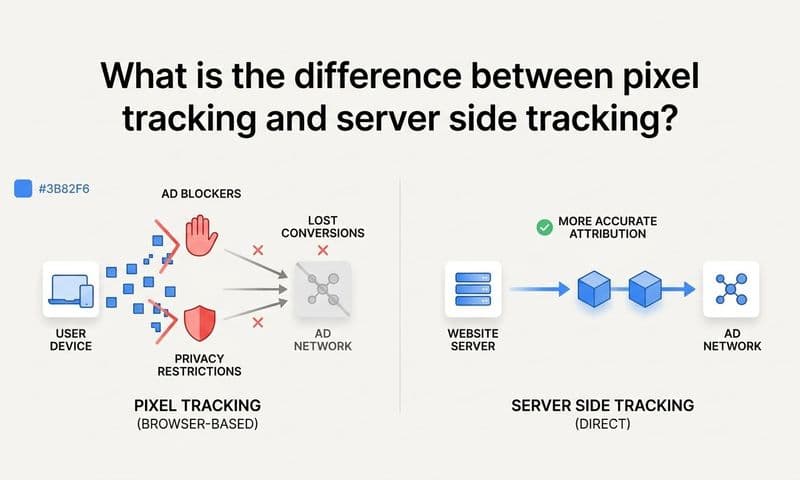
To understand what is breaking, you need to understand what was built. Cookie based tracking operates through a relatively straightforward mechanism. When a user visits a webpage that contains an ad platform pixel, that pixel fires a request to the ad platform's server. In response, the ad platform sets a cookie in the user's browser, a small text file that contains a unique identifier tied to that user's session or profile.
When that same user later completes a conversion action, such as filling out a form or making a purchase, the pixel fires again. This time, it reads the previously stored cookie, matches the unique identifier to the earlier ad interaction, and sends a conversion event back to the platform. The ad platform then credits that conversion to the campaign, ad set, or keyword that drove the original click. That is the core loop of pixel-based attribution.
First-party cookies are set by the domain the user is actually visiting. If you visit a SaaS company's website and that company sets a cookie, that is a first-party cookie. These have generally been viewed as less problematic from a privacy standpoint because they are tied to a direct relationship between the user and the site.
Third-party cookies are fundamentally different. They are set by a domain other than the one the user is visiting, typically an ad platform or tracking network. When you visit Site A and Site B and Site C, and all three contain a Meta pixel, Meta can set and read the same third-party cookie across all three domains. This is what enabled cross-site tracking: the ability to stitch together a user's behavior across multiple websites and build a coherent picture of their journey from initial awareness to conversion.
Persistent third-party cookies became the backbone of retargeting and multi-touch attribution. Unlike session cookies, which expire when the browser closes, persistent cookies remain stored for a defined period, sometimes months or years. This persistence is what allowed ad platforms to recognize a user who clicked an ad on Monday and converted on Friday, or to serve retargeting ads to someone who visited a pricing page two weeks ago. The entire architecture of modern programmatic advertising was built on top of this capability.
The Forces Actively Dismantling Cookie Tracking
The erosion of cookie based tracking is not a single event. It is the cumulative result of several independent forces, each chipping away at the infrastructure from a different direction. Together, they have created a measurement environment that is fundamentally different from the one most tracking setups were designed for.
Safari's Intelligent Tracking Prevention: Apple introduced ITP in Safari starting in 2017, and it has become progressively more aggressive since then. ITP identifies domains that are used for cross-site tracking and restricts or eliminates their ability to set persistent cookies. In many contexts, ITP caps the lifetime of first-party cookies set via JavaScript at seven days, and in some scenarios as low as 24 hours. Since Safari is the dominant browser on iOS and a major browser on macOS, this affects a substantial portion of web traffic. For any user who clicks an ad and then converts more than a week later on Safari, the cookie-based attribution chain is likely already broken.
Firefox Enhanced Tracking Protection: Mozilla's Firefox has had enhanced tracking protection enabled by default for several years, blocking known third-party tracking cookies outright. While Firefox holds a smaller market share than Chrome or Safari, its default-on approach to blocking means that essentially all Firefox users are outside the reach of third-party cookie tracking.
Chrome and Third-Party Cookie Deprecation: Google's approach to third-party cookies in Chrome has gone through an extended and evolving timeline. The direction of travel, however, is clearly toward reduced reliance on third-party cookies. Marketers who are building measurement strategies around the assumption that Chrome will maintain full third-party cookie support indefinitely are taking a significant planning risk. The infrastructure should be built for the direction things are heading, not the temporary status quo.
Apple's App Tracking Transparency: With iOS 14.5, Apple introduced the App Tracking Transparency framework, requiring apps to ask users for explicit permission before tracking them across other apps and websites. This was a structural change to mobile attribution. Opt-in rates across the industry have generally been reported as low, meaning the majority of iOS users are not trackable through traditional pixel-based methods. For ad platforms that relied heavily on mobile signal to inform optimization and attribution, this was a significant loss of data fidelity. Marketers can learn more about iOS link tracking changes and how to prepare for them.
Ad Blockers and Consent Platforms: A meaningful portion of web traffic now flows through ad blockers that strip pixels and tracking scripts before they can fire. Separately, consent management platforms present users with cookie banners, and a significant share of users decline non-essential cookies. Each of these creates systematic blind spots in your pixel data, not random noise but structured gaps tied to specific user behaviors and browser environments.
What Actually Breaks in Your Marketing Data
When cookie based tracking degrades, the downstream effects show up in your reports in ways that are easy to misread. The data does not disappear entirely. It gets distorted, misattributed, or silently dropped, which is in some ways worse than an obvious gap because it creates false confidence.
Attribution gaps and direct traffic inflation: Conversions that happen on Safari or iOS devices, or from users who declined cookie consent, often get attributed to direct traffic in your analytics. The actual source, whether it was a paid LinkedIn campaign or a Google search ad, is lost. Your paid channels look less effective than they are, and direct traffic looks more effective. Budget decisions made on this data are systematically biased.
Retargeting audience shrinkage: Retargeting depends on ad platforms being able to identify users who have visited specific pages or taken specific actions on your site. That identification relies on third-party cookies. As those cookies become unavailable across a growing share of browsers and devices, the retargeting audiences that ad platforms can build shrink. The users you most want to reach, those who have already shown intent, become progressively harder to find and re-engage at scale.
Frequency capping failures: Without a persistent cross-site identifier, ad platforms lose the ability to reliably track how many times a specific user has seen a specific ad. The result is that frequency capping, one of the basic tools for managing ad fatigue and spend efficiency, becomes unreliable. Users may see the same ad far more often than your settings intend, degrading campaign performance and brand perception in ways that do not show up cleanly in your reports.
Conversion deduplication errors: When a user converts and that conversion is captured by both a browser pixel and a server-side event, or across multiple touchpoints, accurate deduplication is essential to avoid inflating your reported conversion numbers. Cookie-based deduplication becomes unreliable when the cookie is absent or expired, which can lead to both over-reporting and under-reporting depending on the specific failure mode. ROAS figures built on these numbers are correspondingly distorted. Understanding how to identify and address conversion tracking gaps is essential for any team relying on paid media data.
View-through attribution degradation: View-through attribution, crediting an ad impression even without a click, depends heavily on persistent cross-site identifiers. As those identifiers become unavailable, view-through attribution windows become unreliable, further fragmenting the picture of what is actually driving conversions.
Why B2B SaaS Teams Feel This More Than Most
Cookie based tracking issues affect all digital advertisers, but B2B SaaS marketing teams face a specific version of this problem that is structurally more damaging than what most B2C teams experience.
The core issue is time. B2B buying cycles are long. A prospect might click a LinkedIn ad in January, visit your pricing page in February, attend a webinar in March, and convert to a trial in April. That is a four-month journey across multiple sessions, devices, and browsers. Cookie expiration windows, which ITP can cap at seven days or less, cannot span that kind of timeline. By the time the conversion happens, the cookie that would have connected it to the original ad click is long gone. The attribution is lost, and the campaign that started the journey gets no credit.
B2B SaaS companies also typically track lead-to-revenue, not just click-to-purchase. The conversion event that matters is not just a form fill. It is the progression from marketing qualified lead to sales qualified lead to opportunity to closed-won revenue. This requires connecting ad platform data to CRM data to revenue data across a chain that can span months. When cookie data breaks early in the funnel, the entire downstream revenue attribution becomes disconnected from the ad spend that generated it. You end up with CRM records that have no clear source, and ad platform reports that show clicks and leads without any visibility into whether those leads ever became customers. Properly tracking closed-won revenue back to its originating campaign is one of the most critical capabilities a B2B marketing team can build.
Audience size compounds the problem further. B2B SaaS companies typically operate with smaller total addressable markets than B2C businesses. When cookie based tracking issues cause attribution loss on even a modest fraction of conversions, the proportional impact on your CAC calculations, pipeline attribution models, and budget allocation decisions is significant. Losing attribution on ten conversions matters far more when your total monthly conversion volume is thirty than when it is three thousand.
Server-Side Tracking and First-Party Data: The Modern Foundation
The solution to cookie based tracking issues is not to find a better cookie. It is to move the tracking infrastructure to a layer that browser restrictions cannot reach: the server.
Server-side tracking works by sending conversion events directly from your server to the ad platform's API, rather than relying on a browser pixel to fire and a cookie to persist. When a user submits a form on your site, instead of waiting for a JavaScript pixel to fire in their browser, your server captures that event and sends it directly to Meta's Conversion API or Google's Enhanced Conversions endpoint. The data never passes through the browser, so ad blockers cannot intercept it, ITP cannot expire the identifier, and consent banner declines do not create a gap in your data. The benefits of server-side tracking extend well beyond privacy resilience, improving data quality and optimization signal across every major ad platform.
Meta's Conversion API (CAPI): Meta's CAPI allows you to send web events, including page views, lead submissions, and purchases, directly from your server to Meta's platform. When CAPI is implemented alongside the browser pixel, Meta can deduplicate events and use the server-side data to fill in gaps where the pixel was blocked or the cookie was expired. Event match quality scores improve when CAPI supplements pixel tracking, which directly improves the quality of Meta's optimization signals and the accuracy of its attribution.
Google Enhanced Conversions: Google's Enhanced Conversions work similarly, allowing you to send hashed first-party data, such as email addresses, directly to Google Ads when a conversion occurs. Google then matches that data against signed-in Google accounts, recovering attribution for conversions that would otherwise be missed due to cookie restrictions or cross-device journeys.
First-party data as a durable foundation: Beyond Conversion APIs, building a first-party data strategy means creating attribution records that do not depend on third-party cookies at any point. This includes capturing UTM parameters server-side and storing them in your CRM at the moment of lead creation, tracking logged-in user behavior through your own identifiers, and syncing CRM data with ad platforms through audience uploads and offline conversion imports. These approaches create a durable chain from ad click to revenue that survives browser restrictions because it is built on data you own and control. A cookieless tracking solution built on these principles is the most future-proof investment a marketing team can make.
Building an Attribution Stack That Survives Cookie Restrictions
Server-side tracking and Conversion API integrations solve the data capture problem. But to actually understand which campaigns, channels, and touchpoints are driving revenue, you need an attribution layer that connects all of that data into a coherent picture.
Relying on any single ad platform's native attribution is insufficient, and not just because of cookie issues. Each platform's native attribution is inherently self-serving: Meta's attribution model credits Meta, Google's credits Google. When you are running campaigns across multiple channels, native attribution from each platform will overcount conversions and make it impossible to understand the true incremental contribution of each channel. You need an independent attribution platform that sits above the individual ad platforms and applies consistent logic across all of them. Reviewing the best marketing attribution software options available is a useful starting point for teams evaluating their measurement stack.
UTM parameters as your first-party tracking backbone: UTMs are passed in the URL at the moment of the click and do not depend on cookies to persist. When you capture UTM parameters server-side at the moment a lead is created and store them in your CRM, you have a durable first-party record of the campaign source for every lead, regardless of what happens to cookies in that user's browser afterward. Consistent UTM tracking strategy across every paid channel is a foundational requirement for any cookie-resilient attribution strategy.
Connecting ad spend to pipeline and revenue: The goal of a modern B2B SaaS attribution stack is to connect every ad dollar to its downstream impact on pipeline and closed revenue. This requires integrating your ad platform data, your CRM data, and your revenue data into a single system that can trace the full journey. When a prospect clicks a LinkedIn ad, becomes a lead, progresses through your pipeline, and closes six months later, your attribution platform should be able to surface that connection and assign appropriate credit to the campaign that started the journey.
Cometly is built specifically for this use case. It connects your ad platforms, CRM, and revenue data into a single attribution view, uses server-side tracking and Conversion API integrations to capture signal that browser pixels miss, and applies multi-touch attribution models to give you an accurate picture of what is actually driving revenue. For B2B SaaS teams dealing with long sales cycles and multi-touch journeys, this kind of end-to-end visibility is not a nice-to-have. It is the foundation of accurate budget decisions.
Putting It All Together
Cookie based tracking is not going to recover. The browser changes, platform updates, and privacy frameworks that have eroded it are not temporary experiments. They reflect a structural shift in how the web handles user data, and that shift is continuing in one direction. The question for B2B SaaS marketing teams is not whether to adapt, but how quickly.
The path forward combines several elements working together. Server-side tracking captures conversion events at a layer that browser restrictions cannot reach. Conversion API integrations with Meta and Google recover signal that pixel-based tracking misses and improve the quality of the data flowing back to ad platform optimization algorithms. First-party data practices, particularly consistent UTM capture stored in your CRM, create a durable attribution record that does not depend on cookies to bridge the gap between ad click and conversion. And a multi-touch attribution platform ties all of these data sources together into a single source of truth that connects ad spend to pipeline and closed revenue.
Each of these elements addresses a different failure mode of cookie based tracking. Together, they create an attribution infrastructure that is resilient to the current environment and built for the direction things are heading, not the environment that existed five years ago.
Cometly brings all of these capabilities into a single platform built specifically for B2B SaaS marketing teams. From server-side event tracking and Conversion API integration to multi-touch attribution and revenue analytics, it is designed to give you accurate, complete attribution data without depending on browser cookies to do the heavy lifting.
If your current attribution setup is built on pixel-based tracking and platform-native reports, the data you are seeing is likely less complete than it appears. The marketers who close that gap now will have a durable measurement advantage over those who wait. Get your free demo and see how Cometly connects every touchpoint from first ad click to closed-won revenue.