
If you've ever stared at your ad platform dashboard and felt like the numbers just don't add up, you're not imagining things. Conversions that you know happened are missing. Cost-per-acquisition figures look inflated. Channels that your sales team swears are generating pipeline appear dead in your attribution reports. The culprit, more often than not, is cookie blocking.
Cookie blocking has quietly become one of the most disruptive forces in digital marketing. It doesn't announce itself. It doesn't throw an error message. It simply erases data, leaving you to make budget decisions based on an incomplete picture of what's actually working.
For B2B SaaS teams running paid campaigns across Google, Meta, LinkedIn, and other channels, this is especially dangerous. Your sales cycles are long. Your touchpoints are many. And every blocked cookie is a gap in the story your attribution data is trying to tell. This article breaks down exactly what cookie blocking is, how it fractures your conversion tracking, and what a modern, resilient tracking strategy looks like in practice.
The Invisible Wall Between Your Ads and Your Data
Let's start with the basics. A cookie is a small piece of data that a website stores in a visitor's browser. When someone clicks your ad and lands on your site, your tracking pixel drops a cookie that records that visit. Later, when that person converts, the pixel reads the cookie to connect the conversion back to the original ad click. Simple in theory. Increasingly broken in practice.
Cookie blocking refers to any mechanism, whether at the browser level, the operating system level, or through user-installed tools, that prevents cookies from being stored or read. The result is that the handoff between an ad click and a conversion event never completes. The data disappears before it ever reaches your ad platform.
There are three primary sources of cookie blocking that marketers face today.
Browser-level restrictions: Safari's Intelligent Tracking Prevention (ITP) and Firefox's Enhanced Tracking Protection (ETP) have progressively tightened the rules around cross-site tracking. ITP, in particular, has shortened the lifespan of third-party cookies dramatically and limits the ability of trackers to follow users across domains. Because Safari is the dominant mobile browser on iOS devices, a large portion of your traffic is already subject to these restrictions.
User-installed ad blockers: Browser extensions like uBlock Origin and AdBlock Plus actively prevent tracking scripts from loading. These tools are widely used, particularly among the technically sophisticated audiences that many B2B SaaS companies are trying to reach. If your ideal customer is a developer or a growth-minded marketer, there's a reasonable chance they're running an ad blocker.
Operating system privacy controls: Apple's App Tracking Transparency framework requires apps on iOS to request explicit permission before tracking users across other apps and websites. Most users decline. This means that a meaningful segment of mobile traffic generates no usable tracking data for ad platforms at all.
Understanding the distinction between first-party and third-party cookies is essential here. A first-party cookie is set by the domain you're visiting directly. A third-party cookie is set by a different domain, typically an ad platform's tracking script running on your site. Browser restrictions and ad blockers overwhelmingly target third-party cookies, and third-party cookies are precisely what power the pixel-based conversion tracking that most ad platforms rely on. That's the core of the problem.
How Cookie Blocking Fractures Your Conversion Funnel
To understand how cookie blocking breaks your tracking, it helps to walk through how pixel-based conversion tracking is supposed to work. When a user clicks your Google or Meta ad, the platform appends a click identifier to the destination URL. Your tracking pixel, loaded in the browser when the user lands on your site, reads that identifier and stores it as a cookie. When the user later completes a conversion action, the pixel fires again, reads the stored cookie, and sends the conversion event back to the ad platform, which matches it to the original click.
Cookie blocking intercepts this flow at multiple points. If the pixel script is blocked by an ad blocker, it never loads, and no cookie is stored. If ITP has shortened the cookie's lifespan, it may have expired before the conversion occurs, which is a real problem for B2B SaaS companies where the path from click to conversion can span days or weeks. If the user switches devices or browsers, the cookie doesn't transfer, and the connection is lost entirely.
The downstream impact on attribution is significant. When the ad platform cannot match a conversion to a click, that conversion goes unrecorded in your campaign data. Your conversion volume looks lower than it actually is. Your cost-per-acquisition looks higher than it actually is. And the return on ad spend figures you're using to make budget decisions are built on an incomplete dataset.
Here's where the problem compounds. Modern ad platforms rely heavily on machine learning to optimize campaign delivery. Meta's algorithm, for example, uses conversion signals to identify which users are most likely to convert and serves ads accordingly. When cookie blocking strips away a portion of those conversion signals, the algorithm is learning from bad data. It optimizes toward the signals it can see, which are increasingly skewed toward users in environments with less privacy protection, rather than toward your actual best customers. Over time, this degrades campaign performance in ways that are difficult to diagnose without understanding the root cause.
The result is a feedback loop that quietly erodes your paid media efficiency. You see underperforming campaigns, reduce budget, and shift spend toward channels that appear to be working, not realizing that the channels you're cutting may be generating conversions that simply aren't being tracked.
What Your Attribution Reports Are Not Telling You
The data gaps created by cookie blocking don't just affect raw conversion counts. They distort the entire attribution picture, and the distortion is often invisible unless you know what to look for.
In a last-click attribution model, the final touchpoint before a conversion gets all the credit. When cookie blocking erases earlier touchpoints in the journey, the last touchpoint that happened to be tracked gets credited for a conversion it may not have driven alone. Channels that operate higher in the funnel, like awareness-stage display ads or LinkedIn campaigns, are particularly vulnerable to being undercounted because their touchpoints are more likely to occur in sessions where cookies are blocked or have expired.
Multi-touch attribution models are supposed to solve this by distributing credit across the full customer journey. But they depend on actually recording that full journey. When cookie blocking removes touchpoints from the record, multi-touch models assign credit to an incomplete sequence. The result is that channels which appear to be underperforming may actually be contributing meaningfully to pipeline, but their contribution is invisible because the cookie data that would have recorded their touchpoints was never captured.
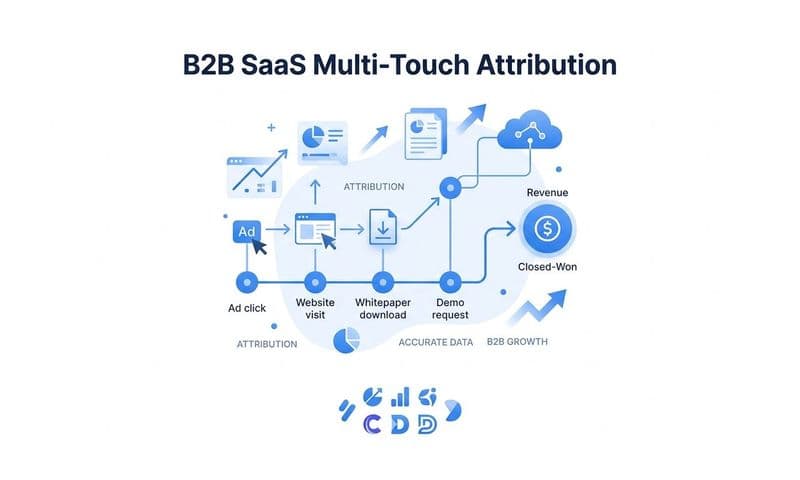
B2B SaaS companies are especially exposed to this problem. A typical enterprise SaaS deal might involve a prospect interacting with your brand across multiple channels over weeks or months before converting. Each of those touchpoints represents an opportunity for cookie blocking to erase part of the record. The longer the sales cycle, the more touchpoints there are, and the higher the probability that at least one of them will be lost to a browser restriction or an expired cookie.
The budget implications are real. If your LinkedIn campaigns appear to generate few conversions because their touchpoints are consistently blocked by privacy-conscious users, you might reduce spend on LinkedIn. But if those touchpoints were actually initiating journeys that eventually converted through other channels, you've just cut a high-value top-of-funnel driver based on data that was never accurate to begin with. Cookie blocking doesn't just hide conversions. It actively misleads the decisions you make with your budget.
Server-Side Tracking: The Modern Fix for Cookie Blocking
The most effective response to cookie blocking is to move conversion data off the browser and onto your server. This is the core principle behind server-side tracking and Conversion APIs.
With a traditional pixel setup, conversion events are captured and transmitted by JavaScript running in the user's browser. That's exactly the environment where cookie blocking operates. Server-side tracking bypasses the browser entirely. Instead of relying on a pixel to fire in the user's browser, your server captures the conversion event and sends it directly to the ad platform via an API. Browser restrictions, ad blockers, and ITP have no effect on a server-to-server data transfer.
Meta's Conversions API (CAPI) and Google's Enhanced Conversions are the two most widely used implementations of this approach. Both allow you to send conversion event data from your server to the respective ad platform, supplementing or replacing the data that would have been captured by a browser pixel. Because the data travels from your server rather than through the user's browser, it arrives reliably regardless of what privacy tools the user has installed. For a step-by-step walkthrough, the Conversion API implementation tutorial covers exactly how to set this up for Meta campaigns.
First-party data collection works in a similar direction. When your own domain captures and stores user event data, that data is classified as first-party data and is not subject to third-party cookie restrictions. Building a first-party data layer, where your site records user interactions under your own domain and stores identifiers in first-party cookies, creates a more durable foundation for tracking that browsers are far less likely to restrict.
It's worth being clear about how server-side tracking fits into your existing setup. It doesn't replace your browser pixel. It layers on top of it. The pixel continues to capture what it can, and the server-side implementation fills in the gaps for events the pixel missed. This redundancy is the point. When both systems record the same event, you use deduplication logic to ensure it's counted once. When only the server-side system records an event because the pixel was blocked, you still have the data you need.
The practical result is a more complete conversion dataset feeding back into your ad platform's optimization algorithms, better campaign performance, and attribution data that actually reflects what's happening in your funnel.
Building a Cookie-Resilient Attribution Stack
Server-side tracking is a critical piece of the puzzle, but a truly resilient attribution strategy requires more than a single technical fix. It requires rethinking the entire stack of data sources that your attribution depends on.
Server-side event tracking: As described above, this is your first line of defense against browser-based data loss. Implementing Meta CAPI and Google Enhanced Conversions ensures that conversion events reach ad platforms even when browser pixels fail.
UTM parameter consistency: UTM parameters travel in the URL, not in cookies. When a user clicks an ad and lands on your site, the UTM parameters in that URL tell you the source, medium, campaign, and other details of that click. If you capture and store those parameters server-side or in your CRM at the point of form submission or sign-up, you retain attribution data that survives cookie blocking entirely. Consistent UTM tagging across every paid channel is a foundational practice that many teams underinvest in.
CRM data integration: Your CRM contains a record of every lead, opportunity, and closed deal. When you connect your CRM data to your ad platform data, you create an attribution layer that doesn't depend on cookies at all. If a lead was created from a form submission that captured UTM parameters, and that lead eventually became a closed-won opportunity in your CRM, you can trace that revenue back to the originating campaign without relying on any cookie-based tracking.
First-party identity resolution: When a user provides their email address, whether through a form, a sign-up, or a login, you have a first-party identifier that can be used to match that user's behavior across sessions and devices. Hashed email matching, used by both Meta and Google, allows you to send conversion events tied to email addresses rather than cookies, creating a more durable connection between ad interactions and conversion outcomes.
This is exactly where Cometly fits into the picture. Rather than asking your team to stitch together these data streams manually, Cometly unifies them in a single platform. It captures touchpoints from the first ad click through CRM events, connects ad spend data directly to pipeline and revenue, and gives you a complete view of the customer journey without depending on fragile third-party cookies. With more than 70 native integrations and built-in support for server-side conversion tracking, Cometly provides the kind of attribution infrastructure that B2B SaaS teams need to make confident budget decisions in a privacy-first world.
Tracking That Survives the Cookie Era
The shift away from browser-dependent pixel tracking isn't a future concern. It's already underway, and the marketers who adapt now will have a significant advantage over those who wait until their attribution data becomes too unreliable to act on.
The core change is straightforward: move from a tracking strategy that depends on third-party cookies stored in the browser to one that captures conversion data at the server level, stores first-party identifiers under your own domain, and connects ad platform data to CRM pipeline and revenue records. This approach is not only more resilient to cookie blocking, it's also more accurate. Server-side data doesn't suffer from the sampling errors and cookie expiration issues that plague pixel-based tracking.
Accurate conversion tracking is not just a technical concern. It's a revenue concern. When your attribution data is distorted by cookie blocking, the budget decisions you make based on that data are also distorted. Channels get cut that shouldn't be cut. Spend gets shifted toward campaigns that appear to perform well simply because their audience is less likely to use privacy tools. The compounding effect of these bad decisions can be substantial over time.
The good news is that the tools to fix this exist today. Server-side tracking, Conversion APIs, CRM integration, and first-party data strategies are all available and implementable. The question is whether your current attribution stack takes advantage of them.
If you're ready to move beyond cookie-dependent tracking and get a true picture of which ads and channels are driving your pipeline and revenue, Get your free demo of Cometly today. See how it connects every touchpoint from the first ad click to closed-won revenue and gives your team the single source of truth it needs to scale with confidence.