
Most growth teams are not losing deals because they lack budget. They are losing ground because they cannot see clearly which parts of their acquisition engine are actually working. You might be running paid search, social ads, content, and outbound simultaneously, yet when a deal closes, the question of what actually drove that customer through the door remains frustratingly unanswered.
This is the core problem that customer acquisition analytics is designed to solve. It is not just about collecting more data. It is about connecting the right data points across the entire acquisition journey, from the first ad impression a prospect ever sees to the moment they sign a contract, so your team can make decisions based on evidence rather than assumption.
For B2B SaaS companies specifically, this challenge runs deeper than it does for most businesses. Sales cycles stretch across weeks or months. Multiple stakeholders touch the same deal. Prospects move between channels, go dark, and re-engage before they ever talk to sales. In that environment, a simple last-click report or a dashboard full of click-through rates tells you almost nothing useful about where to invest your next dollar.
This article breaks down how customer acquisition analytics works, which metrics and models actually reflect acquisition performance, how to build the tracking infrastructure that makes reliable data possible, and how to translate that data into confident scaling decisions. By the end, you will have a clear framework for turning acquisition data into a genuine competitive advantage.
The Building Blocks of Customer Acquisition Analytics
Customer acquisition analytics is the systematic process of collecting, measuring, and interpreting data across every stage of the acquisition funnel, from the first ad impression to a closed deal. It is not a single tool or report. It is a discipline that requires connecting multiple data sources into a coherent picture of how your marketing activity translates into business outcomes.
The foundation rests on four core data inputs, and the accuracy of your analysis depends on how well you connect all four.
Ad platform events: This includes impressions, clicks, and spend data from channels like Google Ads, Meta, LinkedIn, and others. These events tell you what your campaigns are doing at the top of the funnel, but they stop at the click. What happens after someone lands on your site is invisible to the ad platform unless you send that data back.
Website behavior: Page visits, form submissions, demo requests, and scroll depth give you a view of how prospects engage with your content and convert into leads. This layer bridges the gap between ad activity and CRM entry, but it is only meaningful when tied to the channels that drove the traffic.
CRM pipeline stages: This is where most B2B SaaS teams have their richest data and their biggest attribution blind spot. Your CRM knows which leads became opportunities, which opportunities moved through stages, and which deals closed. But without a link back to the marketing touchpoints that sourced those leads, that data sits in isolation.
Revenue data: Connecting actual contract value or subscription revenue to acquisition sources is the final step that transforms marketing analytics into a business intelligence function. When you can see that a specific campaign or channel contributed to a certain volume of closed revenue, you have the basis for real budget decisions.
This is where customer acquisition analytics diverges sharply from general web analytics. Tools that track sessions, bounce rates, and page views are useful for understanding content performance, but they do not tell you which channels are generating pipeline and revenue. Customer acquisition analytics ties marketing activity to business outcomes, not just digital behavior. That distinction matters enormously when you are deciding where to spend your next quarter's budget.
The goal is a connected data layer where an ad click in Google Ads can be traced through a website session, a CRM lead, a sales opportunity, and ultimately a closed deal. Without that connectivity, every budget decision is a educated guess at best.
Key Metrics That Actually Reflect Acquisition Performance
Not all metrics are created equal. In B2B SaaS acquisition, the metrics that look impressive in a weekly report are often the ones that matter least for strategic decisions. Understanding which numbers actually reflect acquisition performance is one of the most important skills a growth team can develop.
The metrics that consistently matter most fall into a few categories.
Customer Acquisition Cost (CAC): This is calculated by dividing total sales and marketing spend over a given period by the number of new customers acquired in that same period. CAC gives you a baseline cost efficiency number, but it becomes far more powerful when calculated at the channel level. A channel with a low lead volume but a low CAC and high average contract value can outperform a high-volume channel with poor conversion quality.
CAC Payback Period: This metric measures how many months of revenue are required to recover the cost of acquiring a customer. For B2B SaaS companies, payback period is a critical indicator of capital efficiency. A shorter payback period means your acquisition spend is generating returns faster, which directly affects how aggressively you can reinvest in growth.
Lead-to-Close Rate by Channel: Not all leads are equal. A channel that generates a high volume of leads but converts poorly through the pipeline is consuming sales resources without producing proportional revenue. Tracking lead-to-close rate at the channel level surfaces these efficiency differences and helps you direct sales attention toward the sources that produce the best-quality pipeline.
Pipeline Contribution by Source: This measures the total value of open and closed deals that can be attributed to each marketing channel. It answers the question that CAC alone cannot: which channels are generating the largest and most valuable opportunities, not just the cheapest leads?
Here is where vanity metrics become genuinely dangerous. Impressions, click-through rates, and even cost-per-click can look strong while your actual pipeline contribution from a channel is weak. A campaign can drive thousands of clicks at a low cost-per-click while generating zero qualified pipeline. If your reporting stops at the click, you will never see that disconnect.
Channel-level ROI brings these threads together by comparing ad spend against pipeline value, not lead volume. This framing shifts the conversation from "which channel is cheapest" to "which channel produces the most revenue per dollar spent." For B2B SaaS teams managing complex multi-channel programs, that distinction is the difference between optimizing for efficiency and optimizing for growth.
The practical challenge is that calculating these metrics accurately requires the connected data layer described in the previous section. CAC payback period is meaningless without revenue data tied to acquisition source. Pipeline contribution by channel requires your CRM and ad platforms to speak the same language. This is why the infrastructure question is not a technical afterthought. It is central to the entire analytics function. Understanding how to calculate customer acquisition cost correctly at the channel level is one of the highest-leverage analytical skills a growth team can develop.
How Attribution Models Shape What Your Data Tells You
Attribution models are the rules that determine how credit for a conversion gets distributed across the touchpoints in a customer's journey. The model you choose does not just affect your reports. It directly shapes which channels look effective, which campaigns get budget, and ultimately how your acquisition strategy evolves over time.
Understanding the major models helps you choose the right one for your context and avoid the trap of making budget decisions based on a model that systematically misrepresents your channel mix.
First-touch attribution: All credit goes to the first interaction a prospect had with your brand. This model is useful for understanding which channels are best at generating initial awareness, but it ignores everything that happened between that first touch and the eventual conversion. In a long B2B sales cycle, the first touch may have occurred months before the deal closed.
Last-click attribution: All credit goes to the final touchpoint before conversion. This model tends to overvalue bottom-funnel channels like branded search or direct traffic, which often capture intent that was built by earlier touchpoints. It is the default in many ad platforms and the source of significant misallocation in B2B marketing budgets.
Linear attribution: Credit is distributed equally across all touchpoints in the conversion path. This approach acknowledges that multiple interactions contributed to the outcome, but it treats every touchpoint as equally influential, which rarely reflects reality. A quick retargeting click and a detailed product demo attended weeks earlier are not equivalent in their impact on the decision.
Data-driven attribution: This model uses machine learning to assign fractional credit based on observed patterns in actual conversion paths. Rather than applying a fixed rule, it learns which combinations of touchpoints are statistically associated with conversion and weights credit accordingly. It is the most accurate approach available, but it requires sufficient conversion volume to produce statistically reliable results.
The B2B SaaS context makes model selection especially consequential. Buyers in this space typically interact with multiple channels over an extended evaluation period. A prospect might discover your product through a LinkedIn ad, read three blog posts over two weeks, attend a webinar, click a retargeting ad, and then convert through a branded search. Under last-click attribution, the branded search gets all the credit. Under first-touch, the LinkedIn ad does. Under data-driven attribution, each touchpoint receives credit proportional to its actual contribution to the outcome.
One of the most valuable practices for growth teams is model comparison. Running the same conversion data through multiple attribution models simultaneously reveals which channels look strong under every model and which ones only appear effective because of model bias. If a channel looks good under last-click but disappears under first-touch or linear, that is a signal worth investigating before you scale spend into it. Teams navigating these decisions often find it helpful to review customer acquisition attribution frameworks that account for the full complexity of multi-touch B2B journeys.
The natural question becomes: which model should you default to? For most B2B SaaS teams, multi-touch models provide a more honest view of channel contribution than single-touch alternatives. Data-driven attribution is the gold standard when you have the conversion volume to support it. The key is to never let a single model define your entire budget strategy without stress-testing those conclusions against alternative views of the same data.
The Tracking Infrastructure Behind Reliable Acquisition Data
Even the best attribution model is only as good as the data feeding it. And for many B2B SaaS teams, the data feeding their attribution reports is significantly less complete than they realize. The gap between what actually happened in a customer's journey and what your analytics tools recorded has widened considerably over the past few years.
Browser-based pixel tracking, which was the dominant method for capturing conversion events for over a decade, now produces incomplete data in most environments. Ad blockers prevent pixels from firing. Safari's Intelligent Tracking Prevention and Firefox's Enhanced Tracking Protection restrict cookie-based attribution. Apple's App Tracking Transparency framework has reduced the signal available to mobile ad platforms. The result is that a meaningful portion of conversion events simply go unrecorded when you rely exclusively on browser-side tracking.
Server-side tracking addresses this gap by moving event collection from the browser to your own server infrastructure. Instead of relying on a JavaScript pixel firing in a user's browser, your server captures the conversion event and sends it directly to the analytics or ad platform. Because this process happens server-to-server rather than browser-to-platform, it is not affected by ad blockers or browser privacy restrictions. A detailed comparison of Google Analytics vs server-side tracking illustrates exactly why this architectural shift matters for data completeness.
Conversion APIs extend this principle to the ad platforms themselves. Meta's Conversion API (CAPI) and Google's Enhanced Conversions allow you to send first-party event data directly from your server to the ad platform, bypassing the browser entirely. This restores the conversion signal that ad platforms need to optimize their delivery algorithms. When Meta or Google receives richer, more complete conversion data, their machine learning models can do a better job of finding and targeting users who are likely to convert, which improves campaign efficiency over time.
Two operational details are critical for keeping this data clean and trustworthy.
Event deduplication: When you run both browser-side pixels and server-side tracking simultaneously (which is often recommended for redundancy), the same conversion event can be recorded twice. Deduplication logic, typically using a unique event ID, ensures that each conversion is counted once regardless of how many times it was captured.
UTM parameter structure: Consistent UTM tagging across every paid channel is what allows you to connect ad platform data to website behavior and CRM records. If your UTM conventions are inconsistent, the same channel can appear under multiple names in your analytics, fragmenting the data and making accurate attribution impossible. Establishing and enforcing a standard UTM taxonomy across your team is one of the highest-leverage operational improvements a growth team can make.
The infrastructure layer is not glamorous, but it is the foundation on which every other part of your customer acquisition analytics function rests. Without reliable data collection, your attribution models are working with incomplete information, your CAC calculations are understated, and your scaling decisions are built on a shaky base. Teams dealing with missing conversion data in Google Analytics often discover that infrastructure gaps are the root cause.
Turning Acquisition Data Into Scaling Decisions
Collecting and attributing acquisition data is only valuable if it changes how you act. The real payoff of a well-built customer acquisition analytics function is the ability to make budget and strategy decisions with confidence rather than relying on intuition or whoever argues most convincingly in a planning meeting.
The practical workflow starts with channel and campaign performance review using attribution data. Instead of looking at cost-per-click or lead volume in isolation, you are examining pipeline contribution, CAC, and lead-to-close rates by source. This view surfaces the channels that are generating revenue efficiently and exposes the ones that look busy but contribute little to actual growth. From there, budget reallocation decisions have a factual basis rather than a hypothetical one.
Here is where it gets interesting. The relationship between your acquisition data and your ad platform performance is not one-directional. When you send enriched, server-side conversion data back to Meta and Google, you are not just improving your own reporting. You are feeding their optimization algorithms with better information. Ad platforms use conversion signals to train their delivery models. When those signals are complete and accurate, the platform can identify higher-quality audiences and optimize toward the outcomes that actually matter to your business, such as pipeline creation or revenue, rather than surface-level engagement metrics.
This creates a compounding effect. Better data into the ad platform produces better targeting. Better targeting produces higher-quality leads. Higher-quality leads improve your lead-to-close rate. And the resulting conversion data, when sent back to the platform, further improves the model. Teams that invest in this feedback loop often find that their acquisition costs decrease over time even as they scale spend, because the platform is getting smarter about where to find their best customers.
AI-driven recommendations add another layer on top of this foundation. When attribution data is aggregated across campaigns, channels, and time periods, patterns emerge that are difficult to identify through manual analysis. An AI layer can surface insights like which creative formats consistently drive pipeline across multiple channels, which audience segments have the shortest CAC payback periods, or which campaigns are showing early signals of fatigue before performance visibly declines. These recommendations allow growth teams to act faster on performance signals and spend less time digging through dashboards to find the insight buried in the data.
The teams that scale most efficiently are not the ones with the largest budgets. They are the ones with the clearest view of what their budget is actually producing, and the operational discipline to act on that view quickly and consistently. Understanding how data analytics can improve marketing strategy is what separates teams that grow predictably from those that rely on guesswork.
Putting Customer Acquisition Analytics Into Practice With Cometly
Understanding the framework for customer acquisition analytics is one thing. Having the infrastructure to execute it across a complex B2B SaaS acquisition program is another. This is where the right platform makes a significant operational difference.
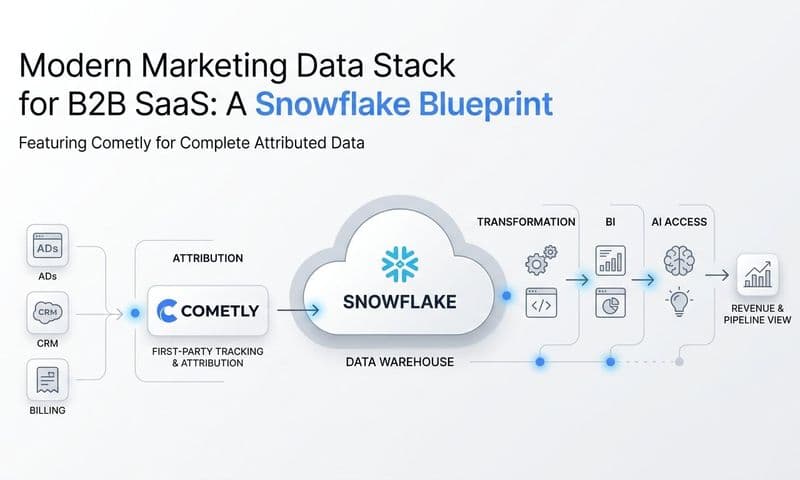
Cometly is built specifically for this use case. It connects your ad platforms, CRM data, and website events into a single attribution view, giving your team a complete picture of the customer journey from the first ad click to closed revenue. Rather than stitching together data from separate ad dashboards, CRM exports, and spreadsheets, your team works from a single source of truth that reflects the entire acquisition funnel in real time.
The platform supports multi-touch attribution across more than 70 native integrations, which means you can track and compare channel performance whether your acquisition mix includes paid search, social, email, organic, or any combination of channels. Attribution model comparison is built in, so you can stress-test your channel assumptions by viewing the same conversion data through multiple models before making budget decisions.
On the tracking infrastructure side, Cometly's server-side conversion tracking and Conversion API integration address the signal loss problems that degrade browser-based tracking. First-party event data is sent directly from the server to Meta, Google, and other ad platforms, restoring the conversion signals those platforms need to optimize effectively. This directly improves the performance of your campaigns by giving ad platform algorithms better data to work with.
Cometly's Stripe revenue integration connects subscription and contract data directly to your ad attribution, so you can see which campaigns and channels are driving actual revenue, not just leads or pipeline. This closes the loop between marketing activity and business outcomes in a way that most analytics setups cannot achieve without significant custom engineering.
The AI-powered campaign recommendations layer surfaces patterns across your acquisition data that would take hours to find manually. Cometly's AI analyzes performance signals across every channel and campaign, then surfaces actionable recommendations so your team can act on what the data is telling you rather than spending time trying to find the signal in the noise.
For growth teams that have been managing acquisition across fragmented tools and disconnected reports, Cometly replaces that complexity with clarity. Every touchpoint is captured, every channel is measured against revenue, and every budget decision has a data foundation behind it.
The Bottom Line on Acquisition Analytics
Customer acquisition analytics is not a reporting exercise you run at the end of the quarter to justify what you already spent. It is a strategic capability that determines how efficiently your B2B SaaS company can grow. The teams that build this capability well gain a compounding advantage: better data produces better decisions, better decisions produce better results, and better results generate more data to learn from.
The progression from raw data to confident scaling decisions follows a clear path. You start by connecting the four core data inputs: ad platform events, website behavior, CRM pipeline stages, and revenue data. You build the tracking infrastructure to make that data reliable and complete. You apply attribution models that reflect the complexity of your buyers' journeys rather than oversimplifying them. You measure the metrics that connect marketing activity to business outcomes. And you feed enriched conversion data back into the systems that use it to optimize on your behalf.
Each layer builds on the one before it. Skip the infrastructure step and your attribution data is incomplete. Skip the attribution step and your metrics are misleading. Skip the metrics step and your scaling decisions are guesswork. The discipline of customer acquisition analytics is about doing all of these things together, consistently, so that growth becomes a repeatable process rather than a series of expensive experiments.
If your team is ready to move from fragmented reporting to a clear, connected view of what is actually driving revenue, Cometly gives you the platform to do it. Get your free demo today and see how real-time, AI-driven acquisition analytics can change the way your team makes growth decisions.