Most B2B SaaS companies pour significant budget into ads and campaigns without a clear picture of how prospects actually move from first touch to closed deal. The result is wasted spend, misaligned messaging, and attribution gaps that make it nearly impossible to know what is working. Customer journey design fixes that problem at the root.
Customer journey design is the deliberate process of mapping, building, and optimizing every touchpoint a prospect encounters before they become a paying customer. When done well, it transforms guesswork into a repeatable, data-backed growth system that your entire marketing and sales team can operate from.
The challenge for most B2B SaaS marketers is that the journey is genuinely complex. Buyers interact with multiple channels, consume content across weeks or months, and involve several stakeholders before signing a contract. A single last-click attribution model cannot capture that reality, and a generic funnel template will not reflect how your specific buyers actually behave.
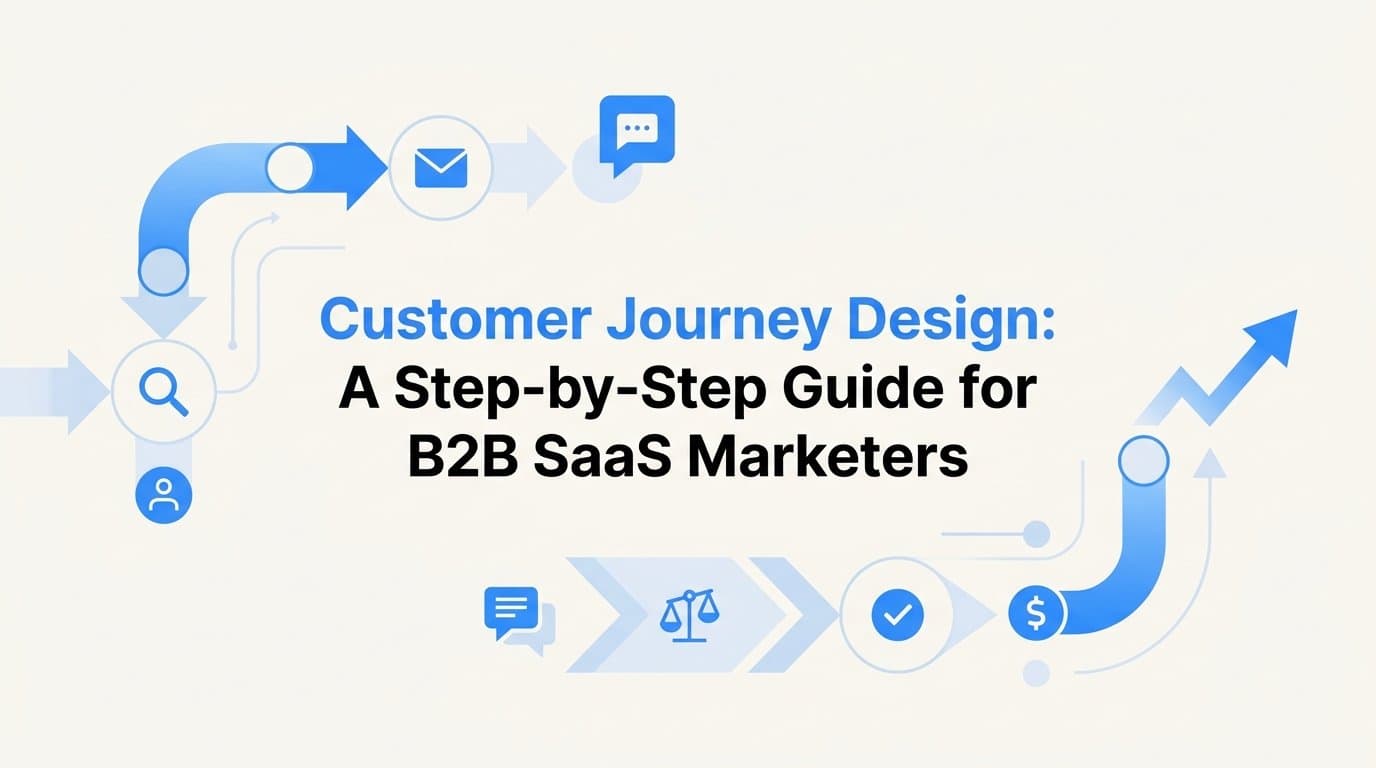
This guide walks you through a practical, seven-step process for designing a customer journey grounded in real data. You will learn how to define your buyer stages, audit your existing channels, instrument your tracking before you build anything, design stage-specific content and ad sequences, apply the right attribution model, analyze where prospects are dropping off, and continuously optimize using attribution insights.
Whether you are starting from scratch or auditing an existing funnel, these steps give you a clear framework to follow. By the end, you will have a structured customer journey that connects your marketing activity directly to pipeline and revenue, so you can make smarter decisions about where to invest and where to cut.
Step 1: Define Your Buyer Stages and Personas
Before you design anything, you need to understand who you are designing for and what they are thinking at each point in the journey. This sounds obvious, but it is the step most teams rush past, and it is the reason so many funnels produce generic experiences that resonate with no one.
Start by mapping the distinct stages a B2B buyer moves through. The most practical framework for SaaS companies covers five stages: awareness, consideration, evaluation, decision, and post-purchase. Each stage represents a fundamentally different mindset, and your messaging, content, and channels need to reflect that difference.
Awareness: The prospect recognizes a problem but may not yet know solutions like yours exist. Their primary questions are diagnostic. They are asking "why is this happening?" not "which vendor should I choose?"
Consideration: The prospect is actively researching solutions and comparing categories. They want to understand how different approaches work and which might fit their situation.
Evaluation: The prospect has shortlisted vendors and is pressure-testing each one. They are looking for proof, specifics, and reasons to trust you over the competition.
Decision: The prospect is ready to buy but needs internal justification, pricing clarity, or a final nudge to commit.
Post-purchase: The customer needs to see value quickly to reduce churn risk and become a candidate for expansion or referral.
Once you have the stages defined, build persona profiles for each major buyer type. The key here is to base these on real CRM data and direct input from your sales team, not assumptions. Pull your closed-won deals from the last twelve months and look for patterns: job titles, company sizes, industries, and the specific pain points that drove the purchase. Interview your account executives about the objections they hear most often at each stage. This is where your personas become genuinely useful rather than decorative.
Define what a qualified lead looks like at each stage so marketing and sales share the same language. A marketing qualified lead at the awareness stage looks very different from a sales accepted lead at the evaluation stage. Without this alignment, leads get passed too early, deals stall, and both teams blame each other.
Your success indicator for this step: you can clearly articulate what a prospect needs to see, hear, or experience to advance from one stage to the next. If you cannot answer that question for each transition, your personas need more work.
Step 2: Audit Your Existing Touchpoints and Channels
Now that you know your buyer stages and personas, the next step is to take honest stock of what you are currently doing. Most B2B SaaS companies have more touchpoints than they realize, but they are often concentrated at one or two stages while leaving critical gaps elsewhere.
Start by listing every channel currently in use: paid search, paid social, organic search, email nurture, content marketing, review sites, webinars, direct outreach, and any partner or affiliate channels. Be exhaustive here. You cannot audit what you have not acknowledged.
Next, build a touchpoint matrix. Create a simple grid with your buyer stages across the top and your channels down the side. For each cell, note whether you have active activity at that intersection. What you will typically find is a heavy concentration at the top of the funnel and at the decision stage, with a thin middle that leaves prospects without support during the consideration and evaluation phases. That gap is where deals go quiet.
Review your current content inventory and map each asset to a specific stage and persona. A blog post about industry trends belongs at awareness. A feature comparison page belongs at consideration. A detailed demo video belongs at evaluation. If you cannot confidently place a piece of content on your matrix, it is probably not targeted enough to be effective.
Look for channel overlap or redundancy that may be creating a fragmented experience. If you are running five different paid social campaigns with inconsistent messaging, prospects who see multiple ads will get a confused picture of your brand. Consolidating and sequencing those touchpoints is often more valuable than adding new ones.
Assess whether your ad creative and landing page messaging match the intent of the buyer at each stage. An awareness-stage ad that drives to a "Request a Demo" page is asking for too much commitment too soon. That friction kills conversion rates and wastes your top-of-funnel budget.
Your success indicator: a completed touchpoint matrix showing which channels are active at each stage and, more importantly, where the gaps are. That matrix becomes your design brief for the next steps.
Step 3: Instrument Your Tracking Before You Build
Here is where most teams make a costly mistake. They design the journey, launch the campaigns, and then try to figure out how to measure it afterward. By that point, they have already spent budget without the data to validate whether any of it is working.
Tracking infrastructure needs to come before content, before ads, and before any new touchpoints go live. This is non-negotiable.
Set up server-side conversion tracking as your foundation. Browser-based pixel tracking has become significantly less reliable due to ad blockers, browser privacy updates, and iOS changes. Server-side tracking sends conversion events directly from your server to ad platforms, bypassing these limitations and giving you more accurate, durable data.
Implement Conversion API integrations for Meta and Google. These integrations ensure that first-party data flows correctly from your website and CRM to the ad platforms, improving match rates and giving their machine learning algorithms better signals to optimize against. Without this, you are likely underreporting conversions and leaving optimization potential on the table.
Define the specific conversion events that matter at each buyer stage. At awareness, you might track content downloads or blog engagement. At consideration, newsletter signups or webinar registrations. At evaluation, demo requests or free trial signups. At decision, closed-won revenue. Each of these events tells a different part of the story, and you need all of them firing accurately to see the full picture.
Connect your CRM data to your ad platforms so offline conversions are attributed back to the original source. When a deal closes six weeks after the first ad click, that revenue needs to flow back to the campaign that started the journey. Without CRM integration, you are optimizing for lead volume rather than revenue quality, which often means scaling the wrong channels.
Integrate your billing system, such as Stripe, with your attribution platform to tie ad spend directly to revenue. This is the connection that lets you answer the question leadership always asks: what is the return on our marketing investment? Platforms like Cometly make this integration straightforward, pulling your revenue data alongside your ad data so you can see true ROI by channel and campaign.
Your success indicator: every key conversion event is firing, deduplicated, and visible in your attribution dashboard. Run a test conversion for each event and verify it appears correctly before moving forward.
Step 4: Design the Content and Ad Sequence for Each Stage
With your buyer stages defined, your touchpoint gaps identified, and your tracking in place, you are ready to design the actual journey. This step is about creating stage-specific content and ad sequences that meet buyers where they are and guide them forward.
The core principle is simple: match the content to the buyer's primary question at that moment. Sending bottom-of-funnel offers to cold audiences who are not ready to buy is one of the most common and expensive mistakes in B2B SaaS marketing. It creates friction, drives up cost per acquisition, and trains your ad platform algorithms on low-quality conversion signals.
Awareness stage: Focus on educational content and thought leadership that introduces the problem your product solves. Broad targeting ads work well here because you are casting a wide net to find prospects who fit your ICP but do not yet know you. Think blog posts, short-form video, and industry-focused social content that speaks to pain points without pitching your product.
Consideration stage: Shift to comparison content, feature breakdowns, and retargeting ads that position your solution. Prospects at this stage are evaluating categories and approaches. Content that helps them understand why your approach is better than alternatives, without being overtly salesy, builds trust and keeps you in the conversation.
Evaluation stage: This is where social proof and specificity matter most. Use case study content, demo invitations, and high-intent ads targeting bottom-of-funnel keywords. Prospects here are pressure-testing you against competitors, so your content needs to answer their hardest questions directly. If you do not have strong case study content, this is the gap that most often stalls deals.
Decision stage: Focus on removing the final barriers to purchase. Sales enablement materials, ROI calculators, and personalized outreach sequences all serve this purpose. The goal is to make it easy for the champion inside the prospect's organization to justify the purchase internally.
Throughout all stages, align your ad creative with your landing page messaging. When a prospect clicks an ad about a specific pain point and lands on a generic homepage, the disconnect creates friction and increases bounce rates. Every ad should connect to a landing page that continues the exact conversation the ad started.
Your success indicator: each stage has at least one content asset and one channel strategy mapped to it. You should be able to trace a clear path from the first touchpoint to the final conversion for your primary buyer persona.
Step 5: Choose and Apply an Attribution Model
Once your journey is designed and your tracking is live, you need to decide how you will assign credit to the touchpoints that contribute to a conversion. This decision shapes every budget allocation and optimization decision you make going forward, so it is worth understanding the options clearly.
First-touch attribution assigns all credit to the first channel or campaign a prospect interacted with. This model is useful for understanding which channels generate initial awareness and bring new prospects into your funnel. If you are trying to evaluate the effectiveness of top-of-funnel investments, first-touch gives you a useful lens.
Last-click attribution assigns all credit to the final touchpoint before conversion. This model is common because it is simple to implement, but it systematically undervalues the awareness and nurture channels that built trust throughout the journey. For B2B SaaS companies with long sales cycles, last-click attribution often makes your bottom-of-funnel channels look more valuable than they actually are.
Linear attribution distributes credit equally across all touchpoints in the journey. It is more balanced than first or last-touch models, but it treats every interaction as equally important, which is rarely accurate in practice.
Multi-touch and data-driven attribution models give credit across all touchpoints based on their actual contribution to the conversion. For complex B2B journeys where prospects interact with multiple channels over weeks or months, these models provide the most accurate picture of what is actually driving pipeline and revenue.
The right model for your business depends on your sales cycle length and the complexity of your buyer journey. A company with a two-week sales cycle and three touchpoints can get away with a simpler model. A company with a ninety-day sales cycle and fifteen touchpoints needs multi-touch attribution to make sound budget decisions.
Use your attribution platform to compare models side by side. Cometly lets you view the same campaigns through different attribution lenses, which makes it easy to see how your budget decisions would change under each model. This comparison is often eye-opening: channels that look underperforming under last-click frequently show strong influence when viewed through a multi-touch model.
Your success indicator: you can identify which channels and campaigns contribute to pipeline at each stage, not just at the final conversion. That visibility is what separates data-driven budget decisions from gut-feel guesses.
Step 6: Analyze Performance Data and Identify Drop-Off Points
Designing the journey is only half the work. The other half is understanding how real buyers are actually moving through it, which is almost never identical to the ideal path you mapped.
Pull stage-by-stage conversion data to see where prospects are advancing and where they are stalling. You are looking for the transitions with the highest drop-off rates, because those are your biggest opportunities for improvement. A high drop-off between consideration and evaluation, for example, often signals a gap in social proof or a friction point in your demo request process.
Use customer journey analytics to visualize the actual paths buyers take. Real buyer behavior is messy. Prospects jump between stages, revisit earlier content, and take paths you did not anticipate. Understanding these actual paths helps you identify which touchpoints are genuinely influential versus which ones you assumed would matter but do not.
Compare performance across channels at each stage to find which sources produce the highest quality leads. A channel that drives high volume at the top of the funnel but low conversion rates downstream is a warning sign. You may be attracting the wrong audience, or the messaging may be creating misaligned expectations that cause buyers to disengage later.
Look at time-to-convert data to understand how long buyers spend in each stage. If prospects are spending significantly longer in the evaluation stage than expected, your nurture sequences may not be providing the right information to move them forward. If they are moving quickly through consideration but stalling at decision, the issue is likely internal friction on the buyer's side, and your sales team needs better enablement materials to help champions get internal buy-in.
A common pitfall here is optimizing for volume at the top of the funnel while ignoring conversion quality downstream. More leads are not always better. Fewer, higher-quality leads that convert at a higher rate are almost always more valuable, and attribution data is what lets you make that distinction with confidence.
Your success indicator: you have a clear view of your funnel conversion rates by stage and can pinpoint the single biggest opportunity for improvement. Start there before trying to fix everything at once.
Step 7: Optimize Continuously Using Attribution Insights
Customer journey design is not a one-time project. The journey you build today will need to evolve as your market changes, your product matures, and your attribution data reveals new patterns. The teams that treat optimization as an ongoing discipline consistently outperform those who treat it as a launch-and-leave exercise.
Use AI-driven recommendations to identify high-performing ads and campaigns across every channel. Rather than manually sifting through dashboards, platforms like Cometly surface which campaigns are driving the most pipeline and revenue, so you can act on those signals quickly. This is particularly valuable when you are running campaigns across multiple channels simultaneously and need to make fast budget decisions.
Reallocate budget toward the channels and touchpoints that are proven to drive pipeline and revenue, not just clicks or impressions. This sounds obvious, but it requires discipline. Channels that generate impressive top-of-funnel metrics but weak downstream conversion rates are easy to defend in a meeting and easy to misallocate budget toward. Attribution data cuts through that noise.
Test messaging variations at each stage and use attribution data to measure which version moves buyers forward faster. This is more nuanced than standard A/B testing for click-through rates. You want to know which message variant produces better stage-to-stage conversion rates, not just which one gets more clicks on the initial ad.
Feed enriched conversion data back to Meta, Google, and other ad platforms to improve their algorithmic targeting. When you send high-quality conversion signals, including offline conversions and revenue data, back to the ad platforms, their machine learning models get better at finding prospects who look like your best customers. This creates a compounding improvement in targeting accuracy and ad ROI over time.
Set a regular cadence for journey reviews. Weekly reviews for ad performance and spend pacing keep you from burning budget on underperforming campaigns. Monthly reviews of stage conversion rates help you spot emerging patterns before they become expensive problems. Quarterly full journey audits give you the strategic view to make larger structural changes when needed.
Use revenue attribution data to justify budget increases to leadership with clear ROI evidence. When you can show that a specific channel contributed to a measurable amount of closed-won revenue, budget conversations become straightforward. You are no longer arguing for marketing spend based on activity metrics; you are presenting a business case backed by financial outcomes.
Your success indicator: your cost per pipeline opportunity is decreasing over time as you eliminate underperforming touchpoints and scale what works. That downward trend is the signal that your optimization process is functioning as it should.
Putting It All Together
Designing a customer journey is not a one-time project. It is an ongoing system that gets sharper as you collect more data and act on what you learn. The seven steps in this guide give you a structured path from defining your buyer stages to continuously optimizing based on real attribution insights.
The most important principle throughout is this: build your tracking infrastructure before you build your journey. Without accurate data flowing from every touchpoint, you are making decisions in the dark, and no amount of creative content or ad spend will compensate for that blind spot.
Use this checklist to validate your progress before moving to the next step:
Buyer stages and personas defined: You can articulate what each buyer type needs at each stage to advance.
Existing touchpoints audited and mapped: You have a completed touchpoint matrix showing active channels and gaps.
Server-side tracking and Conversion API live: Every key conversion event is firing accurately and visible in your dashboard.
Stage-specific content and ad sequences in place: Each stage has at least one content asset and one channel strategy.
Attribution model selected and applied: You can see which channels contribute to pipeline at each stage, not just at the final conversion.
Drop-off points identified and being addressed: You know where prospects are stalling and have a plan to improve those transitions.
Optimization running on a regular cadence: Weekly, monthly, and quarterly reviews are scheduled and producing actionable decisions.
Cometly connects your ad platforms, CRM, and revenue data into a single source of truth so you can see exactly which touchpoints are driving deals and which ones are draining budget. From server-side tracking and Conversion API integrations to AI-driven recommendations and multi-touch attribution, it gives you the infrastructure to run this entire process without stitching together multiple disconnected tools.
If you are ready to build a customer journey backed by accurate, real-time data, Get your free demo and start connecting every touchpoint to revenue from day one.