Financial services buyers do not convert quickly. Unlike impulse purchases or low-friction SaaS sign-ups, the path to a closed deal in financial services is long, deliberate, and shaped by trust. Buyers research extensively, compare multiple options, loop back to content they read weeks ago, and often involve several stakeholders before anyone commits. By the time a prospect converts, they may have touched your brand a dozen times across just as many channels.
For marketing teams operating in or serving financial services companies, this creates a fundamental measurement problem. If you cannot see the full journey, you cannot know which campaigns, channels, or content pieces actually drove the decision. And if your attribution data is incomplete, your budget decisions will be too.
This article breaks down how the financial services customer journey actually works, why traditional tracking methods consistently fall short, and how modern attribution tools can finally connect ad spend to pipeline and revenue. Whether you are a growth marketer at a fintech company, a demand gen leader at a B2B financial SaaS platform, or an agency running campaigns for financial services clients, the frameworks here will help you build a clearer, more accurate picture of what is driving results.
Why Financial Services Buyers Take a Different Path
Most marketing attribution frameworks were built with shorter, simpler journeys in mind. A buyer sees an ad, clicks through, signs up, and converts within a few days. That model works reasonably well for low-consideration purchases. It breaks down almost immediately when applied to financial services.
Financial services purchases, particularly in B2B contexts, involve high stakes and high trust requirements. A company evaluating a lending platform, payment infrastructure provider, or financial SaaS tool is not just choosing a product. It is making a decision that affects its operations, its financial exposure, and often its own customers. That level of consequence demands careful evaluation, and careful evaluation takes time.
Buyers in this space typically move through several distinct stages before converting. They discover a brand through an ad or a piece of organic content, then spend weeks in a research and comparison phase before they ever raise their hand to speak with sales. Along the way, they return to the same content multiple times, explore competitors, read reviews, and often bring additional stakeholders into the process. The journey is rarely linear, and it rarely moves quickly.
This extended, multi-touch reality creates a direct problem for attribution. If your measurement framework only looks at the first or last interaction before a conversion, you are crediting a single touchpoint for a decision that was shaped by many. First-touch attribution tends to over-credit top-of-funnel awareness channels, making them look more valuable than they are in isolation. Last-touch attribution does the opposite, giving all the credit to whatever channel happened to be in front of the buyer at the moment of conversion, often a branded search or direct visit that was the result of earlier campaign work rather than the cause of it.
Neither model tells you what actually happened. And in financial services, where sales cycles can span weeks or months and involve multiple decision-makers, the gap between what single-touch attribution reports and what actually drove revenue can be significant. The only way to close that gap is to track the entire journey, not just the endpoints.
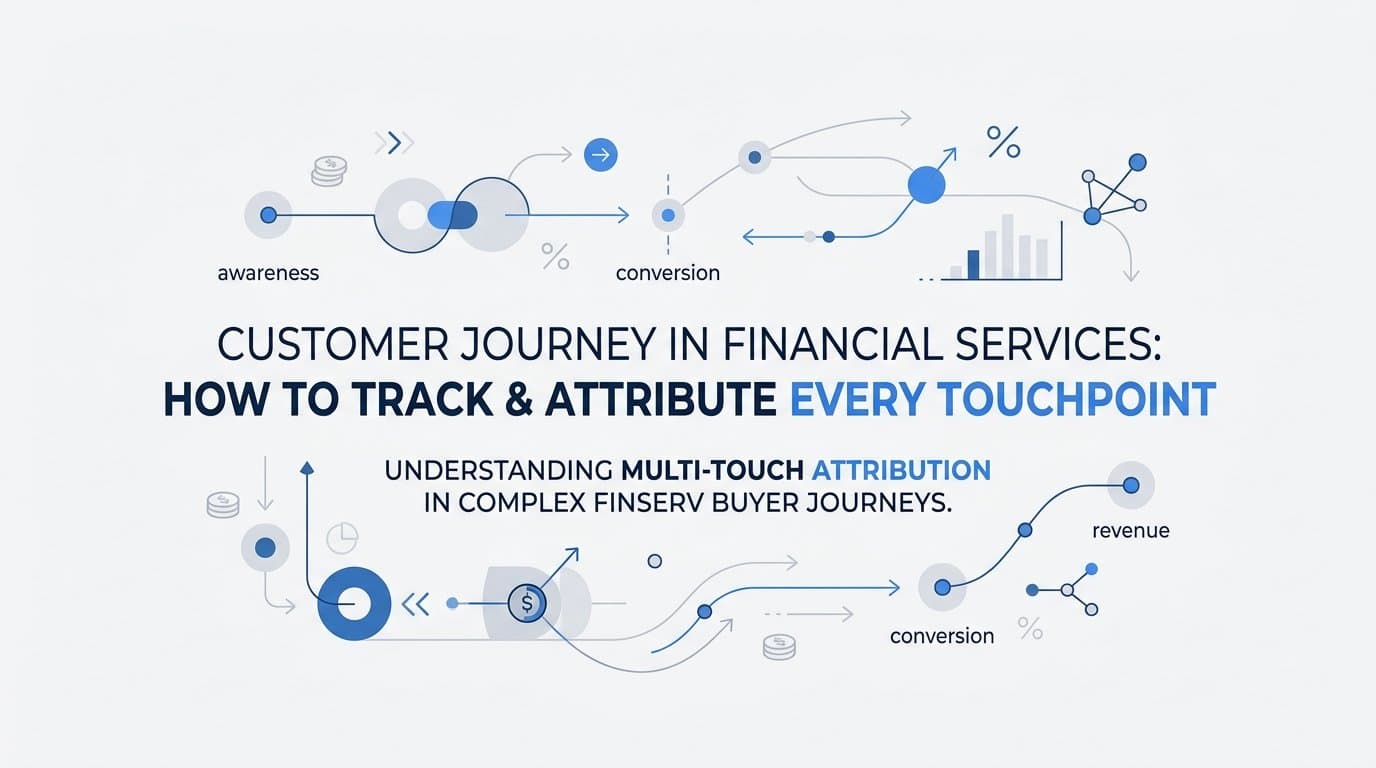
The Five Stages of the Financial Services Customer Journey
Understanding the customer journey in financial services starts with recognizing that it follows a predictable structure, even if the timeline and specific channels vary. Breaking it into five stages makes it easier to map your tracking, align your content strategy, and assign attribution credit accurately.
Stage 1: Awareness. This is where a buyer first encounters your brand. It might happen through a paid social ad on LinkedIn, a Google search for a category-level term, a mention in an industry newsletter, or a referral from a peer. At this stage, the buyer is not yet evaluating you specifically. They are becoming aware that a solution like yours exists. Paid social and paid search tend to dominate this stage, which is why it is critical that these channels receive proper attribution credit even when they do not directly produce conversions.
Stage 2: Consideration. Once a buyer is aware of your brand, they move into a research phase. They read your blog content, compare your product against competitors, watch demos or webinars, and look for social proof. Organic search plays a major role here, as buyers actively seek out answers to specific questions. Email nurture sequences also become relevant if a buyer has shared their contact information. This stage can last a long time in financial services, particularly for B2B buyers who are building an internal case for a purchase.
Stage 3: Intent. Intent signals are actions that indicate a buyer is moving toward a decision. Requesting a demo, downloading a detailed resource, engaging directly with a sales development representative, or visiting your pricing page multiple times all indicate that a prospect is getting serious. This is where your CRM becomes essential, because intent-stage interactions often happen off your website and need to be captured and connected to earlier digital touchpoints.
Stage 4: Decision. This is the conversion event, whether that is a trial sign-up, a contract signature, or a first payment. In B2B financial services, this stage frequently involves multiple contacts within the same account. A marketing manager may have driven the initial research, a finance director may have approved the budget, and a technical lead may have validated the integration. Account-level journey tracking matters here because individual contact tracking will miss the full picture of how a deal was influenced.
Stage 5: Retention. The journey does not end at conversion. Onboarding experience, product engagement, and expansion touchpoints all contribute to long-term customer value. For attribution purposes, understanding which acquisition channels produce customers with the highest retention and expansion rates can meaningfully change how you allocate budget across the earlier stages.
Each of these stages involves different channels and different content types, which is precisely why cross-channel attribution is not optional in financial services. It is the only way to see how each stage contributes to the final outcome.
Where Traditional Tracking Falls Short
Standard pixel-based tracking was designed for a simpler internet. It works reasonably well when buyers use a single device, stay within the same browser session, and do not take steps to limit tracking. Financial services buyers, particularly in B2B contexts, rarely behave this way.
Consider how a typical financial services buyer actually moves through their journey. They might discover your brand on a work laptop during the day, then revisit your website on a personal device that evening. They may use incognito mode when doing competitive research. They might click an ad on LinkedIn, close the tab, and return to your site two weeks later through a direct URL they bookmarked. Each of these behaviors creates a gap in browser-based tracking, and those gaps accumulate quickly across a journey that spans multiple weeks.
Cookie deprecation has accelerated this problem significantly. As major browsers have restricted third-party cookies and as iOS privacy updates have limited mobile tracking, the reliability of pixel-based attribution has declined. Top-of-funnel touchpoints, where awareness and consideration happen, are the most affected. These are often the touchpoints that take the longest to show up in conversion data, which means they are also the ones most likely to be dropped from your attribution model entirely.
The practical consequence is predictable. When awareness and consideration touchpoints disappear from your data, attribution credit flows disproportionately to the channels that are easiest to track: direct traffic, branded search, and the final click before conversion. These channels look like they are doing all the work because they are the only ones your tracking can see reliably. Meanwhile, the paid campaigns that introduced the buyer to your brand in the first place receive little or no credit.
Marketing teams making budget decisions based on this incomplete picture tend to under-invest in the channels that actually start journeys and over-invest in the channels that capture demand that was already created. The result is a gradual erosion of pipeline as top-of-funnel investment gets cut in favor of bottom-funnel channels that appear to perform better on paper.
Server-side tracking and first-party data strategies are the solution to this problem. By moving event tracking to the server level rather than relying on browser-based pixels, you capture conversions even when cookies are blocked, browsers restrict tracking, or buyers switch devices. This is not a nice-to-have for financial services marketers. It is the foundation of any attribution approach that can be trusted.
Attribution Models That Fit Long, Complex Journeys
Once you have reliable tracking in place, the next question is how to assign credit across the touchpoints you are capturing. Not all attribution models are equally suited to the financial services customer journey, and choosing the wrong one can lead you to the same flawed conclusions as having no attribution at all.
Single-touch models, first-touch and last-touch, are the most common and the least appropriate for long journeys. First-touch gives all credit to the initial interaction, which overstates the value of awareness channels and ignores everything that happened in between. Last-touch gives all credit to the final interaction before conversion, which typically rewards branded search or direct traffic rather than the campaigns that built intent over time. Neither model reflects the reality of how financial services buyers make decisions.
Linear attribution distributes credit equally across all touchpoints in the journey. It is a significant improvement over single-touch models because it acknowledges that multiple interactions contributed to the conversion. The limitation is that it treats every touchpoint as equally important, which is rarely accurate. A buyer revisiting your pricing page for the fifth time is probably closer to converting than someone who just read a blog post for the first time, but linear attribution weights them the same.
Time-decay attribution addresses this by giving more credit to touchpoints that occurred closer to the conversion event. This makes intuitive sense for journeys where intent builds gradually over time, and it tends to perform better than linear attribution for financial services because it reflects the increasing engagement that typically precedes a decision.
Data-driven attribution goes further by using your actual conversion data to assign credit dynamically. Rather than applying a fixed rule to every journey, it analyzes the patterns in your specific buyer behavior and distributes credit based on which touchpoints statistically correlate with conversion. For financial services marketers dealing with complex, multi-touchpoint journeys, this approach is the most accurate because it reflects how your buyers actually behave rather than how a model assumes they should.
One important point: attribution model selection is not a one-time decision. As your buyer behavior evolves, as you enter new channels, or as your sales cycle changes, the model that best fits your data will shift as well. Revisiting your attribution model against pipeline and revenue outcomes regularly ensures that your measurement framework stays aligned with reality.
Building a Trackable Journey From Ad Click to Revenue
Understanding the theory of attribution is useful. Building the infrastructure to actually track the financial services customer journey end to end is where the real work happens. Here is how to approach it practically.
The starting point is connecting your ad platforms to your CRM and website using server-side event tracking. Platforms like Meta, Google, and LinkedIn all support server-side conversion APIs that allow you to send event data directly from your server rather than relying on browser pixels. This means that even when a buyer uses an ad blocker, switches devices, or browses privately, the conversion event is still captured and attributed correctly. Setting up these integrations is the single most impactful step you can take to improve the accuracy of your financial services attribution data.
Next, map every key conversion event across the journey and ensure each one is tracked and passed back to your ad platforms with enriched first-party data. This means going beyond basic page view tracking to capture form submissions, demo requests, trial sign-ups, and, critically, closed-won deals from your CRM. Each of these events represents a stage in the journey, and each one provides your ad platform algorithms with the signal they need to optimize toward the outcomes that actually matter, not just the easiest-to-track surface metrics.
Pipeline and revenue attribution is where this infrastructure pays off most clearly. By connecting marketing touchpoints directly to closed deals in your CRM, you can see which campaigns and channels are generating actual revenue rather than just leads. This matters enormously in financial services, where lead quality varies widely and the gap between a marketing-qualified lead and a closed deal can be substantial. A campaign that generates many leads but few closed deals is a very different investment than one that generates fewer leads with higher close rates.
For B2B financial services companies, account-level tracking adds another layer of clarity. When multiple contacts at the same company interact with your marketing before a deal closes, individual contact tracking will undercount the influence of your campaigns. Account-level attribution aggregates all of those touchpoints and connects them to the deal outcome, giving you a complete picture of how your marketing influenced the buying committee rather than just the individual who happened to click the final ad.
Turning Journey Data Into Smarter Budget Decisions
Collecting journey data is only valuable if it changes how you make decisions. Once your attribution infrastructure is in place and your data is unified in a single platform, the real opportunity is using that data to allocate budget more intelligently and improve campaign performance over time.
The most immediate application is channel-level budget reallocation. When you can see which channels drive high-quality leads at each stage of the journey, not just which ones appear in last-touch reports, you can move budget toward the campaigns that consistently contribute to pipeline. This often means investing more in top-of-funnel channels that were previously under-credited and reducing spend on bottom-funnel channels that were capturing demand rather than creating it.
AI-driven analysis adds another dimension to this process. Manually reviewing journey data across hundreds or thousands of touchpoints is impractical, and the patterns that matter most are often not visible in standard reports. AI can surface insights like which ad creative combinations lead to faster deal velocity, which touchpoint sequences correlate with higher average contract values, or which awareness channels produce buyers who are more likely to expand after the initial purchase. These are the kinds of insights that change how you structure campaigns, not just how you measure them.
Journey data also creates a foundation for better alignment between marketing and sales. When sales teams can see where a prospect is in their decision process based on their actual touchpoint history, outreach becomes more targeted and more timely. A prospect who has visited your pricing page multiple times and downloaded a detailed product guide is in a very different place than one who read a single blog post three weeks ago. Sharing that context with sales improves conversion rates and reduces wasted outreach effort.
Finally, unified journey data enables more accurate revenue forecasting. When you can see the typical path from first touch to closed deal in your specific market, including the average number of touchpoints, the typical time from awareness to decision, and the channels that appear most consistently in high-value journeys, you can build pipeline forecasts that reflect how your buyers actually behave rather than how you hope they will.
Putting It All Together
The financial services customer journey is long, complex, and multi-touch by design. Buyers in this space take their time, involve multiple stakeholders, and interact with brands across many channels before they ever commit. That complexity is not a problem to be solved. It is simply the reality of how trust-based, high-consideration purchases work.
What you can control is how well you measure it. The key takeaways from this article are straightforward: understand the five stages of the journey and how channel mix shifts across them; move beyond single-touch attribution to models that distribute credit across the full journey; implement server-side tracking to capture touchpoints that browser-based pixels miss; and use unified attribution data to connect marketing spend directly to pipeline and revenue.
Each of these steps builds on the last. Better tracking produces more complete data. More complete data supports more accurate attribution models. More accurate attribution leads to smarter budget decisions. And smarter budget decisions produce better outcomes over time.
Cometly is built specifically to support this kind of end-to-end attribution for B2B SaaS and financial services marketing teams. It connects your ad platforms, CRM, and website using server-side event tracking, supports multi-touch and revenue attribution, and uses AI to surface patterns in your journey data that manual reporting cannot easily detect. Whether you are trying to understand which campaigns are actually driving pipeline or looking to feed better conversion data back to Meta and Google to improve targeting, Cometly gives you the single source of truth your team needs.
If you are ready to stop guessing and start seeing exactly which touchpoints drive revenue, Get your free demo and see how Cometly handles the complexity of the financial services customer journey from first ad click to closed-won deal.