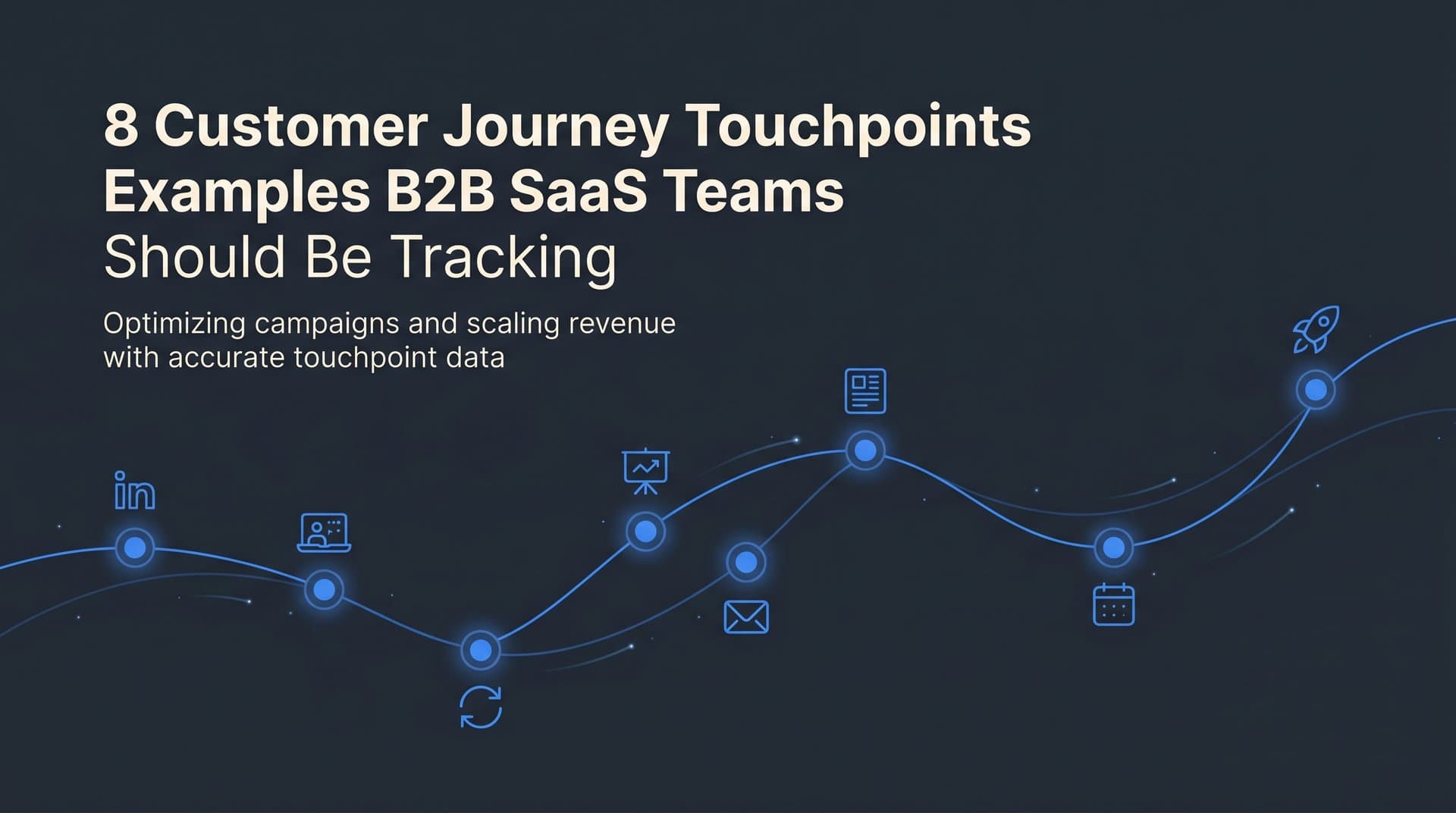
Every B2B SaaS deal involves dozens of interactions before a prospect becomes a paying customer. A prospect might discover your product through a LinkedIn ad, read a comparison article a week later, attend a webinar, and then finally book a demo after seeing a retargeting ad. Each of these moments is a customer journey touchpoint, and each one shapes the buying decision.
The challenge is that most marketing teams only see a fraction of these touchpoints. They rely on last-click attribution or incomplete CRM data, which means they are optimizing campaigns based on a distorted picture of what actually drives revenue.
This article breaks down eight real customer journey touchpoint examples that matter in B2B SaaS, and explains how to track, analyze, and act on each one. Whether you are running paid ads, content programs, or product-led growth motions, understanding these touchpoints gives you the data you need to allocate budget more effectively and scale what works.
1. Paid Ad First Touch
The Challenge It Solves
Last-click attribution systematically under-credits the paid ad that started everything. When a prospect clicks a Google or LinkedIn ad, reads your landing page, and then converts three weeks later through a different channel, that original ad gets zero credit. Over time, this causes teams to underfund the campaigns that are actually filling the top of the funnel.
The Strategy Explained
Paid ad first-touch tracking captures the initial impression or click that introduced a prospect to your brand. This is the entry point for a large share of pipeline in B2B SaaS companies running campaigns on Google Ads, Meta, LinkedIn, or TikTok. Tracking this touchpoint accurately requires more than a pixel. It requires connecting the ad click to downstream CRM events so you can see which campaigns generate not just clicks, but qualified pipeline and closed revenue.
The most reliable approach combines UTM parameter tracking with server-side event capture, ensuring that ad click data survives the multi-week journey from first impression to demo request. Understanding the full B2B customer journey is essential for knowing where paid first-touch fits within the broader buying process.
Implementation Steps
1. Apply consistent UTM parameters to every paid ad across all platforms, covering source, medium, campaign, and ad group.
2. Implement server-side tracking to capture first-touch data without relying solely on browser-based pixels that can be blocked or lost.
3. Connect your ad platform data to your CRM so that first-touch attribution is visible alongside pipeline stage and deal value.
4. Use a multi-touch attribution model that assigns meaningful credit to first-touch paid interactions, not just the final click before conversion.
Pro Tips
Segment your first-touch analysis by channel and campaign type. Top-of-funnel brand awareness campaigns and bottom-of-funnel competitor campaigns play very different roles. Treating them the same in your attribution model will lead to misallocated budget. Look at which first-touch sources correlate with the highest average deal values, not just the most conversions.
2. Organic Search and Content
The Challenge It Solves
Blog posts, comparison pages, and SEO-optimized content are among the most valuable mid-funnel touchpoints in B2B SaaS, yet they are frequently invisible in platform-native attribution. When a prospect reads your "best CRM tools" comparison article and converts two weeks later through a paid retargeting ad, the content touchpoint disappears from most attribution reports entirely.
The Strategy Explained
Organic content touchpoints typically appear when prospects are actively researching solutions. They are not yet ready to buy, but they are forming opinions about which vendors deserve a closer look. Tracking these interactions requires connecting Google Analytics 4 session data with your CRM, so you can see which content pieces appear in the journeys of prospects who eventually convert to pipeline.
The goal is not just to measure page views. It is to understand which content touchpoints correlate with higher conversion rates, shorter sales cycles, or larger deal sizes. That insight tells you where to invest your content budget. Using dedicated customer journey analytics tools makes it far easier to surface these content-to-pipeline connections at scale.
Implementation Steps
1. Set up cross-session user tracking so that a prospect who reads a blog post and returns later through a different channel is recognized as the same person.
2. Tag internal links from content pages with UTM parameters that identify the content piece as a touchpoint source.
3. Integrate your website analytics with your CRM to map content interactions to specific contacts and opportunities.
4. Analyze which content pages appear most frequently in the journeys of closed-won deals, not just high-traffic pages.
Pro Tips
Comparison pages and "alternatives to" content often punch above their weight in B2B SaaS. Prospects reading these pages are in active evaluation mode, which makes them high-intent touchpoints even when organic traffic volume is modest. Prioritize tracking these pages carefully before high-volume blog posts.
3. Social Proof Touchpoints
The Challenge It Solves
G2 profiles, Capterra listings, and peer reviews on social platforms are where B2B buyers go to validate their shortlist. These third-party touchpoints carry significant weight during the evaluation stage, yet most marketing teams have no visibility into them because they sit outside owned channels and cannot be tracked with standard pixels.
The Strategy Explained
Social proof touchpoints represent a category of interactions that happen off your website but directly influence buying decisions. A prospect who reads a dozen five-star reviews on G2 before booking a demo has been meaningfully influenced by that touchpoint, even if your attribution model gives it no credit. Learning how to measure touchpoints across both owned and third-party channels is what separates teams with complete attribution from those working with blind spots.
The practical approach is to use UTM-tagged links in your G2 and Capterra profiles so that traffic arriving from review platforms is identifiable in your analytics. This does not capture every interaction with your review profiles, but it does let you measure the volume of prospects who visit your site after engaging with social proof content.
Implementation Steps
1. Add UTM-tagged links to your G2, Capterra, and other review platform profiles pointing to your website or landing pages.
2. Monitor referral traffic from review platforms in your analytics tool and track how these visitors behave compared to other traffic sources.
3. Include a question in your demo request or trial signup form asking how prospects heard about you, which can surface review platform influence that tracking cannot capture.
4. Connect review platform referral sessions to CRM contacts to see how often social proof touchpoints appear in closed-won journeys.
Pro Tips
Self-reported attribution through intake forms consistently reveals channels that pixel-based tracking misses. Asking "how did you hear about us?" on your demo request form is a low-effort way to quantify the influence of social proof touchpoints that your formal attribution model cannot see.
4. Email and Nurture Sequences
The Challenge It Solves
Email is a bridge channel. It connects prospects who expressed initial interest with the high-intent conversion events that happen weeks or months later. Without tracking email touchpoints within a multi-touch attribution framework, you cannot see how nurture sequences contribute to pipeline, which makes it difficult to justify investment in email programs.
The Strategy Explained
Automated and manual email touchpoints move prospects from awareness toward a demo or purchase decision. Each email open, click, and reply is a signal that belongs in the customer journey record. The challenge is that most email platforms track engagement in isolation, disconnected from the ad clicks and content interactions that preceded the email subscription and the demo request that follows it.
Integrating your email platform with your CRM and attribution layer allows you to see email as one touchpoint in a longer sequence rather than a standalone channel. This is where platforms like Cometly add significant value by connecting email engagement data with ad platform data and CRM pipeline records in a single attribution view. Teams that invest in customer journey tracking at this level gain a clearer picture of how nurture sequences influence pipeline velocity.
Implementation Steps
1. Ensure all email links use UTM parameters that identify the specific email campaign and sequence as the traffic source.
2. Sync email engagement data (opens, clicks, replies) to your CRM contact records so sales teams can see nurture history alongside pipeline activity.
3. Map email touchpoints within your multi-touch attribution model to understand which sequences appear most frequently in closed-won journeys.
4. Segment email attribution analysis by sequence type, distinguishing between onboarding sequences, trial nurture, and re-engagement campaigns.
Pro Tips
Time-decay attribution models tend to under-credit early nurture emails because they weight recent touchpoints more heavily. If email is a primary nurture channel for your business, consider running a position-based or linear model alongside time-decay to get a more balanced view of email's contribution across the full journey.
5. Demo Requests and Trial Signups
The Challenge It Solves
Demo requests and trial signups are the highest-intent conversion events in the B2B SaaS funnel. Missing even a fraction of these events creates significant gaps in your attribution data, because every untracked conversion is a touchpoint chain that disappears from your analysis entirely. Browser restrictions, ad blockers, and iOS privacy changes have made client-side pixel tracking increasingly unreliable for capturing these critical events.
The Strategy Explained
Accurately tracking demo requests and trial signups requires server-side tracking and Conversion API integration to prevent data loss. When a prospect submits a demo request form, that event needs to fire from your server rather than relying solely on a browser pixel. This ensures the conversion is captured regardless of the prospect's browser settings or device type.
Beyond capturing the event itself, connecting demo requests to CRM records is what transforms a conversion event into an attribution insight. Linking the demo request back to the ad click, content interaction, and email touchpoints that preceded it is the foundation of meaningful multi-touch attribution. Teams that have mastered capturing every customer touchpoint consistently see fewer gaps between their ad platform data and actual pipeline created.
Implementation Steps
1. Implement server-side tracking for your demo request and trial signup forms using Conversion API integrations with Meta, Google, and LinkedIn.
2. Pass a unique identifier with each conversion event that connects it to the CRM contact record created at the same time.
3. Verify event match quality scores in your ad platforms to confirm that server-side events are matching to the correct users.
4. Set up deduplication logic to prevent the same conversion from being counted by both client-side and server-side tracking simultaneously.
Pro Tips
Server-side tracking is not a one-time setup. Ad platforms regularly update their Conversion API specifications, and your integration needs to be maintained to stay accurate. Audit your conversion event data monthly by comparing server-side event counts against CRM new contact counts to catch any drift before it compounds into major attribution gaps.
6. Sales Touchpoints
The Challenge It Solves
Discovery calls, follow-up emails, proposal meetings, and other sales interactions are where deals are won or lost, yet they are almost always siloed in CRM systems and disconnected from marketing attribution data. This creates a blind spot in the full customer journey picture. Marketing teams cannot see how their campaigns influence sales cycle length or close rates, and sales teams cannot see which marketing touchpoints preceded the leads they are working.
The Strategy Explained
Sales touchpoints need to be brought into the same attribution framework as marketing touchpoints. This does not mean replacing your CRM. It means connecting CRM activity data to your attribution layer so that the full journey from first ad click to closed-won deal is visible in one place.
When marketing and sales data are unified, you can answer questions that neither system can answer alone. Which paid campaigns generate leads that close fastest? Which content touchpoints correlate with shorter sales cycles? Which nurture sequences produce leads with the highest average contract values? These are revenue-level insights that require bridging the gap between marketing and CRM data. Applying robust SaaS revenue attribution methodology is what makes these cross-functional insights actionable.
Implementation Steps
1. Integrate your CRM with your marketing attribution platform so that deal stage, close date, and contract value are visible alongside upstream marketing touchpoints.
2. Log all sales touchpoints (calls, emails, meetings) consistently in your CRM using standardized activity types that can be analyzed at scale.
3. Build reports that show the full touchpoint sequence from first marketing interaction to closed-won, including sales activities in the middle.
4. Share these unified journey reports with both marketing and sales teams to align on which touchpoints drive the best outcomes.
Pro Tips
One of the most actionable insights from unifying sales and marketing data is identifying which marketing sources produce leads that actually close. High demo volume from a campaign is less meaningful if those leads have low close rates. Connecting CRM outcome data to marketing attribution lets you optimize for pipeline quality, not just pipeline volume.
7. Retargeting Ads
The Challenge It Solves
Retargeting ads are served to prospects who have already interacted with your brand, which means they operate very differently from top-of-funnel awareness campaigns. When retargeting ads are grouped with other paid campaigns in a single attribution bucket, their distinct role in the buying journey becomes invisible. Teams either over-credit retargeting by treating it as the primary conversion driver, or they under-invest in it because they cannot see its incremental contribution.
The Strategy Explained
Retargeting touchpoints need to be tracked as a distinct touchpoint type in your multi-touch attribution model. A prospect who saw a LinkedIn awareness ad three weeks ago, read a blog post, and then converted after seeing a retargeting ad on Meta represents a three-touchpoint journey. Each touchpoint played a different role, and collapsing them into a single "paid" category obscures that story.
Effective retargeting attribution requires audience segmentation that mirrors your attribution logic. Retargeting audiences built from demo page visitors behave differently from audiences built from blog readers, and those differences should be visible in your attribution data. Understanding the distinct stages of the customer journey helps you build retargeting audiences that align with where prospects actually are in their buying process.
Implementation Steps
1. Tag retargeting campaigns with UTM parameters that clearly distinguish them from prospecting campaigns at the campaign and ad group level.
2. Build retargeting audiences that correspond to specific funnel stages, such as landing page visitors, pricing page visitors, and demo page visitors, and track them separately.
3. Apply a multi-touch attribution model that assigns credit to retargeting ads based on their position in the journey rather than defaulting to last-click.
4. Compare conversion rates and cost per acquisition for retargeting campaigns against the prospecting campaigns that fed those audiences to understand the full cost of each conversion.
Pro Tips
Retargeting campaigns often show artificially strong performance in last-click models because they reach prospects who were already close to converting. A time-decay or position-based model gives a more honest picture of retargeting's incremental value. Use Cometly's multi-touch attribution views to compare how retargeting performance changes across different attribution models before making budget decisions.
8. Post-Sale Touchpoints
The Challenge It Solves
In SaaS, the deal closing is not the end of the customer journey. It is the beginning of the revenue relationship. Onboarding sessions, in-product events, customer success check-ins, and expansion offers all influence whether a customer stays, expands, or churns. Most teams treat these touchpoints as entirely separate from marketing, which means they miss the opportunity to connect post-sale behavior back to original acquisition sources.
The Strategy Explained
Post-sale touchpoints matter for two reasons. First, they directly influence net revenue retention, which is a primary growth driver in SaaS business models. Second, connecting post-sale outcomes back to acquisition touchpoints reveals which top-of-funnel sources produce customers who actually succeed with your product.
If customers acquired through one channel consistently expand and renew while customers from another channel churn at higher rates, that is critical information for your marketing budget allocation. You cannot see it unless post-sale data is connected to the attribution layer that tracks acquisition touchpoints. Conducting a thorough customer lifetime value analysis by acquisition source is one of the most powerful ways to act on this insight.
Implementation Steps
1. Track key in-product events (feature adoption, usage milestones, login frequency) and sync them to your CRM contact and account records.
2. Log customer success touchpoints (onboarding calls, QBRs, health check-ins) in your CRM using consistent activity types.
3. Connect expansion and renewal events to the original acquisition touchpoints in your attribution platform to build a complete lifetime value picture by channel.
4. Build cohort reports that compare product adoption rates and expansion revenue for customers acquired through different marketing sources.
Pro Tips
Expansion revenue attribution is an underused competitive advantage. If you can demonstrate that customers acquired through a specific campaign type or channel have meaningfully higher lifetime value, you can justify higher acquisition costs for those channels. This shifts your optimization from cost per acquisition to cost per quality customer, which is a fundamentally stronger way to allocate budget.
Putting It All Together
Tracking customer journey touchpoints is not about collecting more data for its own sake. It is about understanding which interactions actually move prospects through your pipeline so you can invest more in what works and cut what does not.
The eight touchpoint examples covered here represent the full arc of a B2B SaaS buying journey, from the first paid ad impression to post-sale product adoption. Most teams are only tracking a handful of these, which means they are making budget decisions with incomplete information.
The practical starting point is to audit which touchpoints you are currently capturing and identify the gaps. From there, implementing server-side tracking and Conversion API integrations fills the data loss that browser restrictions create. Applying a multi-touch attribution model then gives you a realistic picture of how each touchpoint contributes to revenue.
Cometly is built to do exactly this. It connects your ad platforms, CRM, and website into a single attribution layer so you can see every touchpoint, analyze performance across channels, and make data-driven decisions with confidence. From first-touch paid ads to post-sale expansion events, Cometly gives you the infrastructure to track the complete customer journey and understand what is actually driving revenue.
Ready to move beyond surface-level metrics and start attributing revenue to the touchpoints that actually drive it? Get your free demo today and start capturing every touchpoint to maximize your conversions.