
Most marketing teams can tell you when someone converted. What they cannot tell you is why. They know the last ad that was clicked, the final email that was opened, or the search term that brought someone to the site right before they signed up. But that last interaction is rarely the reason someone bought. It is just the last thing that happened before they did.
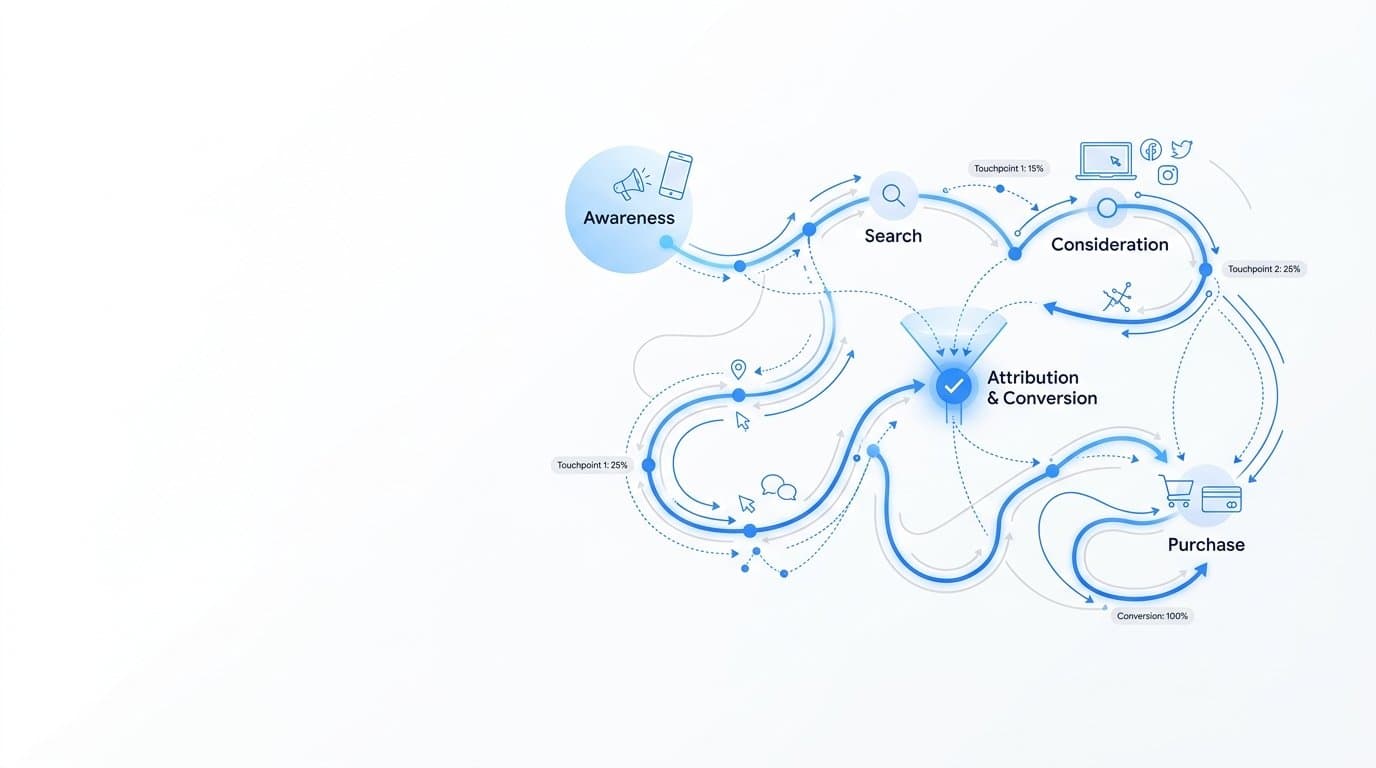
The customer shopping journey is rarely a straight line. In B2B SaaS especially, buyers move through awareness, consideration, and decision across weeks or months, touching your brand through paid ads, organic content, social posts, email sequences, and direct visits, often in sequences that look nothing like the clean funnel diagrams in marketing textbooks. By the time someone clicks "Start Free Trial," they have likely interacted with your brand a dozen times across multiple channels and devices.
This is the gap that costs marketing teams the most: not the budget they spend, but the decisions they make without seeing the full picture. When you can only see the last click, you optimize for the last click. You defund the awareness campaigns that started the journey. You cut the content that built trust during the consideration phase. You reward the wrong channels and starve the ones doing the real work.
This guide is for marketers who are ready to move past surface-level metrics and into full-funnel visibility. You will learn how the modern shopping journey actually works, why standard analytics tools miss most of it, and how to build the tracking infrastructure that connects every touchpoint to real revenue outcomes.
The Non-Linear Path Buyers Actually Take
Picture the last time you made a significant purchase, whether for your business or personally. Did you see one ad, click it, and buy immediately? Almost certainly not. You probably encountered the brand somewhere, forgot about it, saw it again in a different context, did some research, compared a few alternatives, read a review or two, and eventually made a decision after multiple interactions spread across different devices and platforms.
That is the reality of how modern buyers behave. And in B2B SaaS, the complexity is even greater. Buying decisions often involve multiple stakeholders, longer evaluation periods, and touchpoints that span both marketing-owned channels like ads and content and sales-owned channels like demos and outreach sequences.
The challenge for marketers is that each stage of this journey carries different intent signals. Someone encountering your brand for the first time through a LinkedIn ad is in a fundamentally different mental state than someone who has visited your pricing page three times in a week. These different intent levels require different marketing responses: awareness content for early-stage visitors, comparison and social proof for mid-funnel researchers, and conversion-focused messaging for high-intent prospects who are ready to decide.
Here is where the real problem emerges. Most attribution tools are not designed to capture this complexity. They report on what they can easily measure, which is usually the last click or the most recent session. The result is a systematic gap between what the data shows and what actually influenced the purchase. That gap is where marketing budget gets lost.
When a paid social campaign generates awareness that eventually leads to a branded search six weeks later, last-click attribution gives all the credit to the search campaign. The social campaign looks like it produced nothing. The marketer cuts it. The pipeline starts to dry up three months later, and no one can explain why.
Understanding the non-linear nature of the customer shopping journey is not an academic exercise. It is the foundation of every smart budget decision you will make.
Breaking Down the Five Core Stages of the Shopping Journey
While every buyer's path is unique, most shopping journeys move through recognizable stages. Understanding what happens at each stage, and what marketers should be doing there, is the starting point for building a tracking strategy that actually reflects reality.
Awareness: This is where the journey begins. A prospect encounters your brand for the first time, typically through a paid ad, a piece of organic content, a social post, or a mention from a peer. At this stage, the buyer is not actively looking for a solution. They may not even know they have a problem yet. Your job here is not to convert. It is to create a strong enough impression that they remember you when the need arises. Awareness touchpoints are often the hardest to attribute because they rarely produce immediate, measurable actions.
Consideration: Once a buyer recognizes a need, they enter the research phase. This is where the volume of touchpoints spikes dramatically. They revisit your site, compare you against competitors, read case studies, watch demos, and engage with content across multiple channels. This stage often spans the longest period and generates the most interactions, which makes it both the most important and the most difficult to attribute correctly. A buyer in the consideration stage might visit your site seven times before ever filling out a form.
Decision: The buyer has narrowed their options and is ready to commit. This is where high-intent signals appear: pricing page visits, demo requests, free trial sign-ups, and direct outreach. Attribution tools tend to over-index on this stage because the actions are clear and measurable. But the decision was shaped by everything that came before it.
Purchase and Onboarding: The conversion event itself, along with the initial onboarding experience, marks a critical transition. For B2B SaaS teams, this is where marketing attribution should connect to CRM data. Which deal stage did this lead enter? What was the contract value? How long was the sales cycle? These signals tell you not just that a conversion happened, but what kind of conversion it was.
Retention and Expansion: Post-purchase behavior is often ignored in attribution models, but it carries significant intelligence. Customers who expand their contracts or refer others often share characteristics in their pre-purchase journey. Understanding what those journeys looked like helps you find and attract more of the same buyers.
Mapping these stages accurately requires tracking infrastructure that can capture interactions across all of them, not just the ones that happen right before a form fill.
Why Standard Analytics Miss Most of the Journey
If you are relying on default analytics setups and platform-native reporting, you are working with an incomplete picture. This is not a criticism of any specific tool. It is a structural limitation of how most analytics systems are built.
Last-click attribution is the default model in most ad platforms and analytics tools. It assigns 100 percent of the conversion credit to the final touchpoint before a purchase or sign-up. This is simple, easy to implement, and deeply misleading. It systematically undervalues every channel that contributes to awareness and consideration, including display ads, YouTube campaigns, top-of-funnel social content, and organic blog traffic.
Think about what this means in practice. A prospect sees your LinkedIn ad, visits your blog, subscribes to your newsletter, and then converts three weeks later after clicking a Google Search ad. Last-click attribution gives the search campaign full credit. The LinkedIn ad, the blog, and the email sequence show zero contribution. You optimize toward search, reduce LinkedIn spend, and weaken the top of your funnel without realizing it.
Beyond attribution model limitations, there is a growing tracking infrastructure problem. Browser-based pixel tracking, which most analytics and ad platforms rely on, is becoming less reliable. Safari's Intelligent Tracking Prevention and similar privacy features in Firefox limit how long cookies persist. Ad blockers prevent pixels from firing entirely. Cross-device behavior means a prospect who sees your ad on their phone and converts on their laptop may look like two separate, unconnected users in your data.
The result is significant data gaps. Conversion events go unrecorded. Journey paths are broken. Attribution reports reflect only the interactions that were successfully captured by browser-based pixels, which is a shrinking fraction of the total.
Server-side tracking addresses this directly. Instead of relying on a browser pixel to fire and report a conversion, server-side tracking sends conversion data from your own server to the ad platform or analytics tool. This approach is not affected by ad blockers or browser privacy restrictions, which means you capture a more complete and accurate record of what is actually happening.
Conversion API integrations, offered by platforms like Meta and Google, take this further by enabling a direct server-to-server connection that sends enriched first-party data about conversion events. Without this infrastructure, the customer shopping journey data you are working with has gaps you may not even be aware of.
Touchpoint Mapping: Connecting Every Interaction to Revenue
Once you have the tracking infrastructure in place to capture interactions across the full journey, the next step is making sense of them. This is where multi-touch attribution models and touchpoint mapping become essential.
Multi-touch attribution distributes conversion credit across multiple touchpoints rather than awarding it all to one. Different models do this in different ways, and each reflects a different assumption about how influence works in the buying process.
Linear attribution gives equal credit to every touchpoint in the journey. If a buyer had six interactions before converting, each one receives one-sixth of the credit. This is more equitable than last-click but still treats every touchpoint as equally important regardless of when or how it occurred.
Time-decay attribution assigns more credit to touchpoints that occurred closer to the conversion event, on the assumption that recent interactions had more influence. This works reasonably well for short sales cycles but can undervalue early awareness touchpoints in longer B2B buying journeys.
Data-driven attribution uses machine learning to analyze actual conversion path data and assign credit proportionally based on which touchpoints most often appear in journeys that convert. This is the most accurate model when you have sufficient data, because it reflects real patterns rather than predetermined rules.
Beyond choosing a model, the most valuable capability is connecting ad platform data to CRM events and closed-won revenue. This allows you to trace a conversion backward through every interaction that preceded it. You can see not just that a lead converted, but which channels they touched, in what sequence, and what contract value they eventually represented.
This kind of individual-level touchpoint mapping surfaces patterns that aggregate reporting hides. You might discover, for example, that prospects who engage with a specific ad creative early in their journey tend to close at significantly higher contract values. That insight changes how you allocate creative resources and which campaigns you scale.
Connecting these dots requires a platform that integrates your ad channels, your website behavior data, and your CRM in a single view. Without that integration, you are left manually trying to reconcile data from separate systems, which is both time-consuming and prone to error.
How to Use Journey Data to Make Smarter Ad Decisions
Collecting journey data is only valuable if it changes how you make decisions. Here is how teams who get this right actually use it.
Reallocate budget based on journey contribution, not just last-click credit. When you can see which channels consistently appear in the journeys of customers who eventually close at high contract values, you have a real basis for budget decisions. A display campaign that rarely generates last clicks might appear in the early stages of nearly every high-value conversion. That is not a campaign to cut. That is a campaign to protect and potentially scale.
Feed better data back to ad platforms. Ad platforms like Meta and Google use conversion signals to optimize their targeting algorithms. When you send them only last-click conversions captured by browser pixels, you are giving them a narrow and incomplete picture of who your best customers are. When you use Conversion API integrations to send enriched, journey-level conversion data, including signals from CRM events and closed revenue, the platforms receive a much richer signal. They learn which users actually became customers, not just which ones clicked. This improves algorithmic targeting and often reduces cost per acquisition over time.
Optimize creative and sequencing based on journey patterns. AI-driven analysis of journey data can surface which ad combinations and sequences are most likely to produce a conversion. You might find that prospects who see a thought leadership video before a product-focused ad convert at a higher rate than those who see the product ad first. That sequence intelligence should directly inform how you structure your campaign funnels and retargeting flows.
Improve reporting accuracy for leadership and stakeholders. When your attribution data reflects the full journey rather than just the last click, your channel performance reports become more credible and more useful. You can defend budget requests with evidence that connects spend to pipeline and revenue, not just to clicks and impressions.
The shift here is from optimizing for what is easy to measure to optimizing for what actually drives revenue. Journey data makes that shift possible. Without it, you are making allocation decisions based on the last thing that happened, not the full sequence of things that mattered.
Putting Journey Intelligence to Work
The central shift this article has been building toward is this: stop measuring isolated clicks and start understanding the full sequence of interactions that produce revenue. That shift changes everything, from how you plan campaigns to how you allocate budget to how you report results to leadership.
Making this shift requires the right infrastructure. You need server-side tracking to capture conversion data that browser pixels miss. You need first-party data from your own properties and CRM to fill the gaps left by cookie restrictions and ad blockers. You need multi-touch attribution models that distribute credit across the full journey rather than rewarding only the last interaction. And you need a single source of truth that connects your ad spend to your pipeline and closed-won revenue, so you can see the complete picture in one place.
This is exactly what Cometly is built to do. It connects your ad platforms, CRM data, and website behavior to give B2B SaaS marketing teams a real-time view of every customer journey from first ad click to closed-won revenue. With 70-plus native integrations, server-side conversion tracking, and Conversion API support for Meta, Google, and other major platforms, Cometly captures the touchpoints that standard analytics miss.
Its AI-driven analysis surfaces patterns across journey data at a scale that no manual process can match, identifying which channels, creatives, and sequences are most likely to produce high-value conversions. And because it integrates directly with Stripe and CRM systems, you can connect marketing attribution data to actual revenue, not just lead volume.
For B2B SaaS teams who are tired of making budget decisions based on incomplete data, Cometly provides the full-funnel visibility needed to scale what works and stop funding what does not.
Your Next Steps Toward Full-Funnel Clarity
Understanding the customer shopping journey is not a reporting upgrade. It is the foundation of every smart marketing decision your team will make. Every budget call, every creative test, every channel investment is either informed by journey data or it is a guess dressed up as strategy.
Start by auditing your current tracking setup. Ask yourself honestly: can you trace a closed deal back to its first touchpoint? Can you see which channels appeared in the journeys of your highest-value customers? Can you connect your ad spend to pipeline and revenue in a single view? If the answer to any of those questions is no, you have a gap that is costing you more than you realize.
The good news is that closing those gaps is achievable. The infrastructure exists. The attribution models are proven. The platforms that make full-journey tracking possible are built and ready.
If you are ready to move from last-click guesswork to complete journey visibility, see how Cometly maps every touchpoint from first impression to closed revenue. Get your free demo today and start capturing every touchpoint to maximize your conversions.