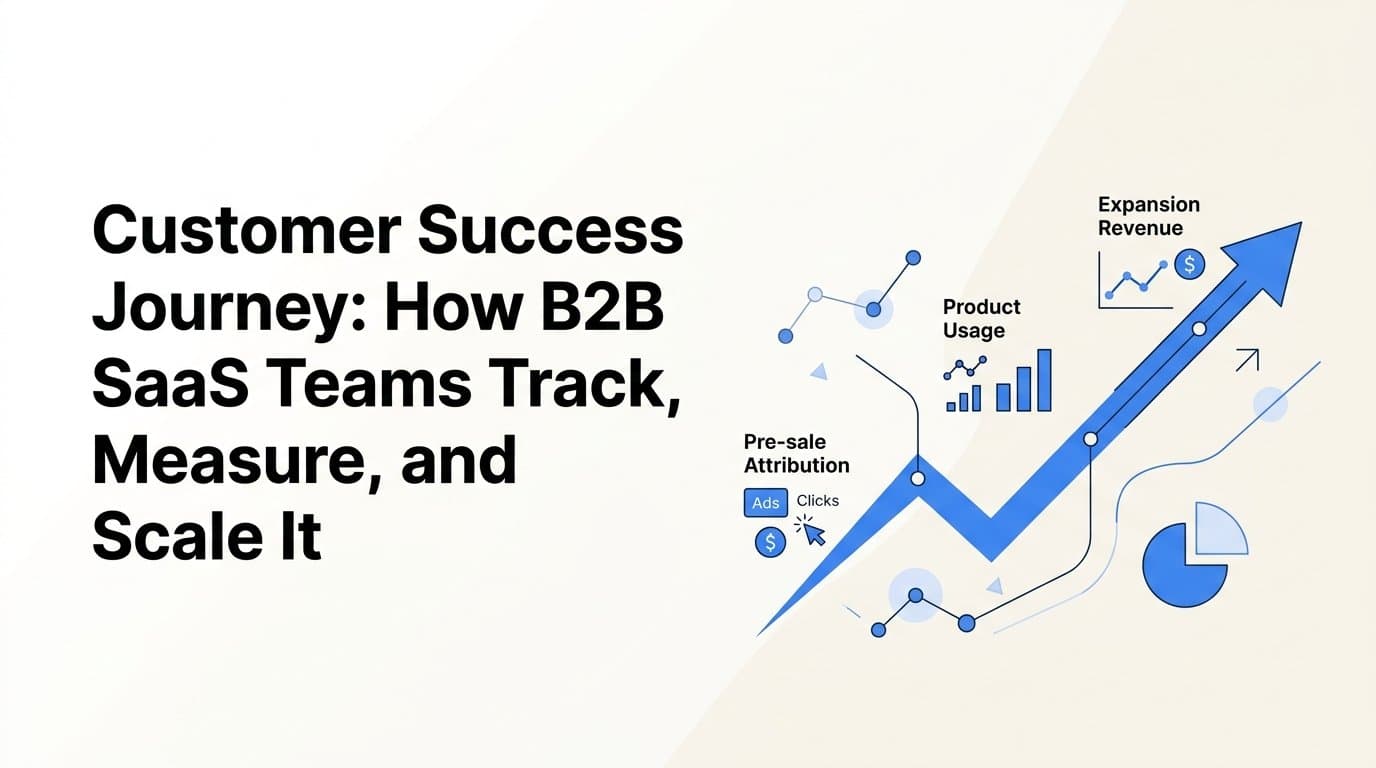
Most B2B SaaS companies are excellent at acquiring customers. They build campaigns, run ads, generate leads, and move prospects through a sales funnel. But the moment a contract is signed, something strange happens: the data trail goes cold. Marketing declares victory, hands the account to customer success, and moves on to the next pipeline target.
This is one of the most expensive blind spots in B2B SaaS growth. The customer success journey does not begin at onboarding. It begins at the very first ad impression, the first organic search click, the first time a future customer reads a blog post or watches a product demo. Everything that happens before the sale shapes what happens after it, and teams that ignore this connection are optimizing for the wrong outcomes.
For growth-focused B2B SaaS teams, understanding the full customer success journey is not a nice-to-have. It is the foundation of sustainable revenue. When you can connect which campaigns drove your highest-retention customers, which channels produce accounts that expand over time, and which early touchpoints predict long-term success, you gain a compounding advantage over competitors who are still measuring success by lead volume alone.
This guide walks through what the customer success journey actually covers in a B2B SaaS context, why most teams lose visibility after the first conversion, and how accurate tracking and attribution infrastructure can make the entire journey measurable. More importantly, it shows how turning that measurement into action drives better marketing decisions, better onboarding outcomes, and better revenue retention at scale.
The Full Arc: What the Customer Success Journey Actually Covers
The term "customer success journey" often gets confined to post-sale activities: onboarding calls, health scores, renewal conversations. But in B2B SaaS, the journey starts much earlier, and treating it as a post-sale concept alone is a structural mistake that costs teams meaningful insight.
Think of the customer success journey as the complete lifecycle a customer moves through, from the first time they encounter your brand to the moment they become an advocate who refers others to you. It is a broader concept than the sales funnel, which typically ends at closed-won. And it is distinct from customer experience, which focuses on the quality of individual interactions. The customer success journey is about outcomes: whether the customer achieves the value they purchased your product to deliver.
In B2B SaaS, this journey moves through several distinct stages, each requiring different success metrics and different team ownership.
Awareness: The customer first encounters your brand through a paid ad, an organic search result, a referral, or a piece of content. This stage sets initial expectations about what your product does and who it is for. The metrics here are reach and engagement, but the quality of this stage matters enormously for what comes later.
Evaluation: The prospect actively investigates your product through demo requests, trial sign-ups, sales conversations, and competitive comparisons. This is where intent sharpens. The success metric is not just conversion rate but the quality of prospects who move forward.
Purchase: A contract is signed and the first payment is processed. Most marketing teams treat this as the finish line. It is actually the starting gate for the real customer success journey.
Onboarding: The customer completes initial setup and takes their first meaningful actions in the product. Time-to-first-value is the critical metric here, and it is often heavily influenced by the expectations set during the pre-sale stages.
Adoption: The customer integrates the product into their regular workflows. Team-wide rollout happens. Feature usage deepens. This stage determines whether the product becomes sticky or gets quietly abandoned.
Value Realization: The customer achieves the outcome they purchased the product to deliver. This is the core success moment, and it is the strongest predictor of renewal and expansion.
Expansion and Advocacy: The customer upgrades, adds seats, participates in a case study, or refers another company. This stage is where customer lifetime value compounds.
Here is the critical point for marketing teams: the quality of every stage after purchase is shaped by decisions made before it. Which channels you acquire customers from, what messaging attracted them, and what expectations were set during the sales process all influence onboarding success, adoption depth, and ultimately retention. Marketing teams that own the data from the awareness stage through to revenue outcomes are the ones who can actually optimize for customer quality, not just customer volume.
Why Most B2B Teams Lose the Thread After the First Conversion
There is a structural problem in how most B2B SaaS companies manage their data. Marketing runs in one system. Sales and CRM data lives in another. Product analytics exist in a third. And revenue data sits somewhere else entirely. Each team optimizes for the metrics visible in their own silo, and no one has a clear view of the full customer journey from first touch to long-term retention.
This fragmentation creates a predictable and costly failure mode. Marketing teams, measured on leads and cost per acquisition, optimize their campaigns to generate volume. They scale the channels that produce the most conversions without knowing whether those conversions become customers who succeed and stay, or customers who churn within the first few months. The result is a treadmill: constantly generating new leads to replace the ones that did not work out, without ever understanding why.
Last-click attribution makes this problem worse. When marketing credits the final touchpoint before conversion, it systematically undervalues the channels and content that build awareness and intent earlier in the journey. A prospect might spend weeks reading your blog, watching webinars, and engaging with LinkedIn ads before clicking a branded search ad and converting. Last-click attribution gives all the credit to that final branded search click and starves the channels that actually built the relationship.
Long B2B sales cycles compound the tracking challenge further. In enterprise SaaS, a deal might involve multiple stakeholders across multiple sessions over several months. Browser-based pixel tracking was never designed for this. Ad blockers, browser privacy restrictions, and session timeouts cause data to drop at every stage, leaving teams with an incomplete picture of which touchpoints actually influenced the outcome.
The downstream effect on customer success is significant. When marketing cannot see which campaigns produced the customers who expanded their contracts, who renewed without negotiation, and who became advocates, they cannot replicate those outcomes. They keep investing in channels that look efficient on a cost-per-lead basis but quietly underperform on the metrics that actually drive revenue growth.
Customer success teams, meanwhile, inherit accounts without context. They do not know which ad creative set the initial expectation, which content shaped the prospect's understanding of the product, or which sales conversation framing led to the purchase. They are starting the post-sale journey blind, and that makes their job harder than it needs to be.
Solving this problem requires more than better reporting. It requires a fundamentally different approach to data infrastructure: one that connects every touchpoint from the first ad click through to renewal and expansion into a single, coherent view of the customer success journey.
The Touchpoints That Shape Customer Success Before the Sale
Here is something most B2B SaaS teams underestimate: the expectations a customer forms before they sign a contract are among the strongest predictors of their post-sale success. The content they consumed, the promises made in your ads, and the framing used during the sales process all shape how they approach onboarding, how quickly they reach value, and how likely they are to renew.
This means pre-sale touchpoints are not just acquisition events. They are customer success events, and they deserve to be tracked and analyzed with that lens.
Consider a prospect who first encounters your product through a paid ad emphasizing rapid setup and ease of use. They convert, onboard, and quickly become frustrated when the product requires more configuration than expected. The churn risk was created before the sale. Now consider a prospect who came in through a detailed technical blog post, attended a product deep-dive webinar, and had a thorough sales conversation about implementation requirements. That customer arrives at onboarding with accurate expectations and a clear plan. The pre-sale journey shaped the post-sale outcome.
Multi-touch attribution, applied with the customer success journey in mind, reveals exactly these patterns. Rather than asking which channel drove the most conversions, you ask which combination of touchpoints produces the customers who succeed. The answer is often surprising. A channel that drives high lead volume might consistently produce customers with poor retention, while a channel that drives fewer leads might produce customers with significantly higher lifetime value.
This distinction between touchpoint quality and touchpoint quantity is one of the most important insights attribution analysis can surface. More touchpoints is not always better. The right touchpoints, in the right sequence, that set accurate expectations and build genuine intent, are the ones that predict customer success.
Demo requests and trial sign-ups are particularly rich signals. A prospect who requests a demo after engaging with multiple pieces of technical content is likely in a different quality tier than one who clicked a broad awareness ad and filled out a form impulsively. If your tracking infrastructure can capture the full journey leading up to that demo request, you can begin to identify which paths through your content and ad ecosystem consistently produce high-value customers.
This kind of analysis requires connecting your ad platform data to your CRM events and eventually to your product usage and revenue data. It is not achievable with standard last-click reporting or disconnected analytics tools. But when you have it, it transforms how you design both your marketing campaigns and your onboarding process. You can build onboarding flows that address the specific expectations set by your highest-performing acquisition paths, and you can invest more confidently in the channels and content that consistently produce customers who succeed.
Metrics That Connect Marketing Acquisition to Customer Success Outcomes
The metrics most marketing teams track stop at the conversion. Cost per lead, cost per trial, conversion rate, pipeline generated. These are useful signals, but they are incomplete. The metrics that actually connect marketing decisions to customer success outcomes require visibility across the full journey, from acquisition source through to revenue retention.
Several metrics are particularly powerful for bridging the gap between marketing and customer success.
Time-to-value by acquisition source: How quickly do customers from different channels reach their first meaningful outcome in your product? If customers acquired through organic content consistently reach activation faster than customers acquired through broad paid campaigns, that difference tells you something important about expectation alignment and customer quality. Time-to-value is one of the strongest early predictors of long-term retention.
Activation rate by channel: Which acquisition sources produce customers who actually complete key onboarding steps? A channel might drive strong conversion numbers but produce customers who never fully activate the product. Tracking activation rate back to acquisition source reveals which channels are delivering genuinely qualified customers versus those who converted but were never a strong fit.
Net revenue retention by acquisition source: This is the metric that most clearly connects marketing quality to business outcomes. Net revenue retention measures whether your existing customer base is growing or shrinking over time, accounting for expansion, contraction, and churn. When you can segment this by the channel or campaign that originally acquired each customer, you can see which marketing investments produce compounding revenue and which produce churn.
Pipeline-to-revenue conversion rate by campaign: Not all pipeline is equal. Some campaigns generate deals that close quickly and stay. Others generate deals that stall, discount heavily, or churn early. Tracking which specific campaigns drive pipeline that converts to retained revenue gives you a far more accurate picture of campaign ROI than pipeline volume alone.
Customer lifetime value by attribution source: This is the ultimate measure of acquisition quality. When you can calculate the full lifetime value of customers grouped by their original acquisition source, you can make genuinely informed decisions about where to invest your marketing budget. A channel with a higher cost per acquisition might consistently deliver customers with three times the lifetime value of a cheaper channel, making it the clearly superior investment.
Cohort analysis is the analytical framework that makes all of these metrics actionable. By grouping customers according to when they were acquired and from which source, you can track their behavior over time and identify which acquisition cohorts consistently outperform others. Teams that build this capability gain a durable competitive advantage: they are not just optimizing for today's conversions but for the quality of customers they will be supporting and growing six, twelve, and twenty-four months from now.
How Accurate Tracking Makes the Customer Success Journey Measurable
Understanding the customer success journey conceptually is one thing. Making it measurable is another, and it starts with the quality of your data infrastructure. Most B2B SaaS teams are trying to analyze a complex, multi-month journey using tracking tools that were designed for simpler, shorter transactions. The result is incomplete data, misleading attribution, and decisions made on a fraction of the actual signal available.
Server-side tracking and Conversion API integration are the foundation of accurate customer journey measurement for B2B SaaS. Rather than relying on browser-based pixels that can be blocked, lost to session timeouts, or degraded by browser privacy restrictions, server-side tracking captures events at the server level. This means that when a prospect submits a demo request, completes a trial sign-up, or reaches a key milestone in your product, that event is recorded reliably regardless of what is happening in their browser.
For B2B SaaS specifically, this reliability matters more than in almost any other context. A B2B buying journey might span three months, involve five stakeholders, and include dozens of touchpoints across paid search, LinkedIn, organic content, email, and direct sales conversations. Browser-based tracking will miss a significant portion of these events. Server-side tracking captures them accurately, giving you a complete record of the journey that actually happened.
Connecting ad platform data, CRM events, and revenue data into a single source of truth is what transforms this tracking capability into customer success insights. When you can see that a specific LinkedIn campaign drove prospects who entered the CRM as qualified leads, moved through the sales stage in a certain number of days, converted at a particular rate, and then achieved product activation within a defined timeframe, you have a genuinely complete picture of that campaign's contribution to customer success.
First-party data enrichment is particularly critical in the B2B context. As third-party cookie restrictions have tightened, the teams that invested in first-party data infrastructure have gained a significant advantage. For B2B SaaS, this means capturing CRM events such as demo completions and opportunity stage changes, form submissions, and revenue milestones as server-side events tied back to the original ad interaction. This enriched data is more accurate, more durable, and more actionable than anything derived from third-party tracking.
Platforms like Cometly are built specifically for this challenge. By connecting your ad platforms, CRM, and revenue data into a unified attribution layer, Cometly gives B2B SaaS teams a complete view of the customer journey from the first ad click through to closed-won revenue and beyond. The result is not just better reporting but a genuine ability to understand which marketing investments produce customers who succeed.
Turning Journey Insights Into Smarter Marketing and Growth Decisions
Measuring the customer success journey is valuable. Acting on those measurements is where the real growth happens. When you have clean, connected data across the full customer lifecycle, the decisions that used to require guesswork become straightforward.
AI-driven analysis of customer journey data can surface patterns that would take human analysts weeks to identify. Which ad creatives consistently attract prospects who become high-retention customers? Which audience segments, when targeted on a specific channel, produce accounts with above-average net revenue retention? Which combinations of touchpoints in the pre-sale journey predict strong post-sale activation? These are questions that attribution data can answer when it is complete and properly connected.
The feedback loop between customer success data and ad platform optimization is one of the most powerful mechanisms available to B2B SaaS growth teams. When you send enriched conversion signals back to Meta and Google that include not just initial conversion events but downstream quality signals like activation and revenue milestones, you are giving those platforms' algorithms the information they need to find more customers who look like your best customers. Rather than optimizing toward lead volume, you are optimizing toward customer quality. Over time, this shifts your acquisition mix toward the audiences and behaviors that consistently produce successful customers.
Cometly's AI ads manager enables exactly this kind of optimization. By identifying high-performing ads and campaigns across every channel and feeding enriched, conversion-ready events back to ad platforms, it helps growth teams scale with confidence rather than intuition.
For teams looking to align marketing, sales, and customer success around shared journey data, a practical framework starts with attribution model selection. For top-of-funnel budget decisions, data-driven or time-decay attribution models provide more accurate credit allocation than last-click, because they account for the multiple meaningful touchpoints that characterize long B2B buying cycles. For understanding which campaigns drive the highest-quality customers, cohort analysis by acquisition source is the right tool. For communicating ROI to leadership, pipeline-to-revenue attribution tied back to specific campaigns provides the clearest picture.
The teams that build this capability do not just make better marketing decisions. They create a shared language across marketing, sales, and customer success. When everyone is looking at the same journey data, conversations shift from "marketing is sending us bad leads" to "here are the acquisition paths that produce our best customers, and here is how we scale them." That alignment is itself a competitive advantage, one that compounds over time as the data gets richer and the decisions get sharper.
Putting It All Together
The customer success journey is only as measurable as the data infrastructure behind it. That is the central insight this guide has built toward, and it has real consequences for how B2B SaaS teams structure their marketing, their tracking, and their growth strategy.
When your ad data, CRM events, and revenue outcomes live in separate systems, you are flying blind on the decisions that matter most. You might be scaling a channel that looks efficient on a cost-per-lead basis but consistently produces customers who churn. You might be underinvesting in a channel that drives fewer leads but produces your highest-retention accounts. Without connected data, you will never know.
B2B SaaS teams that connect the full customer journey gain a compounding advantage. They acquire better customers because they understand which acquisition paths produce quality, not just volume. They onboard more effectively because they know what expectations were set before the sale. They scale confidently because their attribution data shows them which channels drive revenue retention, not just initial conversion.
The teams that will consistently outperform in B2B SaaS growth are the ones who treat the full customer journey as a marketing responsibility, not a handoff point. They do not stop measuring at conversion. They follow the customer through activation, value realization, expansion, and advocacy, and they use that complete picture to make every subsequent acquisition decision smarter.
Cometly is built for exactly this kind of full-funnel visibility. It connects every touchpoint from the first ad click to closed-won revenue, giving B2B SaaS marketing teams the single source of truth they need to understand what is actually driving customer success. If you are ready to move beyond lead metrics and start optimizing for the customers who succeed, Get your free demo and see how Cometly can connect your entire customer journey in one place.