
You're running direct response campaigns across Meta, Google, and LinkedIn. Leads are coming in, conversions are registering in your dashboards, and the numbers look promising. But when your CEO asks which campaigns are actually driving revenue, you hesitate. The platform data tells one story. Your CRM tells another. And somewhere in between, the truth is hiding.
This is the defining frustration of direct response advertising tracking. Unlike brand campaigns, where success is measured in awareness and sentiment, direct response is built on accountability. Every ad is supposed to produce a measurable action. Every dollar is supposed to trace back to an outcome. Yet for most B2B SaaS teams, the gap between what ad platforms report and what revenue data confirms remains stubbornly wide.
The difference between marketing teams that scale confidently and those that constantly second-guess their budgets comes down to one thing: how precisely they track the full journey from first ad interaction to closed-won revenue. This article will walk you through exactly how to do that, from understanding why standard tracking falls short to building the infrastructure that connects every ad dollar to real business outcomes.
Why Direct Response Campaigns Demand a Different Tracking Standard
Direct response advertising, in the context of B2B SaaS, means campaigns designed to produce an immediate, measurable action. A demo request. A free trial signup. A form submission. Unlike brand advertising, which builds awareness and trust over time without expecting an immediate response, direct response campaigns are built to be accountable. Every element, from the headline to the landing page to the call to action, is engineered to drive a specific outcome.
That accountability is what makes direct response powerful. It's also what makes tracking it so demanding. When you're optimizing for outcomes, you need data that actually reflects outcomes, not proxies for them.
The problem is that most marketers rely on native platform reporting as their primary source of truth. Meta Ads Manager, Google Ads dashboards, and LinkedIn Campaign Manager all have significant structural limitations when it comes to direct response tracking accuracy.
Last-click bias: Most platform dashboards default to last-click attribution, meaning the final ad a user clicked before converting gets all the credit. For B2B SaaS, where buying journeys routinely span weeks and involve multiple channels, this systematically undervalues every touchpoint that built intent along the way.
Cross-channel blind spots: Each platform only sees the interactions that happen within its own ecosystem. Meta doesn't know about the Google search that preceded the click. Google doesn't know about the LinkedIn ad that first introduced your brand. No single platform has a complete picture of the customer journey.
The conversion-to-revenue gap: Ad platforms optimize for the conversion events they can observe, which are typically early-funnel actions like form fills. A form fill is not a customer. It's not pipeline. It's not revenue. When platform-reported conversions aren't connected to downstream CRM data, you're optimizing toward leads that may never become paying customers.
This is what's often called the tracking gap: the distance between what ad platforms claim happened and what your CRM and revenue data confirm actually happened. For direct response advertisers, closing that gap isn't optional. It's the entire foundation of making smart budget decisions. Understanding direct marketing attribution is where that foundation begins.
The Metrics That Actually Measure Direct Response Performance
Not all metrics are created equal in direct response advertising. The ones that show up most prominently in platform dashboards, impressions, clicks, click-through rate, are often the least useful for understanding whether your campaigns are working.
Meaningful direct response tracking is built around a layered set of outcome metrics, each adding a deeper level of accountability.
Cost per lead (CPL): The baseline metric. How much did it cost to generate a form fill or demo request? Useful as a starting point, but dangerous on its own because it says nothing about lead quality.
Cost per qualified lead (CPQL): Once your sales team reviews inbound leads, only a subset will meet your ideal customer profile criteria. Tracking cost per qualified lead filters out the noise and starts connecting ad spend to sales-ready demand.
Cost per pipeline opportunity: When a qualified lead progresses to an active sales opportunity, that's a meaningful business event. Tracking how much it costs to generate a pipeline opportunity by channel and campaign gives you a direct line between marketing spend and sales activity.
Cost per closed-won deal: The ultimate direct response metric for B2B SaaS. How much did it cost to acquire a paying customer through each campaign, channel, or creative? This is the number that justifies or challenges every budget decision.
The progression from CPL to cost per closed-won deal is a journey through increasing accountability. Teams that only track CPL are flying partially blind. Teams that track all the way to closed-won revenue have a fundamentally different level of confidence in their decisions.
Beyond cost metrics, payback period analysis is particularly powerful for subscription businesses. It measures how long it takes for a customer acquired through a specific channel to generate enough revenue to cover their acquisition cost. A campaign with a higher CPL but a shorter payback period may actually be more valuable than a cheaper lead source with poor retention.
The connective tissue that makes all of these metrics reliable is attribution. Without knowing which touchpoint influenced which outcome, even the right metrics become unreliable. You might know your cost per closed-won deal in aggregate, but if you can't attribute that deal to the specific campaigns that influenced it, you can't optimize or scale with confidence. Reviewing the best software for tracking marketing attribution can help teams close this gap faster.
How Multi-Touch Attribution Powers Accurate Direct Response Tracking
Here's where direct response tracking gets genuinely interesting. The reality of B2B buying behavior is that no single ad drives a decision. A prospect might encounter your brand through a LinkedIn thought leadership ad, later search for a solution on Google, click a retargeting ad on Meta, and finally convert through a branded search weeks later. That's four touchpoints across three channels before a single form fill.
Last-click attribution gives all the credit to the branded search. Multi-touch attribution distributes credit across the entire journey, which is a far more accurate reflection of what actually influenced the outcome.
Different attribution models distribute that credit in different ways, and each has implications for how you interpret direct response campaign performance.
First-touch attribution: Awards all credit to the first interaction. Useful for understanding which channels generate initial awareness, but tends to over-credit upper-funnel channels and ignore the nurturing work that happens afterward.
Last-click attribution: Awards all credit to the final click before conversion. Tends to over-credit bottom-funnel retargeting and branded search while systematically undervaluing the campaigns that built awareness and intent earlier in the journey.
Linear attribution: Distributes credit equally across all touchpoints. More balanced than single-touch models, but treats every interaction as equally influential, which rarely reflects reality.
Data-driven attribution: Uses algorithmic analysis of actual conversion paths to assign credit based on observed influence rather than assumed position. When sufficient conversion volume exists, this model tends to reflect reality most closely for complex B2B buying journeys because it's based on what actually happened rather than a theoretical framework.
The choice of attribution model has a direct impact on budget decisions. If you're using last-click and it's over-crediting retargeting, you'll over-invest in retargeting and under-invest in the upper-funnel direct response campaigns that generate the demand retargeting then captures.
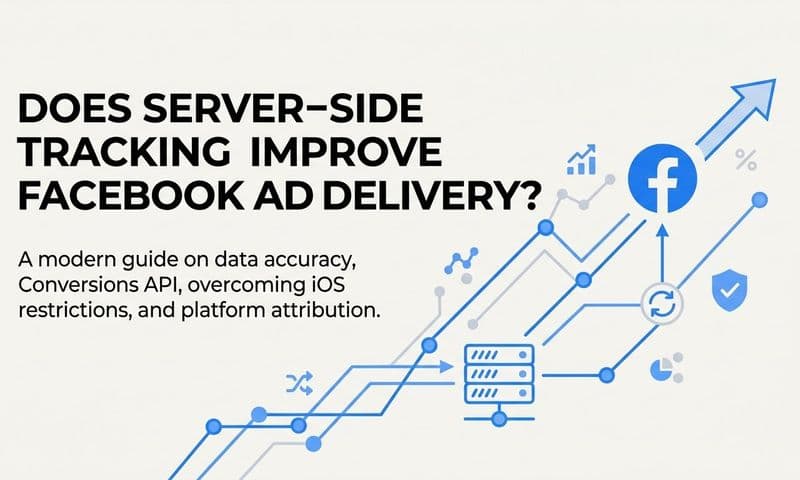
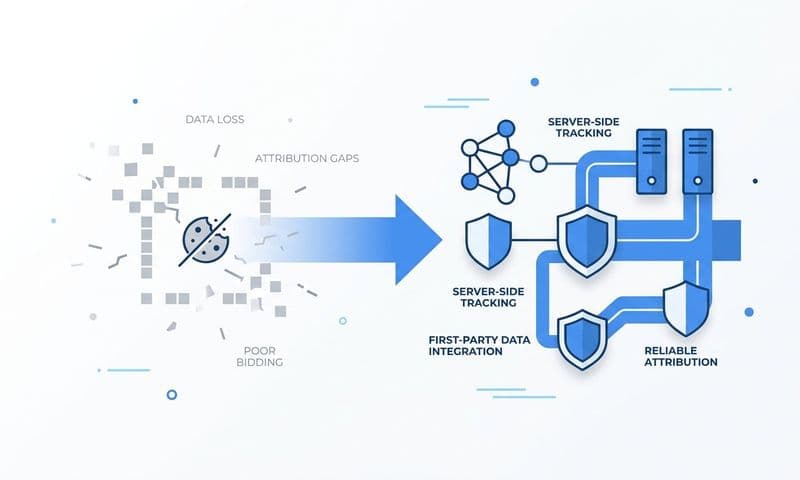
Alongside attribution model selection, the reliability of your underlying tracking data matters enormously. Browser-based pixel tracking has become increasingly unreliable as ad blockers, iOS privacy changes, and third-party cookie restrictions reduce signal quality. Server-side tracking and Conversion APIs, including Meta's Conversions API and Google's Enhanced Conversions, address this by capturing conversion events at the server level and sending them directly to ad platforms.
The result is higher match rates, more accurate optimization signals, and a more complete picture of which ads are actually driving conversions. For direct response advertisers who depend on platform algorithms to optimize toward the right outcomes, the quality of those signals directly affects campaign performance.
Building a Direct Response Tracking Stack That Connects Ads to Revenue
Understanding the principles of good direct response tracking is one thing. Building the infrastructure to execute it is another. A reliable tracking stack for B2B SaaS direct response campaigns typically involves several interconnected components.
Ad platform integrations: Your tracking foundation starts with clean, consistent data flowing from every ad platform you run. This means properly configured campaigns, consistent UTM parameters, and conversion events that are defined the same way across platforms.
CRM connection: This is where the tracking gap gets closed. By connecting your ad platform data to your CRM, you can follow a lead from their first ad click through every sales interaction to the point where they become a paying customer. This connection is what transforms marketing reporting from "we generated 200 leads" to "we generated 12 closed-won deals worth $180,000 in ARR."
Server-side event tracking: As discussed, browser-based pixels alone are no longer sufficient for accurate direct response tracking. Server-side tracking ensures that conversion events are captured reliably and sent back to ad platforms with the data quality needed for effective algorithmic optimization.
Revenue data integration: For subscription businesses, connecting billing data from tools like Stripe to your attribution layer adds another dimension of accountability. You can see not just which campaigns generated customers, but which campaigns generated customers with higher average contract values, better retention rates, or faster expansion revenue.
When these components work together through a unified attribution layer, something important happens: marketing tracking becomes a revenue intelligence function rather than a reporting exercise. You're no longer just measuring marketing activity. You're measuring marketing's contribution to the business outcomes that leadership and investors actually care about.
The feedback loop this creates is one of the most valuable aspects of a well-built tracking stack. When enriched first-party conversion events, including CRM signals that indicate lead quality and deal progression, are fed back to ad platforms through Meta CAPI or Google Enhanced Conversions, the platforms' optimization algorithms learn from better data. They start targeting the audiences most likely to become qualified leads and closed deals, not just the audiences most likely to fill out a form. Building a proper attribution tracking setup is what makes this feedback loop possible.
This compounds over time. Better data in means better targeting out, which means more efficient spend, which means better results, which means more accurate data to feed back in. Teams that build this feedback loop early develop a compounding advantage over competitors still optimizing toward raw form fills.
Platforms like Cometly are built specifically to create this unified layer for B2B SaaS teams, connecting ad platforms, CRM data, and revenue data into a single source of truth for direct response advertising tracking.
Common Direct Response Tracking Mistakes That Distort Your Data
Even teams with good intentions make tracking errors that quietly corrupt their data and lead to poor budget decisions. Understanding the most common mistakes is the first step to avoiding them.
Relying solely on platform-reported conversions: Ad platforms have a structural incentive to show favorable results. They also have genuine technical limitations in what they can observe. Using platform-reported conversions as your only source of truth means accepting a version of reality that is systematically biased toward making the platform look good and missing the downstream outcomes that actually matter.
Failing to deduplicate events between pixel and server-side tracking: When you implement server-side tracking alongside existing browser-based pixels without proper deduplication logic, the same conversion event gets counted twice. This inflates your reported conversion numbers, makes your cost per conversion look artificially low, and causes ad platform algorithms to optimize based on phantom data. Deduplication is a technical requirement, not an optional refinement. Following best practices for tracking conversions accurately helps teams avoid this costly error.
Misaligned conversion event definitions: If your "conversion" in Meta Ads Manager is a form submission, but your sales team considers a qualified demo to be the meaningful threshold, you're optimizing toward a metric that doesn't align with business outcomes. Conversion events need to be defined in terms of what actually matters to the business, then mapped consistently across every platform and reporting layer.
Attribution window mismatches: Different platforms use different default attribution windows. Meta might attribute a conversion to an ad that ran 28 days ago. Google might use a 30-day click window and a 1-day view window. When you add up conversions across platforms without accounting for these differences, you often end up counting the same conversion multiple times. This inflates reported ROAS and creates false confidence in campaign performance.
Missing touchpoints in long B2B buying journeys: For B2B SaaS companies with sales cycles that span weeks or months, early touchpoints are particularly vulnerable to being lost. If a prospect first encounters your brand through a LinkedIn ad but doesn't convert until six weeks later via a Google search, that LinkedIn interaction may fall outside your attribution window entirely. The result is systematic underinvestment in the channels doing the most important work at the top of the funnel. Understanding customer attribution tracking across long buying cycles is essential to solving this problem.
Each of these mistakes individually distorts your data in ways that lead to misallocated budget. Together, they can make it nearly impossible to understand what's actually working in your direct response program.
Turning Tracking Data Into Decisions That Scale Direct Response Results
Accurate tracking data is only valuable if it drives better decisions. The ultimate goal of direct response advertising tracking isn't cleaner reports. It's the ability to confidently move budget toward what works and away from what doesn't.
A unified view of attribution data changes how budget conversations happen. Instead of debating which platform's numbers to trust, you're looking at a single source of truth that shows pipeline generated, revenue influenced, and cost per closed-won deal by campaign, channel, and creative. Budget reallocation decisions become straightforward: invest more in what demonstrably drives revenue, invest less in what drives clicks without downstream outcomes. Learning how to measure advertising effectiveness at this level transforms how teams allocate spend.
This is where AI-driven analysis of attribution data adds a layer of insight that manual reporting can't match. Patterns that would take hours to surface through manual analysis, such as which ad creative formats correlate with faster sales cycles, which audience segments generate deals with higher average contract values, or which channel combinations produce the highest conversion rates from lead to opportunity, can be surfaced automatically.
Cometly's AI-driven recommendations are designed to do exactly this: analyze your attribution data across every channel and surface the insights that help you scale what's working. Rather than spending time building pivot tables, your team can focus on acting on the patterns the data reveals.
The ongoing tracking feedback loop is also a genuine competitive advantage. Teams that continuously feed accurate, enriched conversion data back to ad platforms through server-side integrations are training smarter algorithms. Over time, those algorithms get better at finding the audiences most likely to become customers, not just leads. This drives lower acquisition costs, more predictable revenue growth, and a compounding performance advantage that widens the gap between teams with precise tracking and those without it.
The teams that win in direct response advertising aren't necessarily the ones with the biggest budgets. They're the ones with the clearest picture of what their budget is actually buying.
The Bottom Line on Direct Response Advertising Tracking
Direct response advertising only delivers on its promise when tracking is built to connect every ad interaction to real revenue outcomes. Clicks and form fills are not the destination. Pipeline and closed-won revenue are.
The path to that level of accountability runs through multi-touch attribution that reflects how B2B buyers actually behave, server-side tracking that captures reliable conversion signals in a privacy-first environment, CRM and revenue data integration that closes the gap between marketing metrics and business outcomes, and a unified data layer that makes all of it actionable.
Avoid the common mistakes that distort your data: platform-only reporting, deduplication failures, attribution window mismatches, and missing touchpoints in long buying journeys. Build the feedback loop that compounds performance over time by feeding enriched conversion signals back to ad platforms.
Most importantly, use your tracking data to make decisions, not just reports. The value of precise direct response advertising tracking is the confidence to scale what works and stop funding what doesn't.
Cometly is built specifically to give B2B SaaS teams that clarity. It connects your ad platforms, CRM, and revenue data into a single attribution layer, tracks every touchpoint from first ad click to closed-won deal, and uses AI to surface the insights that drive smarter budget decisions. Ready to close the gap between your ad spend and your revenue data? Get your free demo today and see exactly which campaigns are driving your growth.