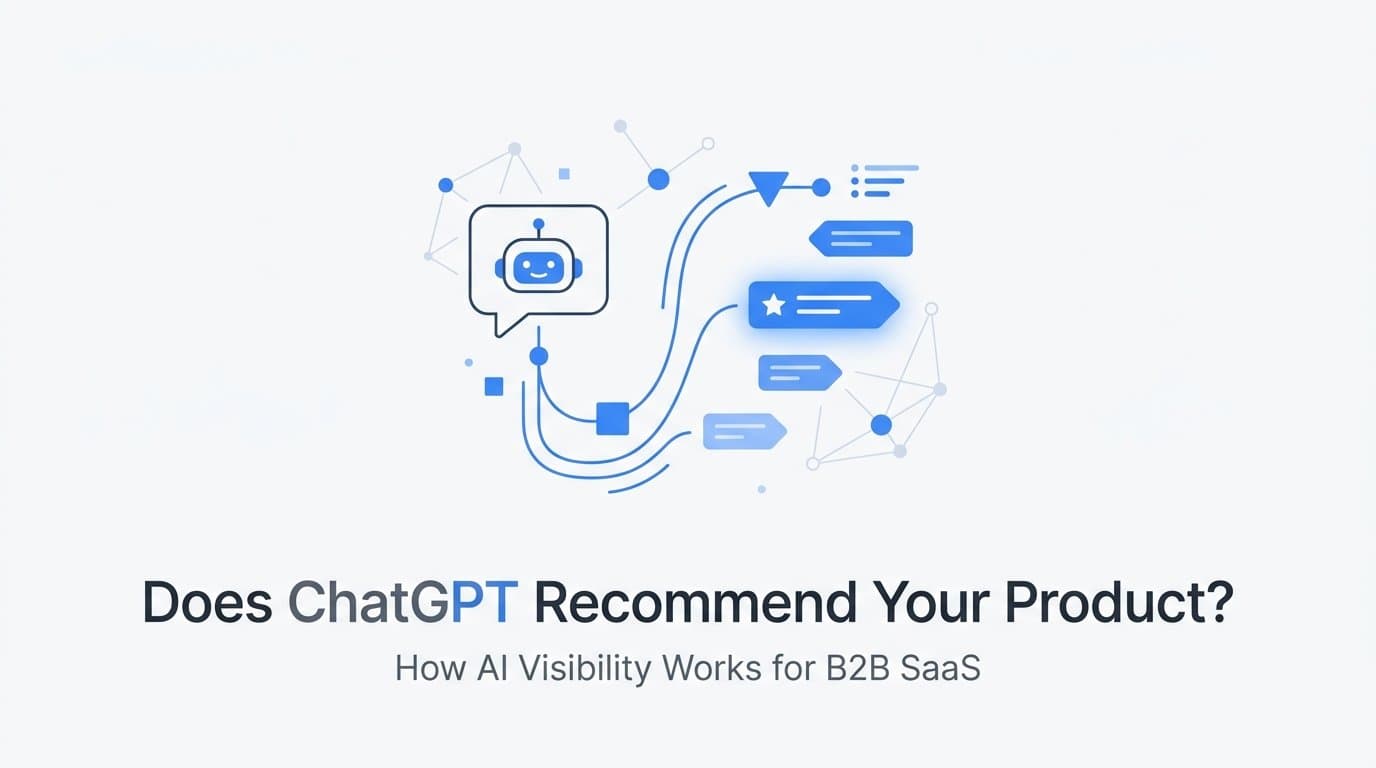
Picture this: a growth-minded VP of Marketing at a B2B SaaS company is evaluating tools to improve their attribution setup. Instead of opening Google, they open ChatGPT and type, "What are the best marketing attribution tools for B2B SaaS?" Within seconds, they get a curated list of recommendations. If your product is on that list, you have a shot at a high-intent buyer. If it is not, you never existed.
This is happening right now, across thousands of software buying decisions every day. Buyers are increasingly turning to AI tools like ChatGPT as their first stop for software research, not review sites, not Google, and certainly not your ads. The implications for B2B SaaS marketers are significant and largely unmeasured.
Your paid campaigns might be perfectly optimized. Your landing pages might convert well. But if ChatGPT has never "heard" of your product in any meaningful sense, you are invisible to a fast-growing segment of high-intent buyers who will never click an ad because they already have their answer.
This is not purely an SEO question. It is a marketing attribution question, a brand authority question, and increasingly, a pipeline question. In this article, we will break down how ChatGPT forms product recommendations, what signals influence AI visibility, why traditional attribution misses this entirely, and what you can do to both build and measure your presence in this new channel.
How ChatGPT Forms Product Recommendations
To understand why your product might or might not appear in an AI recommendation, you need to understand how large language models like ChatGPT learn about products in the first place. These models are trained on enormous volumes of publicly available text from the web: review platforms, industry publications, forums, documentation, comparison articles, and community discussions.
This training process is not real-time. By default, ChatGPT does not browse the web when generating a response. Its knowledge reflects patterns absorbed during training, which means its recommendations are shaped by the cumulative weight of everything written about your product category up to a certain point in time. Think of it less like a search engine and more like a very well-read analyst who has absorbed years of industry content and now synthesizes it on demand.
What this means practically is that brand mentions in high-authority, frequently cited sources carry more weight than obscure blog posts. If your product appears consistently across places like G2, Capterra, Reddit threads, respected industry newsletters, and well-linked comparison articles, it is more likely to surface when someone asks ChatGPT for a recommendation in your category.
Vague or inconsistent positioning works against you here. If your product is described differently across different sources, if some sources call it a "revenue intelligence platform" while others call it "ad tracking software," the model encounters ambiguity. That ambiguity reduces the likelihood of a confident, specific recommendation. AI systems favor clarity, and they reward brands that have established a consistent, recognizable identity across the web.
There is also a recency dimension to consider. While training data has cutoffs, newer model versions and browsing-enabled variants do incorporate more recent signals. This means the work you do today to build presence in authoritative sources is not just a long-term play. It contributes to a compounding signal that grows more powerful over time as it accumulates across more sources and more contexts.
The Signals That Shape AI Product Visibility
If training data is the raw material, signals are the ingredients that determine whether your brand gets surfaced or skipped. Understanding what those signals are gives you a practical roadmap for building AI visibility intentionally.
Third-party validation: This is the most powerful signal category. User reviews on platforms like G2 and Capterra, expert roundups in industry publications, and comparison articles that name-check your product all contribute to the corpus of information an AI model uses to form opinions about a product category. The volume of these signals matters, and so does their recency. A product with hundreds of detailed, recent reviews across multiple platforms sends a much stronger signal than one with a handful of outdated mentions.
Authoritative owned content: Structured, well-written content on your own site also contributes to AI visibility, but with an important condition: it needs to be linked to and referenced by others. A blog post that no one cites is a weak signal. A blog post that gets referenced in industry roundups, linked from comparison pages, and discussed in community threads becomes part of the signal landscape that AI models draw from. The key is creating content that earns external validation, not just content that exists.
Category clarity: This deserves its own emphasis. Products that are clearly positioned within a defined, recognizable category are significantly easier for AI to recommend confidently. When someone asks ChatGPT for "marketing attribution software for B2B SaaS," the model is trying to match buyer intent to a specific product type. If your positioning is crisp and consistent, that match becomes more reliable. If your category positioning is fuzzy or shifts depending on the audience, the model has less to work with.
The practical takeaway is that AI visibility is not a single lever you can pull. It is the outcome of a sustained effort across review generation, content creation, community participation, and consistent positioning. Each of these contributes a thread to a larger tapestry that AI models read when forming recommendations.
Why Traditional Attribution Misses AI-Influenced Buyers
Here is the core measurement problem: when a buyer asks ChatGPT for a software recommendation, decides your product sounds promising, and then navigates directly to your website or searches your brand name in Google, that visit looks like direct traffic or branded organic search in your analytics. The AI interaction that triggered the entire journey is completely invisible.
This is not a minor edge case. It is a structural gap in how most B2B SaaS companies measure their marketing. And it is getting larger as AI tools become a more common part of the software research process.
The result is a growing dark funnel problem. The dark funnel refers to all the buyer research activity that happens outside of tracked channels: peer conversations, review site browsing, community discussions, and now, AI-assisted discovery. Marketers who optimize purely on last-click or even multi-touch attribution models built around ad platforms will systematically undervalue the brand authority work that drives AI recommendations. The work looks invisible because the measurement infrastructure was not built to see it.
B2B SaaS companies with longer sales cycles are especially exposed to this blind spot. A buyer evaluating a marketing attribution platform might interact with ChatGPT multiple times across several weeks before ever clicking an ad, filling out a form, or engaging with a sales rep. They might ask the AI to compare options, explain use cases, and identify the right questions to ask vendors. None of those interactions appear in your CRM or your ad platform dashboards.
What you do see, eventually, is a direct visit or a branded search that seems to come out of nowhere. Without the context of the AI-influenced research journey, that visit gets attributed to "direct" or to whatever ad happened to run closest in time, creating a distorted picture of what actually drove the buyer's decision to engage. The channels that built awareness get no credit, and the channels that happened to be present at the moment of conversion get all of it.
Building the Brand Presence That AI Systems Recognize
Understanding how AI visibility works is only useful if it leads to action. The good news is that the strategies for building AI recognition are grounded in the same principles as strong B2B brand building. You are not learning an entirely new discipline; you are extending what you already know into a new context.
Earn presence in the sources AI draws from most heavily: Software review platforms are not optional. G2, Capterra, and similar sites are among the most heavily weighted sources in AI training data for software categories. Actively generating reviews, responding to feedback, and maintaining complete, accurate profiles on these platforms is foundational. The same applies to industry newsletters, analyst publications, and comparison sites that your buyers already trust.
Publish content that directly answers the questions buyers ask AI tools: If someone asks ChatGPT "what is the best marketing attribution tool for B2B SaaS," your content should exist in the web ecosystem answering exactly that question. This means creating comparison pages, use-case guides, and category explainers that are specific, well-structured, and linked to from other authoritative sources. You are creating the raw material that AI models need to surface your brand in response to relevant queries.
Maintain consistency of positioning across every public-facing surface: Your product category, target audience, and core value proposition should be stated clearly and repeatedly across your website, review profiles, third-party mentions, and community participation. Every time a new source describes your product in a consistent way, it reinforces the signal. Every inconsistency dilutes it. This is not about repetition for its own sake; it is about giving AI systems enough consistent signal to make a confident recommendation.
Participate where your buyers discuss tools: Communities on Reddit, LinkedIn groups, Slack communities, and industry forums are active sources of the kind of peer discussion that carries weight in AI training data. Being genuinely present in these conversations, not just broadcasting, builds the kind of organic mention pattern that contributes to AI visibility over time.
Measuring the Impact of AI Visibility on Your Pipeline
You cannot optimize what you cannot measure, and measuring AI-influenced discovery requires a different approach than measuring paid ad performance. The signals are indirect, but they are real and trackable with the right infrastructure.
Branded search volume as a proxy metric: Because AI-influenced buyers often enter your funnel through branded search after discovering your product through an AI interaction, tracking branded search volume trends over time is a practical leading indicator. When you invest in review generation, publish authoritative content, and earn coverage in relevant publications, rising branded search volume alongside those efforts suggests that AI and other brand channels are amplifying your reach. It is not a perfect signal, but it is a meaningful one.
Behavioral patterns of high-intent direct traffic: Buyers who arrive through AI-influenced paths tend to behave differently than those who click through a cold ad. They are often more familiar with your product before they arrive, more likely to navigate directly to pricing or comparison pages, and more likely to reference your product by name early in sales conversations. Connecting your CRM data to your website analytics helps you identify these patterns and distinguish high-intent direct traffic from low-intent visits.
Comprehensive attribution across the full journey: This is where platforms like Cometly become essential for B2B SaaS teams trying to understand the real drivers of pipeline. When you can connect every touchpoint from first visit to closed revenue, including branded search, direct visits, and the content interactions that precede deal velocity, you start to see the full picture rather than just the last click. Attribution platforms that integrate with your CRM and ad channels give you the ability to identify which content and brand-building efforts are contributing to pipeline, even when the initial discovery happened outside a tracked ad click.
The goal is not to attribute every deal to a specific AI interaction, which is currently not possible. The goal is to build enough measurement infrastructure that you can see the downstream effects of AI visibility and make smarter budget decisions as a result.
Turning AI Discoverability Into a Scalable Strategy
AI visibility is not a campaign. It is a compounding asset. Every review you earn, every authoritative article you publish, every community thread where your product gets mentioned adds to the cumulative signal that shapes future AI recommendations. The brands that invest in this consistently will widen their advantage over time, while those who treat it as a one-time effort will find themselves falling further behind.
The strategic shift required is treating AI discoverability as a core component of your marketing attribution framework, not a separate initiative. When you can see which content drives branded search, which channels bring in high-intent direct traffic, and which touchpoints precede fast-moving deals, you can allocate budget more intelligently across both paid and organic efforts. AI visibility work and paid acquisition are not competing priorities; they are complementary layers of a well-built demand generation strategy.
Use performance data from your attribution platform to identify which customer segments are arriving through AI-influenced paths. These buyers often share characteristics: they arrive more informed, they move faster through the sales cycle, and they tend to have done more comparison research before engaging. Understanding those patterns helps you double down on the content and positioning that resonates with those buyers, creating a feedback loop between what you publish and what drives pipeline.
Practically, this means building a content calendar that balances top-of-funnel awareness content with the specific, category-defining content that AI models draw from. It means treating your G2 profile as a strategic marketing asset, not an afterthought. And it means having the measurement infrastructure in place to connect brand-building efforts to revenue outcomes, so you can make the case for continued investment with data rather than intuition.
The Full Picture Starts With Better Measurement
AI-driven product discovery is not a future trend you can afford to wait on. It is a present reality that is already shaping how B2B buyers find, evaluate, and choose software. The buyers who ask ChatGPT for a recommendation before visiting your website are real, they are high-intent, and many of them are making decisions right now.
Getting recommended by ChatGPT is not luck. It is the result of deliberate brand authority work: consistent positioning, active review generation, authoritative content that earns external links, and genuine presence in the communities where your buyers discuss tools. These are the signals that AI models use to form confident recommendations, and they are entirely within your control to build.
But building AI visibility without the measurement infrastructure to see its impact is only half the equation. The buyers you reach through AI-influenced paths will show up in your funnel as direct traffic, branded searches, and fast-moving deals that seem to come from nowhere. Without comprehensive attribution, those signals are invisible, and the budget decisions that follow will be made on incomplete information.
Cometly connects every touchpoint to revenue so B2B SaaS marketers can finally see the full picture. From the first ad click to closed-won revenue, from branded search spikes to CRM events, Cometly gives you the single source of truth you need to understand what is actually driving pipeline, including the dark funnel paths that AI-influenced buyers take. When you can see everything, you can optimize everything.
Get your free demo today and start capturing every touchpoint to maximize your conversions.