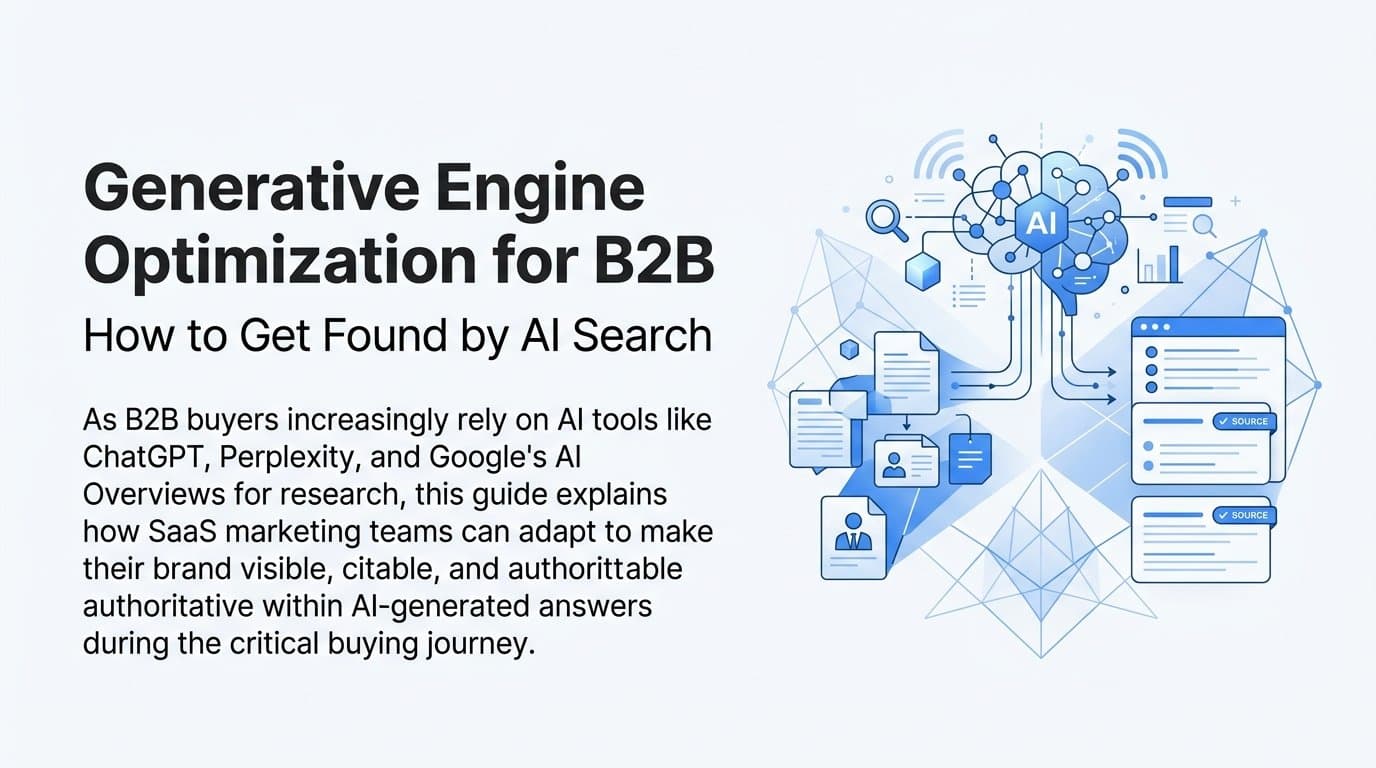
Something has quietly shifted in how B2B buyers start their research. Instead of opening a browser tab and typing a query into Google, a growing number of software buyers are turning to AI-powered tools like ChatGPT, Perplexity, and Google's AI Overviews to get synthesized answers to complex questions. "What are the best marketing attribution tools for B2B SaaS?" "How does multi-touch attribution work?" "Which platforms integrate with Salesforce?" These are the kinds of questions that used to drive organic search traffic. Now, they are increasingly being answered directly by AI, often without a single click to your website.
For B2B SaaS marketing teams, this shift is not a distant trend to monitor. It is happening now, and it is quietly reshaping which brands get discovered during the research phase of the buying journey. If your brand is not showing up in AI-generated answers, you are invisible to a segment of buyers who may never make it to a traditional search results page.
This is where generative engine optimization, or GEO, enters the picture. GEO is the emerging discipline focused on making your brand visible, citable, and authoritative within AI-generated responses. It is distinct from traditional SEO in important ways, but it builds on the same foundation. For B2B SaaS companies with longer sales cycles and complex buying committees, getting GEO right is quickly becoming a meaningful competitive advantage. This article breaks down what GEO actually means, why it matters specifically for B2B, how to execute it, and how to measure its impact on pipeline and revenue.
How AI Search Is Reshaping the B2B Discovery Phase
Traditional search engines present a list of links. The buyer clicks through, reads, evaluates, and decides what to trust. AI-powered search tools work differently. They synthesize information from multiple sources and deliver a single, structured answer. The buyer does not see ten competing results. They see one recommended response, often with a handful of cited sources embedded within it.
This is a fundamental change to the discovery phase of the B2B buying journey. When a procurement manager or marketing director asks an AI tool to recommend marketing attribution software for a SaaS company, the AI does not present a neutral list of options. It generates a recommendation informed by the content it has been trained on and can retrieve in real time. The brands that appear in that response are not necessarily the ones with the largest ad budgets. They are the ones that AI systems have identified as authoritative, relevant, and credible sources of information on that topic.
For B2B software categories specifically, this matters enormously. Buyers researching complex tools often start with educational questions before they ever visit a vendor website. They want to understand the category, compare approaches, and identify which players are considered credible by trusted sources. AI tools are increasingly the first stop for that kind of research. If your brand is not being cited in those early-stage AI responses, you are missing the moment when buyers are forming their initial consideration set.
The signals that drive visibility in AI-generated answers are also different from the signals that drive traditional search rankings. Page authority and backlink profiles still matter, but AI systems also weight factors like topical comprehensiveness, content structure, semantic clarity, and citation frequency across the web. A brand that ranks on page one for a single keyword but lacks depth across a topic area may perform well in traditional search while remaining largely invisible in AI-generated responses. This gap is why a new discipline is needed, and why GEO is becoming a core part of the B2B marketing toolkit.
Defining Generative Engine Optimization
GEO is the practice of structuring, publishing, and distributing content so that generative AI systems recognize your brand as an authoritative, citable source for specific topics and queries. The goal is not just to rank in traditional search results but to be the source that AI models draw from when synthesizing answers for your target buyers.
To understand how GEO works mechanically, it helps to understand how AI search systems retrieve information. Large language models are trained on vast datasets, which means your brand's existing online presence, published content, and mentions across the web all contribute to how these models understand what your company does and what it is authoritative about. Many AI search tools also use real-time retrieval, pulling from indexed web content to supplement their training data. This means that fresh, well-indexed content can influence AI outputs relatively quickly.
Several signals influence whether your brand gets surfaced in AI-generated responses. Topical authority is one of the most significant: AI systems favor brands that demonstrate comprehensive expertise across a subject area, not just isolated pages that target individual keywords. Structural clarity also matters. Content that directly answers specific questions in concise, quotable language is easier for AI systems to extract and cite. Original data, proprietary frameworks, and unique analysis carry additional weight because they offer information that cannot be found elsewhere, making them more valuable as reference points. Citation signals, meaning how frequently your content is referenced by other credible sources, reinforce your authority in a given domain.
It is worth being direct about the relationship between GEO and SEO: GEO is additive, not a replacement. Strong technical SEO remains the foundation. If your site is not properly indexed, if page speed is poor, or if your content structure is disorganized, AI retrieval systems will struggle to surface your content. Schema markup, clean site architecture, and crawlability all support GEO execution. What GEO adds is a layer of content strategy decisions that optimize for synthesis rather than ranking position alone. The question shifts from "how do I rank for this keyword?" to "how do I become the definitive source on this topic that AI systems trust and cite?"
The B2B SaaS Opportunity Inside GEO
GEO is relevant across industries, but it is particularly high-value for B2B SaaS companies. The reason comes down to the nature of the buying process. B2B software purchases typically involve extended research phases, multiple stakeholders, and a significant amount of self-directed education before any vendor conversation begins. Buyers are trying to understand the category, evaluate approaches, identify shortlisted vendors, and build internal consensus, often over weeks or months. AI tools are increasingly being used throughout this process.
Consider the category-level opportunity. When a buyer asks an AI tool which marketing attribution platform is best suited for a B2B SaaS company, the brands that appear in that answer are not determined by who spent the most on paid ads. They are determined by which brands have built the strongest topical authority signals around marketing attribution for SaaS. That is a content and authority problem, not a budget problem. It means that mid-market SaaS companies with disciplined content strategies can compete directly with larger players for visibility in AI-generated responses, in a way that would be difficult to achieve through paid channels alone.
GEO also intersects naturally with the thought leadership and content marketing investments that B2B teams already make. If your team is producing long-form educational content, category explainers, comparison guides, and original research, you are already building the raw material for a GEO strategy. The practical difference is in how that content is structured and what signals it prioritizes. Content written primarily for keyword ranking may need to be restructured to also optimize for AI synthesis: clearer definitions, more direct answers to specific questions, and stronger topical coverage across related subtopics.
For growth-minded marketing leaders, this is an important reframe. GEO is not a new budget line that competes with existing investments. It is a strategic lens applied to content that your team is likely already producing. The teams that adapt their approach early will build topical authority that compounds over time, making their brands progressively more visible in AI-generated research environments as AI search usage continues to grow.
Core GEO Tactics Built for B2B SaaS Teams
Understanding GEO conceptually is one thing. Executing it requires specific tactical decisions about how content is created, structured, and distributed. Here are the approaches that matter most for B2B SaaS marketing teams.
Build deep topical clusters, not isolated pages. AI models reward brands that demonstrate comprehensive expertise across a subject area. A single well-ranked article about marketing attribution is far less powerful than a coordinated cluster of content that covers attribution models, measurement frameworks, integration approaches, use cases by company size, and comparisons between methodologies. Pillar content establishes the core framework, and supporting articles signal depth. When AI systems evaluate your brand's authority on a topic, they are looking at the breadth and coherence of your coverage, not just the performance of a single page.
Structure content for direct, quotable answers. AI systems extract information from content and synthesize it into responses. Content that is written in clear, concise, directly answerable language is far easier to cite than content that buries answers in long-winded paragraphs. FAQ sections, definition blocks, and structured explanations all help. When you write a section that defines what marketing attribution is, write it in a way that could stand alone as a quoted answer. Think about the specific question a buyer might ask an AI tool, then write a paragraph that answers it precisely and completely.
Invest in original data and proprietary insights. AI systems increasingly favor content that contains unique information: original research, first-party data, proprietary frameworks, or analysis that cannot be replicated by summarizing other sources. For B2B SaaS marketing teams, this could mean publishing benchmark data from your own customer base, sharing original frameworks for how you think about a problem, or conducting primary research with your target audience. This type of content becomes a reference point that AI models return to because it offers something genuinely distinctive.
Pursue external citations and mentions. Being referenced by other credible sources reinforces your authority in a given domain. This means earning coverage in industry publications, being cited in analyst reports, and building the kind of brand presence that other content creators naturally reference. Traditional link-building supports this goal, but the intent is broader: you want your brand to be part of the conversation that AI systems have indexed as authoritative in your category.
Maintain semantic clarity about what your brand does. AI systems need to understand clearly what category your product belongs to and what problems it solves. Content that is vague about your product's function or that avoids direct category language makes it harder for AI models to surface you in relevant queries. Be explicit and consistent about your category, your use cases, and the specific buyer problems you address.
Measuring GEO When Standard Analytics Fall Short
Here is the measurement challenge that most B2B marketing teams are not yet prepared for: when a buyer discovers your brand through an AI-generated response, that interaction is often invisible to standard analytics setups. The referral source may show up as direct traffic, as a generic search referral, or not at all. The buyer read about you in a ChatGPT response, visited your site, and your analytics has no record of where they came from.
This is not a minor inconvenience. It is a structural gap in how most teams understand their pipeline. If GEO is working and driving early-stage brand awareness among buyers who later convert, but you cannot connect those conversions back to the content that influenced them, you will undervalue your GEO investment and struggle to justify continued resources.
The solution is not to wait for AI referral attribution to become a native feature of every analytics platform. The solution is to build attribution infrastructure that is robust enough to handle ambiguous entry points. Multi-touch attribution becomes more important, not less, in a world where the top-of-funnel touchpoint may be an AI interaction that leaves no direct referral trace. Server-side conversion tracking helps capture events that client-side tracking misses. And connecting ad platform data, CRM data, and website behavior data into a unified view makes it possible to identify patterns even when individual touchpoints are unclear.
This is where a platform like Cometly becomes directly relevant to GEO strategy. Cometly is built to capture every touchpoint across the customer journey, from the first anonymous visit through to closed-won revenue. When a buyer arrives through an AI-generated referral and their entry point is obscured, the downstream journey still leaves signals. Which content pages did they visit? What did they engage with before converting to a lead? Which campaigns were running when they eventually clicked a paid ad? By connecting these signals across the full funnel, teams can identify which content assets are contributing to pipeline even when the initial touchpoint is not a clean, attributable click.
For B2B SaaS teams investing in GEO, this kind of attribution infrastructure is not optional. It is the mechanism that lets you prove the value of your content investment and make data-driven decisions about where to double down.
Building a GEO Strategy That Compounds
One of the most important characteristics of GEO as a channel is that it compounds over time. Unlike paid advertising, which generates visibility only while budget is flowing, topical authority built through consistent, high-quality content continues to influence AI outputs as models are updated and retrieval systems evolve. The brand that invests in comprehensive, authoritative content today is building an asset that grows more valuable as AI search becomes more prevalent.
For B2B SaaS marketing teams starting to build a GEO strategy, a practical approach begins with an audit of existing content. Map your current content against the topics and questions your ideal buyers are most likely to ask AI tools. Where are the gaps? Which subtopics are underdeveloped? Which questions do you answer well in isolation but have not connected into a coherent topical cluster? The audit reveals where to prioritize new content creation and where to restructure existing content for better AI synthesis.
From there, identify the specific queries your target buyers are entering into AI tools. This requires some research and experimentation: run the queries yourself, observe what AI tools currently say about your category, and note which brands are being cited and why. This gives you a direct view of the competitive landscape in AI-generated responses and helps you identify the content gaps that are allowing competitors to be cited instead of you.
Prioritize content that answers high-intent research questions with depth and precision. Category explainers, methodology guides, comparison frameworks, and original research all perform well in GEO contexts. Each piece of content should be written to serve the buyer's research needs first, with clear structure that makes it easy for AI systems to extract and reference.
Finally, connect your GEO execution to revenue attribution from the start. Teams that invest in content without the infrastructure to measure downstream impact will always struggle to justify and scale that investment. Building attribution infrastructure in parallel with your GEO strategy means you can surface the pipeline impact of your content over time, identify which topics and formats are driving the most valuable traffic, and make confident decisions about where to invest next.
Putting It All Together
Generative engine optimization is not a future consideration. It is an active shift in how B2B buyers discover, research, and evaluate software vendors. The buyers who will eventually become your customers are already using AI tools to form their initial consideration sets, and the brands that show up in those AI-generated responses have a meaningful head start in the sales process.
The path forward for B2B SaaS marketing teams is clear. Build topical authority by covering your subject area with depth and consistency. Structure content so that AI systems can extract and cite direct, quotable answers. Invest in original insights and proprietary frameworks that give AI models something distinctive to reference. And build the attribution infrastructure that lets you measure the downstream impact of those content investments on pipeline and revenue.
That last piece is where many teams will fall short if they are not intentional about it. GEO creates attribution complexity because AI-driven touchpoints are often invisible to standard tracking. Cometly is built to solve exactly this problem. By capturing every touchpoint from the first interaction to closed-won revenue and connecting ad platform data, CRM events, and website behavior into a single source of truth, Cometly gives B2B SaaS marketing teams the visibility they need to understand what is actually driving pipeline, even when the entry point is an AI-generated referral that traditional analytics would miss.
If you are building a content and GEO strategy and want to ensure your attribution infrastructure can keep pace, Get your free demo and see how Cometly tracks every touchpoint from first interaction to closed deal.