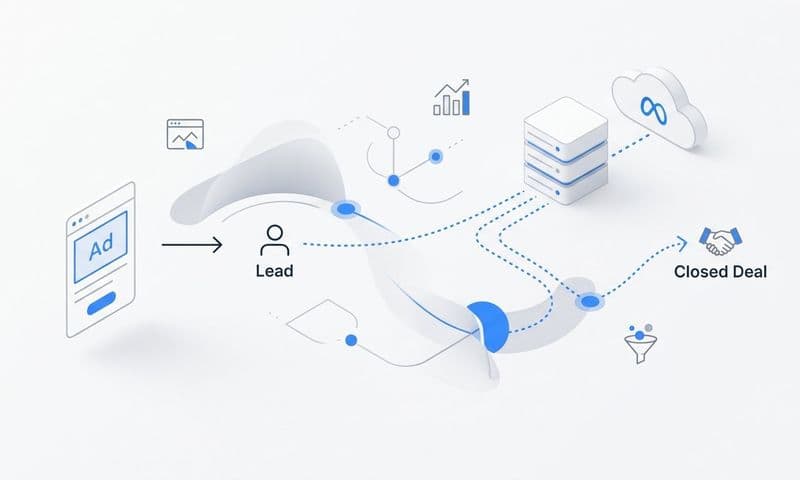
You're spending thousands on ads every month. Traffic looks good. Leads are coming in. But when the sales team closes deals, nobody can say for sure which marketing efforts actually drove those wins.
Sound familiar?
Most marketers face this exact problem. They know marketing contributes to revenue, but they can't draw a straight line from a specific campaign to a specific sale. Without that connection, you're flying blind—guessing which channels deserve more budget and which ones are quietly draining resources.
The solution is marketing attribution: a system that connects every touchpoint in the customer journey to actual revenue. When you implement proper attribution, you stop relying on surface metrics like clicks and impressions. Instead, you see exactly which ads, channels, and campaigns generate real sales.
This guide walks you through six practical steps to set up marketing attribution that tracks revenue, not just activity. You'll learn how to define your attribution goals, build the tracking infrastructure, connect your data sources, choose the right attribution model, analyze what's actually driving sales, and optimize your campaigns based on real revenue data.
By the end, you'll have a clear process for proving marketing ROI and making confident budget decisions backed by data.
Step 1: Define Your Attribution Goals and Sales Cycle
Before you build any tracking system, you need to know exactly what you're measuring. Start by defining what "sales" means for your business.
For an ecommerce company, a sale is straightforward: a completed purchase transaction. For a B2B SaaS company, it might be a closed-won deal in your CRM. For a subscription business, it could be the moment someone converts from free trial to paid plan. Get specific about the conversion event that represents real revenue.
Next, map your typical customer journey length. This matters because it determines how you'll track touchpoints and how long you need to monitor each prospect.
Ecommerce journeys are often short—someone might see an ad, click through, and purchase within the same day. B2B sales cycles run much longer. A prospect might download a whitepaper, attend a webinar, read several blog posts, and take three sales calls before signing a contract 60 days later.
Understanding your timeline helps you set realistic expectations for attribution data. If your sales cycle is 90 days, you won't see complete attribution results for three months after launching a new campaign.
Now list every marketing channel you need to track. Don't just focus on paid ads. Include organic search, email campaigns, social media, referral traffic, content marketing, webinars, and any other touchpoint where prospects interact with your brand.
The goal is comprehensive visibility. If you only track paid ads but ignore email nurture sequences, you'll never understand how those channels work together to drive conversions.
Write down the specific questions you want attribution to answer. These might include: Which campaigns drive the most revenue? What's my true cost per acquisition across all touchpoints? Which channel combinations produce the highest-value customers? How many touches does it take before someone converts?
These questions become your North Star. Every tracking decision you make should help you answer them.
Document everything: your conversion events, average sales cycle length, the channels you're tracking, and your key questions. This becomes your attribution blueprint.
Success indicator: You have a written document that clearly defines what you're measuring, how long your sales cycle runs, which channels matter, and what questions you need answered. This clarity prevents scope creep and keeps your attribution system focused on what actually matters for your business.
Step 2: Implement Cross-Platform Tracking Infrastructure
Now you need the technical foundation that captures data from every marketing touchpoint. This is where many attribution projects succeed or fail.
Start with UTM parameters. These are tags you add to every campaign URL that tell your analytics system where traffic came from. A properly tagged URL looks like this: yoursite.com/?utm_source=facebook&utm_medium=paid&utm_campaign=spring_sale&utm_content=video_ad_1
The critical piece here is consistency. If one campaign manager uses "facebook" and another uses "Facebook" or "fb," your data fragments. Create a standardized naming convention document and make sure everyone on your team follows it religiously. Understanding what UTM tracking is and how UTMs help your marketing is essential for accurate attribution.
Use lowercase for everything. Separate words with underscores. Be specific enough to identify individual ads but consistent enough to roll up data when needed.
Next, install tracking pixels from your ad platforms. Meta Pixel, Google Ads conversion tracking, LinkedIn Insight Tag, TikTok Pixel—each platform needs its code snippet on your website to track conversions and build audience data.
But here's where it gets tricky: browser-based tracking alone isn't enough anymore.
iOS privacy restrictions, browser cookie limitations, and ad blockers mean you're losing visibility on 30-50% of your traffic if you only rely on pixels. The data you're missing isn't random—it's often your highest-intent users who are privacy-conscious.
This is why server-side tracking has become essential. Instead of relying solely on browser cookies, server-side tracking sends conversion data directly from your server to ad platforms and analytics tools. This bypasses browser restrictions and gives you more complete data.
Implementing server-side tracking typically involves setting up a server endpoint that receives conversion events from your website or CRM, then forwards that data to Meta's Conversions API, Google's offline conversion tracking, or other platform APIs.
Add first-party cookies to your website. These are cookies set by your own domain rather than third-party ad platforms. They're more reliable, persist longer, and aren't blocked as aggressively by browsers.
Use unique identifiers to track users across sessions. When someone fills out a form, you can tie their email address to their browsing behavior. When they return days later from a different device, you can still connect their journey.
The most common mistake at this stage is inconsistent implementation. One landing page has proper tracking, another doesn't. One campaign uses UTM parameters correctly, another skips them. These gaps create blind spots in your attribution data.
Run a tracking audit. Visit your website from different sources. Fill out forms. Make test purchases. Verify that every action appears correctly in your analytics with the right source attribution. Learning how to track marketing campaigns effectively prevents these common pitfalls.
Success indicator: You can see complete user journeys in your analytics—from first touch to conversion—with accurate source data for every session. When you check your analytics, traffic sources are clearly labeled and conversion events fire consistently.
Step 3: Connect Your CRM and Revenue Data Sources
You're tracking website behavior, but that's only half the picture. The real magic happens when you connect marketing touchpoints to actual revenue in your CRM or payment system.
This is called closing the loop. You need to see not just that someone clicked an ad and filled out a form, but that they eventually became a paying customer worth $5,000 in annual recurring revenue.
Start by integrating your CRM with your attribution platform. If you use HubSpot, Salesforce, Pipedrive, or another CRM, you need a connection that syncs deal data back to your marketing analytics. For teams using Salesforce specifically, understanding Salesforce marketing attribution capabilities is crucial for proper integration.
The integration should capture key revenue data: deal value, close date, deal stage, and any custom fields that matter for your business like customer segment or product purchased.
For ecommerce businesses, this means connecting your payment processor or shopping platform. Shopify, WooCommerce, Stripe—whatever system processes transactions needs to feed purchase data into your attribution system.
The goal is creating a single view where you can see both the marketing journey and the revenue outcome. When someone converts, you should be able to trace backward through every ad they clicked, every page they visited, every email they opened. Knowing how to connect all marketing data sources makes this unified view possible.
Pay special attention to the handoff points. When does a marketing-qualified lead become a sales-qualified lead? When does a sales-qualified lead become a closed-won deal? Make sure your systems capture and sync data at each transition.
Many attribution breakdowns happen at these handoffs. Marketing passes a lead to sales, but the CRM doesn't capture which campaign generated that lead. Sales closes the deal, but the revenue never flows back to marketing analytics. These gaps make attribution impossible.
Once you've set up the integration, verify it's working correctly. Pick a few recent conversions and trace them manually. Can you see the complete journey from first touch to closed deal? Does the revenue value match what's in your CRM?
If you spot discrepancies, troubleshoot immediately. Common issues include: mismatched email addresses between systems, deals that close before the sync runs, or CRM fields that aren't mapped correctly to your attribution platform.
Some businesses need to connect multiple revenue sources. You might have online purchases, offline sales, and subscription renewals all contributing to revenue. Make sure your attribution system captures all of them.
Success indicator: When you look at your attribution dashboard, you see marketing touchpoints on one side and actual revenue on the other—all in a single view. You can click on any closed deal and see the complete marketing journey that led to it.
Step 4: Select the Right Attribution Model for Your Business
Now comes the strategic decision: how do you assign credit when multiple touchpoints contribute to a sale?
Attribution models are the rules that determine which marketing efforts get credit for a conversion. Different models tell different stories about your marketing performance.
First-touch attribution gives 100% credit to the first interaction. If someone discovered you through a Facebook ad, clicked away, came back three times through different channels, and eventually purchased, Facebook gets all the credit. This model highlights what drives awareness and new customer acquisition.
Last-touch attribution does the opposite—100% credit goes to the final touchpoint before conversion. If that same customer's last click came from a Google search ad, Google gets all the credit. This model shows what closes deals and drives immediate conversions.
Linear attribution splits credit equally across all touchpoints. If there were five interactions in the customer journey, each gets 20% credit. This provides a more balanced view but can overweight minor touchpoints.
Time-decay attribution gives more credit to recent interactions. Touchpoints closer to the conversion get weighted more heavily than earlier ones. This reflects the reality that the final touches often matter more in pushing someone over the finish line.
Position-based attribution (also called U-shaped) assigns 40% credit to the first touch, 40% to the last touch, and splits the remaining 20% among middle interactions. This acknowledges that both awareness and conversion moments are crucial.
So which model should you use?
Match your model to your goals and sales cycle. If you're focused on building awareness and want to understand what brings new prospects into your funnel, first-touch attribution provides valuable insights. You'll see which channels are best at discovery.
If you're optimizing for conversions and want to know what directly drives purchases, last-touch attribution is useful. It shows which final touchpoints convert browsers into buyers.
For businesses with longer sales cycles and complex customer journeys, multi-touch models become essential. A B2B company with a 60-day sales cycle needs to understand the full journey—not just the first or last touch. Understanding how to calculate marketing attribution helps you implement these models correctly.
Here's the reality: no single model tells the complete story. The best approach is comparing multiple models to gain different perspectives.
You might discover that Facebook drives strong first-touch attribution but weak last-touch attribution. That tells you Facebook is great for awareness but doesn't close deals. Google might show the opposite pattern—weak first-touch but strong last-touch—suggesting it captures high-intent buyers ready to convert.
Start with one primary model that aligns with your business goals, but plan to analyze others for comparison. Many attribution platforms let you toggle between models to see how credit shifts.
Success indicator: You've selected a primary attribution model and can clearly explain why it fits your business type and sales cycle. You understand what insights each model provides and have a plan to compare multiple models as you analyze data.
Step 5: Analyze Attribution Data and Identify Revenue Drivers
Your tracking is live, your data is flowing, and you've chosen your attribution model. Now it's time to extract insights that change how you allocate budget.
Start by reviewing which channels and campaigns drive the most attributed revenue—not just leads or clicks, but actual sales dollars. This is the fundamental shift that attribution enables.
You might have been celebrating a campaign that generated 500 leads. But when you look at attributed revenue, you discover those leads converted at a terrible rate and produced only $10,000 in sales. Meanwhile, a smaller campaign with 100 leads generated $50,000 in revenue.
This is the power of revenue-based attribution. It cuts through vanity metrics and shows what actually matters. Learning how to attribute revenue to marketing channels transforms your ability to identify true performance drivers.
Calculate your true cost per acquisition for each channel. Take your total ad spend and divide it by the number of attributed sales. If you spent $10,000 on Facebook and it drove 20 sales, your CPA is $500. Do this for every channel.
You'll likely find surprises. Channels that looked expensive based on cost per click suddenly look efficient when measured by cost per sale. Others that seemed cheap reveal themselves as budget drains.
Compare performance across different attribution models. Look at the same campaign through first-touch, last-touch, and multi-touch lenses. Where do the stories diverge?
If a channel shows strong first-touch attribution but weak last-touch, it's a top-of-funnel awareness driver. You need other channels to close those prospects. If a channel dominates last-touch but barely appears in first-touch, it's capturing demand that other channels created.
Neither pattern is inherently good or bad—they just tell you different things about how channels function in your marketing ecosystem.
Look for patterns in high-value customers. Which touchpoint combinations lead to the biggest deals? You might discover that prospects who engage with both webinar content and retargeting ads convert at 3x the rate of those who only see one touchpoint.
These patterns reveal winning formulas you can replicate. If you know that email nurture followed by a demo request produces your best customers, you can design campaigns specifically to drive that sequence. Understanding how to attribute revenue to specific campaigns helps you identify these high-performing sequences.
Identify underperforming campaigns that consume budget without driving sales. These are your optimization opportunities. You're not looking to kill everything that doesn't work—you're looking for clear losers that free up budget for winners.
Segment your analysis by customer type, deal size, product line, or any other dimension that matters for your business. Attribution often reveals that different channels work better for different customer segments.
Success indicator: You can rank your marketing channels by actual revenue contribution with specific dollar amounts. You know your true cost per acquisition for each channel and can identify which campaigns drive the highest-value customers.
Step 6: Optimize Campaigns and Feed Better Data to Ad Platforms
Attribution insights are worthless if you don't act on them. This final step is about using your data to improve performance and scale what works.
Start with budget reallocation. Take money from channels and campaigns that show weak revenue attribution and move it to proven performers. This sounds obvious, but many marketers resist it because they're emotionally attached to certain channels or campaigns.
Let the data guide you. If LinkedIn drives 40% of your attributed revenue but only gets 20% of your budget, that's a clear signal to shift resources.
But don't just reallocate—feed your attribution data back to ad platforms to improve their optimization algorithms. This is one of the most powerful but underutilized tactics in modern marketing.
Meta's Conversions API and Google's offline conversion tracking let you send conversion data directly from your server to their systems. When you feed them accurate revenue data—including conversions that happened offline or after long consideration periods—their algorithms get smarter.
The ad platforms can then optimize for the conversions that actually matter to your business, not just the ones they can track through browser pixels. This typically improves ROAS by 20-40% because the platforms are optimizing toward real business outcomes.
Use attribution insights to refine your targeting and creative strategy. If you discover that certain audience segments produce much higher attributed revenue, build lookalike audiences based on those high-value converters.
If specific ad creatives show strong revenue attribution while others don't, double down on the winning creative approach. Test variations that amplify what's working.
Set up regular attribution reviews—weekly for fast-moving ecommerce businesses, monthly for longer B2B sales cycles. Marketing performance shifts constantly. New competitors enter the market, ad costs fluctuate, audience behavior changes.
Regular reviews help you catch these shifts early. You'll spot when a previously strong channel starts declining or when a new channel shows surprising promise. Knowing how to measure cross-channel marketing performance ensures you're evaluating all channels consistently.
Create a simple dashboard that shows your key attribution metrics at a glance. You want to see: total attributed revenue by channel, cost per acquisition by channel, revenue attribution by campaign, and conversion rates across different touchpoint combinations.
This dashboard becomes your marketing command center. Before making any significant budget decision, check the data.
Remember that attribution is iterative. Your first implementation won't be perfect. You'll discover tracking gaps, find edge cases your model doesn't handle well, and realize you need to track additional touchpoints.
That's normal. The key is continuous improvement. Each month, your attribution system should become more accurate and more valuable for decision-making.
As your business evolves—launching new products, entering new markets, trying new channels—your attribution system needs to evolve with it. Revisit your goals from Step 1 quarterly and adjust your tracking and models as needed.
Success indicator: You're actively using attribution data to make budget decisions every week or month. Your ROAS improves as you scale winning channels and cut underperformers. You can confidently explain to stakeholders which marketing efforts drive revenue and why.
Putting It All Together
Let's recap the six steps to attribute sales to marketing accurately:
Define your attribution goals, conversion events, and key questions. Map your sales cycle and list every channel you need to track.
Implement comprehensive tracking infrastructure with UTM parameters, tracking pixels, and server-side tracking to capture complete customer journeys.
Connect your CRM and revenue data sources so you can see marketing touchpoints alongside actual sales outcomes in one view.
Select the right attribution model for your business—matching your model to your goals, sales cycle, and the questions you need answered.
Analyze your attribution data to identify which channels drive real revenue, calculate true cost per acquisition, and spot high-value customer patterns.
Optimize based on insights by reallocating budget to proven performers and feeding conversion data back to ad platforms for better algorithmic optimization.
Accurate marketing attribution transforms how teams operate. Instead of arguing about which channel deserves credit, you have data. Instead of guessing where to invest next quarter's budget, you have revenue proof. Instead of defending marketing spend to executives, you can show exactly which campaigns drive growth. Mastering how to prove marketing ROI becomes straightforward when you have proper attribution in place.
The technical implementation takes work, but the payoff is massive: confident decision-making backed by revenue data instead of vanity metrics.
Tools like Cometly simplify this entire process by connecting your ad platforms, CRM, and website tracking in one unified system. You get multi-touch attribution across every channel, AI-powered recommendations for optimization, and conversion sync that feeds better data back to ad platforms—all without building custom integrations or managing multiple dashboards.
Ready to elevate your marketing game with precision and confidence? Discover how Cometly's AI-driven recommendations can transform your ad strategy—Get your free demo today and start capturing every touchpoint to maximize your conversions.