Ad algorithms are only as smart as the data you feed them. This is the single most important thing to understand if you want to improve ad performance in 2026. Whether you are running campaigns on Meta, Google, or LinkedIn, the platform's machine learning engine depends on accurate, rich conversion signals to find the right buyers at the right cost.
When that data is incomplete, delayed, or misattributed, the algorithm does not fail silently. It optimizes confidently in the wrong direction. Your budget follows. And by the time you notice, you have spent weeks funding a machine that was trained on the wrong outcomes.
This is the core challenge for B2B SaaS marketing teams today. The gap between what ad platforms think is happening and what is actually driving pipeline is often significant, and it widens every time a browser update, ad blocker, or iOS privacy change strips another layer of signal from your pixel-based tracking.
The good news is that this is a solvable problem. Improving ad algorithm performance is not about finding smarter bidding hacks or restructuring your campaign architecture. It is a data quality problem, and it has a systematic solution.
This guide walks you through a six-step process for improving ad algorithm performance by building a stronger data foundation. You will learn how to audit your current tracking setup, implement server-side conversion tracking, enrich signals with first-party data, align your attribution model with optimization goals, close the CRM feedback loop, and use attribution analytics to guide ongoing decisions.
Each step builds on the last. By the end, your ad platforms will have what they need to find high-intent buyers, reduce wasted spend, and improve return on ad spend across every channel. This is not about gaming the algorithm. It is about working with it by giving it the quality data it was designed to learn from.
Step 1: Audit Your Current Conversion Tracking Setup
Before you can improve the data you are sending to ad platforms, you need to understand what you are currently sending. Most B2B SaaS teams are surprised by what they find when they do a thorough audit. Duplicate events, misfiring pixels, and conversion actions that do not reflect real business outcomes are far more common than most marketers expect.
Start by pulling up your tracking setup across every active platform: Meta Events Manager, Google Ads conversion tracking, and LinkedIn Insight Tag. For each platform, document every conversion event that is currently active. Note the event name, the trigger, the volume, and whether it is being used for campaign optimization.
Look for duplicate events first. It is common to find the same conversion being tracked through both a pixel and a tag manager implementation, or through both a pixel and a server-side integration that was added later without disabling the original. Duplicates inflate your conversion counts and teach the algorithm that you are getting more results than you actually are.
Check for signal loss next. Browser-based pixel tracking has become increasingly unreliable. Cookie restrictions, ad blockers, and privacy changes introduced by browser vendors and mobile operating systems mean that a meaningful portion of real conversions are simply not being captured. If you want to understand how to improve ad tracking accuracy, closing this signal gap is the essential first step.
Evaluate whether your tracked events reflect real business outcomes. This is where many audits reveal the most uncomfortable truth. If your campaigns are optimizing toward page views, button clicks, or generic form submissions that include everything from contact requests to career applications, the algorithm is learning from noise rather than signal. The events you use for optimization should map to actions that genuinely predict pipeline: demo requests, free trial sign-ups, qualified lead submissions, and ideally downstream CRM stages.
Document everything before making changes. Create a simple spreadsheet that lists every tracked event, its source (pixel, server, tag manager), its current optimization use, and your assessment of whether it reflects a meaningful business outcome. This becomes your baseline and your roadmap for the steps that follow.
The success indicator for this step is straightforward: you have a clear map of every tracked event, its source, and whether it is tied to a real business outcome. Without this map, every subsequent improvement is built on guesswork.
Step 2: Implement Server-Side Tracking to Recover Lost Signal
Once you understand the gaps in your current tracking, the next priority is recovering the signal you are losing. For most B2B SaaS teams running campaigns in 2026, this means implementing server-side event tracking alongside or in place of browser-based pixels.
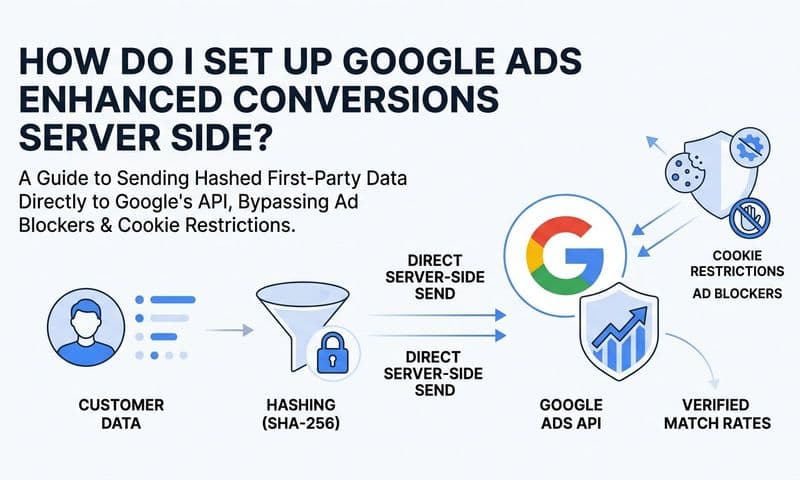
Here is the core problem with pixel-only tracking. When a user clicks your ad and lands on your site, the pixel fires a request from their browser to the ad platform. But if that user has an ad blocker installed, if their browser restricts third-party cookies, or if they converted on a mobile device after an iOS privacy prompt, the pixel may never fire at all. The conversion happens in reality but disappears from your ad platform's data.
Server-side tracking solves this by sending event data directly from your server to the ad platform, bypassing the browser entirely. Meta's Conversion API (CAPI) and Google Enhanced Conversions are the two primary implementations for most B2B SaaS teams. LinkedIn also supports server-side event tracking through its Conversions API.
Setting up the Meta Conversion API: You will need to generate an access token in your Meta Events Manager, configure your server or data pipeline to send events to Meta's API endpoint, and map the events you want to track to Meta's standard event schema. If you are using a platform like Cometly, this integration is handled natively, connecting your CRM and backend systems to Meta without requiring custom engineering work. Understanding how to sync conversion data to Facebook Ads is critical for making this setup effective.
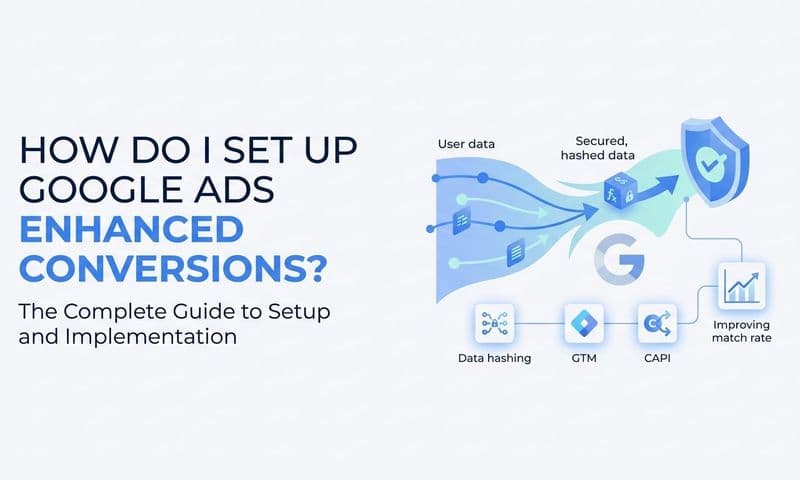
Setting up Google Enhanced Conversions: This implementation sends hashed first-party customer data alongside conversion events, improving Google's ability to match conversions to users even when cookies are unavailable. You configure this through Google Ads and Google Tag Manager, passing email addresses or phone numbers in a hashed format at the point of conversion.
If you're evaluating vendors, our AI ad design tool breakdown can help.
Deduplication is non-negotiable. If you run both pixel and server-side tracking simultaneously, which is often recommended for maximum coverage, you must configure deduplication correctly. Both Meta and Google use event ID matching to identify and deduplicate events that arrive from both sources. Without this, the same conversion gets counted twice, your reported numbers inflate, and the algorithm learns from a distorted picture.
Connect your CRM and backend systems. Server-side tracking becomes significantly more powerful when it is connected to your CRM. This allows you to pass downstream events like qualified leads, opportunities, and closed-won deals as conversion signals, not just the top-of-funnel actions your pixel can see.
The success indicator here is measurable: your event match quality scores should improve in Meta Events Manager, and your reported conversion volume should increase even though your actual lead volume has not changed. That increase represents real conversions you were previously missing.
Step 3: Enrich Conversion Events with First-Party Data
Server-side tracking tells the algorithm that a conversion happened. Enriched conversion events tell it who converted and how valuable that person is. This distinction matters enormously for B2B SaaS companies where not all leads are created equal.
Think about what a raw form submission tells Meta's algorithm. Someone submitted a form. That is it. The algorithm has no way to know whether that person was a solo freelancer or a VP of Marketing at a 500-person SaaS company. It treats both conversions as equally valuable and optimizes accordingly, often finding more of whichever type is easier to reach, which is rarely your ideal customer profile.
Enriched signals change this dynamic. By appending customer attributes to your conversion events before sending them to ad platforms, you give the algorithm the context it needs to find buyers who resemble your best customers rather than just any customers. A strong first-party data strategy is the foundation that makes this level of signal enrichment possible at scale.
What to append to conversion events: The most impactful data points for B2B SaaS include hashed email addresses (which improve audience match rates), company size, industry, job title, and lead score. You do not need all of these for every event, but the more context you can provide, the more precisely the algorithm can identify patterns in who converts into valuable pipeline.
Use hashed identifiers to improve audience matching. Both Meta and Google can match hashed email addresses to their user graphs, which improves the accuracy of conversion attribution and enables more precise lookalike audience creation. When you pass a hashed email alongside a conversion event, the platform can connect that conversion to a real user profile, even if cookies were not present during the session.
Prioritize high-value events over top-of-funnel noise. If you are currently sending every form submission as a conversion signal, consider creating a tiered approach. Send top-of-funnel events as informational signals, but optimize your campaigns toward higher-value events like demo requests, qualified lead designations, or SQL stage entries in your CRM. The algorithm will learn to find users who match the profile of people who take those high-value actions.
We compare the leading options in our AI ad design generator roundup.
Enriched signals build better lookalike audiences. When ad platforms have richer conversion data to work with, the lookalike audiences they generate are more accurate. Instead of finding users who look like anyone who submitted a form, the algorithm can find users who look like your SQLs or your closed-won customers. This shift in audience quality often produces meaningful improvements in cost per qualified lead over time.
The success indicator for this step is audience match rate improvement in your ad platforms, combined with a gradual decrease in cost per qualified lead as targeting becomes more precise.
Step 4: Align Your Attribution Model with Algorithm Optimization Goals
The attribution model you use internally does more than influence how you report on marketing performance. It directly affects which conversion events you prioritize, which signals you send to ad platforms, and therefore what behavior the algorithm learns to optimize for.
This connection between internal attribution and algorithm optimization is one of the most overlooked levers in B2B SaaS marketing. Many teams use last-click attribution for campaign optimization without realizing that this teaches the algorithm to find users who were already close to converting, rather than finding net-new buyers who need to be nurtured through a longer sales cycle.
The problem with last-click in B2B SaaS: B2B buyers rarely convert after a single touchpoint. They see a LinkedIn ad, read a blog post, attend a webinar, and then click a retargeting ad before requesting a demo. If you optimize your campaigns toward last-click conversions, the algorithm learns to prioritize retargeting audiences and bottom-of-funnel placements. This can look efficient in platform dashboards while actually cannibalizing the top-of-funnel investment that created those retargeting opportunities in the first place.
Choose an attribution model that reflects the full customer journey. Multi-touch attribution models distribute credit across all touchpoints that contributed to a conversion, giving you a more accurate picture of which channels and campaigns are genuinely driving pipeline. This is particularly important for B2B SaaS companies with sales cycles measured in weeks or months rather than hours.
Weight your conversion signals accordingly. Once you have multi-touch attribution data showing which channels contribute meaningfully to closed deals, use that intelligence to weight the conversion events you send to ad platforms. If your attribution data shows that LinkedIn consistently contributes to pipeline even when it is not the last touch, that insight should influence how you allocate budget and which events you use to optimize LinkedIn campaigns.
Pass revenue-level conversion values when possible. Rather than sending binary conversion signals (converted or not), pass a conversion value that reflects the revenue opportunity associated with that event. For a demo request, this might be your average deal size. For a closed-won event, it is the actual contract value. This enables value-based bidding strategies where the algorithm optimizes for return on ad spend rather than raw conversion volume.
Connect attribution insights to budget decisions. Attribution data should not live in a reporting dashboard that gets reviewed once a month. It should directly inform weekly budget allocation decisions, ensuring that spend follows what the data shows is actually working rather than what platform-reported metrics suggest. Teams that master data-driven attribution consistently outperform those relying on platform-native reporting alone.
The success indicator here is that your campaign optimization events map to pipeline stages and the algorithm begins finding users who are more likely to convert into actual revenue rather than just form submissions.
Step 5: Build a Feedback Loop Between Your CRM and Ad Platforms
Most B2B SaaS marketing teams track what happens when someone clicks an ad and fills out a form. Very few track what happens after that. This gap between ad platform data and CRM reality is where significant optimization opportunity is lost.
When a lead enters your CRM, it begins a journey through stages: MQL, SQL, opportunity, closed-won or closed-lost. Each of those stage progressions is a signal that tells you something meaningful about the quality of the original ad click that started the journey. But if you never send those downstream signals back to the ad platform, the algorithm never learns from them.
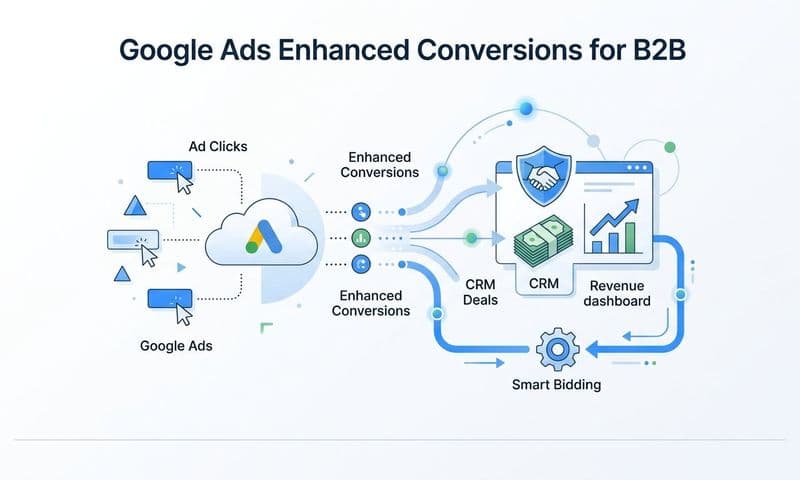
Set up automated CRM-to-ad-platform syncing. The goal is to create a system where every meaningful CRM event automatically triggers a conversion signal back to the originating ad platform. When a lead becomes an SQL, that event goes back to Meta or Google with the original click data attached. When a deal closes, the closed-won event and its associated revenue value go back as well.
This is called offline conversion tracking, and it is available natively in both Meta and Google Ads. The setup requires matching your CRM records to the original ad click using a click ID that you capture and store at the point of form submission. Cometly automates this matching and syncing process, connecting your CRM pipeline stages directly to your ad platform conversion data without requiring manual CSV uploads or custom engineering. Using the right tracking software for performance marketing makes this automation significantly easier to implement and maintain.
Assign conversion values based on deal size or customer lifetime value. When you send closed-won events back to ad platforms, include the actual contract value. This gives the algorithm a revenue-level signal to optimize against. Over time, it learns which audiences, placements, and creatives produce not just conversions, but high-value conversions. This is the foundation of value-based bidding, and it is significantly more effective than optimizing for conversion volume alone.
Maintain a regular sync cadence. Offline conversion data loses its value if it arrives weeks after the original click. Ad platforms use this data to update their models in near real time, so a sync that runs daily or every few hours is far more valuable than a weekly batch upload. The more timely the signal, the more effectively the algorithm can act on it.
The success indicator for this step is visible in your ad platform performance over time: campaigns and audiences that produce higher-value pipeline will begin receiving more budget automatically as the algorithm shifts spend toward what the data shows is working.
Step 6: Use Attribution Analytics to Continuously Optimize Campaign Inputs
The previous five steps build the data infrastructure. This step is about using that infrastructure to make smarter decisions on an ongoing basis. Feeding better data to the algorithm is not a one-time setup project. It requires a continuous cycle of analysis, learning, and refinement.
The most common mistake at this stage is treating attribution analytics as a reporting function rather than a decision-making function. Teams pull reports, nod at the numbers, and return to making campaign decisions based on intuition or platform-reported metrics. The teams that consistently improve ad algorithm performance treat attribution data as the primary input for every campaign decision they make.
Review attribution reports to identify credit discrepancies. One of the most revealing exercises is comparing what your ad platforms claim is driving conversions against what your multi-touch attribution data shows. Platform-reported metrics are inherently self-serving. Google will credit Google. Meta will credit Meta. Your attribution data cuts through this by showing you what actually contributed to closed pipeline, regardless of which platform wants credit. Learning how to fix attribution discrepancies is essential before you can trust the signals you are sending to your ad algorithms.
These discrepancies often reveal channels that are over-credited in platform dashboards but contribute less to actual revenue, and channels that are under-credited but consistently appear in the journeys of your best customers. Reallocating budget based on this intelligence is one of the highest-leverage moves available to a B2B SaaS marketing team.
Analyze the customer journey to inform ad sequencing. Attribution data tells you how many touchpoints your buyers typically need before converting, which channels appear at each stage of the journey, and how long the average sales cycle runs from first touch to closed deal. Use this intelligence to design ad sequences that match the actual buyer journey rather than guessing at frequency and timing.
Identify creative and audience patterns that drive pipeline. Look beyond channel-level attribution to the campaign and creative level. Which ad formats consistently appear in the journeys of your highest-value customers? Which audience segments produce the best ratio of qualified leads to total conversions? These patterns should directly inform your creative briefs and audience strategy for future campaigns. Applying campaign performance analytics at this level of granularity is what separates teams that scale efficiently from those that plateau.
Use AI-driven recommendations to surface what manual analysis misses. Cometly's AI ads manager analyzes performance patterns across every channel and surfaces recommendations for budget reallocation, audience expansion, and creative optimization. This is particularly valuable as campaign data grows in volume and complexity, making it harder to spot meaningful patterns through manual analysis alone.
Set a regular cadence for attribution-driven budget reviews. Weekly reviews of attribution data should inform budget adjustments. Monthly reviews should inform broader strategic decisions about channel mix, audience strategy, and creative direction. The goal is to replace gut-feel budget decisions with a systematic process grounded in what the data shows is actually driving revenue.
The success indicator here is that your campaign decisions are consistently driven by attribution data rather than platform-reported metrics, and your return on ad spend improves quarter over quarter as a result.
Putting It All Together: Your Data-Driven Ad Optimization Checklist
Here is the six-step framework condensed into a practical checklist your team can return to regularly as you build and refine your data-driven ad optimization process.
1. Audit your conversion tracking setup. Map every active event across Meta, Google, and LinkedIn. Identify duplicates, misfires, and events that do not reflect real business outcomes.
2. Implement server-side tracking. Deploy the Meta Conversion API and Google Enhanced Conversions to recover signal lost to browser restrictions and privacy changes. Configure deduplication carefully.
3. Enrich your conversion events. Append first-party data including hashed identifiers, company attributes, and lead scores to your conversion signals before sending them to ad platforms.
4. Align your attribution model with optimization goals. Adopt multi-touch attribution to understand the full customer journey, and use that data to weight conversion signals and budget decisions accordingly.
5. Close the CRM feedback loop. Automate the syncing of downstream CRM events back to ad platforms so the algorithm learns from revenue outcomes, not just form submissions.
6. Use attribution analytics continuously. Make attribution data the primary input for weekly budget decisions, creative direction, and audience strategy rather than treating it as a reporting afterthought.
Each step compounds the previous one. Better tracking produces better signals. Better signals produce better algorithm performance. Better algorithm performance produces more efficient spend and higher-quality pipeline. Most competitors are still relying on incomplete pixel data and last-click attribution, which means executing this framework consistently creates a durable advantage.
Cometly is built to make this entire framework scalable and repeatable. It connects your ad platforms, CRM, and website into a single attribution layer that captures every touchpoint, surfaces what is actually driving revenue, and sends enriched conversion signals back to Meta and Google automatically. If you are ready to give your ad algorithms the data they need to perform, Get your free demo and see how Cometly brings this entire process together in one place.