You have aggressive pipeline targets, a budget that feels tighter every quarter, and a decision sitting in front of you that will shape your entire marketing motion for the next one to two years. Do you build an in-house growth team, or do you partner with an agency? Get it right and you accelerate. Get it wrong and you spend months unwinding the mistake while competitors pull ahead.
This is one of the most consequential decisions a B2B SaaS growth leader makes, and it is also one of the most commonly mishandled. Most teams frame it as a cost question or a speed question. It is neither. The in-house vs agency growth marketing decision is fundamentally a strategic fit question, and the right answer depends on your stage, your data maturity, and where your biggest growth constraints actually live.
What makes this harder is that both models can work. In-house teams and agencies have each driven exceptional growth for B2B SaaS companies. The difference between the ones that succeed and the ones that stall is not which model they chose. It is whether they had the measurement infrastructure to evaluate performance honestly and optimize with confidence. Before you decide who runs your growth function, you need to understand what you can actually see and measure. That thread runs through every section of this article.
What Each Model Actually Looks Like in Practice
The labels get thrown around loosely, so it is worth being precise about what each model involves before comparing them.
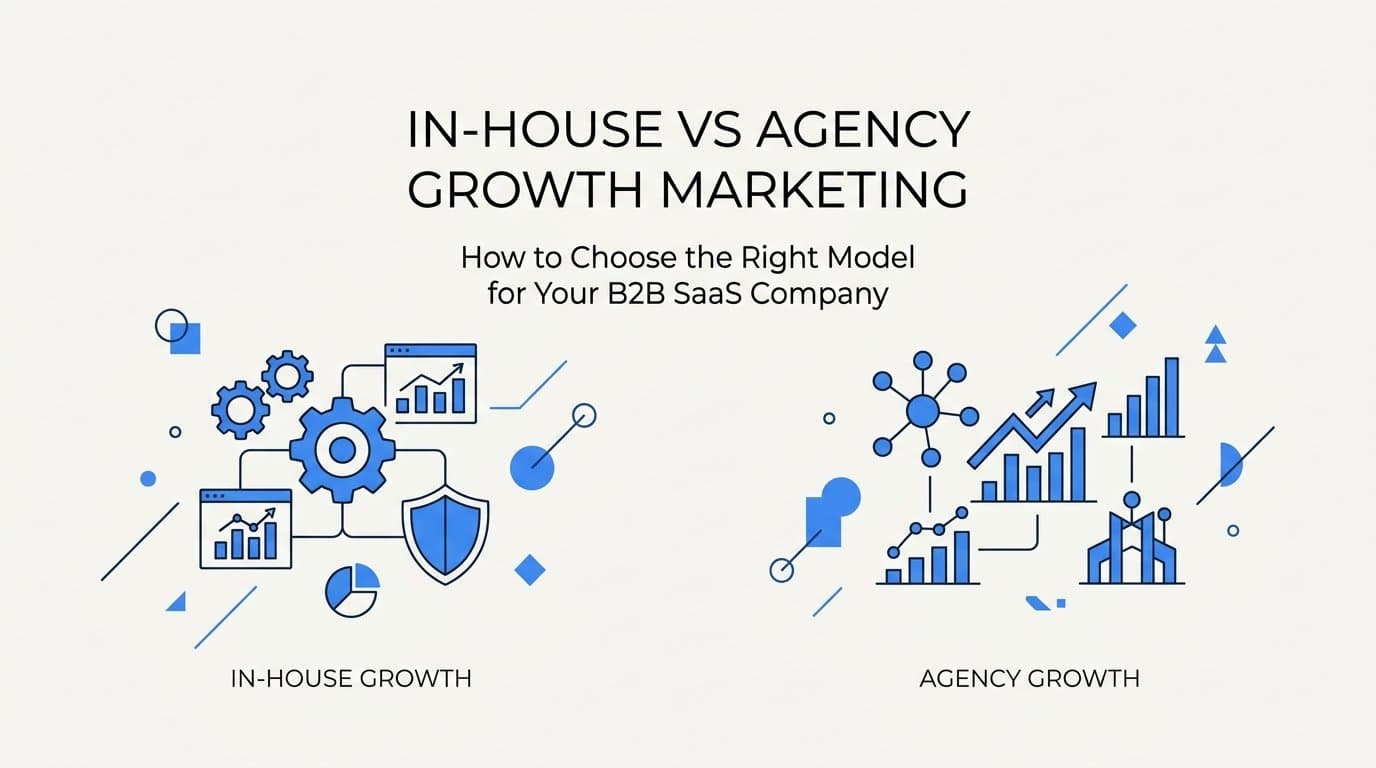
In-house growth marketing means building a dedicated internal team that owns strategy, execution, and optimization across your acquisition channels. These are full-time employees who sit inside your company, absorb your product roadmap, join sales calls, and develop a deep working understanding of your ICP and revenue goals. The team typically includes a mix of channel specialists, a growth strategist or head of growth, and often a marketing operations or analytics function. Everything they learn stays inside the company.
Agency growth marketing means hiring an external team or specialist firm to run specific channels or, in some cases, the full growth function. Agencies bring structured processes, channel expertise, and cross-client pattern recognition. They have usually seen what works across many B2B SaaS companies at different stages, which gives them a calibrated starting point. The tradeoff is that their attention is divided across a client portfolio, and their knowledge of your specific product and customers is always shallower than an internal team's.
The hybrid model is where many scaling B2B SaaS companies actually land, and it deserves its own mention because it is often the most practical path. In a hybrid setup, an internal strategist or head of growth owns the overall growth strategy, the ICP definition, the messaging framework, and the accountability to revenue outcomes. Agency partners execute on specific channels where specialization matters most, such as paid search, paid social, or SEO. The internal leader directs; the agency delivers.
This structure gives you the strategic alignment of an in-house model with the channel expertise and execution speed of an agency. It is not a compromise. For many companies at the growth stage, it is the optimal design. The key is that someone internal must own the strategy and hold the agency accountable to revenue outcomes, not just channel metrics.
Understanding which model fits your situation starts with an honest look at where each one has a genuine structural advantage.
Where In-House Teams Have a Clear Edge
There are three areas where in-house growth teams consistently outperform agency partners, and they all compound over time.
Product and ICP knowledge depth. In-house marketers live inside your company. They hear customer objections on sales calls. They see which feature updates are resonating with which segments. They understand the nuances of your ICP in ways that take months to develop and cannot be fully transferred through a client brief or onboarding document. This depth shows up in messaging precision, audience targeting decisions, and the ability to recognize when a campaign is underperforming because of a creative problem versus a positioning problem. Agencies can get close, but they are always working with a filtered version of your customer reality.
Speed of iteration. When an in-house team spots an opportunity or identifies a problem in campaign performance, they can act on it immediately. There is no account manager handoff, no approval chain, no waiting for the next weekly sync. In paid acquisition especially, where performance can shift quickly based on auction dynamics, creative fatigue, or audience saturation, the ability to move from insight to action within hours rather than days creates a meaningful compounding advantage. Internal teams can test, learn, and adjust in a rhythm that most agency relationships cannot match.
Data ownership and institutional knowledge. Every attribution framework, audience segment, and performance baseline an in-house team builds belongs to the company. Over time, this knowledge compounds. The team develops a working model of which channels perform at which stages of the funnel, which messages resonate with which personas, and how long it typically takes a lead from a specific source to convert to closed revenue. This institutional knowledge becomes a strategic asset. When an agency relationship ends, that knowledge often walks out the door with it.
The in-house model also tends to align more naturally with the rest of the revenue organization. When the growth team sits inside the company, collaboration with sales, product, and customer success is easier to sustain. Feedback loops between marketing and sales tighten. Campaign strategy can respond more quickly to shifts in the competitive landscape or changes in the product roadmap.
These advantages are real, but they take time to develop. An in-house team that is six months old does not yet have these advantages. This is why stage matters so much in this decision.
Where Agencies Deliver Outsized Value
The case for agencies is strongest in three specific situations, and understanding them helps you avoid hiring an agency for the wrong reasons or at the wrong time.
Channel specialization and pattern recognition. A strong growth agency running paid acquisition for B2B SaaS companies has seen what works across dozens of clients simultaneously. They have calibrated intuitions about bidding strategies, audience structures, creative formats, and landing page approaches that perform in the current environment. This cross-client intelligence is genuinely difficult to replicate internally, especially if you are entering a channel for the first time. When you are launching a Google Ads program from scratch or testing LinkedIn for the first time, an agency that has done this hundreds of times will compress your learning curve significantly.
Speed to market. Building an in-house growth team takes time. Recruiting, interviewing, making offers, onboarding, ramping, and getting to full productivity is a process that typically takes many months. An agency can launch a full paid acquisition program in weeks. For companies with a narrow window to prove traction, hit a growth milestone, or test a new market, that speed difference is not a minor convenience. It can be the difference between capturing momentum and missing it.
Flexible capacity without fixed cost. Agencies allow you to scale effort and spend up or down based on what the business needs without the fixed overhead of full-time headcount. If you need to ramp up acquisition for a product launch and then pull back during a repositioning phase, an agency relationship can flex in ways that a team of full-time employees cannot. This flexibility is especially valuable in early-stage or uncertain growth environments where the GTM motion is still being validated.
The strongest agency relationships in B2B SaaS tend to share a common characteristic: the client has a clear internal owner who sets strategy, defines success metrics tied to pipeline and revenue, and holds the agency accountable to those outcomes. When that internal owner is missing, agencies default to optimizing for the metrics they control most directly, which are often channel-level metrics like impressions, clicks, and cost per lead rather than closed revenue.
This is not a flaw in the agency model. It is a structural reality. Agencies perform best when they have clear accountability frameworks and accurate measurement to work within.
The Real Cost Comparison Most Teams Get Wrong
The cost comparison between in-house and agency is one of the most consistently mishandled parts of this decision. Teams often look at an agency retainer and compare it to a single salary, which is not an honest comparison.
The true cost of an in-house team is almost always underestimated. When you account for salary, benefits, payroll taxes, recruiting fees, onboarding time, ramp period before full productivity, tool subscriptions, and the management overhead required to support a growing team, the total cost of two to three in-house growth marketers often rivals or exceeds a mid-market agency retainer. This does not mean in-house is the wrong choice. It means the cost comparison needs to be done honestly, including all of these factors, rather than just comparing base salaries to retainer fees.
Agency cost structures vary widely and carry different risk profiles. Retainer-based agencies offer predictable monthly costs but may not align incentives toward your revenue outcomes if the contract is not structured carefully. Project-based engagements work well for specific campaigns or channel launches but can create gaps in continuity. Performance-based models align incentives more directly but require robust measurement infrastructure to work fairly, because you need to be able to accurately attribute revenue to the agency's efforts. The right cost model depends heavily on how well you can measure outcomes.
The hidden cost that neither side of this debate talks about enough is poor attribution. Both models become expensive when you cannot accurately measure which channels and campaigns are driving pipeline and revenue. Without accurate attribution, budget gets misallocated regardless of who is executing. You end up over-investing in channels that look good on surface metrics but do not drive closed revenue, and under-investing in channels that are actually working but do not get credit in your reporting. This misallocation is a cost that compounds over time, and it affects in-house teams and agencies equally.
Before you finalize any budget model for growth marketing, the most important investment you can make is in the measurement infrastructure that will tell you whether your money is working. Without that foundation, neither model can be evaluated or optimized fairly.
How to Decide: A Framework for B2B SaaS Growth Leaders
Rather than a checklist, think of this as three diagnostic questions that reveal which model fits your current situation.
What does your stage and runway signal? Early-stage B2B SaaS companies that are still validating their ICP, testing channels, and building toward their first repeatable GTM motion often benefit more from agency speed and specialization. You need to learn fast, and an agency with cross-client pattern recognition can compress that learning curve. Growth-stage companies with a proven GTM motion, a defined ICP, and a repeatable sales cycle tend to see better long-term ROI from in-house ownership, because the compounding advantages of institutional knowledge and strategic alignment start to outweigh the speed advantages of an agency.
Are you measurement-ready? This question should come before the in-house vs agency question, not after. Ask yourself honestly: do you have the attribution infrastructure to hold either an internal team or an agency accountable to pipeline and revenue outcomes? Can you connect ad spend to closed revenue across channels? Can you see which touchpoints in the customer journey actually drove conversion? If the answer is no, your first investment should be in building that measurement foundation. Without it, you will evaluate both models on the wrong metrics and make allocation decisions based on incomplete information.
Where does your biggest growth constraint actually live? This is the most clarifying question. If your constraint is channel expertise and execution speed, meaning you know what you want to do but lack the specialized skills or bandwidth to do it quickly, lean toward an agency or a hybrid model where an agency handles execution. If your constraint is strategic alignment and product-market messaging, meaning you need someone who deeply understands your product, your customers, and your revenue goals to shape the growth strategy, lean toward building in-house. Agencies are execution accelerators. They are not substitutes for strategic clarity.
The hybrid model deserves consideration in most growth-stage scenarios. An internal head of growth who owns strategy and accountability, paired with agency partners who execute on specific channels with specialization, often delivers better outcomes than either model in isolation. The internal owner provides the product knowledge and revenue alignment; the agency provides the channel depth and execution capacity.
Why Attribution Determines Which Model Wins for You
Here is the part of this decision that most growth leaders underweight: the model you choose matters far less than your ability to measure it.
Without accurate attribution, you cannot evaluate agency performance or internal team performance fairly. Surface-level metrics like clicks, impressions, and even MQLs do not tell you which touchpoints actually drove closed revenue. A campaign can generate a high volume of leads that never convert, while another campaign drives a smaller number of leads that close at high rates. If your reporting only shows you the top of the funnel, you will make the wrong allocation decisions, and you will do it consistently.
Multi-touch attribution solves this by connecting every ad interaction, CRM event, and channel touchpoint to pipeline and revenue. Instead of asking which campaign drove the most clicks, you can ask which campaign drove the most closed-won revenue, and you can see every touchpoint that contributed to that outcome along the way. This is the difference between managing growth with a complete picture and managing it with a partial one.
For B2B SaaS companies specifically, this matters more than in most other contexts. B2B sales cycles are long. Buyers interact with multiple touchpoints across multiple channels before converting. A prospect might click a LinkedIn ad, visit your site three times, download a guide, attend a webinar, and then respond to an outbound email before booking a demo. If your attribution only captures the last click, you will systematically undervalue every touchpoint that happened before it.
This is where Cometly gives B2B SaaS growth leaders a decisive advantage. Cometly tracks the full customer journey from first ad click to closed-won revenue, connecting your ad platforms, CRM, and website into a single attribution framework. Whether you are managing an in-house team or an agency relationship, you get a single source of truth that shows which channels, campaigns, and touchpoints are actually driving pipeline and revenue.
Beyond reporting, Cometly's AI surfaces recommendations on which campaigns to scale and which to pull back, so your optimization decisions are grounded in revenue data rather than channel-level metrics. It also feeds enriched conversion data back to Meta, Google, and other ad platforms, improving their targeting algorithms and increasing the efficiency of your paid acquisition spend over time.
The result is that both your internal team and any agency partners are held accountable to the same revenue outcomes, with the data to back it up. That accountability structure is what separates growth programs that compound from ones that plateau.
Putting It All Together
The in-house vs agency growth marketing debate is not a question of which model is better. It is a question of which model fits your stage, your constraints, and your measurement maturity right now. Both models can drive exceptional growth. Both can also burn budget without producing results. The difference is almost always in how well you can see what is working.
Start by auditing your measurement infrastructure before you make any structural decision about your growth team. If you cannot connect ad spend to closed revenue across channels, you are not ready to evaluate either model fairly. Build that foundation first.
Then apply the framework: assess your stage and runway, identify your biggest growth constraint, and choose the model that addresses it most directly. Consider the hybrid path if you need both strategic alignment and channel specialization. And whatever model you choose, build the attribution infrastructure that lets you hold it accountable to revenue outcomes rather than vanity metrics.
The growth leaders who win are not the ones who made the perfect structural choice. They are the ones who could see clearly enough to optimize whatever structure they had.
Ready to build that clarity into your growth program? Get your free demo and see how Cometly gives you the attribution foundation to make either model perform at its best, from first ad click to closed-won revenue.