
Most B2B SaaS marketing teams can tell you how many clicks their campaigns generated. Far fewer can tell you how much revenue those clicks actually produced. That gap is where budget gets wasted and growth stalls.
Tracking revenue from marketing campaigns means connecting the dots between an ad impression, a lead, a sales conversation, and a closed deal. It requires more than a basic analytics setup. It requires a system that follows the buyer across every touchpoint, from the first ad click to the moment they become a paying customer.
Think of it like this: if your marketing dashboard shows you 500 leads this month but your finance team is asking why revenue is flat, you have a visibility problem. The leads are there, but the connection between those leads and actual dollars is missing. That missing connection is exactly what this guide helps you build.
You will learn how to define the revenue signals that matter, set up proper tracking infrastructure, connect your ad platforms to your CRM and payment data, choose the right attribution model, and use that data to make smarter budget decisions. Whether you are running paid search, social ads, or a mix of channels, the steps in this guide apply to any B2B SaaS marketing operation.
By the end, you will have a clear, repeatable process for knowing which campaigns are generating pipeline and revenue, not just traffic and leads. Let's get into it.
Step 1: Define Your Revenue Signals and Conversion Events
Before you configure a single tracking tag or integration, you need clarity on what you are actually trying to measure. This is the step most teams skip, and it is the reason their attribution data ends up reflecting marketing activity rather than business outcomes.
Start by mapping the key stages in your funnel that connect to revenue. For most B2B SaaS companies, those stages look something like this: a prospect clicks an ad, fills out a demo request form, qualifies as a lead, enters the sales pipeline as an opportunity, and eventually closes as a paying customer. Each of those stages is a potential conversion event. Not all of them carry equal weight.
The distinction that matters most is between micro-conversions and macro-conversions. Micro-conversions are early signals of interest: a page view, a content download, a webinar registration. They are useful for understanding engagement, but they are not revenue events. Macro-conversions are the events that directly tie to money: a trial signup that converts to a paid plan, a demo that leads to a contract, a subscription that starts billing. These are the events your revenue tracking system needs to prioritize.
Here is where alignment between marketing and sales becomes critical. If marketing is celebrating demo requests while sales is focused on qualified opportunities, your attribution data will tell two different stories. Sit down with your sales team and agree on a shared definition of what counts as a revenue signal. That shared definition becomes the foundation of everything downstream.
Once you have identified your conversion events, assign a value to each one where possible. For closed-won deals, the value is clear. For earlier-stage events like opportunities created, use your average deal size and close rate to estimate pipeline value. Even rough estimates are more useful than no value at all, because they allow you to calculate cost per opportunity and compare that across campaigns.
Common pitfall: Many teams track only top-of-funnel events like form fills and never connect them to closed revenue. This leads to misleading return on ad spend calculations where campaigns look profitable based on lead volume but are actually generating low-quality pipeline that rarely closes.
Success indicator: You have a documented list of conversion events with assigned values that both marketing and sales agree represent real revenue signals. That document should live somewhere both teams can reference and update as your funnel evolves.
Step 2: Set Up Server-Side Tracking and First-Party Data Collection
Once you know what to track, the next challenge is making sure your tracking actually works. This is where many teams discover their existing setup has significant blind spots.
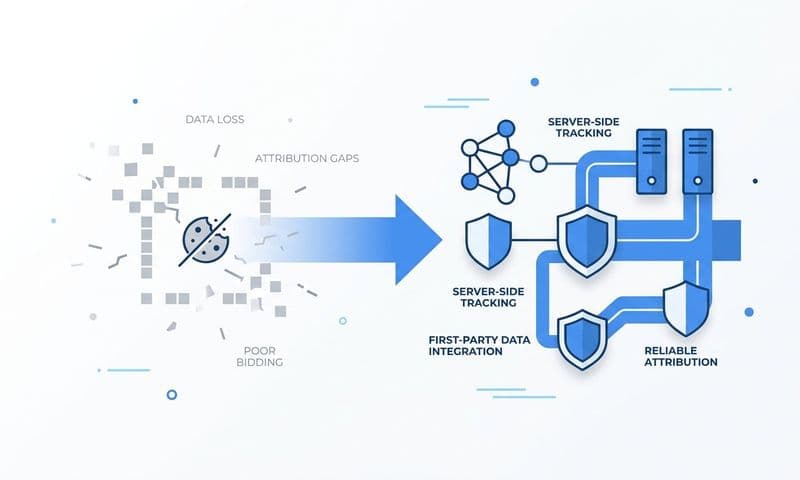
Browser-based pixel tracking, the kind that fires a JavaScript snippet when someone lands on a page or submits a form, has become less reliable over time. Ad blockers prevent pixels from loading. Safari's Intelligent Tracking Prevention limits how long cookies persist. iOS privacy changes reduce the signal available to platforms like Meta. The result is that a meaningful portion of your conversions never get reported back to the ad platforms that generated them, which means those platforms optimize on incomplete data.
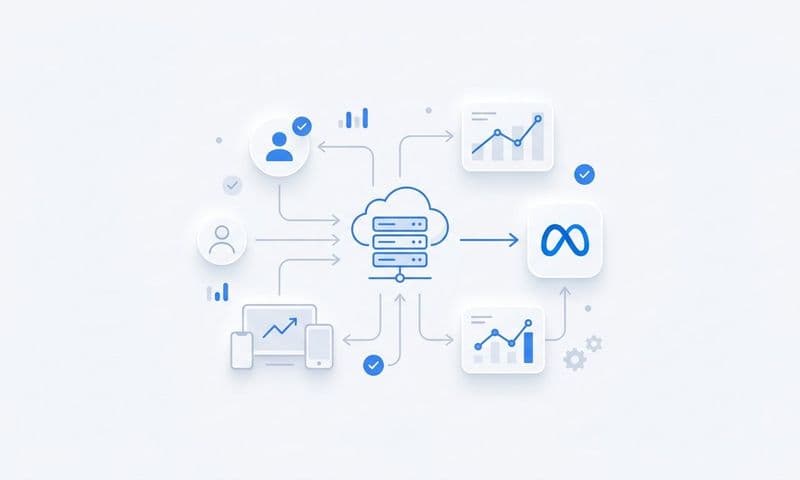
The solution is server-side tracking, also known as Conversion API (CAPI) integration. Instead of relying on the browser to fire a conversion event, your server sends the event data directly to the ad platform after a conversion occurs. This bypasses browser-level restrictions entirely and gives you a much more complete picture of what is happening.
Setting up server-side tracking involves a few key components. First, you need to capture first-party identifiers at the point of lead capture. When someone fills out a form on your site, your system should record the UTM parameters from their session, along with platform-specific click IDs like gclid for Google Ads and fbclid for Meta Ads. These identifiers are what allow the ad platforms to match a conversion event back to the specific campaign, ad set, and ad that drove that click.
Second, those identifiers need to be stored in your CRM attached to the contact record. This is the step most teams miss. If you capture UTM data in your analytics tool but not in your CRM, you lose the thread the moment a lead enters the sales process. The UTM data needs to travel with the contact through every stage of the funnel so it is available when a deal closes months later.
Third, configure event deduplication. If you are running both a browser pixel and a server-side integration, the same conversion event can be reported twice: once by the pixel and once by the server. Deduplication logic, typically using a unique event ID, prevents the same event from being counted more than once. Without it, your reported conversion volume will be inflated and your cost-per-conversion metrics will look better than they actually are.
Success indicator: Your server-side events are firing consistently, and your event match quality scores on Meta and Google are high. High match quality means the platforms can accurately attribute conversions back to campaigns, which improves their optimization and gives you more reliable performance data.
Step 3: Connect Your Ad Platforms, CRM, and Payment Data
This is the step that transforms your tracking setup from a collection of disconnected tools into a unified revenue attribution system. The goal is to create a data flow where information from your ad platforms, your CRM, and your billing system all converge in one place.
Start with your ad platforms. Whether you are running campaigns on Meta, Google, LinkedIn, TikTok, or a combination, each platform generates its own performance data in its own reporting interface. The problem is that ad platform-reported conversions are based on what the platform can see, which is limited by attribution windows, browser restrictions, and the platform's own modeling. To get an accurate picture, you need to pull that data into a central attribution platform where it can be compared and reconciled.
Next, integrate your CRM. This is the missing link for most B2B marketing teams. Your CRM contains the data that tells you what actually happened after a lead was generated: did they qualify, did they enter a sales opportunity, did they close? By connecting your CRM to your attribution platform, you can pull lead status, opportunity stage, and closed-won data back to the campaigns that sourced those contacts. Now instead of seeing "500 leads from Google Ads," you see "500 leads from Google Ads, 80 became opportunities, 22 closed, generating $X in revenue."
The third connection is payment or billing data. For B2B SaaS companies, this typically means integrating with Stripe or your billing platform. When you connect billing data to your attribution system, you can see actual subscription revenue tied to the original marketing source. This is the difference between knowing a campaign generated leads and knowing a campaign generated $40,000 in annual recurring revenue.
Throughout all of this, consistent UTM parameter usage is non-negotiable. Every campaign, every ad set, every ad should have UTM tags that capture source, medium, campaign name, and content or creative variant. Without consistent UTM hygiene, traffic gets misclassified, revenue gets attributed to "direct," and your data becomes unreliable.
Success indicator: When a deal closes in your CRM, you can trace it back to the specific campaign, ad set, and ad that first engaged that buyer. That traceability is what makes revenue attribution actionable rather than theoretical.
Step 4: Choose and Configure Your Attribution Model
With your tracking infrastructure in place and your data flowing into a central system, you now need to decide how credit for revenue gets assigned across the touchpoints in a buyer's journey. This is the attribution model question, and it matters more than most teams realize.
Here is a quick breakdown of the core models and what each one emphasizes:
First-touch attribution gives 100% of the credit to the first interaction a buyer had with your brand. It is useful for understanding what generates initial awareness, but it ignores everything that happened after that first click.
Last-touch attribution gives 100% of the credit to the final touchpoint before conversion. It is simple to implement and understand, but in B2B SaaS with long sales cycles, it systematically undervalues the campaigns that generated awareness and early engagement. A brand search ad that a buyer clicked right before signing up gets all the credit, while the LinkedIn campaign that introduced them to your product three months earlier gets none.
Linear attribution distributes credit equally across all touchpoints in the journey. It is more balanced than first or last touch, but it treats a brief mid-funnel email click the same as a high-intent demo request.
Time-decay attribution gives more credit to touchpoints that occurred closer to the conversion event. This reflects the intuition that recent interactions are more influential, though it still undervalues early-stage campaigns.
Data-driven attribution uses actual conversion path data to assign credit algorithmically based on which touchpoints most frequently appear in successful journeys. This is the most accurate approach, but it requires sufficient conversion volume to generate reliable patterns.
For B2B SaaS companies, multi-touch attribution models generally provide a more complete picture than first or last touch alone. The key is configuring your attribution window to match your typical sales cycle. If your average deal takes 60 to 90 days to close, your attribution window needs to extend at least that far. Otherwise, campaigns that generate top-of-funnel engagement will appear to have no downstream impact simply because the deals they influenced close outside the measurement window.
Success indicator: Your attribution model reflects how your buyers actually make decisions, not just which channel they touched last before converting. A useful test is to run first-touch and multi-touch attribution side by side and look for channels that perform very differently under each model. Those gaps reveal where your current model may be misallocating credit.
Step 5: Build a Revenue Attribution Dashboard
Data that lives in a database no one checks is not useful data. The goal of this step is to surface your revenue attribution data in a way that makes it easy for your team to answer the questions that drive budget decisions.
Your central dashboard should show revenue and pipeline by campaign, channel, ad set, and individual ad. That level of granularity matters because performance often varies significantly within a single campaign. One ad creative might be generating high-quality pipeline while another in the same campaign is burning budget on low-intent clicks.
The metrics that belong in this dashboard include cost per lead, cost per opportunity, cost per acquisition, pipeline generated, and revenue attributed per channel. Together, these metrics tell you not just how much you are spending but what you are getting back at each stage of the funnel. Cost per lead tells you about volume efficiency. Cost per opportunity tells you about lead quality. Revenue attributed tells you about actual business impact.
One of the most valuable features you can build into this dashboard is the ability to toggle between attribution models. Seeing how first-touch versus multi-touch attribution changes your view of channel performance often reveals surprising insights. A channel that looks average under last-touch attribution might look like your best top-of-funnel investment under first-touch. Those insights directly inform how you allocate budget across campaigns.
Set up automated data refresh so the dashboard updates in real time rather than requiring manual exports from each ad platform. Manual reporting processes introduce delays and errors, and they create a bottleneck where insights arrive too late to act on.
Consider adding pipeline velocity metrics to your dashboard as well. Pipeline velocity measures how quickly leads from different campaigns move through the funnel to closed revenue. A campaign that generates fewer leads but those leads close in 30 days rather than 90 may be more valuable than a high-volume campaign with a slow deal cycle.
Success indicator: Your team can open a single dashboard and answer the question "which campaign generated the most revenue this quarter" without pulling data from multiple tools or waiting for a manual report. That speed and clarity is what makes attribution data operationally useful rather than a quarterly exercise.
Step 6: Analyze Performance and Optimize Budget Allocation
Building the system is only half the work. The other half is using it to make better decisions. This is where revenue attribution pays off in a way that no amount of click-through rate optimization ever could.
Start by identifying your highest-performing campaigns based on actual closed revenue, not lead volume or click-through rate. These are often not the same campaigns. A campaign with a high click-through rate might be attracting the wrong audience. A campaign with a lower click-through rate but high close rates might be reaching exactly the right buyers. Revenue data tells you which is which.
Look for channels or campaigns where cost per acquisition is low and revenue per customer is high. These are your scaling opportunities. When you find a campaign that consistently generates customers with strong lifetime value at an efficient acquisition cost, that is where additional budget should go. Without revenue attribution, you would never know to prioritize it.
On the other side, identify campaigns that generate high lead volume but low close rates. This pattern usually indicates one of two things: a targeting mismatch where you are attracting people who are not a good fit for your product, or a lead quality problem where the offer or messaging is attracting early-stage curiosity rather than genuine buying intent. Either way, the fix starts with knowing the problem exists, which requires revenue data.
Use AI-driven analysis to surface patterns that are difficult to spot manually. For example, certain ad creative formats might correlate with faster deal cycles. Certain audience segments might have a higher average contract value. These patterns exist in your data, but they require more than a spreadsheet to find them.
Finally, close the feedback loop by sending enriched conversion data back to your ad platforms through CAPI integrations. When Meta and Google receive high-quality conversion signals that include actual revenue events rather than just form fills, their optimization algorithms improve. They learn to target users who look like your best customers, not just users who are likely to click. This data feedback loop compounds over time, improving your targeting efficiency with every campaign cycle.
Success indicator: You are making budget reallocation decisions based on revenue data rather than platform-reported ROAS, and your cost per acquisition is trending down over time as your targeting improves and your budget concentrates on what works.
Your Revenue Tracking Checklist: Putting the System to Work
Here is a summary of the six-step process as a repeatable operational checklist:
1. Define your revenue signals: Document your conversion events, assign values, and align marketing and sales on what counts as a revenue event.
2. Set up server-side tracking: Implement CAPI integrations, capture UTM parameters and click IDs at the point of lead capture, store them in your CRM, and configure event deduplication.
3. Connect your data sources: Link your ad platforms, CRM, and billing data to a central attribution platform with consistent UTM tagging across all campaigns.
4. Configure your attribution model: Choose a model that reflects your sales cycle length and buyer journey complexity. Set attribution windows that match your typical deal timeline.
5. Build your dashboard: Create a centralized view of revenue and pipeline by campaign and channel, with real-time data refresh and multi-model comparison.
6. Analyze and optimize: Use revenue data to reallocate budget, identify scaling opportunities, fix lead quality problems, and feed enriched signals back to ad platforms.
Revenue tracking is not a one-time setup. It is an ongoing system that requires consistent UTM hygiene, CRM discipline, and regular dashboard review. The quality of your decisions is only as good as the quality of your data.
This is exactly what Cometly is built to support. Cometly connects your ad platforms, CRM, and Stripe billing data in one place, provides server-side tracking and CAPI integrations, supports multi-touch attribution across the full customer journey, and surfaces AI-powered recommendations that help you act on your data faster. If you are ready to stop guessing and start tracking revenue from marketing campaigns with precision, Get your free demo and see how Cometly brings every step of this system together.