You launch a campaign on Monday. By Wednesday, you still don't have a clear picture of what's working. The budget is running, the ads are live, but the data sitting in your dashboard is already hours old and missing half the conversion events that actually matter. Sound familiar?
This is the default experience for most B2B SaaS marketing teams. You're making decisions about where to scale and where to cut based on information that no longer reflects what's happening in your campaigns right now. And in a market where every dollar of ad spend is scrutinized, that lag isn't just inconvenient. It's expensive.
Instant ad performance data changes that equation. Instead of waiting for platforms to batch and process your results, you get visibility into impressions, clicks, conversions, and revenue contribution as they happen. The shift from reactive to proactive isn't just a workflow upgrade. It's a competitive advantage that compounds with every campaign you run.
This article breaks down what instant ad performance data actually means, what technology makes it possible, and how it changes the decisions you make every day as a marketer running paid campaigns across multiple channels.
Why Delayed Ad Data Is Costing You More Than You Think
Most marketers accept reporting delays as part of the job. You check your dashboard in the morning, see yesterday's numbers, and make your calls. But that acceptance comes at a real cost, and it's worth being direct about what that cost looks like in practice.
Ad platforms like Meta and Google process conversion events on a delay. Depending on the event type and the platform, that delay can range from a few hours to more than 24 hours. By the time a conversion shows up in your native dashboard, the conditions that produced it have already changed. The audience segment that was performing well may have saturated. The ad creative that was dragging down your cost-per-lead may have already burned through a significant portion of your daily budget.
This is what you can think of as the optimization gap. There's a window during any active campaign where acting on a signal, whether that's scaling a high-performing ad or pausing a losing one, produces the most leverage. That window is often hours wide, not days. When your data arrives on a delay, that window closes before you even know it existed.
Traditional reporting cycles make this worse. Many teams still rely on daily exports, weekly performance reviews, or platform-native dashboards that don't unify data across channels. If you're running campaigns on Meta, Google, and LinkedIn simultaneously, you're likely logging into three separate interfaces, pulling numbers manually, and trying to reconcile them in a spreadsheet. By the time you have a complete picture, you're already operating on stale information.
The financial impact is real. Budget allocated to underperforming ads continues to run while you wait for data to confirm what's happening. High-performing audiences get under-invested because the signal to scale arrives too late to act on during peak performance windows. Decisions about channel allocation get made based on last week's data rather than what's driving pipeline right now.
For B2B SaaS companies with longer sales cycles, this problem is compounded further. The distance between an ad click and a closed deal is already significant. Adding reporting latency on top of that means you're making budget decisions with multiple layers of delay between you and the actual revenue outcomes your campaigns are driving.
The optimization gap isn't a minor inefficiency. It's a structural disadvantage that accumulates over every campaign cycle you run without addressing it.
Defining Real-Time Visibility in Paid Advertising
The phrase "instant ad performance data" gets used loosely, so it's worth being precise about what it actually means and what it doesn't.
At its core, instant ad performance data refers to real-time or near-real-time visibility into the metrics that matter across your ad campaigns: impressions, clicks, cost-per-click, conversions, cost-per-result, and downstream revenue events. The key distinction is that this data is available as events occur, not after a platform has batched and processed them on its own schedule.
There's an important difference between platform-native reporting and true cross-channel instant data. When you look at Meta Ads Manager or Google Ads, you're seeing data through a single platform's lens, on that platform's processing timeline, and limited to the events that platform has visibility into. That's useful, but it's incomplete. It tells you how a campaign is performing within one channel, not how it's contributing to your overall pipeline relative to everything else you're running.
True cross-channel instant ad performance data unifies your ad spend, touchpoints, and conversion events from every channel into a single view, updated continuously. This means you can see, in real time, that a LinkedIn campaign is generating a high volume of clicks but low downstream pipeline contribution, while a Google branded search campaign is driving a smaller click volume but a disproportionate share of closed revenue. That's a different kind of insight, and it leads to different decisions.
It's also worth clarifying what "instant" realistically means in practice. Event-level tracking, where a conversion event fires and is recorded within seconds of occurring, is achievable with the right infrastructure. What you're contrasting this against is aggregated reporting across platforms, where platforms collect events, apply attribution modeling, and surface results in batches. The latter can introduce delays that range from hours to more than a day for certain conversion types.
The practical implication is that "instant" doesn't mean you're watching a live ticker of every individual ad impression. It means that when a meaningful event occurs, such as a form submission, a demo request, or a deal closing in your CRM, that event flows into your reporting environment quickly enough that you can act on it within the same campaign cycle, not the next one.
For B2B SaaS marketers, the events that matter most are often downstream from the initial click: trial sign-ups, qualified leads, opportunities created, and revenue closed. Instant ad performance data means those events are connected back to the originating ad touchpoints in near-real time, not reconstructed days later through a manual data export.
The Technology Stack Behind Real-Time Ad Tracking
Understanding what makes instant ad performance data possible helps you evaluate whether a platform is actually delivering it or just using the language without the infrastructure to back it up.
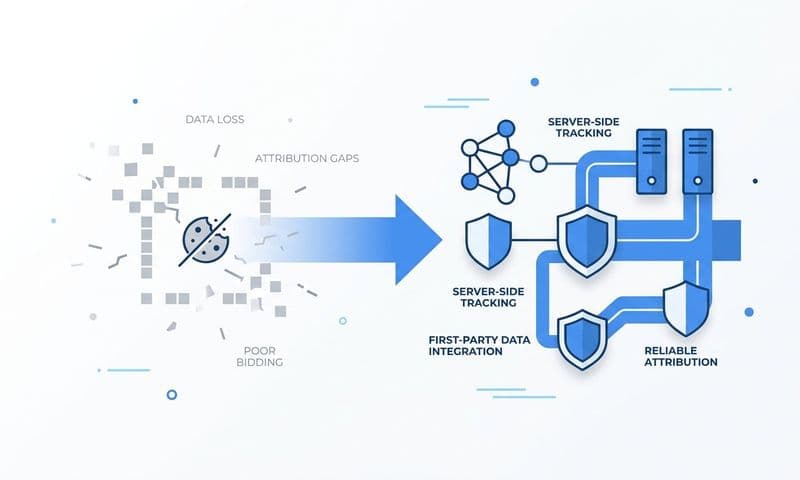
The most significant shift in ad tracking technology over the past few years has been the move from browser-based pixels to server-side event tracking. Browser pixels, the traditional method of capturing conversion events, work by firing a piece of JavaScript code in a user's browser when they complete an action. The problem is that this method has become increasingly unreliable. iOS 14 and subsequent Apple privacy updates significantly reduced the effectiveness of browser-based tracking. Ad blockers filter pixel events before they fire. Browser privacy settings and cookie restrictions further degrade signal quality.
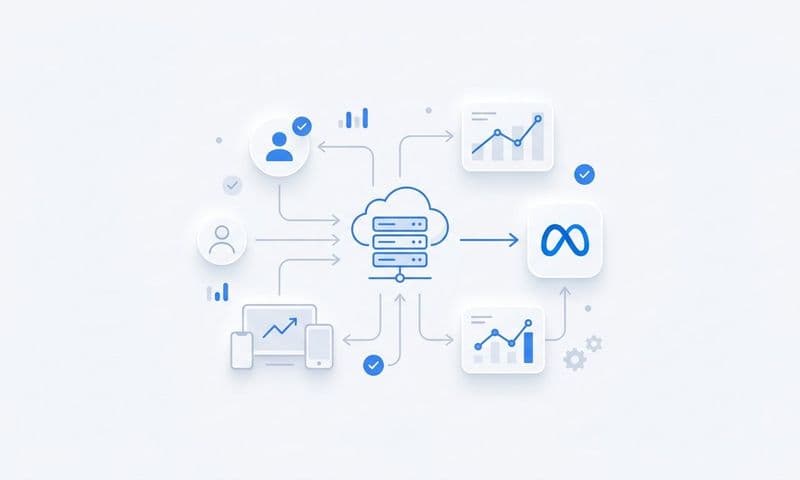
Server-side tracking solves this by moving event capture from the user's browser to your own server infrastructure. Instead of relying on a pixel to fire correctly in a user's browser, your server sends conversion data directly to the ad platform via an API. Meta's Conversions API (CAPI) and Google's Enhanced Conversions are the primary implementations of this approach, and both Meta and Google explicitly recommend server-side tracking as the more accurate and durable method for conversion reporting.
The result is faster, cleaner conversion data. Events that would have been lost to ad blockers or browser restrictions are captured server-side and transmitted directly to the platforms that need them for optimization. This also reduces the latency between when a conversion occurs and when it appears in your reporting, because you're not dependent on a browser environment to initiate the event.
First-party data pipelines work alongside server-side tracking to ensure the data flowing through your system is accurate and deduplicated. When you're capturing events from multiple sources, such as your website, your CRM, and your payment processor, the same conversion can potentially be recorded more than once. Event deduplication logic ensures each conversion is counted once, keeping your performance data clean and your reporting trustworthy.
UTM parameters and touchpoint capture are the connective tissue that links ad click data to downstream revenue events. When a user clicks an ad, UTM parameters embedded in the URL record the source, medium, campaign, and ad creative. As that user moves through your funnel, those parameters travel with them, connecting their eventual conversion back to the original ad that started the journey. In a B2B SaaS context where a buyer might interact with multiple touchpoints across weeks or months, this continuous data stream is what makes it possible to attribute closed revenue back to specific campaigns with accuracy.
How Real-Time Data Transforms Campaign Decision-Making
The value of instant ad performance data isn't abstract. It shows up in specific decisions you make every day as a marketer running paid campaigns.
Consider the scenario of a losing ad creative. With delayed data, you might not know an ad is underperforming until it has already consumed a meaningful portion of your weekly budget. With real-time visibility, you can see within hours that a creative's cost-per-result is trending well above your target, pause it before the damage compounds, and reallocate that budget to what's actually working. That's not a minor operational improvement. Across a full campaign cycle, those early interventions add up to significant budget efficiency.
On the flip side, instant data lets you move quickly when something is working. High-performing audience segments often have performance windows that don't last indefinitely. Saturation, auction dynamics, and competitive pressure can shift results within days. When you can see in real time that a specific audience is delivering strong pipeline contribution at an efficient cost, you can increase budget while that window is open, not after it has already started to close.
Channel reallocation is another area where real-time data creates a genuine edge. If you're running campaigns across Meta, Google, and LinkedIn, real-time pipeline contribution data tells you which channel is actually driving opportunities right now, not which one drove the most clicks last week. That's the signal you need to make intelligent budget allocation decisions rather than defaulting to historical patterns that may no longer apply.
AI-driven optimization is also directly dependent on data quality and speed. Ad platform algorithms like Meta's Advantage+ and Google's Smart Bidding learn from the conversion signals you send them. When those signals are enriched, accurate, and delivered quickly, the algorithms have better inputs to work with. When signals are delayed, incomplete, or degraded by browser tracking limitations, the algorithm is optimizing against a distorted picture of reality. Faster, richer conversion data means better algorithm performance, which compounds over time as campaigns learn and improve.
Attribution accuracy also improves when every touchpoint is captured as it happens. In B2B SaaS, where a buyer might click a LinkedIn ad, later search for your brand on Google, attend a webinar, and then convert through a direct visit weeks later, reconstructing that journey after the fact introduces gaps and approximations. When touchpoints are captured in real time and connected to a unified customer record, your attribution model reflects the actual journey rather than a best-guess reconstruction. That accuracy is what makes channel investment decisions trustworthy.
What to Look For in an Instant Ad Performance Platform
Not every tool that claims real-time reporting actually delivers it. There's a meaningful difference between a dashboard that refreshes every few hours and a platform built on the infrastructure required to capture, unify, and surface performance data as it happens.
Cross-channel data unification is the starting point. A platform that shows you real-time data from one channel but requires you to switch tools or manually aggregate data from others isn't solving the core problem. You need a single view that consolidates ad spend, touchpoints, and conversion events from every channel you're running, updated continuously.
Server-side event tracking is non-negotiable. If a platform is still relying primarily on browser pixels for conversion capture, the data you're seeing is already degraded before it reaches your dashboard. Look for platforms that support Conversion API integrations with Meta and Google, and that have the infrastructure to capture events server-side and deduplicate them accurately.
CRM and revenue integration is what separates a reporting tool from a true attribution platform. For B2B SaaS companies, the conversion events that matter most, qualified leads, opportunities, and closed-won revenue, live in your CRM and payment processor, not in your ad platforms. A platform that integrates directly with your CRM and with payment processors like Stripe can connect ad spend data to actual revenue outcomes, not just clicks or form fills. That's the data that tells you what's actually driving business results.
Multi-touch attribution model support is also critical. B2B buyers interact with multiple touchpoints before converting, and a platform that only offers last-click attribution will systematically misrepresent which channels and campaigns deserve credit. Look for platforms that support multiple attribution models and let you compare them, so you can understand how credit is being distributed across the full customer journey.
Native integrations with ad platforms, CRMs, and payment processors reduce the lag and manual work that typically delays performance insights. The more of your data stack a platform connects to natively, the less time you spend on data wrangling and the more time you spend on actual optimization decisions.
Operationalizing Real-Time Insights Across Your Campaigns
Having access to instant ad performance data is only valuable if your team is set up to act on it. The technology is one part of the equation. The operational framework is the other.
Real-time alerts are the first practical step. Rather than logging into a dashboard to check performance, set up automated alerts that notify you when a campaign crosses a threshold, whether that's a cost-per-result exceeding your target, a daily budget pacing ahead of plan, or a specific audience delivering above-benchmark conversion rates. Alerts move you from passive monitoring to active management without requiring constant manual checking.
Performance benchmarks give context to real-time data. Without established baselines, a spike or drop in performance is hard to interpret quickly. Define what good looks like for each campaign type, channel, and funnel stage, and use those benchmarks as the reference point against which you evaluate live data. This makes real-time signals actionable rather than just informational.
Your review cadence should match the speed of your data. If you're getting near-real-time performance signals, a weekly review cycle means you're still operating with a lag, just a self-imposed one. Build in daily check-ins that focus on what the data is showing right now, and reserve weekly reviews for strategic decisions about budget allocation and campaign direction.
Implementation challenges are real and worth addressing directly. Data deduplication across channels requires careful setup, particularly when you're capturing events from server-side tracking, CRM integrations, and ad platform APIs simultaneously. Attribution windows need to align with your actual sales cycle. In B2B SaaS, a 7-day attribution window that might work for ecommerce will miss a significant portion of the conversions driven by your campaigns. Configuring attribution windows that reflect your typical deal timeline is essential for the data to be meaningful.
The strategic takeaway is this: instant ad performance data isn't just a reporting upgrade. It's the foundation for compounding ad efficiency over time. Every optimization decision you make based on accurate, real-time data improves your campaigns faster than decisions made on delayed or incomplete information. That advantage accumulates across every campaign cycle, every budget allocation decision, and every creative test you run.
The Bottom Line on Instant Ad Performance
The gap between when your ads run and when you understand what they produced is a competitive disadvantage. It's not a minor inconvenience. It's a structural problem that affects every budget decision, every optimization call, and every channel investment you make. And it compounds over time.
The shift to instant ad performance data means moving from fragmented, delayed, siloed reporting to a unified, real-time view that connects every ad touchpoint to pipeline and revenue. It means your decisions are grounded in what's happening now, not what happened yesterday or last week.
Cometly is built specifically for this use case. It captures every touchpoint from ad click to CRM event, connects your ad spend directly to pipeline and closed revenue, and feeds enriched conversion data back to ad platform algorithms so they can optimize against signals that actually reflect your business outcomes. With 70+ native integrations, server-side conversion tracking, multi-touch attribution model support, and Stripe revenue integration, Cometly gives your team the real-time visibility it needs to make faster, smarter decisions across every channel you run.
If you're ready to stop making campaign decisions on stale data and start operating with the clarity that real-time attribution provides, Get your free demo and see instant ad performance data in action.