You're running campaigns across Meta, Google, TikTok, LinkedIn, and email. Each platform has its own dashboard, its own attribution logic, and its own version of the truth. At the end of the month, you pull the numbers together and realize they don't add up. Meta says it drove 200 conversions. Google claims another 150. But your CRM shows only 180 total. Which platform do you believe? Which campaign actually drove revenue?
This is the fragmented data problem, and it's not a minor inconvenience. It's a structural flaw in how most marketing teams operate today. When your data lives in disconnected silos, every budget decision you make is built on an incomplete picture. You end up over-investing in channels that look good in their own dashboards and pulling budget from campaigns that were quietly doing the heavy lifting.
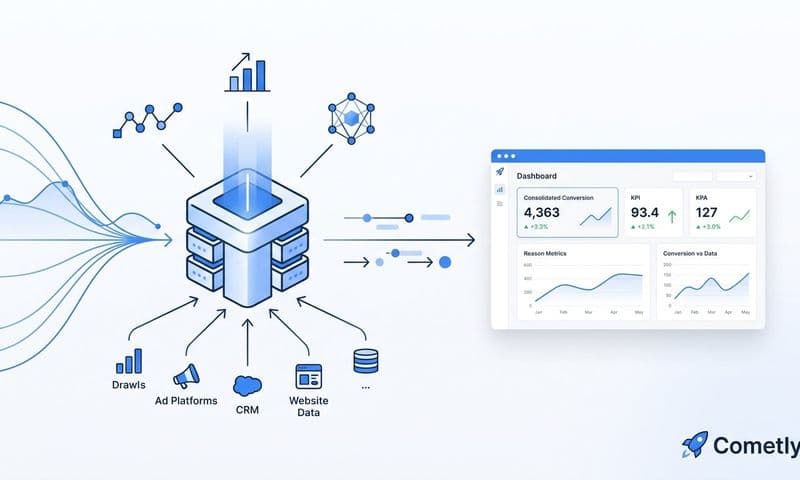
A unified marketing data platform solves this by connecting all of your data sources, including ad platforms, your CRM, and your website, into a single system with consistent attribution logic. Instead of reconciling five dashboards that disagree with each other, you get one clear view of how every touchpoint contributes to revenue. For marketing teams running paid campaigns at any meaningful scale in 2026, this kind of unified infrastructure has shifted from a competitive advantage to a baseline requirement.
The Fragmented Data Problem Costing Marketers Real Money
Here's the core issue: every ad platform measures its own performance using its own rules. Meta attributes conversions using a 7-day click and 1-day view window by default. Google uses last-click attribution in many standard reports. TikTok has its own logic. LinkedIn has another. None of them are talking to each other, and all of them are eager to take credit for every conversion they can reasonably claim.
The result is a well-documented phenomenon in marketing operations circles: when you add up the conversions reported across all your ad platforms, the total almost always far exceeds the actual conversions recorded in your CRM or analytics tool. This isn't a bug in any one platform. It's the inevitable outcome of running siloed measurement systems in parallel.
The downstream consequences are significant. When you can't trust your attribution data, you can't confidently allocate budget. You might cut spend on a channel that was generating strong assisted conversions, simply because it didn't show up as the last click. You might scale a campaign that looks efficient in one platform's dashboard but is actually cannibalizing performance from another channel. Decisions that should be driven by data driven marketing strategies end up being driven by gut instinct, or worse, by whichever platform's reporting looks most convincing in a given week.
There are also blind spots in the customer journey itself. When your ad platform data, CRM data, and website analytics aren't connected, you lose visibility into what happens between a first ad impression and a final conversion. For businesses with longer sales cycles, this gap can span weeks or months and involve dozens of touchpoints. Without a connected system, those touchpoints are invisible.
Contrast this with what becomes possible when all your marketing data flows into one unified system. You can see the actual path a customer took from first click to closed deal. You can compare channel performance using consistent attribution logic rather than each platform's self-serving numbers. You can identify which campaigns are genuinely driving revenue versus which ones just happen to be present at the final click. That shift from fragmented guessing to connected clarity is the foundational value of a unified marketing data platform.
Core Components That Power a Unified Platform
Understanding what a unified marketing data platform actually does under the hood helps you evaluate whether a given tool can deliver on its promise. At a high level, these platforms operate across three technical layers: data ingestion, data normalization, and analytics with attribution.
Data Ingestion: This is the layer that connects your data sources. A capable platform needs native integrations with your ad platforms (Meta, Google, TikTok, LinkedIn), your CRM, and your website. The goal is to pull in raw event data from each source so it can be processed in a single environment rather than staying locked in separate systems.
Data Normalization: Raw data from different sources doesn't naturally speak the same language. A click event from Meta is structured differently than a form submission from your CRM or a pageview from your website analytics. Normalization is the process of translating all of this into a consistent format so you can make meaningful cross-channel comparisons. Without this layer, you're just aggregating noise.
Attribution and Analytics: This is where the unified data becomes actionable. The analytics layer applies attribution logic across all your connected touchpoints, giving you a consistent view of how credit should be distributed across the customer journey. This is also where reporting, visualization, and AI-powered insights live.
One component that has become especially critical in this layer is server-side tracking. Apple's App Tracking Transparency framework, which began rolling out with iOS 14.5, significantly degraded the effectiveness of browser-based pixel tracking for mobile users. Ad blockers and cookie restrictions have compounded this problem across all devices. Server-side tracking addresses this by moving event data collection from the user's browser to your own server, making it far more reliable and resistant to the limitations that have made client-side pixels increasingly inaccurate.
Closely related are Conversions APIs, like Meta's CAPI and Google's Enhanced Conversions. These allow you to send conversion data directly from your server to the ad platform, bypassing the browser entirely. The result is more complete conversion data reaching the platforms that need it to optimize their algorithms.
Multi-touch attribution is the connective tissue that ties all of this together. Rather than assigning 100% of the credit to a single touchpoint, multi-touch attribution distributes credit across every interaction in the customer journey according to a defined model. This gives you a much more accurate picture of how your channels work together to drive revenue, rather than competing with each other for sole credit.
How Unified Data Changes the Way You Analyze Ad Performance
When all your marketing data flows through a single platform with consistent attribution logic, your ability to analyze ad performance fundamentally changes. The most immediate shift is that you stop comparing apples to oranges.
In a fragmented setup, comparing Meta performance to Google performance means comparing two different attribution models, two different reporting windows, and two different definitions of a conversion. Any conclusion you draw from that comparison is built on an unstable foundation. A unified platform applies the same attribution logic to both channels, so when you see that one is outperforming the other, you can actually trust that comparison.
This is also where attribution model flexibility becomes a powerful analytical tool. Different attribution models tell different stories about your customer journey. First-touch attribution highlights the channels that generate initial awareness. Last-touch attribution emphasizes the final interaction before conversion. Linear attribution distributes credit equally across all touchpoints. Time-decay models give more weight to interactions closer to conversion. Data-driven models use algorithmic analysis to assign credit based on actual patterns in your data.
None of these models is universally correct. The right model depends on your business, your sales cycle, and what question you're trying to answer. A unified platform lets you toggle between models and compare the results side by side, so you can understand how your channels contribute at different stages of the funnel rather than committing to a single perspective that may be misleading. Exploring the best marketing attribution platforms for revenue tracking can help you identify which tools offer this kind of model flexibility.
Real-time data visibility adds another dimension to performance analysis. When your unified platform is pulling in fresh data continuously, you can catch underperforming campaigns early and reallocate budget before significant spend is wasted. You don't have to wait until the end of the month to discover that a campaign was burning through budget without driving results. You can see it happening and respond in near real time.
This speed of insight is particularly valuable for teams managing significant ad spend across multiple channels. The faster you can identify what's working and what isn't, the more efficiently you can deploy your budget. Unified data doesn't just improve the quality of your analysis. It accelerates the entire decision-making cycle.
The Role of AI in Making Unified Data Actionable
Unified data is powerful on its own, but the volume of information flowing through a connected marketing data platform can quickly exceed what any analyst can process manually. This is where AI becomes a meaningful differentiator rather than a marketing buzzword.
When AI is built on top of a complete, unified data set, it can surface patterns and anomalies that would take a human analyst hours to find. Which ad creative is quietly outperforming everything else in your account? Which audience segment is converting at a much higher rate than your overall average? Which campaign is showing early signs of fatigue before performance visibly drops? These are the kinds of insights that AI can identify continuously, across all your channels simultaneously.
The practical output of AI-powered analysis is recommendations you can act on. Rather than presenting you with a dashboard of metrics and leaving you to draw your own conclusions, an AI-driven platform can tell you specifically which campaigns to scale, which to pause, and where to shift budget based on actual performance patterns in your data. For marketing teams managing complex, multi-channel campaigns, this kind of guidance compresses the time between insight and action.
There's also a feedback loop dimension that's worth understanding. When you feed enriched, unified conversion data back to ad platforms like Meta and Google, their own algorithms become more effective. Meta's delivery system uses conversion signals to optimize who sees your ads. The more complete and accurate those signals are, the better Meta can target your ideal customers. The same principle applies to Google's Smart Bidding algorithms. Server-side tracking and Conversions APIs make this feedback loop possible by ensuring that high-quality conversion data actually reaches the platforms, rather than being lost to browser restrictions or ad blockers.
The compounding effect here is significant. Better data fed to ad platform algorithms means better targeting, which means more efficient spend, which means more conversions, which means even better data to feed back into the system. Unified data doesn't just improve your reporting. It improves the performance of every campaign running on top of it.
Who Gets the Most Value from Unified Marketing Data
The short answer is that any team running paid campaigns across more than one channel will benefit from a unified marketing data platform. But the value scales with complexity, and certain profiles see an especially strong return.
Growth-focused marketing teams managing multi-channel paid campaigns are the most direct beneficiary. If you're running Meta, Google, and at least one other paid channel simultaneously, the attribution confusion described earlier is already costing you money. A unified platform gives you the consistent cross-channel view you need to allocate budget intelligently.
B2B SaaS companies with longer sales cycles have a particular need for full-funnel visibility. When a customer's journey from first ad impression to closed deal spans weeks or months and involves multiple marketing and sales touchpoints, last-click attribution in any single platform is essentially useless for understanding what actually drove the revenue. The best marketing attribution tools for B2B SaaS companies are designed specifically to handle this kind of complex, multi-touch journey.
Agencies managing multiple client accounts benefit from the operational efficiency of a unified platform that can handle multiple data environments in one place, as well as the credibility that comes with being able to show clients accurate, consistent attribution data rather than conflicting platform reports.
One common objection worth addressing directly: unified marketing data platforms are not exclusively for enterprise teams with large analytics budgets. Modern platforms have made this capability accessible to growing businesses. The complexity of your data environment, not the size of your company, is the better indicator of whether you need one. If you're running meaningful ad spend across multiple channels and your attribution data doesn't add up, you need unified data infrastructure regardless of your company's size.
What to Look for When Evaluating Your Options
Not all unified marketing data platforms are built the same way, and the differences matter significantly for the quality of insights you'll get. Here are the criteria that should drive your evaluation.
Breadth of native integrations: A platform is only as unified as the data sources it can connect. Look for native integrations with the ad platforms you actually use, your CRM, and your website analytics. Custom API connections can fill gaps, but native integrations are more reliable and require less ongoing maintenance.
Server-side tracking capability: Given the ongoing degradation of browser-based pixel tracking, a platform without server-side tracking is operating with structurally incomplete data. This isn't a nice-to-have feature in 2026. It's a requirement for accurate attribution.
Attribution model flexibility: You should be able to choose from multiple attribution models and compare them side by side. A platform that locks you into a single model limits your ability to understand your customer journey from different analytical perspectives. Reviewing digital marketing attribution software options can help you benchmark which platforms offer the broadest model selection.
Quality of AI-driven insights: Look beyond dashboards and ask whether the platform actively surfaces recommendations. The goal isn't just to see your data in one place. It's to understand what your data means and what you should do about it.
Conversion sync functionality: This is a differentiator that's easy to overlook. A platform that only reports on your conversions is useful. A platform that also feeds enriched conversion data back to Meta, Google, and other ad platforms actively improves your campaign performance by giving their algorithms better signals to work with. These are fundamentally different levels of value.
Cometly is built specifically to address all of these requirements for paid advertising teams. It connects your ad platforms, CRM, and website into a single attribution environment using server-side tracking that captures conversion data that pixel-based tracking misses. Its multi-touch attribution engine lets you analyze the full customer journey across every touchpoint rather than relying on each platform's self-reported numbers. The AI layer surfaces recommendations on which campaigns to scale and where to reallocate budget, based on complete cross-channel data rather than isolated platform metrics. And Cometly's conversion sync actively feeds enriched event data back to Meta and Google, improving the quality of signals those platforms use to optimize targeting and bidding. It's a purpose-built solution for teams who need accurate attribution, not just more dashboards.
Putting It All Together
Fragmented marketing data isn't just an operational inconvenience. It's a competitive disadvantage that compounds over time. Every budget decision made on incomplete attribution data is a decision that could have been better. Every campaign scaled based on inflated platform-reported conversions is a potential waste of spend. Every customer journey that goes untracked is a missed opportunity to understand what actually drives revenue for your business.
A unified marketing data platform addresses this at the root level. By connecting your ad platforms, CRM, and website into a single system with consistent attribution logic, server-side tracking for data completeness, and AI-powered analysis to surface actionable insights, it transforms marketing data from a source of confusion into a genuine strategic asset.
The capabilities covered in this article, including cross-channel attribution, multi-touch analysis, conversion sync, and AI-driven recommendations, aren't theoretical features. They're the practical tools that allow modern marketing teams to understand what's working, act on it faster, and continuously improve the efficiency of their ad spend.
If your current setup involves reconciling conflicting dashboards, guessing at attribution, or making budget decisions you can't fully justify with data, the gap between where you are and where you could be is significant. Ready to close it? Discover how Cometly connects your ad platforms, CRM, and website into one clear attribution view. Get your free demo today and start capturing every touchpoint to maximize your conversions.