
There was a moment, sometime in mid-2021, when marketing teams started noticing something was off. Campaigns that had been running profitably for months suddenly looked like they were underperforming. Conversion counts dropped. Return on ad spend figures became harder to trust. Attribution windows shrank. And the data that ad platforms were reporting no longer matched what was showing up in the CRM.
The culprit was not a bad campaign or a sudden shift in consumer behavior. It was a software update. Apple's iOS 14.5 introduced a privacy framework that fundamentally changed how apps could track user behavior, and the ripple effects hit the entire digital advertising ecosystem almost immediately.
iOS privacy tracking is now one of the most important topics in modern marketing, not because it is a crisis to be feared, but because understanding it is the difference between making confident decisions and flying blind. This article breaks down what iOS privacy tracking actually is, how it works technically, what it broke in your attribution setup, and what smart marketers are doing to build measurement strategies that hold up in a privacy-first world.
The Privacy Shift That Rewired Digital Advertising
Before April 2021, the default state of mobile advertising was opt-out. Apps could track user behavior across other apps and websites by default, and users had to actively dig into their settings to stop it. For ad platforms, this was enormously valuable. It meant they could follow a user's journey from ad exposure to app install to purchase, even when those events happened across different apps or browsers.
The mechanism that made this possible was the IDFA, or Identifier for Advertisers. Apple assigns a unique IDFA to every iPhone, and ad platforms used it as a universal key to match ad impressions to downstream conversions. If someone saw a Facebook ad, downloaded an app, and made a purchase three days later, the IDFA allowed the platform to connect those dots and report that conversion back to the advertiser.
iOS 14.5 changed the default. With the introduction of the App Tracking Transparency (ATT) framework, Apple flipped the model to opt-in. Now, every app that wants to track user activity across other apps or websites must display a permission prompt explicitly asking for consent. If the user declines, the app cannot access the IDFA, and the cross-app tracking pipeline breaks.
The practical consequence was significant. A substantial portion of iOS users choose to opt out when presented with the ATT prompt, which means ad platforms lost access to device-level signals for a large share of their audience. For platforms like Meta, which had built their optimization and measurement infrastructure around IDFA-based matching, this was a foundational disruption. Meta publicly acknowledged that ATT affected its ability to measure and target ads following the iOS 14.5 rollout, and the impact was widely covered across industry press.
This was not a one-time policy change. Apple has continued expanding its privacy posture across subsequent iOS versions. iOS 15 introduced Mail Privacy Protection, which prevents senders from detecting when an email has been opened by masking IP addresses and pre-loading email content. Safari's Private Click Measurement (PCM) offers a limited, privacy-preserving alternative for web-to-web conversion tracking that intentionally restricts the granularity of data available to advertisers.
Taken together, these changes reflect a deliberate, sustained platform strategy. Apple is not walking this back. Marketers who treat iOS privacy tracking as a temporary inconvenience are misreading the direction of travel. The question is not whether to adapt, but how. Understanding privacy-compliant tracking alternatives is now a core competency for any growth team.
Under the Hood: How iOS Privacy Tracking Actually Works
Understanding what iOS privacy tracking does technically helps clarify what you can and cannot recover with the right infrastructure. Let's walk through what actually happens when a user encounters the ATT prompt.
When a user opens an app that wants to track their activity across other apps or websites, iOS displays a system-level prompt. The app cannot customize this prompt beyond providing a brief usage description. If the user taps "Ask App Not to Track," the app is blocked from accessing the IDFA. It cannot share that identifier with ad networks, data brokers, or any third party for cross-app tracking purposes. The device-level signal is gone.
What the app can still do is collect first-party data within its own experience. In-app events, user inputs, and behavioral signals within that specific app are still available, as long as they are not used to build a cross-app tracking profile. This distinction matters because it defines where your data collection strategy needs to shift.
For ad attribution, Apple introduced SKAdNetwork as its privacy-preserving alternative. SKAdNetwork allows ad networks to receive aggregated conversion data without accessing individual user identifiers. When a user converts after seeing an ad, SKAdNetwork sends a postback to the ad network, but with significant constraints. Conversion values are limited to a 6-bit schema in earlier versions, meaning you can encode a relatively small number of distinct conversion outcomes. Postback delivery is delayed, often by 24 to 48 hours or longer depending on the conversion window configuration, which reduces the real-time feedback loops that ad platform algorithms rely on. SKAdNetwork also has a campaign limit that constrains how granularly you can segment your reporting.
These limitations make SKAdNetwork a floor, not a ceiling. It provides some signal, but not enough to run sophisticated attribution or optimization at scale.
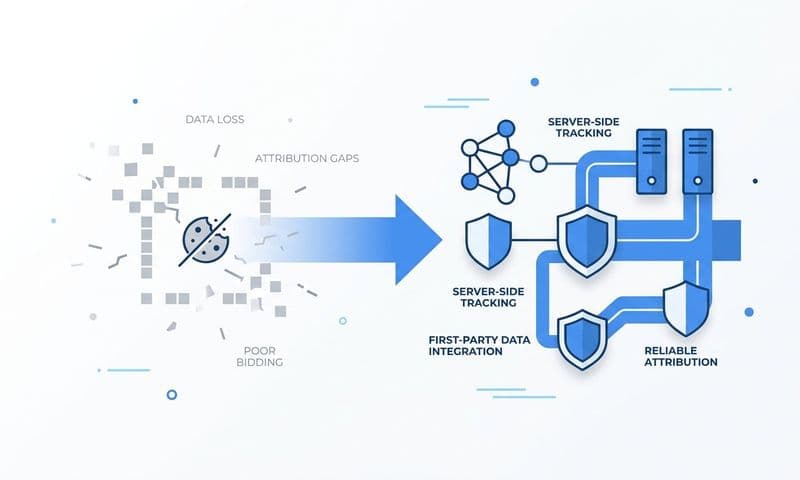
Here's the critical distinction that shapes every modern attribution strategy: what is blocked at the device level is not the same as what is blocked everywhere. iOS privacy restrictions apply to client-side tracking, meaning the signals that originate from the device itself. Server-side events, first-party data collected through your own properties, and probabilistic modeling are all less affected or entirely unaffected by ATT. This is the gap that server-side tracking strategies are designed to fill, and it is where the most meaningful attribution improvements are happening today.
What Breaks in Your Attribution When iOS Privacy Kicks In
The practical damage to attribution is not abstract. There are specific, measurable gaps that emerge when iOS privacy tracking reduces the signal available to ad platforms, and each one has real consequences for marketing decisions.
The most immediate impact is conversion undercounting. When ad platforms cannot match an ad exposure to a downstream conversion because the IDFA is unavailable, that conversion simply does not get reported. The sale happened, the lead was generated, but the platform has no way to connect it to the ad that influenced the user. This is especially acute for platforms that relied heavily on pixel-based tracking, because browser and in-app pixels depend on client-side signals that iOS limits or blocks entirely. The full scope of pixel tracking problems on iOS goes deeper than most marketers initially realize.
Attribution windows also shrank as a result of ATT. Platforms adjusted their default windows to work within the constraints of SKAdNetwork, which means conversions that happen days or weeks after an ad exposure are less likely to be captured and reported. For B2B SaaS companies with longer consideration cycles, this is particularly disruptive. A buyer might see a LinkedIn or Meta ad on their iPhone during research, then convert through a sales conversation two weeks later. Under pixel-only tracking, that journey is largely invisible.
Audience segmentation took a hit as well. Lookalike audiences and retargeting segments built on cross-app behavioral data became less precise as the pool of trackable users shrank. When ad platforms have less data to work with, their ability to find and target high-intent users degrades, which affects campaign efficiency even before you factor in attribution gaps.
The decision-making consequences of this are significant and often underappreciated. When a profitable campaign appears to be underperforming because its conversions are being undercounted, marketers may reduce budget or pause it entirely. When a channel appears to be outperforming because its tracking is less affected by iOS restrictions rather than because it is actually driving more revenue, it can attract disproportionate investment. Both scenarios represent real money being misallocated based on incomplete data. Fixing conversion tracking gaps is essential before any meaningful optimization can happen.
Server-Side Tracking and Conversion APIs: The Modern Fix
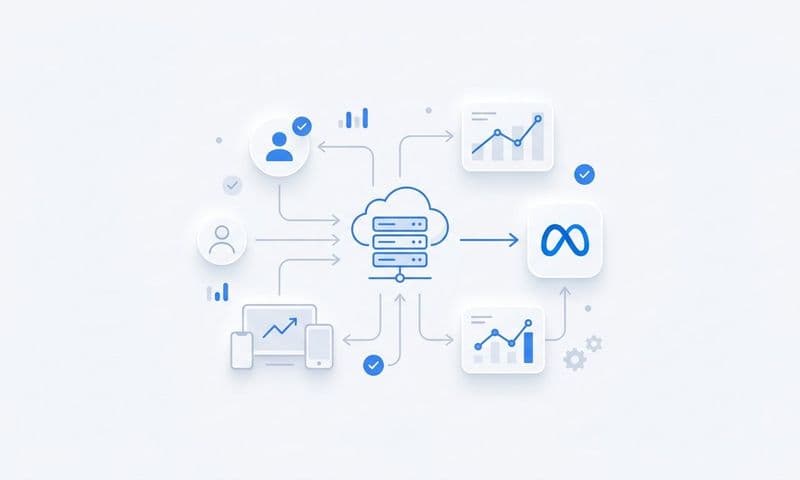
The most effective technical response to iOS privacy limitations is server-side tracking, and understanding why requires going back to the core problem. Pixel-based tracking fails because it depends on the browser or device to fire an event and send data to an ad platform. iOS privacy restrictions interfere with that client-side signal. Server-side tracking removes the device from the equation entirely.
With server-side tracking, when a conversion event occurs, your server sends that event data directly to the ad platform's API. The data travels from your infrastructure to the platform's infrastructure, bypassing the browser and device restrictions that ATT imposes. The conversion is still recorded, and the ad platform still receives the signal it needs to optimize and report.
The two dominant implementations of this approach are Meta's Conversions API (CAPI) and Google's Enhanced Conversions. Both allow marketers to send first-party event data from their own servers to supplement or replace pixel signals. When implemented correctly, they can recover a meaningful portion of the conversions that would otherwise go unattributed.
Meta's Conversions API is particularly important for B2B SaaS teams running paid social campaigns. It allows you to send events like form submissions, trial signups, and purchase completions directly from your server, along with first-party identifiers like hashed email addresses or phone numbers. Meta uses these identifiers to match the event to a user in its system, even when the IDFA is unavailable. The match rate depends on the quality and completeness of the first-party data you send, which is why enriching your events matters. Following a thorough server-side tracking implementation guide ensures these integrations are set up correctly from the start.
Google Enhanced Conversions works similarly for search and display campaigns, allowing you to send hashed first-party data alongside conversion events to improve attribution accuracy when cookies or device identifiers are unavailable.
One technical requirement that becomes critical when running both a pixel and a server-side event is deduplication. If a user completes a form and both your pixel and your server fire a conversion event for the same action, the ad platform could count it twice. Ad platforms use event ID matching to deduplicate: you assign a unique ID to each conversion event and include it in both the pixel event and the server-side event. The platform recognizes the duplicate and counts the conversion only once. Getting this right is not optional. Without proper deduplication, your reported conversion data will be inflated, which creates its own set of bad decisions downstream.
Building a First-Party Data Strategy Around iOS Limitations
Server-side tracking solves the technical pipeline problem, but the quality of what flows through that pipeline depends on your first-party data strategy. In a post-ATT world, the data you collect directly from users through your own properties is your most durable asset, because it is not subject to device-level tracking restrictions.
First-party data includes everything users share with you directly: email addresses from form submissions, account information from product signups, behavioral data from logged-in sessions, and CRM records from sales conversations. This data belongs to you, and you can use it to enrich the conversion events you send through Conversion APIs.
The enrichment piece matters more than most marketers realize. When you send a server-side conversion event to Meta or Google with a hashed email address attached, the platform attempts to match that email to a user in its system. If the match succeeds, the platform can attribute that conversion to the ad that influenced the user, even without the IDFA. Higher match rates mean more conversions get attributed, which means better optimization signals for the algorithm and more accurate reporting for you.
This shifts the strategic priority toward capturing more first-party identifiers earlier in the funnel. Forms that collect email addresses, gated content that requires account creation, and product experiences that encourage logged-in usage all become more valuable from an attribution standpoint, not just from a lead generation standpoint. Improving your lead tracking process is one of the highest-leverage investments a team can make in this environment.
Multi-touch attribution also becomes more important in this environment. When any single platform's data is incomplete due to iOS privacy restrictions, relying on that platform's self-reported attribution creates a distorted picture. Multi-touch attribution aggregates signals from multiple sources, including your CRM, your server-side events, and platform-reported data, to build a fuller view of the customer journey. It does not require perfect data from any single source. It requires enough signal across enough sources to triangulate what is actually driving conversions.
For B2B SaaS companies specifically, this often means connecting mobile research touchpoints to desktop or sales-assisted conversions, a journey that spans devices and time windows in ways that pixel-only tracking was never well-equipped to handle even before iOS privacy changes.
Measuring What Actually Matters in a Privacy-First World
The instinct to chase pixel-perfect attribution is understandable, but it is increasingly the wrong goal. The more productive framing is building a measurement strategy that triangulates across multiple signals, none of which is complete on its own, but together tell a reliable story about what is driving growth.
That strategy has four layers. Platform-reported data gives you the ad platform's view, which is directionally useful even when it undercounts conversions. Server-side events give you a more complete conversion signal that is less affected by iOS restrictions. CRM pipeline data tells you which leads actually progressed through the funnel and which ones converted to revenue. And revenue attribution connects the ad spend to closed deals, bypassing the iOS-related gaps in top-of-funnel tracking entirely.
For B2B SaaS teams, that last layer is often the most important and the most underutilized. When you can see which campaigns and channels are generating pipeline and closed revenue, not just clicks and form fills, you have a measurement foundation that iOS privacy changes cannot erode. Tracking closed-won revenue back to specific ad campaigns is the clearest signal available in a privacy-constrained world. Closed revenue data lives in your CRM. It is first-party, it is not subject to device-level restrictions, and it is the number that actually matters to the business.
This is the environment Cometly was built for. Cometly connects your ad platforms, CRM data, and server-side events into a single attribution view, so you can see the full customer journey from first ad click to closed-won revenue without depending on any single platform's self-reported numbers. It captures every touchpoint across the funnel, feeds enriched conversion data back to ad platforms to improve their optimization, and uses AI to surface which campaigns are actually driving results.
For teams running paid acquisition across Meta, Google, LinkedIn, and other channels, having that unified view means you can make scaling decisions based on what is actually working, not on whichever channel happens to have the least broken tracking. In a privacy-constrained environment, that clarity is a genuine competitive advantage. The right marketing attribution software makes that clarity accessible without requiring a data engineering team to build it from scratch.
The Bottom Line on iOS Privacy Tracking
iOS privacy tracking is not a temporary obstacle waiting to be reversed. It is a permanent feature of the digital advertising landscape, and the direction is toward more privacy protection, not less. Marketers who are still waiting for the old tracking infrastructure to come back are losing ground to competitors who have already adapted.
The adaptation path is clear. Implement server-side tracking through Conversion APIs to recover the conversion signal that client-side pixels can no longer reliably capture. Build a first-party data strategy that enriches those events with identifiers that improve match rates. Adopt multi-touch attribution to triangulate across sources rather than depending on any single platform's incomplete view. And connect your ad data to CRM pipeline and revenue so your measurement foundation rests on data that iOS restrictions cannot touch.
The marketers who thrive in this environment will not be the ones with the most data. They will be the ones with the most accurate, well-structured data and the infrastructure to act on it confidently.
If you are ready to build attribution that works regardless of device-level restrictions, Cometly gives your team the tools to do it. From server-side event tracking to AI-driven campaign recommendations to full-funnel revenue attribution, it is built specifically for B2B SaaS teams who need a single source of truth for their marketing data. Get your free demo today and start capturing every touchpoint with the clarity your growth decisions deserve.