
LinkedIn is one of the most powerful B2B advertising platforms available today. It puts your message in front of decision-makers, buying committees, and the exact job titles that matter to your pipeline. So when LinkedIn Campaign Manager shows strong conversion numbers, it feels like validation that your spend is working.
Then you open your CRM.
The numbers don't match. LinkedIn is claiming dozens of conversions, but your CRM shows a fraction of that in qualified leads. The deals that did close don't trace back cleanly to the campaigns you were running. Your cost-per-acquisition looks reasonable in Campaign Manager but alarming when you calculate it against actual revenue. Sound familiar?
This disconnect is not a reporting glitch, and it's not a one-time anomaly. It's a structural problem rooted in how LinkedIn tracks conversions by default. The platform's attribution windows are generous, its pixel is vulnerable to modern browser environments, and its reporting stops at the conversion event without connecting to downstream business outcomes. The result is that many B2B marketing teams are making budget decisions based on data that is fundamentally broken.
This article breaks down exactly why LinkedIn ads tracking accuracy fails, what technical and methodological gaps are causing the problem, and how modern attribution approaches give you a clear, honest picture of what LinkedIn is actually delivering for your business.
Why LinkedIn Conversion Data Rarely Tells the Full Story
Let's start with the most common source of confusion: LinkedIn's default attribution settings. Out of the box, LinkedIn Campaign Manager uses a 30-day view-through attribution window and a 7-day click attribution window. This means that if someone sees your LinkedIn ad and then converts anywhere within the next 30 days, LinkedIn claims credit for that conversion, even if they never clicked your ad and even if three other channels influenced their decision in the meantime.
For B2B buyers with long research cycles, this window is enormous. A prospect might see your sponsored content in January, spend weeks reading your competitors' blogs, attend a webinar, talk to a colleague, and finally fill out your demo form after clicking a Google Search ad. LinkedIn gets credit for the conversion. Google does too. So does whatever else was running. Everyone wins on paper. Your CRM records one lead.
The second structural issue is pixel reliability. LinkedIn's Insight Tag is a JavaScript-based pixel that fires client-side, meaning it depends entirely on the user's browser environment to execute correctly. B2B audiences are particularly problematic here because they often use corporate-managed devices, VPNs, and browsers with strict privacy settings. These environments block or interfere with third-party pixels at a higher rate than consumer audiences. A meaningful share of real conversions simply go unrecorded because the pixel never fires.
The third issue is that LinkedIn's reporting stops at the conversion event. Campaign Manager tells you how many conversions a campaign generated and at what cost, but it has no visibility into what happened after that. A campaign generating a high volume of low-quality leads looks identical to one generating fewer, high-value leads that close into revenue. Without connecting ad data to pipeline and revenue, you're optimizing toward a metric that may have no relationship to business outcomes.
These three issues compound each other. Inflated conversion counts from wide attribution windows, underreported real conversions from pixel limitations, and no connection to downstream revenue create a reporting environment where the numbers feel meaningful but tell you very little about what's actually working.
The Attribution Window Problem and Why It Inflates Results
View-through attribution is the most misunderstood feature in LinkedIn's reporting, and it's also the one that does the most damage to tracking accuracy. When a user sees your ad but never clicks it, that impression still gets credited as a conversion trigger if the person converts within the attribution window. The logic is that brand exposure influenced the decision. Sometimes that's true. Often, it's a stretch.
The problem becomes acute in B2B contexts where buying cycles stretch across weeks or months. A prospect who sees your LinkedIn ad in week one might not convert until week four, after interacting with organic search results, a sales development rep's outreach, a peer recommendation, and a product review site. LinkedIn's 30-day view-through window captures that conversion and counts it as a LinkedIn win. None of the other touchpoints get acknowledged in LinkedIn's reporting at all.
Here's where it gets particularly messy for teams running multi-channel campaigns. Google Ads has its own attribution windows. Meta has its own. If all three platforms were running ads during the same period, all three platforms will claim credit for the same conversion. This is not a bug or an oversight. It's how each platform is designed to report. Each one is showing you its own performance through its own lens, with no coordination between them.
The practical consequence is that total platform-reported conversions routinely exceed the actual number of leads or deals recorded in your CRM. If LinkedIn claims 80 conversions, Google claims 60, and Meta claims 40, you might have 90 actual leads in your CRM. Every platform looks like it's performing. The combined total is mathematically impossible, but each dashboard looks fine in isolation. This same pattern of platform-reported discrepancies affects every major ad channel, not just LinkedIn.
Adjusting LinkedIn's attribution window settings can help reduce inflation. Tightening the view-through window or switching to click-only attribution gives you a more conservative and more honest picture of direct response performance. But window adjustments alone don't solve the multi-platform double-counting problem, and they don't give you revenue-level visibility. They're a starting point, not a complete fix.
The deeper issue is that single-platform reporting was never designed to give you an accurate cross-channel view. It was designed to show each platform in the best possible light. Understanding that is the first step toward building a tracking approach that actually serves your business decisions.
Technical Gaps That Silently Kill Tracking Accuracy
Beyond attribution window settings, there are technical realities that undermine LinkedIn ads tracking accuracy at the data collection layer. These gaps are less visible than reporting discrepancies but equally damaging to the quality of your decisions.
The LinkedIn Insight Tag fires client-side. This means the tracking code runs in the visitor's browser, and if anything in that environment prevents it from executing, the conversion goes unrecorded. Ad blockers are the most obvious culprit, but they're not the only one. Corporate browsers often have strict content security policies. VPNs can interfere with domain resolution. Privacy-focused browsers like Brave block third-party scripts by default. iOS privacy changes have reduced cross-site tracking across the board.
B2B audiences are disproportionately affected by all of these factors. The professionals LinkedIn is best at reaching, senior decision-makers at mid-market and enterprise companies, are exactly the people most likely to be working on managed devices with IT-enforced security settings. The audience you're paying a premium to reach is the audience most likely to slip through pixel-based tracking.
Form tracking adds another layer of fragility. When you're tracking form submissions via pixel, the tracking event depends on the page loading fully, JavaScript executing without errors, and the submission happening in the same browser session where the original click occurred. Slow page loads, JavaScript conflicts, and cross-device journeys all create scenarios where the form is submitted but the conversion event never fires. Your cost-per-lead calculation is built on an incomplete denominator.
Cross-device behavior compounds this further. A B2B buyer might click a LinkedIn ad on their phone during a commute, research your product on their work laptop later that day, and submit a demo request from their home computer that evening. Client-side pixels have no reliable way to stitch that journey together. The conversion looks like it came from nowhere, or it gets attributed to direct traffic, or it gets lost entirely.
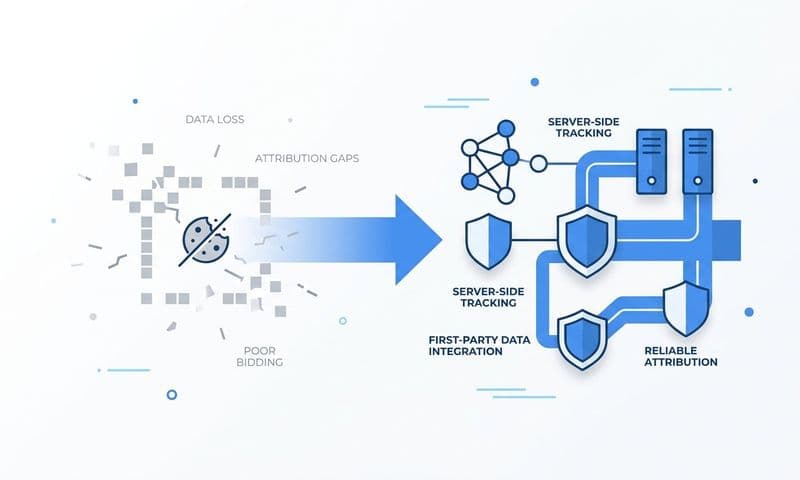
Server-side event tracking addresses many of these limitations by sending conversion data directly from your server to ad platforms rather than relying on the browser. This approach bypasses ad blockers, is unaffected by browser privacy settings, and produces a more complete conversion signal. Server-side tracking is significantly more accurate than client-side methods, which makes third-party attribution platforms particularly valuable for teams running significant LinkedIn spend.
How Multi-Touch Attribution Gives LinkedIn Its True Grade
If single-platform reporting inflates results and technical gaps underreport real conversions, what does an accurate view of LinkedIn's performance actually look like? The answer is multi-touch attribution applied across your full customer journey data.
Multi-touch attribution distributes credit across every touchpoint a prospect interacted with before converting, rather than assigning full credit to the last click or the most recent impression. Instead of LinkedIn claiming 100% of a conversion because an impression occurred within the attribution window, multi-touch models spread credit proportionally based on each channel's actual role in the journey. This gives you a far more honest assessment of what LinkedIn is contributing.
The insight this unlocks is qualitative as well as quantitative. By mapping LinkedIn ad exposures against CRM data and pipeline events, you can see where in the funnel LinkedIn is doing its best work. Is it generating first-touch awareness for prospects who had never heard of your product? Is it re-engaging mid-funnel leads who went cold? Is it appearing as a closing influence for deals that were already in late-stage conversations? Each of these roles has different strategic value, and optimizing for the right one requires knowing which one LinkedIn is actually playing.
Comparing attribution models side by side sharpens this analysis further. A first-touch model gives LinkedIn credit when it's the initial point of contact. A linear model distributes credit evenly across all touchpoints. A data-driven model weights touchpoints based on their observed correlation with conversion. Running all three and comparing the outputs reveals how sensitive LinkedIn's apparent performance is to the model you choose, and where the real signal lives. The right attribution tracking setup makes this kind of model comparison straightforward rather than a manual exercise.
This kind of analysis regularly surfaces surprises. A LinkedIn campaign that looks mediocre on last-touch attribution might turn out to be a strong first-touch driver for high-value accounts. A campaign that looks great on view-through attribution might show almost no influence when you look at click-based or CRM-connected data. The model you choose isn't just a reporting preference. It directly shapes which campaigns you scale and which you cut.
Multi-touch attribution doesn't eliminate uncertainty, but it replaces the false precision of single-platform reporting with a more grounded, multi-dimensional view of what's actually driving pipeline. For B2B teams where LinkedIn spend is significant, that shift in perspective changes budget decisions in meaningful ways.
Connecting LinkedIn Spend to Pipeline and Revenue
Fixing attribution windows and adopting multi-touch models improves the accuracy of your conversion data, but the most important upgrade you can make to LinkedIn ads tracking is connecting your ad spend directly to pipeline stages and closed-won revenue.
Platform-reported conversions, even accurate ones, stop at the moment someone submits a form or completes a defined action. They tell you nothing about whether that lead became a qualified opportunity, progressed through your sales cycle, or closed into revenue. For B2B SaaS companies where sales cycles can span months and deal values vary significantly, optimizing toward lead volume is often optimizing toward the wrong thing entirely. Understanding how LinkedIn ads work for SaaS businesses makes this revenue-connection even more critical.
The foundation of revenue-connected attribution is consistent UTM tagging. Every LinkedIn ad should carry UTM parameters that identify the campaign, ad set, and creative at minimum. When a lead submits a form, those parameters get captured in your CRM alongside the contact record. From that point forward, as the lead moves through pipeline stages and eventually closes or churns, the original ad attribution travels with it. You can trace a closed deal back to the exact LinkedIn campaign and creative that first generated the lead.
Passing enriched data back through the funnel creates a feedback loop that transforms how you evaluate LinkedIn performance. Instead of asking "how many conversions did this campaign generate?", you start asking "how much pipeline did this campaign generate, and at what cost?" and "which LinkedIn audiences produce deals that close at the highest rate?" These are the questions that drive real budget decisions.
Revenue attribution at the campaign and creative level enables cost-per-pipeline and cost-per-revenue calculations that give you a fundamentally different view of LinkedIn's value. A campaign generating leads at a low cost-per-lead but a high cost-per-pipeline is a bad investment. A campaign generating fewer leads at a higher cost-per-lead but a low cost-per-pipeline is a strong one. You can only see this distinction when ad data is connected to revenue data. The best marketing attribution platforms are purpose-built to make this connection automatic.
For B2B SaaS teams, integrating billing or subscription data adds another layer. Connecting LinkedIn attribution to actual subscription revenue, including average contract value and retention, reveals which campaigns are generating customers who stay and expand versus customers who churn quickly. This level of visibility changes how you think about LinkedIn's role in your growth strategy entirely.
Building a Reliable LinkedIn Tracking Stack
Understanding the problems is one thing. Building the infrastructure to solve them is another. A reliable LinkedIn tracking stack combines several layers that each address a specific gap in the default setup.
UTM parameters as the foundation: Every LinkedIn campaign, ad set, and ad should have consistent, structured UTM tags. This creates a session-level record of traffic source that lives in your analytics and CRM independent of LinkedIn's own tracking. Even when the pixel fails, UTMs capture the source. Understanding UTM tracking is non-negotiable for any team serious about LinkedIn ads tracking accuracy.
First-party event tracking for on-site behavior: Complement the LinkedIn pixel with your own first-party tracking that captures key on-site events: page views, form interactions, demo requests, and content downloads. First-party data is less affected by browser restrictions and gives you a parallel record of conversion activity that you can cross-reference against LinkedIn's reported numbers.
Server-side or Conversion API layer: For teams running significant LinkedIn spend, adding a server-side tracking layer captures conversions that the client-side pixel misses. This is particularly important for B2B audiences using corporate devices and privacy tools. While LinkedIn's native server-side capabilities are still maturing, third-party attribution platforms can bridge this gap by receiving server-side events and mapping them back to ad platform data.
CRM integration for pipeline and revenue visibility: Connect your CRM to your attribution platform so that lead source, campaign, and ad creative data flows through the entire funnel. When a lead converts to an opportunity or closes, the attribution data closes with it. This is the layer that transforms LinkedIn tracking from conversion counting to revenue measurement.
Centralized attribution platform to eliminate double-counting: Centralizing all ad platform data, including LinkedIn, Google Ads, and Meta, into a single attribution platform eliminates the multi-platform double-counting problem and creates one consistent source of truth. When every channel's performance is measured through the same model with the same data, you can make meaningful comparisons and allocate budget with confidence. Ad tracking tools built on accurate data are what make this level of confidence possible.
This is exactly what Cometly is built to do. Cometly connects LinkedIn ad data with CRM events, pipeline stages, and revenue in real time, giving B2B SaaS teams the visibility to see which LinkedIn campaigns, audiences, and creatives are actually generating revenue, not just clicks. By capturing every touchpoint and feeding enriched conversion data back to ad platforms, Cometly helps you improve both your attribution accuracy and the quality of signal you're sending to LinkedIn's own optimization algorithms.
The Bottom Line on LinkedIn Tracking
LinkedIn ads tracking accuracy is not a minor reporting inconvenience. It's a strategic blind spot that causes B2B marketing teams to misallocate budget, misjudge campaign performance, and miss real revenue opportunities. When the numbers in Campaign Manager don't reflect reality, every decision built on those numbers carries compounding risk.
The path forward is clear. Start by adjusting LinkedIn's attribution window settings to reduce view-through inflation. Layer in server-side tracking to capture conversions the pixel misses. Adopt multi-touch attribution to understand LinkedIn's true role across the full customer journey. And connect your ad spend directly to pipeline and revenue so that every budget decision is grounded in business outcomes rather than platform-reported conversions.
None of these steps requires reinventing your marketing stack. They require building the right connections between the data you already have and the platforms where your campaigns run.
Cometly gives B2B SaaS marketers a single source of truth for LinkedIn and all paid channels, connecting ad spend to closed-won revenue with the precision that modern growth teams need. If you're ready to stop making decisions based on broken data, Get your free demo and see exactly which LinkedIn campaigns are driving revenue for your business.