
Most B2B SaaS marketing teams invest in a marketing analytics package and then underuse it. They pull surface-level reports, check channel-level spend, and call it a day. But the teams consistently scaling pipeline and lowering customer acquisition costs are doing something different. They are using their analytics package as an active decision-making engine, not just a reporting dashboard.
This article breaks down seven practical strategies to help you extract maximum value from your marketing analytics package. Whether you are evaluating attribution models, tightening your conversion tracking, or connecting ad spend directly to closed revenue, each strategy here is designed to move you from data collection to data-driven action.
The goal is simple: know exactly which channels, campaigns, and touchpoints are driving real revenue so you can invest more in what works and cut what does not.
1. Define Your Attribution Model Before You Analyze Anything
The Challenge It Solves
Many marketing teams open their analytics package and start drawing conclusions without ever asking a foundational question: which attribution model is active, and is it the right one for how our buyers actually behave? Without intentional model selection, your data will consistently misrepresent which channels and campaigns deserve credit and budget.
The Strategy Explained
Different attribution models produce materially different credit allocations across your channels. First-touch, last-click, linear, time-decay, and data-driven models each tell a different story about which campaigns deserve budget. For B2B SaaS companies with longer sales cycles involving multiple stakeholders, last-click attribution routinely undervalues top-of-funnel and mid-funnel touchpoints.
The choice of attribution model should be intentional, not a default setting you inherited when the account was set up. Before you analyze performance, align your team on which model best reflects your actual sales cycle. Then apply that model consistently so comparisons across time periods are valid. You can explore the differences between models in detail by reviewing the 5 most common ad attribution models and how to approach choosing the best attribution model for optimizing ad campaigns.
Implementation Steps
1. Audit your current attribution model settings across every platform in your analytics stack.
2. Map your average sales cycle length and count how many touchpoints a typical buyer interacts with before converting.
3. Select a model that weights credit proportionally to how your buyers actually move through the funnel.
4. Document the selected model so every team member is analyzing data under the same framework.
Pro Tips
Run a side-by-side comparison of your current default model versus a multi-touch model before making any budget decisions. The delta between the two often reveals which channels are being systematically over-credited or underfunded. This single exercise can reshape your entire budget allocation strategy. Understanding common attribution challenges in marketing analytics will help you anticipate and avoid the most costly mistakes during this process.
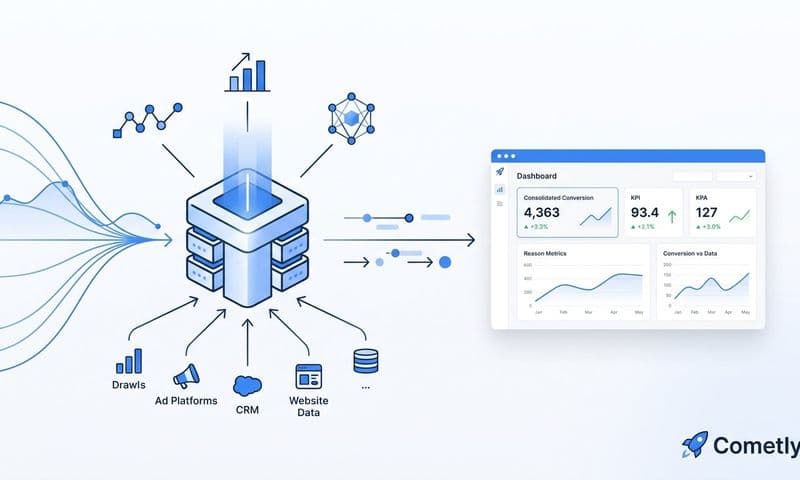
2. Unify Your Ad Platforms, CRM, and Website Into One Data Source
The Challenge It Solves
Marketing teams commonly manage data across Google Ads, Meta, LinkedIn, their CRM, and their website independently. When these sources live in silos, teams often over-attribute conversions to the last channel they can see and miss the contribution of earlier touchpoints. Manual reconciliation across platforms is time-consuming and error-prone.
The Strategy Explained
Connecting all your data sources into a single analytics view eliminates the blind spots created by platform-native reporting. When Google Ads, Meta, LinkedIn, your CRM, and your website feed into one unified system, you can see how each channel contributes to the full pipeline rather than just its own isolated metrics.
Native integrations reduce the manual work of reconciling data and lower the risk of reporting errors that distort your decision-making. A unified view also makes it far easier to compare channel performance on an apples-to-apples basis. Learn more about how this approach works in practice by exploring 20 ways marketing attribution software can help improve digital marketing efforts.
Implementation Steps
1. Audit every platform where marketing data currently lives, including ad platforms, your CRM, your website analytics, and any billing tools.
2. Identify which platforms have native integrations available in your analytics package and activate them.
3. Establish a consistent UTM tagging convention across all campaigns so data flows cleanly into your unified view.
4. Validate that data from each source is populating correctly before using the unified view for budget decisions.
Pro Tips
Standardize your UTM parameters before you connect anything. Inconsistent naming conventions are the most common reason unified dashboards produce confusing or misleading data. A simple shared naming doc across your marketing team prevents hours of cleanup later. Reviewing a marketing analytics solution that is purpose-built for unification can accelerate this process significantly.
3. Implement Server-Side Tracking to Protect Data Accuracy
The Challenge It Solves
Browser-based pixel tracking is increasingly unreliable. Ad blockers, iOS privacy changes, and the ongoing deprecation of third-party cookies all chip away at the completeness of the conversion data your analytics package receives. If your tracking is missing events, every decision you make downstream is built on incomplete information.
The Strategy Explained
Server-side tracking and Conversion APIs like Meta CAPI and Google Enhanced Conversions send conversion data directly from your server to ad platforms, bypassing browser-level limitations entirely. This approach improves event match quality, which directly affects how well ad platform optimization algorithms can target and convert your ideal customers.
The shift away from browser-based tracking is not optional for teams that want accurate data. It is a necessary infrastructure upgrade. For context on why this matters, the impact of iOS 14 on digital advertising and the broader implications of third-party cookie deprecation both illustrate how much the tracking landscape has shifted. Understanding the difference between first-party and third-party cookies is also foundational here.
Implementation Steps
1. Audit your current tracking setup to identify how many conversions are being captured via browser-based pixels versus server-side events.
2. Enable Conversion API connections for Meta and Google Enhanced Conversions through your analytics platform.
3. Test event match quality scores in your ad platform accounts after implementation to confirm improvement.
4. Monitor conversion volume before and after the switch to quantify the data recovery from previously missed events.
Pro Tips
Do not deactivate your browser-based pixels immediately after enabling server-side tracking. Run both in parallel temporarily and use deduplication logic to avoid double-counting. This transition period helps you validate that server-side events are firing correctly before you rely on them fully. Teams navigating this shift often benefit from reviewing how to use data analytics in marketing to ensure the full measurement infrastructure is aligned.
4. Map the Full Customer Journey, Not Just the Last Click
The Challenge It Solves
B2B SaaS buyers rarely convert after a single interaction. They see a paid ad, read a blog post, attend a webinar, receive a nurture email, and then finally book a demo. A marketing analytics package that only shows last-click data misrepresents this reality and leads teams to defund the earlier touchpoints that actually initiated the buying journey.
The Strategy Explained
Multi-touch journey mapping reveals which touchpoints assist conversions, not just which one closes them. When you can see that a LinkedIn ad introduced a buyer who later converted through an organic search, you understand the true contribution of that paid channel even though it did not get last-click credit.
Journey analytics tools allow teams to visualize the paths buyers take from first awareness to closed deal, making it possible to make smarter budget allocation decisions across the full funnel. This is especially important for B2B SaaS, where the buying committee often includes multiple stakeholders who interact with your content at different stages. Explore how customer journey software helps B2B SaaS companies scale for a deeper look at this approach.
Implementation Steps
1. Enable multi-touch attribution reporting in your analytics package and select a model that distributes credit across all touchpoints in the journey.
2. Identify the most common paths buyers take from first interaction to conversion by reviewing journey flow reports.
3. Tag and track all content assets, including blog posts, webinars, and email sequences, as part of the journey map.
4. Use journey data to identify which top-of-funnel and mid-funnel touchpoints are undervalued in your current budget allocation.
Pro Tips
Pay close attention to the touchpoints that appear most often in the journeys of your highest-value customers. These are the channels and content types that deserve more investment, even if they rarely receive last-click credit. Assist metrics are often the most actionable data in a journey report. A deeper understanding of the different types of marketing analytics can help you identify which analytical frameworks best support full-funnel visibility.
5. Connect Ad Spend Directly to Pipeline and Closed Revenue
The Challenge It Solves
Lead volume and MQL counts are lagging indicators for B2B SaaS. A campaign can generate hundreds of leads and still produce zero closed revenue if those leads never qualify. Without connecting ad spend to pipeline stages and closed-won data, you cannot calculate true return on ad spend or customer acquisition cost at the campaign level.
The Strategy Explained
Linking ad platform data to your CRM pipeline stages and billing data creates a direct line from ad spend to revenue. This allows marketing teams to calculate true CAC and ROAS at the campaign and channel level, not just at the aggregate marketing level. Integrating billing tools like Stripe with your ad platform data closes the loop entirely.
This shift from lead-based to revenue-based measurement changes the conversations marketing has with leadership. Instead of reporting impressions and MQLs, you can report pipeline contribution and closed revenue by campaign. For B2B SaaS teams ready to make this transition, resources on B2B revenue attribution software, SaaS revenue attribution, and the key SaaS marketing metrics worth tracking provide a strong foundation.
Implementation Steps
1. Connect your CRM to your marketing analytics package so that deal stages and closed-won data flow into your attribution reports.
2. Integrate your billing platform to pull actual revenue data alongside pipeline data.
3. Map each campaign and channel to the pipeline it generates, tracking progression from MQL through to closed-won.
4. Calculate CAC and ROAS at the campaign level using closed revenue, not just lead counts.
Pro Tips
Start by identifying your highest-volume lead source and tracing those leads through to closed revenue. In many cases, the channel generating the most leads is not the channel generating the most revenue. That single insight is often enough to justify a significant budget reallocation. Teams making this shift should also familiarize themselves with the core marketing analytics metrics that signal true pipeline health beyond surface-level lead counts.
6. Use AI-Driven Insights to Identify Scaling Opportunities Faster
The Challenge It Solves
Manual analysis of large marketing datasets is slow and prone to confirmation bias. By the time a team has reviewed creative performance across dozens of ad sets and multiple audience segments, the window to act on an insight has often passed. AI applied to your marketing analytics package surfaces patterns that manual review would miss entirely.
The Strategy Explained
AI layers applied to marketing analytics can identify which creative combinations perform best across audience segments, which campaigns are showing early signs of fatigue, and which channels have headroom to scale before performance degrades. These are the kinds of signals that take analysts hours to find manually but can be surfaced in seconds with the right tooling.
There is a second dimension here that is equally important. Feeding enriched, server-side conversion events back to ad platforms like Meta and Google improves their machine learning models. Better input data leads to better audience targeting and lower cost per acquisition over time. The combination of AI-driven insights within your analytics package and enriched data flowing back to ad platforms creates a compounding performance advantage. For practical guidance, explore how ad tracking tools help you scale ads using accurate data and 30 tips to improve ad performance.
Implementation Steps
1. Ensure your analytics package is receiving complete, enriched conversion data via server-side tracking before activating AI features.
2. Enable AI-driven recommendations or insight alerts within your analytics platform and review them on a structured cadence.
3. Identify campaigns flagged as high-potential by AI analysis and test incremental budget increases to validate the signal.
4. Set up automated conversion event feeds back to Meta CAPI and Google Enhanced Conversions to continuously improve ad platform algorithms.
Pro Tips
Treat AI recommendations as hypotheses to test, not directives to follow blindly. The most effective teams use AI insights to generate prioritized experiments, then let performance data confirm or reject each one. This approach captures the speed advantage of AI while maintaining the rigor of data-driven decision-making. For a broader perspective on this capability, the power of AI marketing analytics is worth exploring to understand how leading teams are operationalizing these tools.
7. Build a Consistent Measurement Cadence Around Your Analytics Package
The Challenge It Solves
Without a structured review cadence, marketing teams tend to react to short-term fluctuations rather than identifying meaningful trends. A single bad week triggers a campaign pause. A single strong day triggers premature scaling. Neither decision is based on a real signal, and both erode long-term performance.
The Strategy Explained
A consistent cadence, such as weekly performance reviews, monthly attribution analysis, and quarterly budget reallocation reviews, creates a feedback loop that compounds over time. Each review builds on the last, and patterns that would be invisible in a single snapshot become clear across multiple periods.
The key is defining which metrics get reviewed at which cadence. Weekly reviews should focus on campaign-level performance and anomalies. Monthly reviews should assess attribution model accuracy and channel contribution. Quarterly reviews should drive budget reallocation decisions based on cumulative CAC and ROAS data. For the metrics that matter most in this framework, the SaaS marketing metrics guide and 5 marketing analytics techniques to boost your strategy are worth bookmarking.
Implementation Steps
1. Define the specific metrics reviewed at each cadence: weekly, monthly, and quarterly.
2. Build standardized dashboards in your analytics package for each review type so the team is always looking at the same data.
3. Assign ownership for each review cadence so accountability is clear and reviews actually happen on schedule.
4. Document decisions and the rationale behind them after each review so you can learn from both successful and unsuccessful changes over time.
Pro Tips
The most valuable metric to track across all three cadences is CAC by channel, broken down by attribution model. When you see CAC trending in a direction, you want to know whether it is a creative issue, an audience issue, or a channel saturation issue. That level of diagnostic clarity only comes from consistent, structured measurement over time.
Putting It All Together
A marketing analytics package is only as valuable as the strategy behind how you use it. The teams winning in B2B SaaS are not just collecting more data. They are connecting that data from ad click to closed revenue, choosing attribution models that reflect their actual sales cycle, and using AI to act on insights faster than their competitors.
Start with the strategies that address your biggest current gap. If your attribution model is misconfigured, fix that first. If your data is siloed across platforms, focus on unification. If you are tracking leads but not revenue, connect your CRM and billing data. Each of these improvements builds on the last, and the compounding effect over time is significant.
The teams that treat their analytics package as a living decision-making system rather than a static reporting tool are the ones that consistently improve CAC, grow pipeline, and scale with confidence. The data you need is almost certainly already flowing through your stack. The strategies above are about making sure you are actually using it.
Cometly is built to help B2B SaaS marketing teams do all of this in one place, from multi-touch attribution and server-side tracking to AI-powered ad insights and pipeline revenue attribution. The goal is a single source of truth that tells you exactly what is driving growth and what is wasting budget. Ready to elevate your marketing game with precision and confidence? Discover how Cometly's AI-driven recommendations can transform your ad strategy. Get your free demo today and start capturing every touchpoint to maximize your conversions.