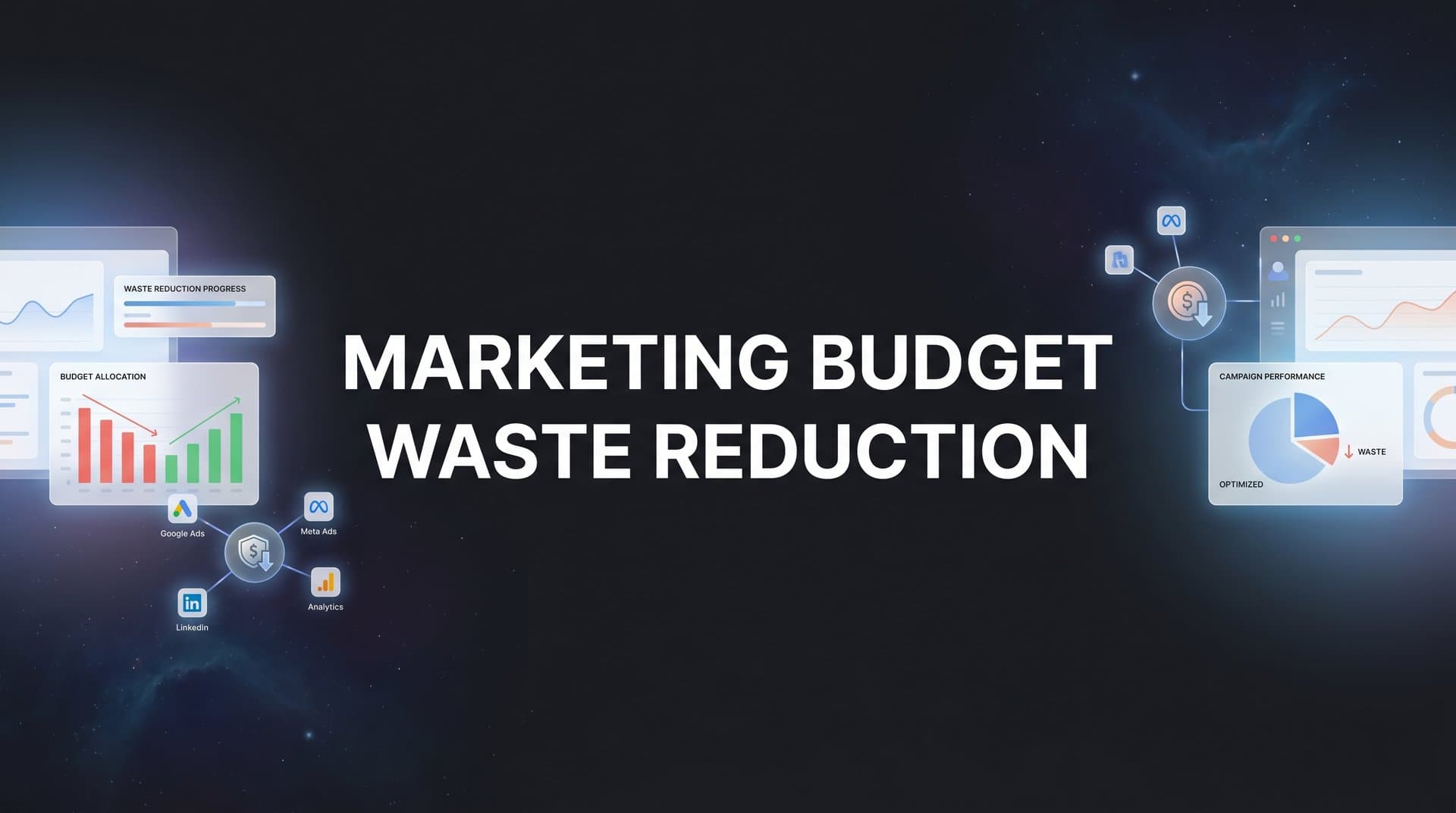
Every dollar in your marketing budget should drive measurable results, but for many teams running paid campaigns across multiple platforms, a significant portion of spend quietly leaks away. Budget waste shows up in many forms: ads served to the wrong audiences, campaigns optimized on flawed data, duplicate spend across overlapping channels, and decisions made on vanity metrics instead of revenue signals.
The challenge is that most marketers know waste exists but struggle to pinpoint exactly where it happens and how to stop it. Without accurate tracking and clear attribution, it is nearly impossible to separate the campaigns that generate real pipeline from the ones that just burn through budget.
This guide breaks down eight actionable strategies for marketing budget waste reduction, each targeting a specific leak in your ad spend. Whether you are managing campaigns on Meta, Google, TikTok, or LinkedIn, these approaches will help you identify inefficiencies, reallocate spend toward what actually converts, and build a system where every marketing dollar is accountable.
Let us dig into the strategies that high-performing marketing teams use to eliminate waste and scale with confidence.
1. Close Your Attribution Gaps to Stop Blind Spending
The Challenge It Solves
Last-click attribution is one of the most common sources of budget misallocation. When your reporting model credits only the final touchpoint before conversion, every channel that contributed earlier in the journey looks like it is underperforming. Teams cut those campaigns, and then wonder why their pipeline dries up. Blind spending happens when you optimize based on an incomplete picture of what actually drives revenue.
The Strategy Explained
Multi-touch attribution connects every ad interaction across the full customer journey to downstream revenue. Instead of giving all the credit to the last click, it distributes credit across the touchpoints that genuinely influenced the decision. This gives you a much more accurate view of which campaigns, channels, and creatives are doing real work.
Think of it like this: if a prospect sees your LinkedIn ad, clicks a Google retargeting ad three days later, and then converts through a direct visit, last-click attribution gives Google all the credit and makes LinkedIn look worthless. Multi-touch attribution tells you the real story. With a platform like Cometly, you can compare attribution models side by side and see how credit shifts across your channels before making budget decisions.
Implementation Steps
1. Audit your current attribution model and identify which channels appear to underperform under last-click reporting.
2. Implement a multi-touch attribution solution that connects ad platform data, website events, and CRM conversions into a unified view.
3. Run your last-click and multi-touch models in parallel for at least 30 days before making any budget reallocation decisions based on the new data.
Pro Tips
Do not rush to cut channels that look weak under last-click before you have multi-touch data to compare. Some of your most valuable awareness and consideration campaigns will only show their true impact once you can see the full journey. Attribution model changes should inform gradual budget shifts, not sudden cuts.
2. Audit Cross-Platform Overlap to Eliminate Duplicate Spend
The Challenge It Solves
Running campaigns simultaneously on Meta, Google, TikTok, and LinkedIn is a smart diversification strategy, but it creates a hidden problem. When you use broad or overlapping audience definitions across platforms, you often end up paying multiple times to reach the same person. This duplicate spend inflates your cost per acquisition and makes it look like your campaigns are less efficient than they really are.
The Strategy Explained
Cross-platform audience overlap auditing means systematically mapping who you are targeting on each platform and identifying where those audiences intersect. The goal is not to stop running on multiple platforms. It is to make sure each platform is reaching a meaningfully distinct segment of your market, or serving a distinct role in the funnel, rather than competing with itself for the same eyeballs.
For example, if you are running broad interest-based targeting on Meta and a similar in-market audience on Google Display simultaneously, there is a good chance a large portion of your impressions are hitting the same users. Using cross-channel marketing attribution alongside tightening your audience definitions or using exclusion lists can immediately reduce redundant spend.
Implementation Steps
1. Document your active audience definitions across every platform, including custom audiences, lookalikes, interest segments, and retargeting lists.
2. Use each platform's built-in audience overlap tools where available, and cross-reference your CRM data to identify likely overlap zones.
3. Assign distinct funnel roles to each platform, such as awareness on TikTok, consideration on Meta, and intent capture on Google, and adjust targeting and exclusions accordingly.
Pro Tips
Suppression lists are your best friend here. Upload your existing customer list as an exclusion on prospecting campaigns across every platform. You are already paying to retain those customers through other means. Stop paying to acquire them again through paid prospecting.
3. Feed Better Conversion Data Back to Ad Platform Algorithms
The Challenge It Solves
Ad platform algorithms like Meta Advantage+, Google Performance Max, and TikTok Smart Performance are powerful, but they are only as good as the conversion signals you feed them. When iOS privacy updates and browser-based tracking limitations cause conversion events to go unreported or get misattributed, the algorithm optimizes toward the wrong audiences. Over time, this compounds into significant budget waste as your campaigns learn to find users who look like converters but are not.
The Strategy Explained
Server-side tracking bypasses the browser entirely by sending conversion events directly from your server to the ad platform's API. This approach is far more reliable than pixel-based tracking because it is not affected by ad blockers, browser privacy settings, or iOS restrictions. Understanding the digital marketing strategy that tracks users across the web is essential to grasping why this matters so much.
When you sync enriched conversion events back to platforms through tools like Cometly's Conversion Sync, you are not just fixing a data gap. You are actively improving the quality of the audience signals that drive your campaign optimization. Better signals mean the algorithm finds more of your actual buyers and fewer people who simply clicked but never converted.
Implementation Steps
1. Audit your current tracking setup to identify where browser-based events are being lost, particularly for high-value conversion actions like purchases, form fills, and qualified leads.
2. Implement server-side event tracking using a solution that connects your CRM and backend data to ad platform APIs.
3. Monitor your event match quality scores on Meta and conversion rate improvements on Google after switching to server-side data to confirm the improvement.
Pro Tips
Enrich your conversion events with as much customer data as possible, including email, phone, and purchase value. The more data you pass back, the better the platform's matching algorithm can identify and find similar high-value users. This directly improves your targeting efficiency and reduces wasted impressions on low-intent audiences.
4. Shift Budget Allocation From Vanity Metrics to Revenue Signals
The Challenge It Solves
Clicks, impressions, and even cost-per-click are easy to measure, but they tell you almost nothing about whether your campaigns are generating real business value. When teams optimize toward these metrics, budget flows toward campaigns that look active but do not actually drive revenue. The result is a portfolio of campaigns with impressive engagement numbers and disappointing pipeline contributions.
The Strategy Explained
Revenue-signal budgeting means building your reporting and decision-making framework around metrics that connect directly to money: cost per qualified lead, cost per opportunity, cost per acquisition, and true return on ad spend. Learning how to evaluate marketing performance metrics is critical to making this shift effectively.
This requires connecting your ad platform data to your CRM so that downstream revenue events can be tied back to the original ad click. Cometly's analytics dashboard is designed specifically for this, giving you a unified view of ad spend alongside the revenue it generates so you can make allocation decisions based on what is actually working.
Implementation Steps
1. Define your primary revenue-based KPIs: cost per qualified lead, cost per closed deal, and true ROAS calculated against actual revenue, not just reported conversions.
2. Connect your ad platforms, website analytics, and CRM into a unified reporting environment that can attribute revenue back to specific campaigns and channels.
3. Set a regular cadence, such as weekly or bi-weekly, for reviewing revenue-signal performance and making incremental budget shifts toward higher-performing campaigns.
Pro Tips
When you first switch to revenue-signal reporting, expect some surprises. Campaigns that looked like your best performers based on click metrics may rank much lower on revenue contribution, and vice versa. Treat this initial audit as a discovery exercise before making any dramatic budget changes.
5. Implement Real-Time Budget Pacing to Catch Waste Early
The Challenge It Solves
Budget waste rarely announces itself. It accumulates quietly as underperforming campaigns continue to spend day after day while you are focused on other priorities. By the time a weekly or monthly review surfaces the problem, thousands of dollars have already been lost to campaigns that should have been paused or adjusted much earlier.
The Strategy Explained
Real-time budget pacing means setting up automated monitoring that tracks spend and performance continuously, not just when you remember to check. The goal is to create a system that flags anomalies, such as a campaign burning through budget without generating conversions, before the damage becomes significant.
This is where having a centralized marketing campaign analytics platform pays dividends. When all your campaign data flows into one place in real time, you can set performance thresholds and receive alerts when campaigns drift outside acceptable ranges. Think of it like a circuit breaker for your ad budget: it does not replace human judgment, but it makes sure problems surface quickly enough for you to act.
Implementation Steps
1. Define performance thresholds for each campaign type, including maximum acceptable cost per conversion and minimum expected conversion rate, based on historical benchmarks.
2. Set up automated alerts within your ad platforms and analytics tools that trigger when spend exceeds a threshold without a corresponding conversion event.
3. Establish a clear escalation process so that when an alert fires, someone on the team is responsible for reviewing and taking action within a defined timeframe.
Pro Tips
Avoid setting alerts so sensitive that they fire constantly and get ignored. Calibrate your thresholds based on realistic performance ranges for each campaign type and funnel stage. A top-of-funnel awareness campaign should have different pacing benchmarks than a bottom-of-funnel retargeting campaign.
6. Prune Low-Performing Audiences and Creatives Ruthlessly
The Challenge It Solves
One of the most common forms of budget waste is continuing to run audiences and creatives that have clearly stopped working. Teams often hold onto underperformers out of uncertainty, hoping the numbers will improve, or because there is no agreed-upon standard for when to cut. Without clear kill criteria, budget keeps flowing to campaigns that have already demonstrated they will not deliver.
The Strategy Explained
Ruthless pruning means establishing objective, data-driven criteria for pausing or killing audiences and creatives, and then enforcing those criteria consistently. The key word is "consistently." Kill criteria only work if they are applied the same way every time, regardless of how much creative effort went into a particular ad or how long an audience has been running.
Your kill criteria should be based on statistical significance and revenue data, not just gut feel. Effective approaches to measuring marketing campaign effectiveness will help you set the right thresholds. For example, you might decide that any creative with more than 1,000 impressions and a cost per conversion more than twice your target gets paused automatically. The exact thresholds will vary by campaign type and industry, but the principle is the same: define the line before you start spending, not after.
Implementation Steps
1. Establish kill criteria for each campaign type based on your target cost per conversion, minimum impression thresholds for statistical significance, and maximum acceptable spend without a conversion.
2. Document these criteria in a shared performance standard that the entire team references during campaign reviews.
3. Schedule a weekly creative and audience audit where underperformers are paused or eliminated based solely on the established criteria, freeing budget to flow toward what is working.
Pro Tips
When you pause an underperforming creative, do not delete it immediately. Archive it for reference so you can identify patterns in what consistently fails for your audience. Over time, this creates a valuable library of negative learnings that improves your creative briefing process and reduces waste on future campaigns.
7. Consolidate Your Analytics Stack to Reduce Data Fragmentation
The Challenge It Solves
Many marketing teams are working with data scattered across five, six, or more separate tools: one for each ad platform, a separate website analytics tool, a CRM, and maybe a standalone reporting dashboard. When data lives in silos, it is nearly impossible to get a coherent picture of performance. Teams spend hours manually pulling reports and reconciling numbers that never quite match, and decisions get made on whichever data source happens to be most convenient rather than most accurate.
The Strategy Explained
Consolidating your analytics stack means creating a single source of truth that connects your ad platforms, website behavior, and CRM data into one unified view. This is not about eliminating every specialized tool. It is about making sure there is one authoritative place where all the data comes together so that everyone on the team is working from the same numbers. Reviewing the best tools for marketing analytics is a good starting point for evaluating your options.
Cometly is built specifically for this purpose. It pulls together data from your ad platforms, tracks the complete customer journey from first click to closed deal, and presents everything in a single analytics environment. When your team has one reliable dashboard to reference, budget decisions become faster, more confident, and less prone to the errors that come from stitching together data from multiple disconnected sources.
Implementation Steps
1. Audit your current analytics stack and list every tool that holds marketing performance data, including ad platforms, website analytics, CRM, and reporting tools.
2. Identify the gaps and overlaps in your current setup, particularly where data is being manually reconciled or where key metrics cannot be connected across tools.
3. Implement a centralized attribution and analytics platform that ingests data from all your sources and provides a unified reporting environment for the full marketing funnel.
Pro Tips
Consolidation is also a team alignment tool. When everyone from the CMO to the campaign manager is looking at the same numbers, you eliminate the time wasted in meetings debating whose data is correct. A single source of truth shifts the conversation from reconciling data to acting on it.
8. Track the Full Customer Journey to Uncover Hidden Conversion Paths
The Challenge It Solves
Most marketing teams have a reasonably good understanding of their bottom-of-funnel performance but a much hazier picture of how prospects actually travel from first awareness to closed deal. When you cannot see the full journey, you are vulnerable to cutting top-of-funnel campaigns that look expensive and underperforming on direct conversion metrics but are actually playing a critical assist role in driving revenue downstream.
The Strategy Explained
Full customer journey tracking means mapping every touchpoint from the first ad impression or organic visit all the way through to a closed deal in your CRM. This reveals the real conversion paths your best customers take, including which channels tend to initiate journeys, which ones nurture consideration, and which ones close.
With this visibility, you can make much smarter decisions about where to invest. You might discover that your LinkedIn campaigns rarely drive direct conversions but consistently appear in the journeys of your highest-value customers. Reviewing a detailed marketing attribution report helps surface these assist roles so you can protect the campaigns that are doing real work even when they do not get direct conversion credit.
Implementation Steps
1. Define the key milestones in your customer journey, from first touch through lead qualification, opportunity creation, and closed deal, and ensure each milestone is tracked as a conversion event.
2. Connect your ad platform data to your CRM so that revenue events can be traced back to the original source campaign and the full sequence of touchpoints that preceded them.
3. Analyze your top-converting customer journeys to identify common patterns, such as which channels typically initiate, which nurture, and which close, and use these patterns to inform your marketing budget allocation strategy.
Pro Tips
Pay particular attention to the journeys of your highest-value customers, not just your highest-volume converters. The path that leads to a large enterprise deal often looks very different from the path that drives a high volume of small transactions. Understanding both patterns helps you allocate budget toward the channels that drive the outcomes that matter most to your business.
Putting It All Together
Marketing budget waste reduction is not a one-time project. It is an ongoing discipline that requires accurate data, clear attribution, and a willingness to act on what the numbers tell you.
If you are starting from scratch, prioritize the two strategies with the highest immediate impact. Close your attribution gaps by implementing multi-touch attribution, and fix your conversion data by switching to server-side tracking. These two steps alone can fundamentally change how your campaigns optimize and where your budget flows.
From there, build out your real-time monitoring, consolidate your analytics stack, and enforce consistent performance standards across every campaign. The marketers who eliminate waste fastest share one thing in common: they have a single, reliable source of truth connecting their ad spend to actual revenue, and they use it to make every budget decision.
Cometly gives you that foundation. It captures every touchpoint from ad click to closed deal, connects your ad platforms and CRM into one unified view, and uses AI to surface the insights that matter most. You stop guessing where your budget goes and start scaling what actually works.
Ready to eliminate waste and make every marketing dollar count? Get your free demo and see how Cometly's AI-driven attribution and analytics can transform the way your team tracks, analyzes, and optimizes campaigns across every channel.