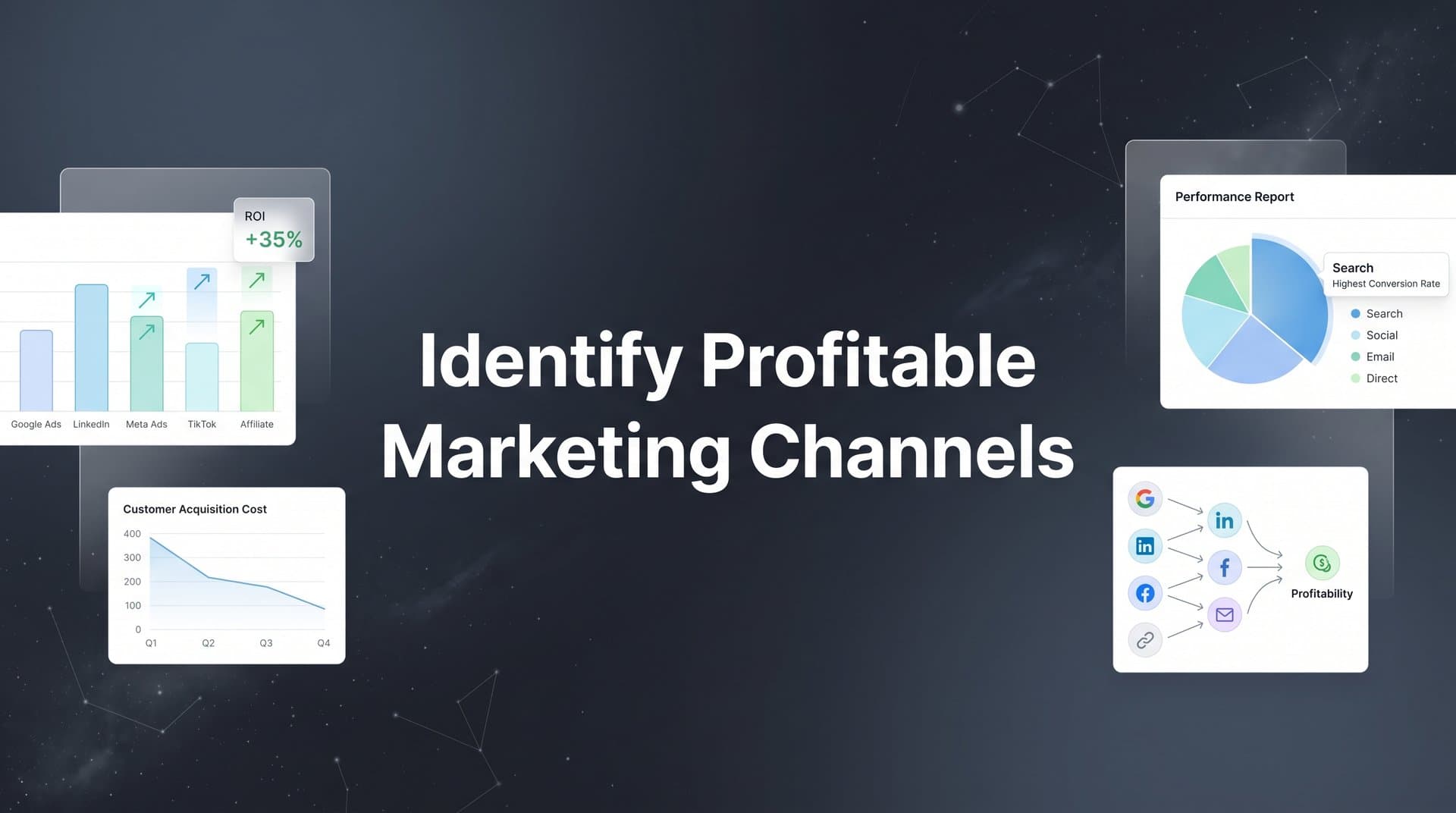
Every marketing team faces the same high-stakes question: where should we spend our next dollar? With dozens of channels competing for budget, from paid social and search to email, content, and display, the cost of guessing wrong compounds quickly. Budgets drain into underperforming campaigns while the channels that actually drive revenue stay underfunded.
The core problem is not a lack of options. It is a lack of clarity. Most teams rely on platform-reported metrics that inflate results, last-click models that ignore the full journey, or gut instinct shaped by recency bias. The result is a distorted picture of what is truly profitable.
This guide lays out seven actionable strategies to cut through that noise and identify the marketing channels that genuinely move the needle for your business. Each strategy builds on the last, moving from foundational measurement practices to advanced optimization techniques. Whether you are a solo marketer managing a handful of campaigns or part of a team running cross-platform spend in the six or seven figures, these approaches will help you allocate budget with confidence, scale what works, and cut what does not.
1. Map Revenue Back to First Touch with Multi-Touch Attribution
The Challenge It Solves
Last-click attribution is the default for many teams, and it systematically lies to you. It hands all the credit to whichever channel a customer touched last before converting, completely ignoring the channels that sparked awareness, built interest, and warmed the lead over time. If a prospect first discovered your brand through a YouTube ad, engaged with a retargeting campaign on Meta, and then clicked a Google Search ad to convert, last-click gives Google 100% of the credit. The other two channels look worthless and get cut.
The Strategy Explained
Multi-touch attribution distributes conversion credit across every touchpoint in the customer journey. Models like linear (equal credit to all touches), time-decay (more credit to recent touches), position-based (heavier weight on first and last touch), and data-driven (algorithmic credit based on actual conversion patterns) each tell a different part of the story. Teams looking for the right tools can explore multi-touch marketing attribution software to find the best fit for their needs.
The goal is not to find one perfect model and declare victory. The goal is to use attribution data to understand which channels initiate high-value journeys, which channels nurture prospects through the middle, and which channels close. That three-dimensional view is what makes profitable channel decisions possible.
Implementation Steps
1. Audit your current attribution setup and identify whether you are relying on a single platform's last-click reporting or a true multi-touch model.
2. Choose an attribution platform that connects your ad channels, website, and CRM data into a unified model. Cometly's multi-touch attribution is built specifically for this, tracking the full customer journey across every paid and organic touchpoint.
3. Compare channel performance under at least two attribution models side by side. Note which channels gain or lose credit when you move away from last-click.
4. Use those insights to adjust budget allocation, giving more investment to channels that consistently appear early in high-value journeys.
Pro Tips
Pay special attention to channels that appear frequently in first-touch position for your highest-value customers. These channels are building your pipeline even when they do not get credit for closing it. Underfunding them is one of the most common and costly attribution mistakes teams make.
2. Connect Ad Engagement to CRM Events and Real Revenue
The Challenge It Solves
Clicks and impressions are the metrics most ad platforms put front and center, and they are also the least useful for evaluating channel profitability. A channel can drive thousands of clicks at a low cost per click and still be completely unprofitable if those clicks never convert into paying customers. Without connecting ad data to what happens downstream in your CRM and revenue systems, you are measuring activity instead of outcomes. Understanding how to evaluate marketing channels beyond vanity metrics is essential for making profitable decisions.
The Strategy Explained
Tracking the full funnel means following a prospect from the moment they first engage with an ad all the way through to becoming a customer, and ideally through their lifetime value. This requires stitching together data from your ad platforms, your website, your CRM, and your billing or revenue system into a single connected view.
When you do this, cost-per-click gives way to cost-per-qualified-lead and cost-per-acquisition by channel. Those are the numbers that actually tell you whether a channel is worth its budget. Many marketing teams find that channels with higher CPCs turn out to be far more profitable once downstream conversion rates are factored in.
Implementation Steps
1. Define the funnel stages that matter for your business: ad click, landing page visit, lead form submission, sales qualified lead, opportunity, and closed revenue.
2. Implement tracking that passes a consistent identifier (such as a UTM-tagged click ID or a CRM contact ID) through every stage so you can connect ad spend to CRM outcomes.
3. Use Cometly's analytics dashboard to visualize channel performance at each funnel stage, not just at the top.
4. Calculate true cost-per-acquisition by channel and compare it against the average revenue or lifetime value generated from customers sourced by each channel.
Pro Tips
Build a simple channel profitability scorecard that tracks CPL, CPA, and average deal size by source. Review it monthly. Channels that look expensive at the top of the funnel often look very different once you account for close rates and deal value. A solid understanding of the return on marketing investment formula will help you frame these comparisons accurately.
3. Deploy Server-Side Tracking to Recover Lost Conversion Data
The Challenge It Solves
Browser-based tracking has become increasingly unreliable. Safari's Intelligent Tracking Prevention, Firefox's Enhanced Tracking Protection, and the ongoing evolution of Chrome's privacy model all limit how long and how accurately cookies can track user behavior. Add ad blockers into the mix and many teams are operating with significant gaps in their conversion data. When your tracking misses conversions, your channel performance data becomes skewed, and you end up making budget decisions based on an incomplete picture. Learning about the digital marketing strategy that tracks users across the web provides important context for why server-side solutions matter.
The Strategy Explained
Server-side tracking moves the event collection process from the user's browser to your own server. Instead of relying on a browser pixel to fire and report a conversion, your server directly sends the event data to your analytics and ad platforms. This approach bypasses browser restrictions and ad blockers entirely, recovering conversion signals that would otherwise be lost.
The practical impact is that your channel performance data becomes more complete and more accurate. Channels that appeared to have higher CPAs due to underreported conversions often look significantly more efficient once server-side tracking is in place.
Implementation Steps
1. Audit your current tracking setup to identify which conversions rely entirely on browser-side pixels and where data loss is most likely occurring.
2. Implement server-side tracking through Cometly, which collects conversion events at the server level and ensures they are captured regardless of browser restrictions.
3. Compare conversion volumes before and after server-side implementation to understand how much data you were previously missing.
4. Use the recovered data to recalibrate your channel performance benchmarks and adjust budget allocation accordingly.
Pro Tips
Server-side tracking is not just about recovering lost data. It also improves the quality of the data you send back to ad platforms. Higher-quality signals lead to better algorithmic optimization, which compounds over time into better campaign performance across every channel you run.
4. Run Controlled Budget Experiments to Measure True Channel Lift
The Challenge It Solves
Attribution models are powerful, but they have an inherent limitation: they measure correlation, not causation. Just because a channel appears frequently in the paths of converting customers does not mean those customers would not have converted without it. Incrementality testing addresses this gap by measuring whether a channel is actually causing conversions or simply taking credit for them.
The Strategy Explained
Incrementality testing involves creating a control group that does not receive exposure to a specific channel, then comparing conversion rates between the exposed group and the holdout group. The difference in conversion rates represents the true incremental lift that channel is generating. Knowing how to measure marketing campaign effectiveness through controlled experiments is one of the most valuable skills a performance team can develop.
Two common approaches are geo-split tests, where you run a channel in some geographic markets but not others, and holdout group tests, where a percentage of your audience is randomly excluded from seeing a campaign. Both methods isolate the causal impact of a channel in a way that attribution modeling alone cannot.
Implementation Steps
1. Select one channel you want to test and define a clear hypothesis: for example, "pausing this channel will not significantly reduce conversions because it is capturing demand that would have converted anyway."
2. Design your test structure. For a geo-split, identify comparable markets to use as test and control regions. For a holdout test, define what percentage of your audience will be excluded from the campaign.
3. Run the test for a statistically meaningful duration, typically at least two to four weeks depending on your conversion volume.
4. Measure the conversion rate difference between your test and control groups and calculate the incremental revenue attributable to the channel.
Pro Tips
Start with channels where you have the most budget and the most uncertainty about true impact. High-spend channels that may be capturing organic demand rather than creating it are the highest-value candidates for incrementality testing. Even a single well-designed test can dramatically change how you think about your channel mix.
5. Feed Enriched Conversion Data Back to Ad Platform Algorithms
The Challenge It Solves
Ad platforms like Meta, Google, and TikTok rely on conversion signals to optimize their delivery algorithms. When those signals are incomplete, delayed, or of low quality, the algorithm optimizes toward the wrong outcomes. It might optimize for users who fill out a lead form but never become customers, or it might miss high-value buyer segments entirely because the conversion data it received was too thin to identify them accurately.
The Strategy Explained
Syncing enriched conversion data back to ad platforms through their server-side APIs, such as Meta's Conversions API, Google's Enhanced Conversions, or TikTok's Events API, gives their algorithms a much richer signal to work with. Instead of a basic pixel fire, you are sending detailed event data that includes customer match parameters, purchase values, and downstream CRM outcomes.
This is documented in the developer documentation of all three platforms and is widely recommended by performance marketers as a way to improve targeting quality and campaign efficiency. Better data in means better optimization out, which directly affects which performance marketing channels perform well and how accurately you can evaluate them.
Implementation Steps
1. Identify which ad platforms you are running and which server-side conversion APIs they support.
2. Use Cometly's Conversion Sync to send enriched, server-side conversion events back to Meta, Google, and other platforms automatically.
3. Include downstream CRM data in your conversion events where possible, such as lead quality scores, opportunity stages, or closed revenue, so platforms can optimize toward your actual buyers rather than just form fills.
4. Monitor event match quality scores within each platform's reporting interface and use them as a proxy for signal health over time.
Pro Tips
The quality of the data you send back to ad platforms directly affects the quality of the audiences those platforms build for you. Teams that consistently feed high-quality conversion signals often find that their campaigns become more efficient over time as the algorithm learns to find more of their best customers.
6. Centralize All Channel Data in a Unified Reporting View
The Challenge It Solves
When each channel lives in its own platform dashboard, cross-channel comparison becomes nearly impossible. You are looking at Meta's reported ROAS in one tab, Google's conversion data in another, and your email platform's click rates in a third. Each platform uses different attribution windows, different conversion definitions, and different ways of counting results. Comparing them directly is like comparing apples to aircraft carriers.
The Strategy Explained
A unified dashboard pulls all your channel data into a single view with standardized KPIs, consistent attribution windows, and a shared definition of what counts as a conversion. Selecting the right marketing analytics platform is a critical step in making this possible. This is not just a convenience feature. It is the infrastructure that makes fair, defensible channel comparison possible.
When every channel is measured on the same terms, you can rank them by true cost-per-acquisition, compare return on ad spend across platforms, and identify which channels are pulling their weight and which are not. The goal is to replace the chaos of siloed platform dashboards with a single source of truth your whole team can act on.
Implementation Steps
1. Define the KPIs that matter most for your business: cost-per-acquisition, return on ad spend, revenue attributed, pipeline generated, or whatever metrics connect most directly to business outcomes.
2. Connect all your ad platforms, CRM, and website data to a centralized analytics platform. Cometly's analytics dashboard is built to aggregate cross-channel data and present it in a unified, comparable format.
3. Standardize your attribution window across all channels so you are comparing performance over the same time horizon.
4. Set up a regular channel review cadence, weekly or monthly, where the team reviews the unified dashboard together and makes budget decisions based on consistent data.
Pro Tips
Resist the temptation to keep looking at platform-native dashboards for your primary performance reviews. Those dashboards are designed to make each platform look good, not to help you make cross-channel decisions. Your unified view is the one that should drive budget conversations.
7. Use AI to Surface Patterns and Prioritize Where to Scale
The Challenge It Solves
Even with clean, centralized data, identifying the patterns that predict channel profitability is not always straightforward. Cross-channel performance data is high-dimensional. There are interactions between channels, seasonal effects, audience overlap dynamics, and creative performance variables that are genuinely difficult for a human analyst to untangle manually. By the time you have identified a trend and acted on it, the window for maximum impact may have passed.
The Strategy Explained
AI-powered analytics can process large volumes of cross-channel performance data and surface insights that would take a human analyst hours or days to find. Understanding the power of AI marketing analytics is becoming essential as data complexity grows. More importantly, AI can identify non-obvious patterns, such as which channel combinations tend to produce the highest-value customers, or which signals predict a campaign is about to underperform before the metrics visibly decline.
The practical output is actionable recommendations: scale this campaign, pause that ad set, shift budget from this channel to that one. These recommendations are grounded in your actual performance data, not generic benchmarks, which makes them far more relevant and actionable for your specific business.
Implementation Steps
1. Ensure your data foundation is solid before layering in AI. AI recommendations are only as good as the data they are built on. Complete the foundational steps in this guide first.
2. Activate Cometly's AI Ads Manager to get automated performance analysis and budget optimization recommendations across all your active campaigns.
3. Use AI Chat to query your performance data conversationally. Ask questions like "which channel has the lowest cost-per-acquisition this month?" or "which campaigns are trending downward?" and get immediate, data-backed answers.
4. Build a feedback loop: act on AI recommendations, track the outcomes, and use those results to inform the next round of budget decisions.
Pro Tips
Use AI as a force multiplier for your team's judgment, not a replacement for it. The best results come from marketers who combine AI-generated insights with their own contextual knowledge of the business, the competitive landscape, and the creative strategy. AI surfaces the signal; you decide what to do with it.
Your Implementation Roadmap
Identifying profitable marketing channels is not a one-time exercise. It is an ongoing discipline that combines accurate tracking, rigorous testing, and intelligent analysis. The seven strategies in this guide are designed to build on each other, and the order matters.
Start by laying the foundation. Implement multi-touch attribution so you can see the full customer journey, and deploy server-side tracking so your data captures what browsers miss. These two steps alone will give you a dramatically more accurate picture of channel performance than most teams have.
Next, build the comparison framework. Centralize your reporting into a unified dashboard with standardized KPIs, and sync enriched conversion data back to your ad platforms so their algorithms are working with your best data. At this stage, you have both clarity and leverage.
Then layer in the advanced work. Connect your ad data to full-funnel CRM outcomes so you are measuring true cost-per-acquisition. Run incrementality tests to validate which channels are genuinely driving revenue versus taking credit for organic demand. And activate AI-powered analysis to continuously surface patterns and prioritize where to scale.
The marketers who win in 2026 and beyond are the ones who treat channel evaluation as a system, not a guess. With the right attribution infrastructure in place, every budget decision becomes a data-driven one.
Cometly is built to power exactly this kind of clarity. It connects your ad platforms, CRM, and website so you can see which channels truly drive revenue and scale them with confidence. Ready to build that infrastructure for your business? Get your free demo today and start capturing every touchpoint to maximize your conversions.