
You're running paid search, LinkedIn ads, content programs, and email sequences. The budget is real, the activity is measurable, and the dashboards are full of numbers. But when the CFO asks which campaigns are actually driving revenue, the honest answer is often: "We think it's this, but we're not totally sure."
That uncertainty is not a data problem. It's a structural one. Most marketing teams have plenty of metrics. What they lack is a coherent system for connecting those metrics to business outcomes. That's exactly what a marketing measurement framework is designed to solve.
A measurement framework is not a dashboard or a reporting template. It's the operating logic that determines what you measure, how you measure it, and how marketing inputs connect to pipeline and revenue. Without it, budget decisions get made on incomplete signals, high-performing channels get underinvested, and underperforming ones keep burning spend.
This guide is written for growth leaders and marketing teams in B2B SaaS who are ready to move past activity-based reporting and build a system that ties every dollar of ad spend to business outcomes. Let's get into it.
The Gap Between Marketing Activity and Business Outcomes
Ask most marketing teams what they're tracking, and you'll hear a familiar list: clicks, impressions, sessions, form fills, cost per lead. These metrics are easy to pull and easy to report. The problem is that none of them answer the question that actually matters: did this marketing effort generate revenue?
This is the measurement gap. It's the distance between what marketing does and what the business cares about. And in B2B SaaS, that gap is wider than almost any other category.
Here's why. A typical B2B SaaS buyer doesn't convert after a single ad click. They discover you through a LinkedIn post, read three blog articles over two weeks, attend a webinar, get retargeted with a case study ad, and then respond to a sales email six weeks later. Multiple stakeholders are often involved. The sales cycle can stretch from weeks to months. By the time a deal closes, the original marketing touchpoints are buried in a timeline that no single tool is capturing end to end.
When your measurement system only captures what's easy to track, like last-click conversions or top-level traffic, you're making decisions based on a fragment of the actual story. You might conclude that paid search is your best channel because it shows up at the last click, while completely missing the fact that LinkedIn content is driving the initial awareness that puts prospects into your funnel in the first place.
A marketing measurement framework is the structured system that closes this gap. It defines what to measure at each stage of the funnel, how those measurements connect to each other, and how the entire chain traces back to business outcomes like new ARR, customer acquisition cost, and payback period.
Think of it like a blueprint for a building. Without the blueprint, every contractor makes independent decisions that may or may not work together. With it, every element is designed to support the whole structure. A measurement framework does the same thing for your marketing data: it ensures that every metric you track is intentional, connected, and pointed toward a business outcome.
The teams that close this gap don't just report better. They make smarter decisions faster, allocate budget with more confidence, and build a compounding advantage over competitors who are still guessing.
The Four Layers Every Framework Needs
A well-built marketing measurement framework isn't flat. It has layers, and each layer feeds the one above it. When these layers are aligned vertically, every metric your team tracks connects directly to a business outcome. When they're not, you end up with dashboards full of numbers that don't actually inform decisions.
The four layers are: business goals, marketing KPIs, channel-level metrics, and attribution logic.
Business Goals: This is the top of the framework and the anchor for everything below it. For B2B SaaS companies, the goals that matter most typically include new ARR, pipeline generated, customer acquisition cost, and payback period. If a metric doesn't trace back to one of these, it's worth questioning whether it belongs in your framework at all.
Marketing KPIs: These are the leading indicators that predict progress toward business goals. Marketing-qualified leads, marketing-sourced pipeline, and cost per opportunity are examples. KPIs sit between goals and execution: they tell you whether your marketing activity is heading in the right direction before the revenue data catches up.
Channel-Level Metrics: This is where execution gets measured. Click-through rates, cost per click, conversion rates by channel, and lead quality scores all live here. These metrics are useful for optimizing individual campaigns, but they only mean something in the context of the KPIs and goals above them. A low cost per click is meaningless if those clicks never convert to pipeline.
Attribution Logic: This is the connective tissue of the entire framework. Attribution logic determines how credit is assigned across the touchpoints in a buyer's journey. It answers questions like: which channel gets credit for this conversion, and how much? Without a defined attribution model, the same conversion can be claimed by multiple channels simultaneously, leading to inflated ROI figures and misallocated budget.
The attribution layer is where many teams get stuck. Choosing an attribution model feels technical, but it's fundamentally a strategic decision. It reflects your understanding of how buyers make decisions and which marketing influences matter most across your specific funnel.
The key principle here is vertical alignment. Your channel-level metrics should roll up to your KPIs. Your KPIs should connect to your business goals. And your attribution logic should accurately reflect how credit flows through the entire system. When these four layers are coherent, your framework becomes a genuine decision-making tool rather than a collection of disconnected reports. Exploring a digital marketing strategy framework can help you see how these layers fit together in practice.
Choosing the Right Attribution Model for Your Funnel
Attribution models are not interchangeable. Each one tells a different story about your marketing, and choosing the wrong one can lead to budget decisions that actively hurt performance.
Here's the thing: there's no universally correct model. The right choice depends on the complexity of your funnel, the length of your sales cycle, and the volume of conversion data you have available.
First-Touch Attribution: Gives 100% of the credit to the first touchpoint in the buyer's journey. It's useful for understanding what creates initial awareness and brings prospects into your funnel. If you're trying to justify investment in top-of-funnel content or brand campaigns, first-touch data makes the case. The limitation is that it completely ignores everything that happens after that first interaction.
Last-Click Attribution: Assigns all credit to the final touchpoint before conversion. This is the default model in many ad platforms and analytics tools. It's simple to implement and easy to understand, but in B2B SaaS, it consistently overstates the value of bottom-of-funnel channels like branded search while undervaluing the awareness and nurture touchpoints that built the relationship over months.
Linear Attribution: Distributes credit equally across all touchpoints in the journey. It's more balanced than single-touch models and gives a fuller picture of channel influence, but it treats a five-second ad impression the same as a 30-minute product demo, which doesn't reflect how buyers actually engage.
Time-Decay Attribution: Gives more credit to touchpoints that occurred closer to the conversion event. This can work well for shorter sales cycles but tends to undervalue early-stage awareness efforts in longer B2B funnels.
Position-Based Models: U-shaped and W-shaped models assign heavier credit to specific touchpoints, typically the first interaction, the lead creation event, and the opportunity creation event. These are popular in B2B SaaS because they acknowledge the significance of key conversion moments without ignoring the full journey.
Data-Driven Attribution: This is where modern measurement is heading. Rather than applying a fixed rule to every conversion, data-driven models use historical conversion data to assign weighted credit dynamically. The result is a model that reflects how your specific buyers actually make decisions, not a generic assumption about buyer behavior. The trade-off is that data-driven attribution requires sufficient conversion volume to generate statistically meaningful signals.
For most B2B SaaS companies with sales cycles longer than a few weeks, multi-touch attribution is the minimum standard. A single touchpoint rarely explains a closed deal, and any model that pretends otherwise will distort your understanding of what's working. Understanding the common attribution challenges in marketing analytics can help you anticipate where your model may break down.
The natural question becomes: which multi-touch model should you start with? If you're new to this, a position-based model is a practical starting point. It acknowledges the importance of first and last touches while giving credit to the middle of the journey. As your data volume grows, graduating to a data-driven model will give you the most accurate picture of marketing influence across your funnel.
Tracking the Full Customer Journey: From First Click to Closed Revenue
Choosing the right attribution model is only half the equation. The model is only as accurate as the data feeding it, and for most B2B SaaS teams, the tracking infrastructure is where the framework breaks down.
Browser-based pixel tracking has become significantly less reliable over the past few years. Ad blockers, iOS privacy updates, and the progressive deprecation of third-party cookies all create gaps in the data that browser pixels collect. When those gaps exist, conversions go unmeasured, attribution models get distorted, and ad platforms optimize against incomplete signals.
Server-side tracking addresses this directly. Instead of relying on a JavaScript pixel firing in the user's browser, server-side events are captured at the server level and sent directly to ad platforms through Conversion API (CAPI) integrations. This approach is more durable, more accurate, and increasingly considered a foundational requirement rather than an optional upgrade.
But accurate event capture is only the starting point. The bigger challenge in B2B SaaS is identity resolution across a long, multi-channel journey. A prospect might click a LinkedIn ad on their work laptop, read a blog post on their phone, join a webinar from a different email address, and then respond to a sales email weeks later. Without a persistent identity layer that connects these interactions, you're looking at fragments of a journey rather than the whole story.
This is where the integration between your ad platforms, CRM, and revenue data becomes critical. You might be able to see that a lead originated from a LinkedIn campaign, but if that data doesn't connect to your CRM, you can't verify whether that lead progressed to an opportunity, and if it doesn't connect to your billing system, you can't confirm whether they became a paying customer.
Closing this loop requires intentional data architecture. Ad platform data needs to flow into a central system. CRM events like lead creation, opportunity stage changes, and closed-won deals need to be tied back to the original marketing touchpoints. And revenue data needs to be connected to the full attribution chain so that you can measure marketing performance in terms of actual dollars generated, not just leads produced.
When this infrastructure is in place, your measurement framework stops being a reporting exercise and starts being a real-time operating system for marketing decisions. You can see not just which campaigns are generating clicks, but which ones are generating customers.
Metrics That Actually Matter at Each Funnel Stage
One of the most common measurement mistakes is applying the wrong metrics to the wrong stage of the funnel. When top-of-funnel success gets measured by the same standards as bottom-of-funnel performance, it leads to either over-investment in vanity metrics or premature dismissal of channels that are genuinely building pipeline.
Here's how to think about metrics at each stage.
Top-of-Funnel: The goal here is demand creation, not just volume. Raw impression counts and session numbers tell you that content is being seen, but they don't tell you whether the right people are engaging. More useful metrics include qualified traffic by source, cost per lead broken down by channel, and lead-to-opportunity conversion rate. These signals help you distinguish between channels that attract your ideal customer profile and those that generate noise.
Mid-Funnel: This stage is about pipeline progression. Opportunity creation rate tells you how efficiently leads are converting to qualified pipeline. Pipeline velocity, which factors in the number of opportunities, average deal size, win rate, and sales cycle length, tells you how quickly that pipeline is moving. Marketing-influenced pipeline value shows the aggregate impact of marketing touches on deals that are actively in progress. These metrics connect marketing effort to sales outcomes without requiring deals to close first.
Bottom-of-Funnel: This is where marketing performance gets measured in the language of the business. Marketing-sourced revenue, customer acquisition cost by channel, and return on ad spend are the numbers that justify budget and inform scaling decisions. These metrics require the full tracking loop to be closed: ad data connected to CRM data connected to revenue data. Without that connection, bottom-of-funnel reporting is either incomplete or inaccurate.
The principle that ties all three stages together is this: marketing analytics metrics should answer questions, not just report activity. Every number in your framework should connect to a decision. If a metric doesn't change how you allocate budget or adjust your strategy, it's worth questioning whether it belongs in the framework at all.
Building the Data Infrastructure Your Framework Depends On
A measurement framework is only as strong as the data feeding it. You can have the most thoughtfully designed attribution model and the most precisely defined KPIs, but if the underlying data is fragmented, delayed, or incomplete, the framework produces unreliable outputs.
The foundational requirement is a centralized source of truth. Marketing data typically lives in multiple disconnected systems: ad platforms, website analytics, CRM, email tools, and billing systems. When teams try to reconcile these manually, they spend more time on data cleanup than on analysis, and the numbers they report are often inconsistent across tools.
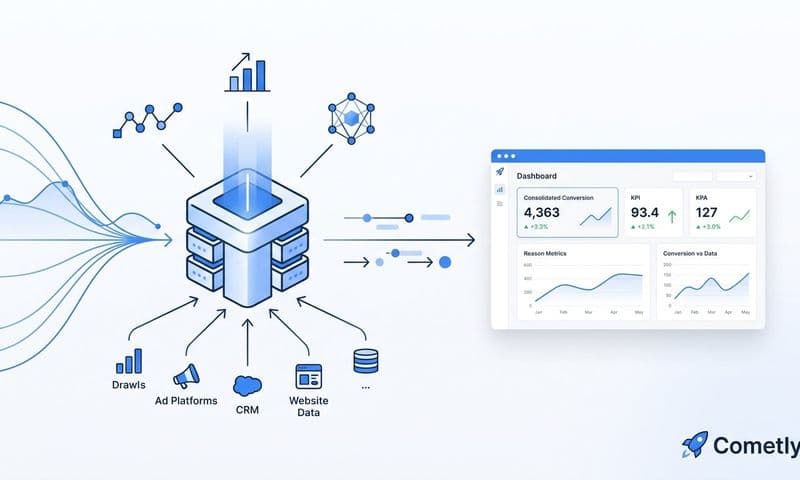
A centralized system pulls from all of these sources, normalizes the data, and presents a unified view of marketing performance without requiring manual reconciliation. This is what makes real-time decision-making possible. Instead of waiting for a weekly export from four different platforms, your team can see campaign performance, pipeline influence, and revenue attribution in a single place. A purpose-built marketing analytics solution is what makes this kind of unified visibility achievable at scale.
Server-side tracking and Conversion API integrations are the other non-negotiable infrastructure components. As discussed earlier, browser-based tracking is no longer sufficient for accurate measurement. CAPI integrations with Meta, Google, and other ad platforms ensure that conversion events are captured reliably and fed back to the platforms for optimization. This improves not just your measurement accuracy but also the performance of your campaigns, since ad platform algorithms optimize better when they receive complete, high-quality conversion signals.
This is where Cometly is specifically built to help. Cometly connects your ad platforms, CRM, and revenue data in real time, giving B2B SaaS marketing teams a single source of truth for campaign performance. It supports multi-touch attribution across the full customer journey, integrates server-side tracking and Conversion API connections, and surfaces AI-driven recommendations that identify which channels, campaigns, and creatives are driving the highest-quality pipeline. With 70+ native integrations, it eliminates the manual reconciliation that slows most teams down and replaces it with a live view of what's actually working.
The teams that invest in this infrastructure don't just report more accurately. They make faster decisions, scale winning campaigns with confidence, and build a durable advantage in marketing efficiency.
Putting Your Measurement Framework Into Practice
Understanding the components of a measurement framework is one thing. Actually building one requires a clear starting point and a willingness to treat it as an ongoing system rather than a one-time project.
Start with an audit of your current tracking setup. Before adding new tools or redefining KPIs, understand what you're actually capturing today. Where are the gaps? Are there touchpoints that aren't being tracked? Are pixels firing inconsistently? Is your CRM data connected to your ad platform data? Identifying these gaps first ensures that your framework is built on a reliable foundation rather than inheriting the problems of the existing setup.
Next, define your measurement hierarchy before selecting tools. This is a step many teams skip, and it's why they end up with tools that don't align with their actual goals. Start by aligning on the business outcomes that matter most, then define the KPIs that predict progress toward those outcomes, then identify the channel-level metrics that inform those KPIs. Document the attribution logic your team will use consistently and make sure everyone, including sales leadership and finance, understands how credit is assigned.
Then build the infrastructure that supports the framework. This means implementing server-side tracking, setting up Conversion API integrations, connecting your CRM to your attribution system, and establishing a centralized reporting environment that reflects the measurement hierarchy you've defined. Learning how to track marketing campaigns end to end is essential before any of these tools can deliver their full value.
Finally, treat the framework as a living system. Your channels will evolve. Your buyer journey will shift. Your business model may change. A measurement framework that was accurate last year may not reflect how revenue is actually generated today. Build in a regular cadence, quarterly at minimum, to review the framework, validate that the attribution logic still reflects buyer behavior, and update the KPIs as business priorities shift.