B2B SaaS marketing teams are operating in one of the most demanding environments in the history of the discipline. Channels multiply faster than budgets can keep up. Buyer journeys stretch across weeks or months, touching paid search, social ads, organic content, email sequences, and direct sales conversations before a deal ever closes. And at every quarterly review, leadership wants the same answer: what did marketing actually produce?
The pressure is real, and the irony is sharper. Marketers today have access to more tools, more data, and more channels than any generation before them. Yet many teams still struggle to connect ad spend to actual revenue. They can tell you how many clicks a campaign generated. They cannot always tell you how many deals it closed.
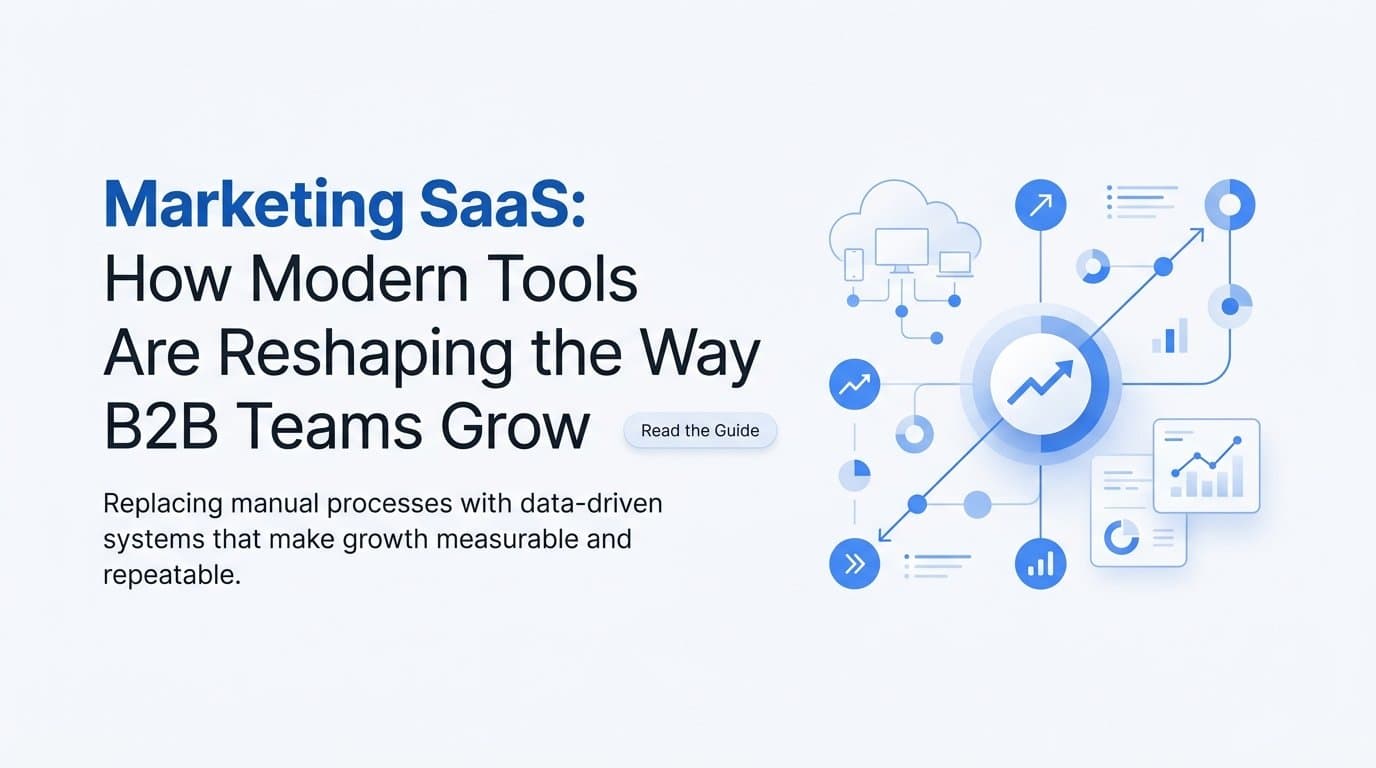
This is the central problem that marketing SaaS exists to solve. As a category, marketing SaaS refers to the cloud-based software platforms that help teams plan, execute, track, and optimize their marketing activities at scale. These tools have transformed how B2B companies approach growth, replacing disconnected spreadsheets and manual processes with connected, real-time systems that turn raw data into decisions.
This article breaks down everything you need to understand about marketing SaaS: what it is, how its core categories work together, why attribution is the most critical piece of the stack, what to look for when evaluating platforms, and how to measure whether your investment is actually paying off. If you are building or refining a marketing stack for a B2B SaaS company, this is where to start.
The Software Layer That Powers Modern B2B Marketing
Marketing SaaS is cloud-based software delivered on a subscription basis that helps teams plan, execute, track, and optimize their marketing activities without managing on-premise infrastructure. Instead of purchasing a license, installing software, and waiting for annual updates, teams subscribe to a platform that updates continuously, scales with usage, and connects natively to the other tools in their stack.
The SaaS delivery model is particularly well-suited to marketing for a specific reason: marketing channels, ad platforms, and buyer behaviors change constantly. When Meta updates its ad auction algorithm or Google shifts how it handles conversion tracking, a cloud-based platform can adapt in real time. An on-premise tool requires a manual update cycle that simply cannot keep pace.
Cross-team collaboration is another structural advantage. Modern marketing teams are rarely siloed. Demand generation works alongside content, paid media coordinates with sales, and RevOps needs visibility into pipeline attribution. Marketing SaaS platforms are built for this reality, with shared dashboards, role-based access, and integrations that keep everyone working from the same data.
Think about what the old way looked like. Campaign data lived in spreadsheets that someone updated manually each week. Ad performance from Google Ads sat in one tab, Facebook results in another, and CRM pipeline data somewhere else entirely. Connecting those sources required hours of work, and by the time the report was finished, the data was already stale. Decisions made on that data were inherently reactive.
The modern marketing SaaS stack inverts that dynamic. Data flows automatically between platforms. Attribution models run in real time. Dashboards update as campaigns run. When a campaign starts underperforming, a team running a connected stack can see it the same day and act on it, not two weeks later when the monthly report lands.
This shift matters because speed of decision-making is now a competitive advantage. In B2B SaaS, where customer acquisition costs are high and sales cycles are long, the ability to reallocate budget toward what is working, and away from what is not, faster than your competitors is a meaningful edge. Marketing SaaS is the infrastructure that makes that speed possible.
Core Categories Every Growth Team Should Know
Marketing SaaS is not a single tool. It is a category that spans several distinct types of software, each serving a specific function within the broader marketing operation. Understanding these categories, and how they connect, is the foundation of building an effective stack.
Attribution and Analytics Platforms: These tools track how prospects find and interact with your brand across every channel, connecting touchpoints to pipeline and revenue. They answer the fundamental question: what is actually driving growth?
Marketing Automation Tools: These platforms handle the execution layer, managing email sequences, lead nurturing workflows, and behavioral triggers that move prospects through the funnel without requiring manual intervention at every step.
CRM and Pipeline Software: Customer relationship management platforms store contact and account data, track deal stages, and give sales and marketing a shared view of where prospects are in the buying journey.
Ad Management Platforms: These tools help teams build, launch, and optimize paid campaigns across channels like Google, Meta, and LinkedIn, often incorporating bidding automation and creative testing capabilities.
Content and SEO Tools: These platforms support organic growth by helping teams research keywords, optimize content, track rankings, and understand how organic traffic contributes to pipeline.
Here is where most stack conversations go wrong: teams evaluate each category in isolation, picking the best-reviewed tool in each bucket without thinking about how the pieces connect. The connections between categories matter as much as the individual tools themselves. If your CRM cannot pass deal stage data to your attribution platform, you cannot measure which campaigns are generating revenue versus just generating leads. If your ad management platform cannot receive enriched conversion signals, its optimization algorithms are working with incomplete information.
Attribution and analytics function as the connective tissue of the entire stack. Every other category produces data, but without a reliable measurement layer, you cannot know whether that data reflects reality. Decisions made in ad management, automation, and content strategy are only as good as the attribution data informing them. This is why the measurement layer deserves to be the first investment in any marketing SaaS stack, not an afterthought added once everything else is already running.
Why Attribution Is the Most Critical Piece of Your Marketing SaaS Stack
The attribution problem in B2B SaaS is genuinely hard. A typical enterprise buyer might see a LinkedIn ad, read a blog post a week later through organic search, attend a webinar, receive three nurture emails, and then have two discovery calls with sales before a deal closes. That journey can span two to four months and involve multiple stakeholders from the same account, each interacting through different channels.
If you are using first-touch attribution, you credit LinkedIn and ignore everything else. If you are using last-touch, you credit the final sales call and undervalue the content that generated awareness. Neither model reflects how the deal actually happened, and both lead to budget decisions that are at least partially wrong.
Multi-touch attribution distributes credit across the full customer journey based on the actual interactions that occurred. This gives marketing teams a more accurate picture of which channels, campaigns, and content pieces contribute to pipeline and revenue. When budget allocation is informed by multi-touch data, teams stop over-investing in the last touchpoint and start understanding the full mix that drives deals forward.
This matters for budget decisions in a direct and practical way. If multi-touch data shows that LinkedIn ads consistently appear in the early stages of deals that eventually close, but last-touch attribution never credits them because sales calls happen last, a team using last-touch will systematically underinvest in LinkedIn. Over time, that misallocation compounds and the pipeline suffers.
Beyond the attribution model itself, there is a data completeness problem that has grown more serious in recent years. Browser-based tracking has become significantly less reliable due to ad blockers, browser privacy restrictions, and mobile operating system changes that limit third-party cookie access. When tracking events are fired from a user's browser, a meaningful portion of those events never reach the analytics platform because something in the browser environment blocked or dropped them.
Server-side tracking and Conversion API integrations solve this problem at the source. Rather than relying on a browser to fire a tracking pixel, server-side tracking sends event data directly from a company's server to the ad platform. Meta's Conversion API and Google's Enhanced Conversions work this way, receiving conversion data through a direct server-to-server connection that bypasses browser limitations entirely.
The practical impact is significant. When conversion data is more complete, ad platform algorithms have better signal to optimize against. Campaigns that were previously showing inflated cost-per-conversion numbers, because a portion of conversions were being lost to browser restrictions, start reporting more accurately. Budget decisions improve because the underlying data improves.
For any B2B SaaS company running paid acquisition, server-side tracking is no longer optional. It is the baseline for reliable measurement in a privacy-first environment, and the marketing SaaS platforms that support it natively are positioned to deliver more accurate attribution as a result.
What to Look for When Evaluating Marketing SaaS Platforms
Not all marketing SaaS platforms are built the same, and the differences that matter most are not always visible in a product demo. Here is how to evaluate platforms against the criteria that actually affect your team's ability to make good decisions.
Depth of Integration: The most important integrations are with your ad platforms and your CRM. A platform that pulls data from Google Ads and Meta but cannot connect to your CRM cannot close the loop between marketing activity and revenue. Evaluate not just whether an integration exists, but how deeply it connects. Does it pull campaign-level data, ad-level data, or both? Does it sync CRM deal stages in real time or on a delayed schedule?
Attribution Modeling Options: Look for platforms that offer multiple attribution models, including first-touch, last-touch, linear, time-decay, and position-based models, along with the ability to compare them side by side. The ability to see how budget allocation would shift under different models is a meaningful analytical capability that simpler tools do not provide.
Real-Time Reporting: In fast-moving paid campaigns, delayed data reporting is a real cost. A platform that updates attribution data daily is meaningfully better than one that updates weekly, and a platform that updates in near real time is better still. Understand the data latency before committing to a platform.
First-Party Data Ownership: As third-party cookies continue to decline in reliability, the platforms that help you collect, enrich, and activate your own first-party data are the ones worth investing in for the long term. Look for platforms that give you control over your own data rather than routing everything through a proprietary data layer you cannot export or port.
AI-Driven Recommendations: AI is becoming a genuine differentiator in marketing SaaS rather than a marketing feature. The most useful AI capabilities are those that surface actionable insights: which campaigns are underperforming relative to their spend, where budget reallocation would improve efficiency, and which creative variants are driving the strongest conversion rates. The goal is to reduce the time between data collection and action, so look for platforms where AI surfaces recommendations rather than simply presenting raw data and leaving interpretation entirely to the analyst.
Setup Without Engineering Dependency: For most B2B SaaS marketing teams, waiting on a data engineering team to configure a new platform is a real bottleneck. Evaluate how long implementation actually takes and whether marketing can own the setup process independently.
Measuring the Real Impact of Your Marketing SaaS Investment
The metrics that matter for marketing SaaS are not the ones that look impressive in a weekly email update. Impressions, clicks, and click-through rates tell you whether an ad was seen and interacted with. They do not tell you whether it contributed to revenue.
The shift to revenue-connected metrics is what separates marketing teams that are genuinely accountable from those that are busy. The metrics worth tracking are pipeline influenced by channel, cost per opportunity by source, revenue attributed by campaign, and customer acquisition cost broken down by the channel that actually sourced the customer. These numbers connect marketing activity to the outcomes that the business cares about.
Achieving this level of reporting requires a closed-loop system. The mechanism is straightforward in concept: connect your ad platform data to your CRM, and connect your CRM to your revenue data. When a prospect who clicked a Google ad three months ago closes as a customer in your CRM, and that deal value flows back to the attribution platform, you can see the full journey from first ad click to closed-won revenue. Platforms that integrate with payment processors like Stripe make this connection possible without requiring custom data engineering work.
This closed-loop reporting changes how marketing leaders have conversations with finance and leadership. Instead of presenting cost-per-lead metrics and hoping leadership trusts that leads eventually become revenue, marketing can present cost-per-opportunity and revenue-per-channel with the same confidence that sales presents pipeline data.
A practical reporting workflow for a team running this kind of system looks like this. Daily performance monitoring focuses on spend efficiency and conversion volume, catching campaigns that are burning budget without producing results. Weekly channel comparison looks at which sources are generating the most pipeline influence and whether the mix is shifting. Monthly attribution model reviews compare how credit distribution looks under different models and whether budget allocation should change as a result. This cadence turns reporting from a backward-looking summary into a forward-looking decision engine.
The teams that get the most value from their marketing SaaS investment are the ones that treat the data as an active input to strategy, not a passive record of what already happened. When reporting is connected to revenue and reviewed on a consistent cadence, the stack pays for itself through better allocation decisions alone.
Building a Marketing SaaS Stack That Scales With Your Business
The most common mistake in building a marketing SaaS stack is starting in the wrong place. Teams often begin with the most visible tools: an ad management platform, a CRM, or a marketing automation tool. These are important, but without a measurement layer underneath them, you are making decisions in the dark from day one.
The right starting point is attribution and analytics. This layer informs every other tool decision. When you know which channels are driving pipeline, you know where to invest in ad management. When you understand how leads move through the funnel, you can design automation workflows that match actual buyer behavior. When you have revenue attribution data, you can justify CRM investment by connecting it to specific deal outcomes. The measurement layer is not just one tool among many. It is the foundation that makes every other tool more valuable.
B2B SaaS companies at different growth stages have genuinely different tool needs, and a good stack should reflect that reality. Early-stage teams typically need lightweight attribution, a simple CRM, and a single paid channel to start. Adding complexity before the measurement foundation is solid creates fragmentation that is hard to undo. Growth-stage teams are ready to layer in marketing automation, expand to multiple paid channels, and invest in deeper CRM integrations that connect pipeline data to marketing activity. Scale-stage teams benefit from AI-driven recommendations, advanced attribution modeling, and revenue reporting that connects directly to finance systems.
The modular nature of marketing SaaS is one of its structural advantages. You can add tools as your program matures without rebuilding from scratch, as long as the tools you add are designed to integrate with the measurement layer you already have in place. This is why platform compatibility matters more than individual feature lists when evaluating new additions to the stack.
The ideal end state is a single source of truth for marketing data. Ad performance, customer journey data, pipeline attribution, and revenue reporting all live in one connected system rather than scattered across disconnected dashboards that tell different stories depending on which one you look at. When your team can open one platform and see how every dollar of ad spend connects to every dollar of revenue, marketing stops being a cost center and starts being a growth engine with a measurable return.
Putting It All Together
Marketing SaaS is not just a collection of tools. It is a strategic infrastructure decision that determines how well your team can see, understand, and act on the data that drives growth. The teams that win in B2B SaaS marketing are not necessarily the ones with the largest budgets. They are the ones who build their stack around accurate data, starting with attribution and measurement, then layering automation, CRM, and ad management on top of a reliable foundation.
The direction of the category is clear. AI and first-party data are becoming the defining competitive advantages in marketing SaaS. As browser-based tracking continues to degrade and ad platforms lean harder on algorithmic optimization, the teams that feed those algorithms better data, collected through server-side tracking and enriched with first-party signals, will consistently outperform those that do not. And the teams that use AI to surface recommendations faster than they could through manual analysis will make better decisions at a pace their competitors cannot match.
Building this kind of stack is not a one-time project. It is an ongoing commitment to treating measurement as a core competency, not an afterthought. The payoff is a marketing operation where every budget decision is grounded in real data, every channel is evaluated on its contribution to revenue, and leadership has the visibility to trust what marketing is telling them.
If you are ready to build that foundation, Cometly connects your ad platforms, CRM, and website into a single attribution system built specifically for B2B SaaS companies. From capturing every touchpoint to feeding enriched conversion data back to Meta and Google, Cometly gives your team the complete picture it needs to scale with confidence. Get your free demo today and start connecting every ad click to closed-won revenue.