
Marketing budgets in B2B SaaS are under more scrutiny than ever. Growth leaders are being asked to do more with less, prove ROI on every dollar, and justify channel investments to finance teams who want hard numbers, not gut instincts.
The problem is that most teams are still allocating budgets based on incomplete data. They look at last-click attribution, make assumptions about which channels are working, and spread spend across campaigns without a clear picture of what is actually driving pipeline and revenue. The result is wasted budget on underperforming channels while high-performing ones stay underfunded.
Optimizing marketing budget allocation is not about cutting spend. It is about redirecting it toward what works. That requires a systematic approach: understanding your current performance baseline, mapping spend to actual revenue outcomes, applying the right attribution models, and building a feedback loop that improves allocation decisions over time.
This guide walks you through exactly that process. Whether you are managing a six-figure ad budget or scaling past seven figures, these steps will help you move from intuition-based spending to data-driven allocation that connects every dollar to measurable business outcomes.
By the end, you will have a repeatable framework for evaluating channel performance, identifying budget waste, and confidently reallocating spend toward the campaigns and channels that drive qualified pipeline and closed revenue.
Step 1: Establish Your Attribution Foundation Before Touching Budget Numbers
Here is the hard truth: budget optimization without proper attribution is guesswork. If you cannot accurately credit conversions to the right touchpoints, any reallocation decision you make is built on flawed data. You might cut a channel that is quietly influencing half your pipeline, or double down on one that looks great in last-click reports but contributes almost nothing to closed revenue.
A solid attribution foundation starts with how you collect conversion data. Browser-based pixel tracking has become increasingly unreliable due to privacy changes, ad blockers, and the fragmented nature of cross-device journeys. If your tracking still depends entirely on client-side pixels, you are likely missing a meaningful portion of your conversions before they even reach your reporting.
Server-side tracking and Conversion API integrations with platforms like Meta and Google address this directly. By sending conversion events from your server rather than the browser, you capture signals that would otherwise be lost. Combined with first-party data collection, this creates a more durable and accurate data layer that holds up even as third-party cookies continue to disappear.
Beyond the technical tracking layer, you need CRM event syncing. This is what connects marketing activity to actual business outcomes. When your CRM data flows into your attribution system, you can see which campaigns sourced opportunities, which touchpoints influenced deals before they closed, and what the revenue contribution looks like at the channel level. Using the right marketing campaign attribution tool makes this connection far more reliable and actionable.
The goal is a single source of truth where ad platform data, CRM data, and website events are unified in one place. Without this, you are reconciling spreadsheets manually and making budget decisions based on partial information.
Common tracking gaps to audit: Look for conversion events that are only tracked client-side, cross-device journeys where the same user appears as multiple anonymous visitors, and CRM stages that are not syncing back to your attribution platform.
Your action for this step: Audit your current tracking setup and identify where conversion data is missing or misattributed before making any budget changes. Document every gap you find.
Success indicator: You can trace a clear, unbroken data trail from ad click to closed-won revenue across all active channels. If that trail has gaps, fix them first.
Step 2: Map Your Current Spend Against Actual Pipeline and Revenue
Once your attribution foundation is solid, the next step is to understand what your current budget is actually buying. Not impressions. Not clicks. Not even leads. Pipeline and revenue.
This is where many B2B SaaS teams discover a significant disconnect. A channel might be generating hundreds of leads per month at a low cost per lead, and yet contribute almost nothing to qualified pipeline. Meanwhile, another channel with a much higher cost per lead might be sourcing the majority of opportunities that actually close. If you are only looking at lead volume and cost per lead, you will consistently make the wrong budget decisions.
The shift you need to make is from vanity metrics to revenue-connected metrics. Think cost per opportunity, pipeline generated by channel, and revenue influenced or closed by channel. These are the numbers that should drive allocation decisions. Understanding how to measure marketing campaign effectiveness at this level is what separates teams that allocate well from those that guess.
To build this view, pull a channel-by-channel spend breakdown for the last 90 days and align it against your CRM pipeline data. You want to see which campaigns sourced opportunities, which touched deals at various stages before close, and what the average deal value looks like per channel. This is pipeline attribution in practice.
A common finding at this stage is that a large portion of budget is going to channels that generate volume but not revenue-quality leads. Broad audience campaigns, low-intent content syndication, or channels optimized toward top-of-funnel form fills often show up here. They look productive in a dashboard that measures leads. They look very different when you connect those leads to CRM outcomes.
Build a channel performance matrix that captures the following for each active channel over the last 90 days: total spend, leads generated, opportunities created, pipeline value generated, and revenue closed. Then calculate cost per opportunity and cost per pipeline dollar for each channel. This gives you a ranked view of channel efficiency that goes far beyond cost per lead.
Important nuance: Include both first-touch and multi-touch data in this view. First-touch tells you which channels are initiating relationships. Multi-touch tells you which channels are contributing throughout the journey. Relying on only one perspective leads to over-crediting or under-crediting channels that play different roles in your funnel.
Your action for this step: Build the channel performance matrix described above. If your current tools do not allow you to connect ad spend to CRM pipeline data directly, that is a gap worth closing before you proceed.
Success indicator: You have a ranked view of channels by cost per pipeline dollar, not just cost per lead, and you can see clearly which channels are earning their budget and which are not.
Step 3: Choose the Right Attribution Model for Your Budget Decisions
The attribution model you use directly shapes which channels appear to deserve more budget. This is not a minor technical detail. It is one of the most consequential decisions in your entire budget optimization process.
Defaulting to last-click attribution is one of the most common and costly mistakes in B2B SaaS marketing. Because B2B sales cycles are long, often spanning weeks or months across multiple touchpoints, last-click attribution systematically under-credits the channels that build awareness and nurture intent early in the journey. Paid search on branded terms often gets the credit. The LinkedIn campaigns that generated the initial awareness get nothing.
Understanding the available models helps you choose the right one for your situation.
First-touch attribution gives full credit to the channel that first introduced a prospect to your brand. It is useful for evaluating awareness and top-of-funnel investments, but it ignores everything that happened after that first interaction.
Last-touch attribution gives full credit to the final touchpoint before conversion. It is simple and easy to implement, but for longer B2B sales cycles, it consistently misfires by over-crediting conversion-stage channels and ignoring the channels that built the relationship.
Linear attribution distributes credit equally across all touchpoints in the customer journey. It gives a more balanced view of full-funnel contribution and works well for teams that want to understand which channels are participating in deals without trying to weight their relative importance.
Data-driven attribution uses machine learning to assign credit based on the actual influence each touchpoint had on conversion outcomes. It is the most accurate model available, but it requires sufficient conversion volume to produce statistically reliable results. For teams with lower conversion volumes, the model can produce noisy or misleading outputs.
For most B2B SaaS teams with longer sales cycles, a multi-touch attribution model such as linear or time-decay provides more actionable budget insights than single-touch models alone. The key is using attribution model comparison as a stress-test: run your channel performance data through two or three models and observe how channel rankings shift. If a channel looks strong in last-touch but weak in linear, that tells you something important about its role in the journey.
Your action for this step: Select a primary attribution model that matches your sales cycle length and conversion volume. Use a secondary model as a sanity check before finalizing any budget changes.
Common pitfall: Switching attribution models too frequently creates inconsistency in your data and makes it impossible to track performance trends over time. Pick one primary model and stick with it for at least one full quarter before evaluating results.
Step 4: Identify Budget Waste and High-Performing Segments Worth Scaling
Budget optimization is a two-sided exercise. You are simultaneously looking for where to cut and where to invest more. Both sides of this analysis require the same foundation: channel performance data connected to pipeline and revenue outcomes.
Start with budget waste. The clearest indicators are campaigns with high spend and low or zero pipeline contribution. These are the easiest calls to make. If a campaign has been running for 60 to 90 days, has consumed meaningful budget, and has not sourced or influenced a single qualified opportunity, it is a strong candidate for reallocation.
Beyond zero-contribution campaigns, look for more subtle waste signals. Audiences with poor conversion rates relative to their spend, ad sets showing declining return on ad spend over time, and channels that generate volume metrics like clicks and form fills but produce opportunities that never progress past the first sales stage are all patterns worth flagging. Knowing how to optimize marketing spend at this granular level is what turns a budget review into a genuine performance improvement exercise.
Common sources of waste in B2B SaaS include campaigns targeting broad audiences with low purchase intent, retargeting spend on audiences that would have converted organically anyway, and ad sets that have exhausted their audience pool and are showing declining efficiency as a result.
Now flip to the other side: scaling opportunities. These are campaigns that are generating pipeline efficiently but are currently budget-constrained. The signal to look for is a stable or improving cost-per-opportunity trend as spend increases. When you see that pattern, it suggests the campaign has not yet hit its diminishing returns threshold and has room to scale.
Every channel and campaign has a point where incremental spend starts producing less efficient results. Identifying where that threshold sits for each channel is important before scaling aggressively. The way to find it is by looking at efficiency metrics over time, not just point-in-time snapshots. A campaign that looked efficient last month may already be showing early signs of saturation this month.
Go deeper than campaign level: Look at conversion rates by audience segment within your campaigns. Sometimes a broad campaign is underperforming overall but contains a specific audience segment converting at well above average rates. Isolating that segment and giving it dedicated budget can unlock efficiency that the aggregate numbers were hiding.
Your action for this step: Flag the bottom 20 percent of campaigns by pipeline contribution for reallocation review. Flag the top performers that are currently under-resourced relative to their efficiency. These two lists become the inputs for your reallocation decisions.
Success indicator: You have a clear, documented list of campaigns to pause or reduce, and a separate list of campaigns to test scaling with reallocated budget.
Step 5: Reallocate Budget Using a Structured Testing Framework
Budget reallocation should be treated as a series of controlled tests, not a one-time overhaul. This is especially important when moving significant spend between channels, where the risk of making multiple simultaneous changes is that you cannot isolate what drove any improvement or decline in performance.
The practical approach is to shift a defined percentage of budget from underperforming areas to high-confidence opportunities, set a clear evaluation window, and define the metrics that will determine success before you launch the test. A 30 to 60 day window is typically enough to generate meaningful signal for most B2B SaaS campaigns, though longer sales cycles may require extending this window to capture downstream pipeline impact.
Before moving any budget, set realistic performance benchmarks. What does success look like for the reallocated spend? If you are moving budget from a broad awareness campaign to a more targeted demand capture campaign, define the cost-per-opportunity target you expect to hit and the pipeline volume you expect to generate. Having a clear standard to measure against prevents you from evaluating results in a vacuum and making premature judgments. Reviewing marketing budget allocation best practices before setting these benchmarks can help you calibrate realistic targets based on what high-performing teams typically achieve.
One often-overlooked factor during testing periods is the quality of conversion signals being sent back to ad platforms. When you reallocate budget, the platform algorithms need accurate signals to optimize effectively. If you are feeding those algorithms surface-level conversion events like form fills or page views rather than revenue-quality signals like opportunities created or deals closed, the algorithm will optimize toward the wrong outcomes.
Sending enriched conversion data back to platforms through Conversion API integrations gives the algorithm the signal quality it needs to find more of the right buyers. This compounds the impact of your budget reallocation by improving automated bidding performance at the same time you are redirecting spend.
Your action for this step: Run one or two budget reallocation tests at a time. Document each test with a clear hypothesis, defined start and end dates, specific success metrics, and the budget shift you are making. Treat each reallocation like an experiment, not a permanent decision.
Common pitfall: Making too many changes at once, shifting budgets across five channels simultaneously while also changing creative and audience targeting, makes it impossible to know what drove any change in results. Keep tests focused and isolated.
Step 6: Build a Recurring Budget Review Cadence That Keeps Allocation Sharp
Budget optimization is not a project with a finish line. It is a continuous process that requires a structured review cadence to stay effective as market conditions, channel performance, and buyer behavior change over time.
A practical review schedule operates at three levels. Weekly performance checks at the campaign level catch early warning signs before they become expensive problems. You are looking for sudden drops in conversion rate, unusual spikes in cost per click, or campaigns that are pacing ahead of budget without delivering proportional pipeline results. Tracking these signals consistently is easier when you have a structured approach to marketing campaign tracking already in place.
Monthly channel-level budget reviews are where you evaluate whether your current allocation still reflects channel performance. This is the meeting where you compare actual cost-per-opportunity by channel against your benchmarks and decide whether any shifts are warranted. Monthly cadence gives you enough data to spot trends without reacting to short-term noise.
Quarterly strategic reallocation decisions are tied directly to pipeline and revenue outcomes. This is where you look at the full picture: which channels have earned more budget based on three months of performance data, which channels are showing structural decline, and how your overall allocation aligns with your pipeline targets for the next quarter.
What to examine in each review goes beyond top-line spend and leads. Look at channel efficiency trends over time, pipeline velocity by source, conversion rate changes at each funnel stage, and shifts in cost per opportunity that signal a channel is becoming more or less efficient. These trends tell you more than any single data point. Knowing how to evaluate marketing performance metrics systematically ensures you are reading those trends correctly rather than drawing the wrong conclusions from short-term fluctuations.
AI-driven insights can surface optimization opportunities between your scheduled reviews. Rather than waiting for your monthly check-in to discover that a campaign has been declining for three weeks, AI can flag performance trends earlier and give you time to act before significant budget is wasted. This kind of proactive alerting is particularly valuable during periods of rapid spend scaling.
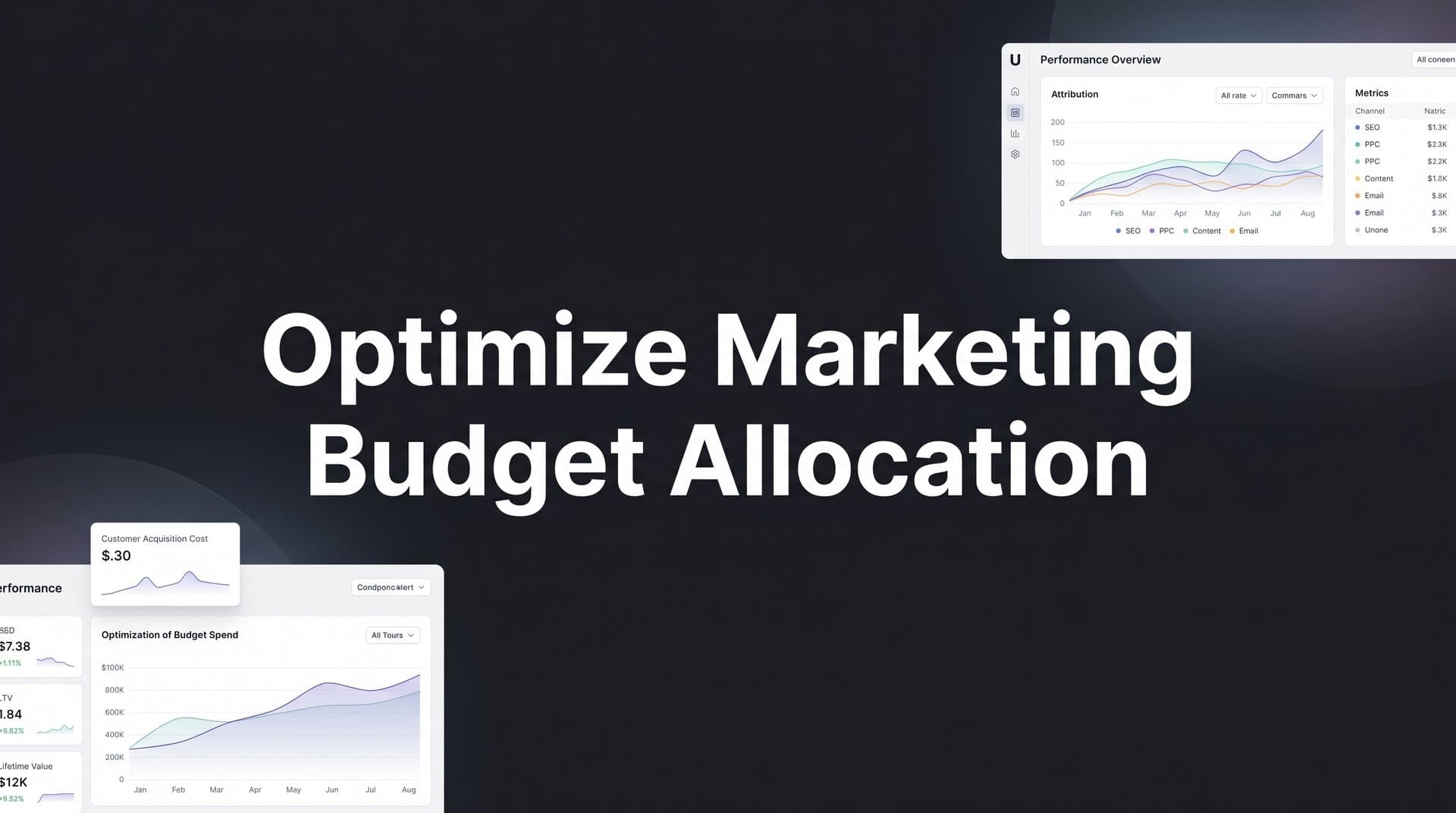
Your action for this step: Set up a marketing performance dashboard that gives you a real-time view of spend, pipeline, and revenue by channel. This dashboard becomes the single source of truth for every budget conversation, whether it is a weekly team check-in or a quarterly finance review.
Success indicator: Budget allocation decisions are driven by a documented review process with clear criteria, not reactive responses to short-term fluctuations or gut instinct about which channels feel like they are working.
Putting It All Together: Your Budget Optimization Framework
Optimizing marketing budget allocation comes down to one core principle: connect every dollar of spend to a measurable outcome, then systematically redirect resources toward what is working. The six steps in this guide give you a framework to do exactly that.
Start by fixing your attribution foundation so your data is trustworthy. Map spend to pipeline and revenue, not just leads. Choose an attribution model that reflects how your buyers actually make decisions. Identify waste and scaling opportunities with clear criteria. Test reallocations in a structured way. And build a review cadence that keeps your allocation decisions sharp over time.
Here is a quick-start checklist to work through:
1. Audit your tracking setup and close data gaps, starting with server-side tracking and Conversion API integrations.
2. Build a channel performance matrix tied to pipeline and revenue for the last 90 days.
3. Select a primary attribution model that fits your sales cycle length and conversion volume.
4. Flag bottom performers for reallocation and top performers for scaling with documented criteria.
5. Launch one or two controlled budget reallocation tests with defined hypotheses and success metrics.
6. Set up a recurring review cadence with a live performance dashboard as your decision-making anchor.
Cometly gives B2B SaaS marketing teams the attribution data and AI-driven insights needed to make every one of these steps faster and more accurate. From capturing every touchpoint across the customer journey to connecting ad spend directly to closed revenue, it is built to help growth teams allocate budgets with confidence rather than guesswork.
Ready to optimize your marketing budget allocation with data you can actually trust? Get your free demo today and see how Cometly connects every ad dollar to the pipeline and revenue outcomes that matter.