
Most marketing teams are making critical budget decisions based on data that is already stale. A campaign runs overnight, conversions happen, and by the time your dashboard catches up, you have already overspent on audiences that were not converting and underinvested in the ones that were. This is not a reporting inconvenience. It is a structural problem that costs real money every single day.
Real time conversion tracking changes the equation. Instead of waiting for ad platforms to process and surface your conversion data, you get a continuous feed of live signals that connect every ad click to every downstream action, from a trial signup all the way through to closed revenue. For B2B SaaS teams running paid acquisition at scale, this shift is not incremental. It is foundational.
This article breaks down exactly what real time conversion tracking is, how the technical infrastructure works, why delayed data creates compounding damage to your campaigns, and how to act on live conversion signals to improve ad performance and revenue attribution. If you are tired of optimizing campaigns with yesterday's numbers, this is where that changes.
Why Delayed Conversion Data Is Costing You Budget
Here is a scenario that plays out constantly across B2B SaaS marketing teams. A paid campaign launches on Monday. Conversions start coming in throughout the week. By Friday, the team reviews performance and realizes that one audience segment was burning through budget with almost no conversions while another was converting efficiently but had been capped at a low daily spend. The fix is obvious in hindsight, but five days of wasted budget are already gone.
This is the direct cost of delayed conversion data. Most ad platform dashboards and analytics tools report conversions with a lag that can range from a few hours to several days, depending on attribution windows, platform processing times, and tracking configuration. For teams making active optimization decisions on live campaigns, that lag is not a minor inconvenience. It is a broken feedback loop.
The compounding effect makes it worse. Ad platform algorithms rely on conversion signals to adjust bidding, targeting, and audience delivery. When those signals arrive late or incomplete, the algorithm is essentially flying blind. It continues spending budget based on outdated performance data, pushing spend toward audiences that have already proven ineffective while the high-converting segments wait for signals that have not arrived yet. Understanding impression time lag to conversion is essential for diagnosing exactly where these delays are occurring in your funnel.
Stale data also creates a disconnect between your CRM, your ad platforms, and your analytics. A lead that converts to an opportunity in your CRM on Tuesday may not be reflected in your ad platform attribution until Thursday, if it is reflected at all. By then, the campaign decisions for that week have already been made. The feedback loop between what is actually happening in your pipeline and what your ad platform thinks is happening is broken at the source.
This is why real time visibility is not just a nice-to-have feature. It is the prerequisite for making campaign decisions that actually reflect current reality. Without it, optimization is always reactive, always delayed, and always more expensive than it needs to be.
Defining Real Time Conversion Tracking
Real time conversion tracking is the ability to capture, process, and surface conversion events as they happen, without meaningful delay between the event occurring and the data becoming available for analysis and optimization. The emphasis here is on the full pipeline: capture, process, and surface. All three steps need to happen quickly for the data to be genuinely actionable.
In a B2B SaaS context, the definition of a conversion event extends well beyond a form fill or a page view. The conversion journey typically includes form submissions and demo requests, trial signups, marketing-qualified lead status, sales-qualified lead status, opportunity creation, and closed-won revenue. Real time conversion tracking needs to capture all of these events and connect each one back to the originating ad click or touchpoint that started the journey.
Understanding how conversion data is captured requires distinguishing between two fundamentally different approaches. Client-side tracking uses browser-based pixels that fire when a user takes an action on your website. This method has become increasingly unreliable. Ad blockers prevent pixels from firing, iOS privacy changes limit data passed between apps and browsers, and third-party cookie deprecation has reduced the accuracy of cross-site tracking. The result is significant data loss, often without teams realizing how much is missing.
Server-side tracking takes a different approach. Instead of relying on the user's browser to send conversion data to ad platforms, server-side tracking sends event data directly from your server to platforms like Meta and Google through their Conversion API integrations. This bypasses browser-level restrictions entirely. The data arrives more reliably, with higher match rates, and with richer first-party signals attached.
For B2B SaaS teams, server-side tracking is not optional if you want accurate real time data. It is the mechanism that makes the whole system work. When a prospect fills out a demo request form, that event is captured server-side, enriched with first-party data, and sent directly to your ad platforms and analytics stack without depending on a browser pixel that may or may not fire correctly.
The Technical Architecture Behind Live Conversion Data
Understanding how real time conversion data flows through your stack helps clarify why some implementations produce accurate, actionable data while others produce gaps and inconsistencies. The architecture matters as much as the intent.
At the core of a modern real time tracking setup is server-side event tracking combined with Conversion API integrations. When a conversion event occurs, your server captures the event data, including relevant first-party identifiers like email address, phone number, or user ID, and sends it directly to ad platforms through their respective APIs. Meta's Conversion API and Google's Enhanced Conversions are the primary mechanisms here. Following a proper Conversion API implementation tutorial ensures these integrations are configured correctly from the start, with enriched conversion signals that would never survive a browser-based pixel transmission, particularly in privacy-restricted environments.
First-party data plays a central role in this architecture. Because third-party cookies are no longer a reliable tracking mechanism, the conversion signals that matter most are the ones tied to identifiable first-party data that your users have directly provided. When server-side events include hashed email addresses or phone numbers, ad platforms can match those events to their own user graphs with much higher accuracy. This improves match rates, which in turn improves the quality of optimization signals sent back to bidding algorithms.
Event deduplication is a critical but often overlooked component. Many teams run both client-side pixels and server-side tracking simultaneously to maximize coverage during a transition period. Without deduplication, the same conversion event can be counted twice, once by the browser pixel and once by the server-side event. Ad platforms provide deduplication keys, typically called event IDs, that allow you to tag each event with a unique identifier so the platform knows to count only one instance even if it receives the event from multiple sources.
The final layer is CRM and ad platform data syncing. For B2B SaaS teams, the most valuable conversion signals live inside your CRM, not on your website. When a lead becomes an opportunity or a deal closes in Salesforce or HubSpot, that event needs to flow back to your ad platforms and analytics in real time. This requires a continuous data pipeline that connects CRM deal stage changes to ad platform conversion events, creating a live feedback loop between your revenue data and your campaign optimization signals.
When these components work together, you get a real time data pipeline that does not just count form fills. It connects every ad click to every downstream revenue outcome as those outcomes happen.
How Real Time Data Changes Campaign Optimization
The practical impact of real time conversion signals on campaign performance comes down to one thing: ad platform algorithms get better data faster, and better data means better decisions at every level of the system.
Ad platforms like Meta and Google use conversion signals to train their automated bidding strategies. When you are running Target CPA or Target ROAS bidding, the algorithm is constantly adjusting bids based on which users it predicts are most likely to convert. The accuracy of those predictions depends entirely on the quality and recency of the conversion data it receives. Delayed or incomplete signals mean the algorithm is optimizing toward a version of reality that no longer exists. Real time signals mean the algorithm is always working with current information. Reviewing best practices for real time marketing optimization can help teams structure their bidding workflows to take full advantage of live data.
For marketing teams, real time attribution data enables same-day budget reallocation decisions. Instead of waiting for a weekly performance review to discover that one campaign is outperforming another, you can see conversion performance as it happens and shift budget accordingly. This is especially valuable during high-stakes periods like product launches or competitive campaigns where every day of misallocated spend has a real cost.
Feeding enriched, conversion-ready events back to Meta and Google also improves the quality of automated audience targeting. When server-side events include first-party customer data, ad platforms can build higher-quality lookalike audiences based on your actual converters rather than approximations derived from browser behavior. The result is more accurate targeting, lower cost per acquisition, and better overall campaign efficiency.
The shift from weekly reporting cycles to live optimization is not just a workflow change. It is a fundamental improvement in how marketing teams interact with their campaigns, moving from reactive analysis to proactive management grounded in what is actually happening right now.
Connecting Conversions to Pipeline and Revenue in Real Time
For B2B SaaS teams, tracking conversions at the lead level is only the beginning. A form fill or a trial signup is a signal, but it is not revenue. The decisions that matter most, like which channels to scale and which campaigns to cut, require attribution that extends through the full funnel to pipeline creation and closed-won deals.
This is where most attribution setups fall short. They are optimized to capture top-of-funnel events quickly and accurately, but the connection between those events and downstream revenue outcomes is either missing entirely or updated on a lag. The result is that marketing teams are scaling campaigns based on lead volume rather than revenue impact, which often means scaling the wrong things. Choosing the right software for tracking marketing attribution is what makes it possible to close this gap between lead data and actual revenue outcomes.
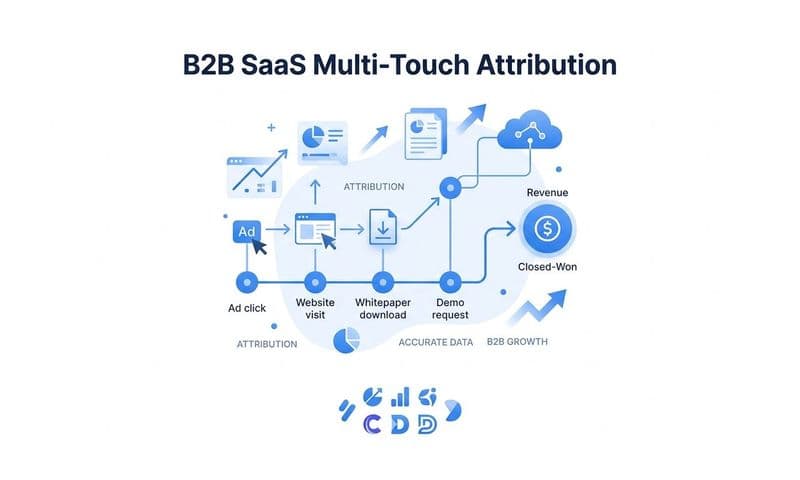
Multi-touch attribution models address this problem by assigning credit to every touchpoint as conversions move through the funnel, rather than waiting until the end of the journey to apply a single attribution model retroactively. In a real time context, this means that as a lead progresses from MQL to SQL to closed-won, each stage triggers an attribution update that flows back through the entire touchpoint history. Every channel and campaign that contributed to that outcome receives credit in proportion to its role in the journey.
This approach is particularly valuable for B2B SaaS teams with longer buying cycles involving multiple channels and interactions. A prospect might first encounter your brand through a LinkedIn ad, visit your site twice through organic search, attend a webinar, and then convert through a retargeting campaign. Without real time multi-touch attribution, only the last touchpoint gets credit. With it, every contributing interaction is visible and measurable as it happens.
Connecting Stripe or CRM revenue data to your ad platform data in real time is what creates a genuine single source of truth for marketing ROI. When a deal closes in your CRM or a payment is processed in Stripe, that revenue event flows directly into your attribution data and is mapped back to the originating ad spend. You can see, in real time, exactly which campaigns are generating pipeline and which ones are generating closed revenue. These are often different answers, and knowing the difference is what separates lead-level attribution from true revenue attribution.
This level of visibility changes the conversation inside marketing and sales teams. Instead of debating which channel deserves credit, everyone is looking at the same live data that connects ad spend directly to revenue outcomes.
Putting Real Time Conversion Tracking Into Practice
Implementing real time conversion tracking is a multi-step process, but the path is clear when you break it into its core components.
Define your conversion events first. Before setting up any tracking infrastructure, map out every conversion event that matters to your business across the full funnel. For most B2B SaaS teams, this includes form fills, trial signups, demo requests, MQL and SQL status changes, opportunity creation, and closed-won revenue. Each event needs a clear definition and a data source so you know exactly where the signal will come from.
Set up server-side tracking and Conversion API integrations. Move away from relying solely on browser-based pixels. Implement server-side event tracking that captures conversion events at the server level and sends them to Meta, Google, and any other ad platforms you are running through their respective Conversion API integrations. Configure event deduplication using event IDs to prevent double-counting across client and server sources.
Connect your CRM and payment data. Integrate your CRM, whether that is Salesforce, HubSpot, or another platform, so that deal stage changes flow into your attribution data in real time. If you use Stripe for billing, connect your revenue data so that closed revenue events are mapped back to the originating ad spend automatically.
Validate your data before acting on it. Real time data is only valuable if it is accurate. Before making optimization decisions based on live signals, verify that your event tracking is firing correctly, your deduplication is working, and your CRM integration is syncing without gaps. Following established best practices for tracking conversions accurately at this stage prevents compounding errors from undermining your entire attribution setup.
AI-driven attribution platforms take this a step further by surfacing actionable recommendations from live data automatically. Instead of manually reviewing dashboards to identify high-performing campaigns, AI can flag which ads are generating the most pipeline, which audiences are converting at the highest rate, and where budget reallocation would have the greatest impact. This turns real time data from a reporting asset into an active optimization engine.
Cometly is built specifically for this workflow. It captures every touchpoint from the first ad click through to closed revenue, connects your ad platforms, CRM, and payment data through more than 70 native integrations, and surfaces AI-driven recommendations that help B2B SaaS teams scale what is working with confidence. Whether you are tracking trial signups, demo requests, or closed deals, Cometly gives you a single, real time view of exactly which ads and channels are driving revenue.
The Bottom Line on Real Time Attribution
The shift to real time conversion tracking is not about getting faster reports. It is about making better decisions with accurate, current data instead of guessing based on information that is already out of date. For B2B SaaS teams investing in paid acquisition, the difference between optimizing with live signals and optimizing with stale data shows up directly in cost per acquisition, pipeline quality, and revenue outcomes.
When your conversion data flows in real time from your server to your ad platforms, from your CRM to your attribution model, and from your payment processor to your marketing dashboard, you stop flying blind. You see what is actually driving pipeline. You see which campaigns are closing revenue, not just generating leads. And you can act on that information the same day it happens, not the following week.
The goal is a direct, unbroken line between every dollar of ad spend and every dollar of closed revenue, updated continuously as your funnel moves. That is what real time conversion tracking makes possible, and it is what separates marketing teams that scale efficiently from those that are always catching up.
Ready to see exactly which ads and channels are driving your pipeline and revenue in real time? Get your free demo and discover how Cometly's AI-driven attribution platform connects every touchpoint from first click to closed-won revenue for B2B SaaS teams.