SaaS marketing is a different game. You're not just selling a product — you're building a pipeline, nurturing long sales cycles, and proving ROI across channels that don't always talk to each other. The tools you choose determine whether your team operates with clarity or confusion.
This list covers the tools that consistently show up in high-performing SaaS marketing stacks: attribution and analytics, CRM, SEO, email automation, conversion optimization, product analytics, customer engagement, paid media, and content operations. Each was selected based on its fit for B2B SaaS teams specifically, not generic small businesses or ecommerce brands.
Whether you're a lean startup team or a scaling growth org, these are the platforms worth your budget and attention. For deeper context on building a data-driven SaaS marketing strategy, explore Cometly's resources on B2B SaaS marketing and marketing attribution models.
1. Cometly
Best for: B2B SaaS teams that need end-to-end attribution from first ad click to closed revenue.
Cometly is a marketing attribution and revenue analytics platform built specifically for B2B SaaS companies, connecting ad platforms, CRM, and website data to track every touchpoint across the customer journey.
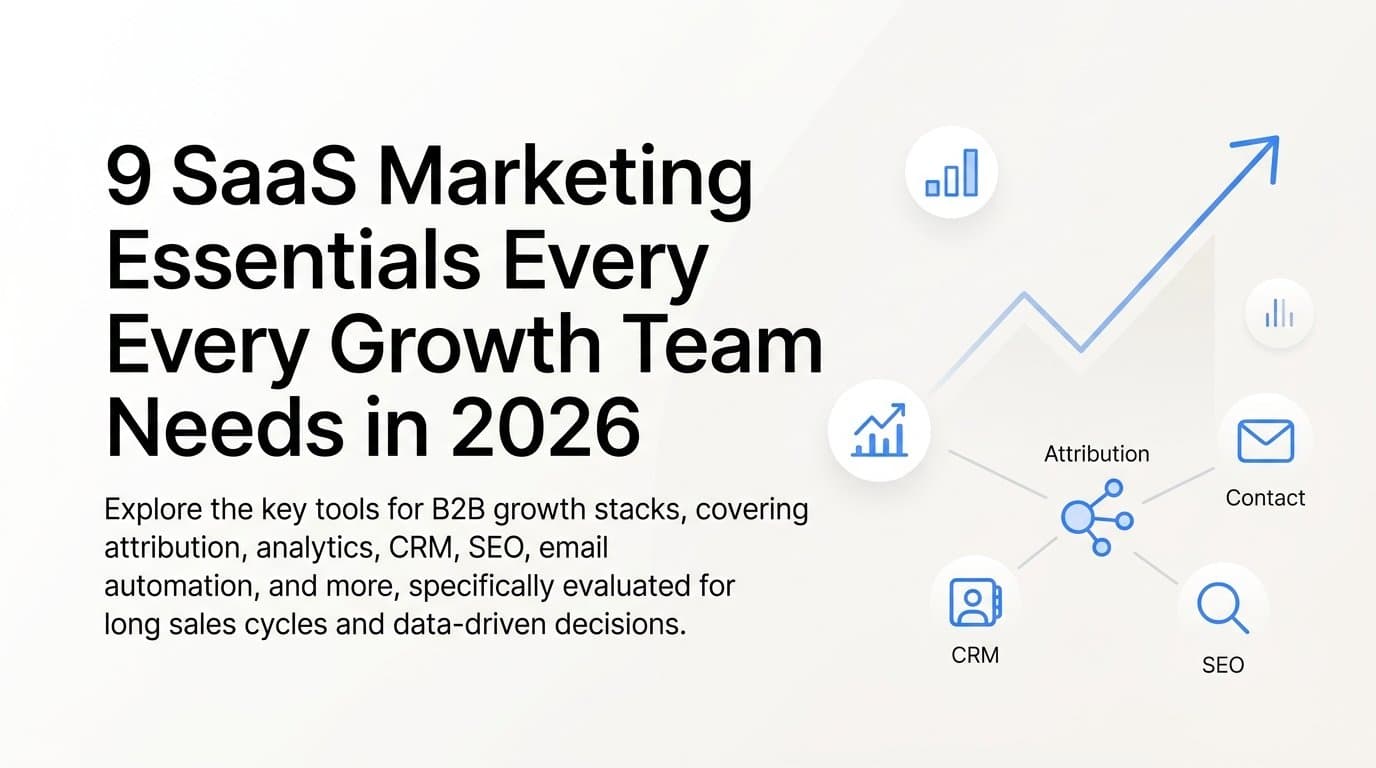
 9 SaaS Marketing Essentials Every Growth Team Needs in 2026
Where This Tool Shines
Most SaaS marketing teams are running paid search, paid social, email, and SEO simultaneously — and they have no reliable way to know which combination is actually closing deals. Cometly solves this by creating a single source of truth that ties ad spend directly to pipeline and revenue, not just leads or clicks.
What sets it apart is the depth of the revenue connection. Through Stripe integration and CRM sync, Cometly links actual closed-won deals back to the specific campaigns and touchpoints that influenced them. That means you're optimizing for revenue, not vanity metrics.
Key Features
Multi-Touch Attribution: Tracks paid and organic touchpoints across every channel, giving you a complete view of what influenced each conversion.
Server-Side Tracking and Conversion API: Captures conversion data more accurately by bypassing browser limitations and ad blockers that cause data loss in pixel-based tracking.
AI Ads Manager: Surfaces performance recommendations across your active campaigns, helping you identify what to scale and what to cut without manual analysis.
Pipeline and Revenue Attribution: Connects ad data to Stripe and CRM deal stages so you can see which campaigns are generating actual revenue, not just form fills.
70+ Native Integrations: Connects with the tools already in your stack, from ad platforms to CRMs to analytics tools, without custom engineering work.
Best For
Growth teams and marketing leaders at B2B SaaS companies who need to justify ad spend with revenue data, not just lead volume. Particularly valuable for teams running multi-channel paid programs where attribution clarity is the difference between scaling the right channels and wasting budget on the wrong ones.
Pricing
Paid plans available. Visit cometly.com/pricing for current tiers and plan details.
2. HubSpot
Best for: SaaS teams that need a unified CRM, marketing automation, and inbound lead management platform.
HubSpot is an all-in-one CRM, marketing automation, and sales platform widely used by B2B SaaS companies for managing contacts, email campaigns, and inbound lead generation.
 9 Best Tools for B2B SaaS Marketing Strategies in 2026
Where This Tool Shines
HubSpot earns its place in most SaaS stacks because it serves as the system of record for contacts, deals, and lifecycle stages. When your attribution tool, email platform, and sales team all need a shared source of truth about where a lead is in the funnel, HubSpot is typically that source.
Its strength is breadth. You get CRM, email marketing, landing pages, lead scoring, and workflow automation under one roof. For teams that want to reduce tool sprawl without sacrificing capability, that consolidation is genuinely valuable.
Key Features
CRM with Contact and Deal Management: Tracks every lead and opportunity through the pipeline with full activity history and deal stage visibility.
Email Marketing and Workflow Automation: Builds automated nurture sequences triggered by contact behavior, lifecycle stage changes, or form submissions.
Lead Scoring and Segmentation: Prioritizes leads based on firmographic data and engagement signals so sales focuses on the highest-intent prospects.
Landing Page and Form Builder: Creates conversion-optimized pages without developer support, with built-in A/B testing.
Native Integrations: Connects with major SaaS tools including attribution platforms, ad channels, and customer success tools.
Best For
B2B SaaS teams running inbound-heavy GTM motions who need a CRM that also handles marketing automation. Especially useful for companies where marketing and sales share a platform and need consistent pipeline visibility.
Pricing
Free tier available. Paid plans start at $15/month per seat for Marketing Hub. Pricing scales significantly with contact volume and feature tiers.
3. Ahrefs
Best for: SaaS marketing teams building organic search as a scalable, long-term acquisition channel.
Ahrefs is an SEO and content intelligence platform used by SaaS marketing teams to research keywords, analyze backlinks, audit site health, and track organic search performance.
 9 Best Tools for B2B SaaS Marketing Strategies in 2026
Where This Tool Shines
For SaaS companies with inbound or product-led growth motions, organic search is often the most cost-efficient acquisition channel at scale. Ahrefs gives you the data infrastructure to compete for that traffic intentionally, with keyword research, competitive analysis, and content gap identification all in one platform.
The backlink database is particularly strong, making it the go-to tool for understanding why competitors rank where they do and identifying link-building opportunities that can move the needle on domain authority over time.
Key Features
Keyword Explorer: Provides search volume, keyword difficulty, and click-through data to help you prioritize which terms are worth targeting.
Site Audit: Crawls your site and surfaces technical SEO issues that could be limiting your organic visibility.
Backlink Analysis: Shows who links to your site and your competitors, with data on link quality and referring domain authority.
Content Gap Tool: Identifies keywords your competitors rank for that your site doesn't, revealing untapped content opportunities.
Rank Tracking: Monitors your keyword positions across multiple search engines and locations over time.
Best For
SaaS content and SEO teams that are serious about organic growth as a core acquisition channel. Most valuable for companies with dedicated content resources who can act on the data Ahrefs surfaces.
Pricing
Starts at $129/month for the Lite plan. Higher tiers unlock more data limits and advanced features for larger teams.
4. ActiveCampaign
Best for: SaaS teams with freemium models or longer sales cycles that need behavioral email automation.
ActiveCampaign is an email marketing and marketing automation platform known for its advanced workflow builder, behavioral triggers, and CRM-lite features suited to SaaS nurture sequences.
 9 SaaS Marketing Essentials Every Growth Team Needs in 2026
Where This Tool Shines
Where basic email tools send the same message to everyone, ActiveCampaign branches based on what users actually do. If a trial user activates a key feature, they get one sequence. If they go dark after sign-up, they get another. That behavioral logic is what makes it well-suited to SaaS nurture flows where the right message at the right moment can meaningfully affect activation and conversion rates.
The visual automation builder is genuinely powerful without requiring a developer to maintain it, which matters for lean marketing teams that need to move fast and iterate on their sequences regularly.
Key Features
Visual Automation Builder: Creates complex, conditional email workflows with branching logic based on contact behavior and properties.
Behavioral Email Triggers: Fires automations based on site visits, product activity, or integration events from connected SaaS tools.
Contact Scoring and Segmentation: Scores contacts based on engagement and assigns them to targeted segments for more relevant outreach.
Built-In CRM with Deal Pipeline: Manages sales opportunities without requiring a separate CRM for teams that want a lighter-weight option.
Deep SaaS Integrations: Connects with Stripe, Intercom, Mixpanel, and other tools commonly found in SaaS stacks.
Best For
SaaS companies with trial-to-paid conversion goals, freemium models, or longer sales cycles where personalized, behavior-driven email sequences drive meaningful lift in activation and revenue.
Pricing
Starts at $15/month for the Starter plan, billed annually. Pricing scales with contact list size and feature requirements.
5. Hotjar
Best for: SaaS teams looking to improve conversion rates on landing pages, sign-up flows, and onboarding screens.
Hotjar is a conversion rate optimization and user behavior analytics tool that gives SaaS teams visual insight into how visitors interact with their most important pages.
 9 Best Tools for SaaS Marketing Best Practices in 2026
Where This Tool Shines
Quantitative analytics tell you that users are dropping off a page. Hotjar tells you why. Session recordings and heatmaps reveal the friction points that standard analytics tools miss: the form field that confuses people, the CTA that nobody scrolls to, the onboarding step where users consistently abandon.
For SaaS teams, this is especially valuable on trial sign-up pages and onboarding flows, where small improvements in completion rates can have a compounding effect on activation and downstream revenue.
Key Features
Heatmaps: Visualizes where users click, scroll, and move on any page, making it easy to spot engagement patterns and dead zones.
Session Recordings: Captures real user sessions so you can watch exactly how visitors navigate your site and where they get stuck.
On-Site Surveys and Feedback Widgets: Collects qualitative feedback from users in context, without requiring them to leave the page.
Funnel Analysis: Identifies where users drop off in multi-step conversion flows so you can prioritize what to fix.
Lightweight Implementation: Installs with a single script tag and has minimal impact on page load performance.
Best For
SaaS product marketers and growth teams focused on improving conversion rates on high-traffic pages. Most impactful when paired with A/B testing tools to validate the changes informed by Hotjar's qualitative data.
Pricing
Free tier available. Paid plans start at $32/month, with pricing based on daily session volume.
6. Mixpanel
Best for: SaaS product and growth teams that need to understand in-app behavior, feature adoption, and retention patterns.
Mixpanel is an event-based product analytics platform that helps SaaS teams understand what users do inside the product, from activation through churn.
 9 SaaS Marketing Essentials Every Growth Team Needs in 2026
Where This Tool Shines
Most marketing analytics tools stop at the conversion event. Mixpanel starts there. It tracks what happens after a user signs up — which features they use, how quickly they reach activation milestones, and whether they come back after day one. That data is critical for SaaS companies where retention and expansion are as important as acquisition.
The cohort analysis capabilities are particularly strong, letting you compare how different user groups behave over time and identify which acquisition channels or onboarding paths produce the most retained users.
Key Features
Event Tracking: Captures granular in-app actions to build a detailed picture of how users engage with every feature.
Funnel Reports: Analyzes conversion rates through activation and onboarding flows, with step-by-step drop-off visibility.
Retention Cohort Analysis: Measures how well different user segments retain over time, helping identify what drives long-term engagement.
User Segmentation: Filters analysis by user properties, behaviors, and plan types to surface meaningful differences between segments.
Experiment Analysis: Measures the impact of A/B tests and product changes on key behavioral metrics.
Best For
Growth and product teams at SaaS companies where understanding in-app behavior is central to improving retention, reducing churn, and identifying expansion opportunities. Works best when integrated with your CRM and marketing tools to connect product data with acquisition data.
Pricing
Free tier available, supporting up to 20 million events per month. Paid plans start at $28/month, scaling with event volume and team size.
7. Intercom
Best for: SaaS companies that want to improve trial activation, reduce churn, and drive expansion through in-app messaging.
Intercom is a customer engagement platform that combines live chat, automated messaging, product tours, and support tools into a single interface for SaaS teams.
 9 SaaS Marketing Essentials Every Growth Team Needs in 2026
Where This Tool Shines
Intercom bridges the gap between marketing and customer success in a way few tools do. It lets you reach users at exactly the right moment inside the product, whether that's a welcome message when they first sign up, a nudge when they haven't completed a key activation step, or a proactive outreach when usage drops and churn risk rises.
For SaaS companies where expansion revenue from upsells and cross-sells is a meaningful growth lever, Intercom's segmentation and in-app messaging capabilities make it possible to run targeted campaigns to existing users without relying entirely on email.
Key Features
In-App Messaging and Live Chat: Reaches users directly inside the product with contextual messages based on their behavior and segment.
Automated Onboarding Sequences: Guides new users through activation steps with product tours and triggered message flows.
AI-Assisted Support Inbox: Handles customer support conversations with AI-powered response suggestions to reduce resolution time.
User Segmentation for Targeted Outreach: Targets specific user groups based on plan, behavior, usage patterns, or lifecycle stage.
CRM and Analytics Integrations: Syncs with HubSpot, Salesforce, Mixpanel, and other tools to keep user data consistent across your stack.
Best For
SaaS companies with self-serve or product-led motions where in-app engagement is critical to activation and retention. Also valuable for teams that want to consolidate support, onboarding, and user communication in a single platform.
Pricing
Starts at $29/month for the Essential plan. Pricing scales with seat count and active user volume.
8. Google Ads
Best for: SaaS teams capturing bottom-of-funnel demand through keyword-intent search advertising.
Google Ads is the largest paid search advertising platform, used by SaaS marketing teams to reach high-intent buyers actively searching for solutions in their category.
Where This Tool Shines
Organic SEO takes time to build. Google Ads lets you show up for competitive, bottom-of-funnel keywords today. For SaaS companies targeting buyers who are actively searching for software in their category, paid search captures demand that already exists rather than creating it from scratch.
The platform's smart bidding capabilities have improved significantly, allowing you to optimize campaigns toward actual conversion events rather than just clicks. When paired with accurate attribution data, Google Ads becomes a highly measurable channel where you can confidently connect spend to pipeline.
Key Features
Search, Display, YouTube, and Performance Max: Covers the full range of Google's ad inventory across intent levels and audience types.
Keyword-Level Intent Targeting: Reaches buyers at the exact moment they're searching for solutions, with granular control over match types and bid adjustments.
Smart Bidding Strategies: Uses machine learning to optimize bids toward conversions, conversion value, or target ROAS based on your campaign goals.
Audience Targeting and Remarketing: Re-engages site visitors and trial users who haven't converted, keeping your brand visible throughout a longer B2B sales cycle.
Enhanced Conversions: Improves tracking accuracy by sending hashed first-party data back to Google, reducing the attribution gaps caused by cookie restrictions.
Best For
SaaS marketing teams with budget to invest in paid demand capture, particularly for competitive categories where organic ranking is slow to build. Most effective when conversion tracking is set up accurately and integrated with an attribution platform for full-funnel visibility.
Pricing
Pay-per-click model with no platform fee. You set your own budget, and costs vary by keyword competitiveness and industry. Minimum spend is determined by the advertiser.
9. Notion
Best for: SaaS marketing teams that need a flexible workspace for content planning, campaign management, and cross-functional documentation.
Notion is a flexible workspace and documentation platform used by SaaS marketing teams to manage content calendars, campaign briefs, SOPs, and cross-functional collaboration in one place.
Where This Tool Shines
Marketing teams produce a constant stream of briefs, calendars, playbooks, and documentation. Notion gives you a single place to organize all of it without forcing you into a rigid structure. You can build a content calendar as a database, a campaign brief as a doc, and a team wiki as a nested page system, all within the same workspace.
For lean SaaS marketing teams that don't want the overhead of a full project management tool, Notion hits a practical sweet spot: flexible enough to adapt to your workflow, structured enough to keep things findable and consistent.
Key Features
Customizable Databases: Builds content calendars, campaign trackers, and asset libraries with properties, filters, and views tailored to your team's workflow.
Docs and Wikis: Creates team documentation, onboarding guides, and campaign playbooks that stay organized and searchable over time.
Multiple Project Views: Switches between board, calendar, table, and list views depending on how your team wants to visualize work.
AI Writing Assistant: Drafts, summarizes, and edits content directly within Notion, useful for generating first drafts of briefs or summarizing meeting notes.
Team Collaboration: Supports comments, mentions, and real-time editing so cross-functional teams can work together without constant Slack threads.
Best For
SaaS marketing teams of all sizes that want a single, flexible workspace for content operations and campaign planning. Particularly well-suited to teams that find traditional project management tools too rigid for the way marketing work actually flows.
Pricing
Free tier available for individuals and small teams. Paid plans start at $10/month per seat, billed annually.
Building Your Stack Around What Actually Drives Revenue
The tools on this list aren't chosen arbitrarily. Each one addresses a distinct function in the SaaS marketing workflow, and together they cover the full spectrum from attracting visitors to retaining customers and attributing revenue back to the campaigns that earned it.
If you're building or refining your stack, the most important place to start is attribution. Without a clear picture of which channels and campaigns are actually driving pipeline and revenue, every other tool in your stack is operating with incomplete feedback. You might be scaling a channel that looks good on surface metrics but converts poorly downstream, or cutting a channel that's quietly closing deals you can't see.
Here's a practical way to think about prioritization by growth stage:
Early-stage teams (0-10 person marketing org): Start with Cometly for attribution, HubSpot for CRM and email, and Google Ads for paid demand capture. Add Notion for operational structure. That core stack covers acquisition, pipeline management, and measurement without overwhelming a small team.
Growth-stage teams (scaling headcount and spend): Layer in Ahrefs for organic, ActiveCampaign for behavioral nurture, Hotjar for conversion optimization, and Mixpanel for product analytics. These tools help you optimize across the full funnel as complexity increases.
Scaling teams (multi-channel, multi-segment): Add Intercom to bridge marketing and customer success, and invest more deeply in the attribution layer to handle the increased complexity of multi-touch journeys across a larger contact base.
The common thread across every stage is this: your attribution platform should be the foundation everything else connects to. When Cometly sits at the center of your stack, every campaign decision, every channel investment, and every optimization is grounded in revenue data rather than guesswork.
Ready to build a marketing stack that actually shows you what's working? Get your free demo and see how Cometly connects every touchpoint to closed revenue, giving your team the clarity to scale with confidence.