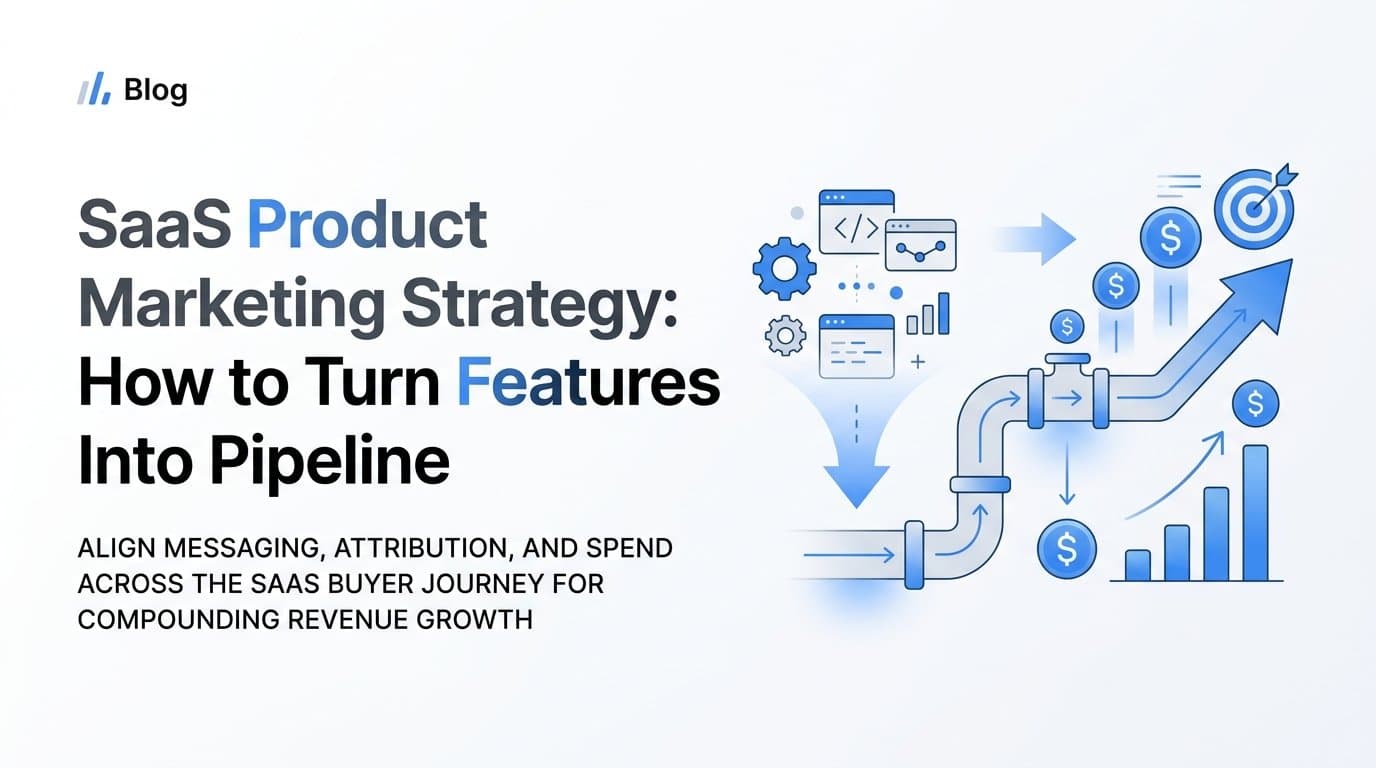
You have a product that solves a real problem. Your team has built something genuinely useful, and you can articulate why it matters. But when the board asks which campaigns are actually driving revenue, you find yourself pointing at MQL counts and traffic charts rather than pipeline numbers tied to specific spend. That gap, between marketing activity and provable business impact, is where most SaaS product marketing strategies quietly break down.
This is not a failure of effort. It is a structural problem. SaaS product marketing operates under a different set of rules than traditional B2B marketing, and applying the wrong framework leads to misallocated budget, misread performance data, and messaging that resonates in isolation but fails to drive compounding growth.
The distinction matters because SaaS revenue is recurring, the product itself is often the primary acquisition vehicle, and the buyer journey spans weeks or months across channels that rarely talk to each other. A strategy built for a one-time purchase cycle will systematically underperform in this environment, no matter how good the creative or how sharp the copy.
This article is a practical framework for building a SaaS product marketing strategy that actually works. It moves from positioning to channel selection to measurement, with attribution as the connective tissue that holds the whole system together. The goal is not to give you a checklist. It is to give you a mental model that lets you make better decisions with the data you already have, and to show you what becomes possible when that data is clean, connected, and actionable.
Why SaaS Product Marketing Operates by Different Rules
Traditional B2B marketing was designed around a relatively straightforward journey: a buyer sees an ad, fills out a form, talks to a salesperson, and signs a contract. Attribution in that world is imperfect but manageable. In SaaS, the journey is fundamentally more complex, and the old playbook creates blind spots that cost real money.
Start with the buying cycle. In B2B SaaS, a single deal often involves multiple stakeholders: a technical evaluator who tests the product, an end user who advocates internally, and a financial decision-maker who approves the contract. Each of these people may encounter your brand through completely different channels at completely different times. A last-click attribution model collapses all of that complexity into a single touchpoint, almost always the one closest to the form fill, and systematically misrepresents how the deal actually came together.
Then there is the product itself. In SaaS, the product is not just what you sell. It is a major part of how you sell. Free trials, freemium tiers, and self-serve demo flows create conversion events that traditional B2B marketing never had to account for. A user who signs up for a free trial and spends three weeks in the product before converting to paid is not the same as a lead who downloaded a whitepaper. The marketing strategy has to treat these as distinct conversion types with distinct signals, not lump them together as "leads."
Revenue structure changes everything too. Because SaaS revenue is recurring and expansion-driven, the marketing team's job does not end at acquisition. Activation, the moment a new user experiences meaningful value, directly affects retention and expansion. If your product marketing strategy is optimized purely for top-of-funnel volume without regard for the quality of users it attracts, you will see high churn rates and poor net revenue retention, and those numbers will eventually come back to haunt your budget conversations.
This means a SaaS product marketing strategy needs to account for three distinct stages as a connected system: acquisition (bringing the right people in), activation (helping them reach value quickly), and retention (keeping them and growing them). These stages require different messaging, different channels, and different success metrics. Treating them as one undifferentiated funnel is one of the most common and costly mistakes SaaS marketing teams make.
Building a Positioning Foundation That Drives Demand
Positioning is the most leveraged work in SaaS product marketing. Get it right, and every channel becomes more efficient. Get it wrong, and you spend more money to generate worse results, no matter how well you execute tactically.
Effective SaaS positioning starts with a sharp ideal customer profile, and that means going well beyond firmographics. Knowing that your best customers are mid-market B2B SaaS companies with fifty to two hundred employees is a starting point, not a destination. What matters more is understanding the specific pain they are experiencing, the trigger event that caused them to start looking for a solution, and the job they are trying to get done. The jobs-to-be-done framework is useful here because it forces you to define positioning around the outcome the buyer wants rather than the features you offer.
Think about the difference between "we help marketing teams track campaigns" and "we help growth teams prove which ad spend is actually driving revenue before the next board meeting." Both describe the same product. Only one speaks to the moment of urgency that makes a buyer take action.
Once you have that ICP clarity, you need a messaging hierarchy that holds together across the entire funnel. At the category level, your messaging needs to create awareness of the problem and establish that your category of solution is the right approach. At the mid-funnel level, messaging should differentiate your specific approach from alternatives. At the bottom of the funnel, feature-level proof points and social proof close the gap between interest and commitment. The mistake most SaaS teams make is leading with feature-level messaging at the top of the funnel, where buyers are not yet ready to evaluate specifics, and then failing to escalate to stronger proof when buyers are ready to decide.
Competitive differentiation in a crowded SaaS market is a related challenge. The temptation is to compete on feature breadth, to position your product as doing more than the alternatives. This rarely works because feature lists are easy to replicate and hard to communicate quickly. A stronger approach is to own a specific outcome or use case with unusual depth and clarity. If your platform is the one that B2B SaaS marketing teams trust to connect ad spend to closed revenue, that is a more defensible position than claiming to be the most comprehensive analytics platform on the market.
Positioning is not a one-time exercise. As your product evolves, as the competitive landscape shifts, and as you learn more about what actually resonates with buyers, your positioning should evolve with it. Build a feedback loop between sales conversations, customer interviews, and your messaging so that positioning stays grounded in what buyers actually care about rather than what your internal team thinks they should care about.
Channel Strategy: Where SaaS Buyers Actually Pay Attention
Channel selection is where positioning meets execution, and where a lot of SaaS marketing budgets quietly leak. The core principle is simple: different channels serve different jobs in the buyer journey, and confusing those jobs leads to misallocated spend and misleading performance data.
Paid search captures existing demand. When a buyer is actively searching for a solution to a specific problem, paid search puts your product in front of them at exactly the right moment. For SaaS categories with established search volume, Google Ads is often the highest-intent paid channel available. The trade-off is that search volume is finite. You can capture the demand that exists, but you cannot manufacture demand that does not.
Paid social, particularly LinkedIn and Meta, does the opposite job. It creates demand among audiences who are not yet actively searching. This is fundamentally different from capturing existing demand, and it requires different creative, different messaging, and different success metrics. A LinkedIn campaign targeting growth leaders at mid-market SaaS companies is not going to generate the same immediate conversion rates as a branded search campaign, and holding it to that standard will cause you to cut a channel that is doing essential work earlier in the buyer journey.
Content and SEO build compounding organic pipeline over time. The key word is compounding: content that ranks well continues to generate pipeline months and years after it was published, unlike paid channels that stop the moment you pause spend. But this requires a clear topical authority strategy tied to the buyer's problem space, not just product keywords. Buyers do not start their research by searching for your product name. They search for the problem they are trying to solve. Your content strategy should meet them there.
Product-led growth channels are where many SaaS teams leave significant pipeline on the table. In-app referral programs, integration marketplace listings, and review platforms like G2 and Capterra function as high-intent distribution channels that most teams underinvest in. A buyer who finds your product through a G2 comparison page is already in evaluation mode. They are not at the top of the funnel wondering if they have a problem. They have a problem and they are actively comparing solutions. That is a fundamentally different and more valuable buyer state than someone who saw a display ad.
The practical implication is that your channel mix should be intentional about which stages of the buyer journey each channel serves, and your measurement framework should reflect that. Cutting a top-of-funnel channel because it does not generate immediate conversions is often a mistake. The question is whether it generates awareness and consideration that eventually converts through other channels, and answering that question requires attribution data, not just last-click reporting.
The Customer Journey in SaaS Is Not Linear
Here is something worth saying plainly: SaaS buyers rarely convert on a single visit. In practice, a buyer might encounter your brand through a LinkedIn post, read a few blog articles over the following weeks, see a retargeting ad, check your G2 profile, ask a peer in a Slack community, and then search for your brand name before finally booking a demo. Last-click attribution gives all the credit to the branded search. Every other touchpoint gets zero.
This is not just a measurement inconvenience. It is a strategic problem. If your attribution model consistently credits branded search and ignores the content, social, and community touchpoints that drove initial awareness and consideration, you will systematically defund the channels that are doing the most important work. Over time, the top of your funnel will thin out, branded search volume will decline because there are fewer people discovering you to begin with, and you will be left wondering why performance is degrading despite maintaining spend levels.
Multi-touch attribution models exist precisely to address this. Linear attribution distributes credit evenly across all touchpoints. Time-decay models give more credit to touchpoints closer to conversion. Data-driven models use statistical analysis to assign credit based on actual patterns in your conversion data. Each model tells a different story, and understanding those differences is essential for making good budget decisions.
The dark funnel adds another layer of complexity. A significant portion of B2B SaaS buyer research happens in places you cannot directly track: private Slack communities, peer conversations, analyst briefings, and social media scrolling that never results in a click. This does not mean attribution is hopeless. It means you should build a measurement framework that acknowledges the limits of trackable data while maximizing the signal you can capture from the touchpoints you can see.
Connecting ad platform data to CRM events and revenue data is the critical step that most teams skip or execute poorly. If your ad platform shows clicks and your CRM shows leads but the two systems never talk to each other, you have no way of knowing which clicks became qualified pipeline and which became closed revenue. You are optimizing ad spend based on click volume rather than business outcomes, which is a bit like steering a ship by watching the wake rather than the horizon.
Measuring What Actually Moves the Needle
The metrics that matter in SaaS product marketing are not the ones that are easiest to report. MQL volume, click-through rates, and cost per click are easy to measure and easy to present in a dashboard. But they are not what earns budget approval, and they are not what actually predicts revenue growth.
The metrics that matter are pipeline attribution by channel, cost per pipeline dollar, and revenue influenced by campaign. These numbers require more work to produce because they require connecting marketing data to sales and revenue data. But they are the only metrics that let you have a credible conversation with a CFO or CEO about why marketing spend should increase.
Attribution model selection is where measurement strategy gets genuinely complex, and it is worth being honest about the trade-offs. A last-click model is simple and easy to implement, but it systematically undercredits awareness and consideration channels. A linear model is more equitable but may overweight touchpoints that had minimal actual influence. A data-driven model is theoretically the most accurate but requires substantial conversion volume to produce reliable results and can be a black box that is hard to explain to stakeholders.
The right answer is not to pick one model and treat it as gospel. The right answer is to use multiple models in parallel, understand what each one is telling you, and use the differences between them to generate hypotheses about channel contribution that you can test. If linear attribution says your LinkedIn campaigns are contributing meaningfully to pipeline but last-click gives them almost no credit, that is a signal worth investigating rather than ignoring.
Server-side conversion tracking and first-party data have moved from best practice to necessity. As browser-based tracking degrades due to cookie restrictions and ad blockers, the signal quality that ad platforms receive from pixel-based tracking has declined significantly. This matters because ad platform machine learning, the algorithms that decide who to show your ads to, depends on conversion signal to optimize effectively. When that signal is degraded, the algorithm optimizes toward the wrong outcomes, and your ad spend becomes less efficient over time without any obvious explanation.
Conversion APIs, Meta CAPI and Google Enhanced Conversions among them, allow you to send conversion data directly from your server to ad platforms, bypassing browser-based tracking limitations. This keeps the signal clean and gives ad platform algorithms the information they need to find the users who actually become customers, not just the ones who click.
Turning Measurement Into a Scalable Growth System
Measurement is only valuable if it changes decisions. A dashboard that shows you which channels are driving pipeline is useful. A system that automatically feeds that insight back into your ad platforms, improves algorithmic targeting, and compounds over time is transformative.
A closed-loop attribution system connects ad spend to pipeline and revenue in a single view. This gives product marketers something they rarely have: the ability to walk into a budget conversation with clear evidence that a specific dollar of spend produced a specific amount of pipeline. That evidence changes the nature of the conversation from "we think this is working" to "here is what the data shows, and here is what we want to do next."
Feeding enriched conversion data back to ad platforms is the step that most teams either skip or implement incompletely. When you send Meta or Google not just "this person converted" but "this person converted and became a paying customer worth this much," you are giving the algorithm a much more useful signal. Over time, the algorithm learns to find more users who match the profile of your best customers rather than just your most frequent form-fillers. This is how paid channel efficiency compounds: the more quality signal you feed in, the better the targeting gets, and the better the targeting gets, the more efficiently your budget generates pipeline.
AI-driven insights add another layer of leverage. Rather than manually reviewing campaign performance across every channel and creative variant, an AI layer can surface which campaigns and creatives are driving the highest-quality pipeline and flag underperformers before they waste significant budget. This is particularly valuable for teams managing spend across multiple channels simultaneously, where the volume of data makes manual analysis slow and error-prone.
Platforms like Cometly are built specifically for this workflow. By connecting ad platforms, CRM data, and revenue data including Stripe into a single attribution view, Cometly gives B2B SaaS marketing teams the closed-loop system that makes scalable growth possible. Its server-side tracking and Conversion API integrations address the data quality challenges that degrade ad platform optimization, and its AI layer surfaces actionable insights about which campaigns are actually driving revenue rather than just activity. The result is a measurement foundation that does not just report on what happened but actively improves the performance of future campaigns.
Putting It All Together
The through-line of a great SaaS product marketing strategy is not complexity. It is coherence. Sharp positioning defines who you are for and what outcome you deliver. Channel strategy distributes that message where buyers are actually paying attention. Journey mapping acknowledges that the path from awareness to revenue is rarely direct. And attribution is the measurement layer that connects all of it, turning individual tactics into a system that learns and improves over time.
Most SaaS teams have pieces of this in place. The gap is usually in the measurement layer: ad platforms report on clicks, CRMs report on leads, and finance reports on revenue, but no single view connects them. Without that connection, product marketers are making channel and budget decisions based on incomplete information, and the cost of those decisions compounds quietly over time.
The good news is that building a closed-loop attribution system is more achievable now than it has ever been. The tools exist. The APIs exist. The frameworks exist. What is required is the decision to treat measurement as a strategic priority rather than a reporting afterthought.
If you are ready to see which ads and channels are actually driving pipeline and revenue for your SaaS business, Cometly gives you the complete attribution picture your growth strategy depends on. Get your free demo today and start capturing every touchpoint to maximize your conversions.