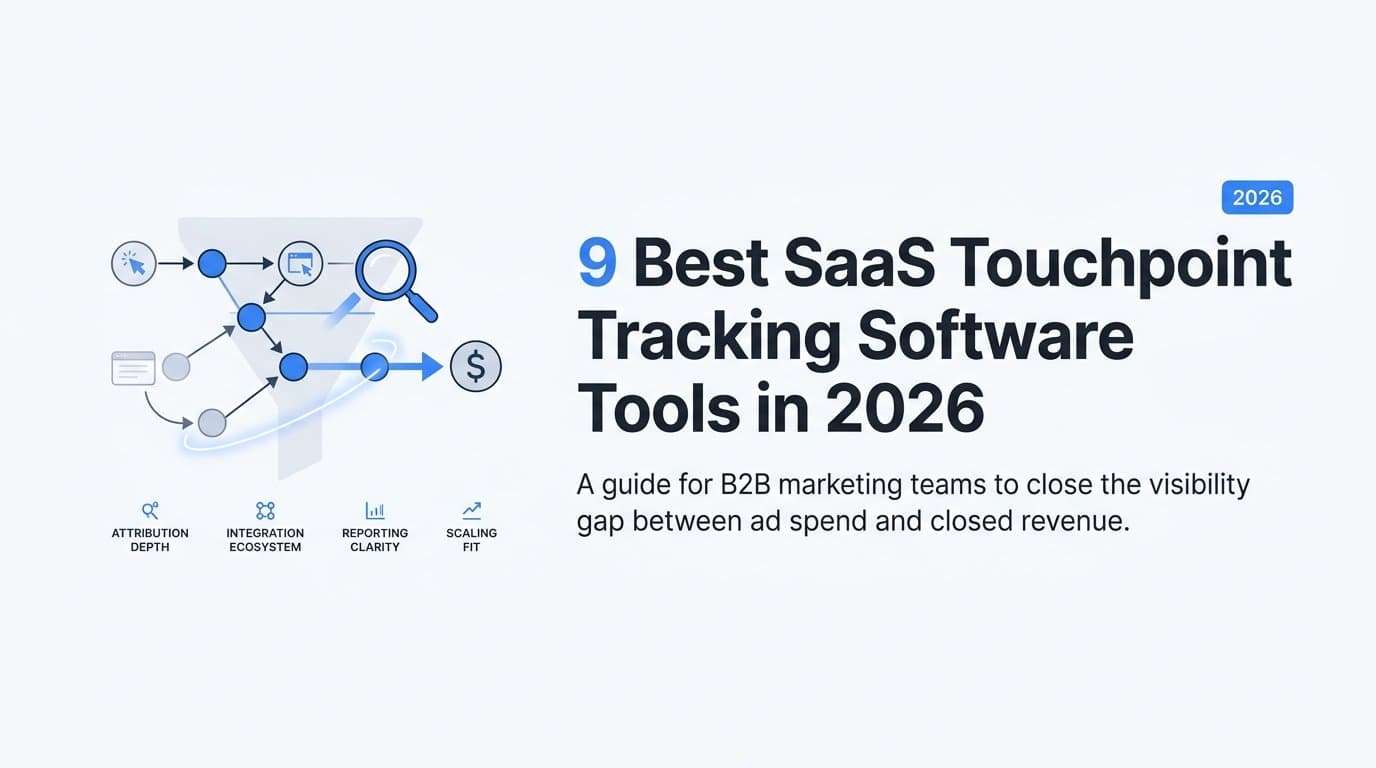
When a prospect clicks your ad, visits your pricing page, reads a case study, and then books a demo three weeks later, which touchpoint gets the credit? For most B2B SaaS teams, the honest answer is: they have no idea. That visibility gap is exactly what touchpoint tracking software solves. These platforms capture every interaction across the customer journey, from the first ad click to the closed-won deal, and connect them to real pipeline and revenue data.
Without this visibility, marketing teams are flying blind, cutting budgets from channels that actually drive revenue and doubling down on ones that only look good on the surface. This guide covers the best SaaS touchpoint tracking tools available in 2026, evaluated on attribution depth, integration ecosystem, reporting clarity, and fit for B2B SaaS teams.
Whether you are a growth marketer trying to justify ad spend or a marketing leader building a scalable measurement stack, this list will help you find the right fit.
1. Cometly
Best for: B2B SaaS teams that need end-to-end attribution from first ad click to closed revenue.
Cometly is a purpose-built marketing attribution and analytics platform for B2B SaaS companies that tracks every touchpoint across the customer journey and connects ad spend directly to pipeline and revenue.
 9 Best SaaS Touchpoint Tracking Software Tools in 2026
Where This Tool Shines
Cometly stands out because it was designed specifically for B2B SaaS attribution, not adapted from an ecommerce or general analytics tool. It captures every touchpoint from the first paid ad click through to closed-won revenue, giving marketing and growth teams a single source of truth that connects ad spend to MRR and ARR.
The AI ads manager is a genuine differentiator. Rather than just presenting attribution data, it surfaces actionable recommendations, identifying which campaigns and creatives are actually driving conversions so teams can scale with confidence. Server-side tracking and Conversion API support for Meta and Google also ensure signal quality holds up as browser-based tracking becomes less reliable.
Key Features
Multi-Touch Attribution: Tracks touchpoints across all paid and organic channels with multiple attribution model options for flexible analysis.
Server-Side Tracking and CAPI Integration: Maintains conversion signal quality for Meta and Google campaigns even as cookie-based tracking degrades.
AI Ads Manager: Identifies high-performing campaigns and creatives across every ad channel and surfaces recommendations to help teams act on data, not just read it.
Stripe Revenue Integration: Connects ad spend data directly to MRR and ARR, giving leadership a clear view of marketing's contribution to revenue.
Customer Journey Analytics: Provides a full touchpoint timeline per contact, showing every interaction from awareness through conversion.
70+ Native Integrations: Connects with major CRMs, ad platforms, and marketing tools without custom development work.
Best For
Growth marketers and marketing leaders at B2B SaaS companies who need to connect ad spend to pipeline and revenue. Particularly strong for teams managing paid acquisition across multiple channels who want AI-assisted optimization, not just reporting.
Pricing
Pricing is available at cometly.com/pricing. Plans scale based on usage and team size, with options for both growing teams and larger marketing organizations.
2. HubSpot Marketing Hub
Best for: Teams already in the HubSpot ecosystem that want native touchpoint tracking tied to CRM records.
HubSpot Marketing Hub is an all-in-one marketing platform with native CRM integration that logs touchpoints across email, ads, forms, and web visits directly to contact and deal records.
 9 Best SaaS Revenue Attribution Platforms in 2026
Where This Tool Shines
HubSpot's biggest strength is the depth of its native CRM integration. Every touchpoint, whether it is an email open, a form submission, or an ad click, is automatically logged to the contact record without any additional configuration. For teams that live in HubSpot, this creates a naturally rich touchpoint history tied to real deals and pipeline data.
Attribution reporting, available on Professional and Enterprise tiers, allows teams to analyze which channels and content influenced pipeline. It is not the most granular attribution tool on the market, but for HubSpot-centric organizations, the convenience of having touchpoint data and CRM data in the same platform is a meaningful advantage.
Key Features
Contact-Level Touchpoint Timeline: Every interaction is logged to the contact record and visible alongside deal history.
Multi-Touch Attribution Reporting: Available on higher tiers, covering first-touch, last-touch, and linear attribution models.
Ad Tracking: Connects Google, Meta, and LinkedIn ad data to contact and deal records for channel-level attribution.
Email and Form Tracking: Native tracking for opens, clicks, and form submissions without additional setup.
Integrated Reporting Dashboard: Combines marketing and sales data in a single reporting view across the funnel.
Best For
Marketing teams already using HubSpot as their CRM who want touchpoint visibility without adding another tool to their stack. Less ideal for teams that need deep, customizable attribution modeling or granular paid channel analysis.
Pricing
A free tier is available. Paid plans start at an accessible entry-level price point, with attribution reporting unlocked on Professional and Enterprise tiers.
3. Segment
Best for: Engineering and data teams that need a flexible event collection and routing layer for touchpoint data.
Segment is a customer data platform that collects, normalizes, and routes touchpoint event data to any downstream analytics, attribution, or CRM tool in your stack.
 9 Best SaaS Touchpoint Tracking Software Tools in 2026
Where This Tool Shines
Segment does not provide attribution reporting on its own. What it does is solve the upstream data problem: collecting clean, consistent touchpoint events from web, mobile, and server sources and routing them wherever they need to go. If your attribution tool needs reliable event data, Segment is often the infrastructure layer that makes it possible.
Its identity resolution capabilities are particularly valuable for B2B SaaS teams. Segment can unify anonymous visitor sessions with known user profiles, creating a more complete picture of the pre-conversion journey that most attribution tools would otherwise miss.
Key Features
Centralized Event Collection: Collects touchpoint events from web, mobile, and server sources through a single unified API.
400+ Downstream Destinations: Routes data to analytics, attribution, CRM, and data warehouse tools without custom integrations.
Identity Resolution: Stitches anonymous visitor sessions to known user profiles for a more complete journey view.
Real-Time Event Streaming: Sends events downstream in real time with transformation and filtering capabilities.
Developer-Friendly SDKs: Supports custom event instrumentation for teams with specific tracking requirements.
Best For
Data and engineering teams at growth-stage or enterprise SaaS companies that need a reliable, scalable event collection layer. Requires technical resources to implement and maintain effectively.
Pricing
A free tier is available for limited monthly tracked users. Paid plans scale with data volume and the number of destinations used.
4. Ruler Analytics
Best for: B2B teams with long sales cycles that need to connect anonymous web touchpoints to CRM revenue.
Ruler Analytics is a B2B marketing attribution platform that connects anonymous web visitor touchpoints to CRM contacts and revenue, purpose-built for complex and extended sales cycles.
 9 Best SaaS Revenue Attribution Platforms in 2026
Where This Tool Shines
Ruler Analytics addresses a problem that many B2B SaaS teams face: a prospect visits your site multiple times before ever filling out a form, and most tools lose the touchpoint history from those anonymous visits. Ruler tracks these sessions and, at the point of conversion, maps all prior touchpoints back to the new lead record in your CRM.
This makes it particularly valuable for teams where the sales cycle stretches across weeks or months. The ability to attribute revenue from closed CRM deals back to the original marketing touchpoints, including those that happened before the visitor was known, is a meaningful capability for long-cycle B2B attribution.
Key Features
Visitor-Level Touchpoint Tracking: Tracks anonymous sessions across multiple visits before conversion and maps them to the lead at the point of form submission.
CRM Integration: Maps touchpoint history to leads and deals in your CRM at the moment of conversion.
Multi-Touch Attribution Models: Supports linear, time-decay, and position-based attribution for flexible analysis.
Revenue Attribution: Ties attribution data to actual CRM deal values for revenue-level reporting.
Call Tracking and Offline Conversion Support: Extends touchpoint visibility to phone calls and offline conversion events.
Best For
B2B marketing teams with sales cycles longer than a few days who need to understand which channels drove pipeline, even when the conversion happened weeks after the first visit.
Pricing
Paid plans are available, with pricing that scales based on the number of tracked visitors and integrations required.
5. Dreamdata
Best for: B2B teams running account-based strategies that need to track touchpoints at the company level, not just the individual contact level.
Dreamdata is a B2B revenue attribution platform that tracks touchpoints at the account level, grouping interactions from multiple stakeholders at the same company into a unified journey view.
 8 Best SaaS Pipeline Attribution Software Tools in 2026
Where This Tool Shines
In B2B SaaS, deals rarely involve just one person. A champion explores your product, a manager attends a webinar, and an executive reads a case study, all before a single opportunity is created in your CRM. Dreamdata is built around this reality. It aggregates touchpoints by company account, giving you a complete picture of how the buying committee engaged before the deal closed.
This account-level view is especially useful for teams running ABM strategies or selling into mid-market and enterprise accounts where multiple stakeholders are involved across a longer buying process.
Key Features
Account-Level Journey Tracking: Aggregates touchpoints by company rather than individual contact for a complete buying committee view.
Customizable Attribution Models: Supports multiple attribution models designed for complex B2B funnels.
CRM Integration: Connects with Salesforce, HubSpot, and other major B2B CRMs for deal-level attribution.
Ad Platform Data Ingestion: Pulls in spend and impression data from major ad platforms for cross-channel attribution.
Pipeline and Revenue Attribution Reporting: Ties touchpoint data to pipeline stages and closed-won revenue.
Best For
B2B SaaS teams selling to accounts with multiple stakeholders, particularly those running ABM programs or dealing with sales cycles that involve committee-based buying decisions.
Pricing
A free tier is available with limited features. Paid plans scale with data volume and team size.
6. Rockerbox
Best for: Marketing teams managing a diverse mix of paid and organic channels who need a clean, deduplicated attribution view.
Rockerbox is a marketing data platform that centralizes and normalizes touchpoint data across paid, organic, and offline channels to provide a consistent, deduplicated attribution view.
 9 Best SaaS Touchpoint Tracking Software Tools in 2026
Where This Tool Shines
One of the most persistent problems in multi-channel attribution is double-counting. When every ad platform claims credit for the same conversion, your reported ROAS looks great but your actual results tell a different story. Rockerbox solves this by creating a unified marketing data layer that deduplicates touchpoints across channels before attribution is applied.
The platform also offers media mix modeling alongside multi-touch attribution, giving teams two lenses to evaluate channel performance. For organizations with significant channel diversity and a need for clean, trustworthy data, Rockerbox provides a solid foundation.
Key Features
Unified Marketing Data Layer: Centralizes touchpoint data from all paid, organic, and offline channels into a single normalized view.
Deduplicated Attribution: Removes double-counting across channels so credit is assigned accurately.
Multi-Touch and Media Mix Modeling: Offers both rule-based and statistical attribution approaches for flexible analysis.
Raw Data Access: Provides access to underlying data for custom analysis and reporting in external tools.
Broad Integration Support: Connects with major ad platforms, CRMs, and data warehouses.
Best For
Growth and performance marketing teams running campaigns across five or more channels who need confidence that their attribution data is clean and not inflated by platform-level double-counting.
Pricing
Custom pricing based on ad spend and data volume. Contact Rockerbox directly for a quote.
7. ActiveCampaign
Best for: SaaS teams with email-driven funnels that want touchpoint tracking built into their marketing automation and CRM workflow.
ActiveCampaign is a marketing automation and CRM platform that tracks email, behavioral, and messaging touchpoints and logs them to contact records, supporting funnel visibility for email-driven SaaS funnels.
Where This Tool Shines
ActiveCampaign is not a dedicated attribution platform, but for teams whose primary conversion driver is email nurture, it offers strong touchpoint visibility within a single tool. Every email open, link click, and form submission is automatically logged to the contact timeline, and behavioral triggers can kick off automation sequences based on those signals.
The CRM pipeline integration means touchpoint history travels with the contact through the sales process. For smaller SaaS teams that do not need deep cross-channel attribution, ActiveCampaign can serve as a practical all-in-one solution for tracking what matters most in their funnel.
Key Features
Automated Touchpoint Logging: Captures email opens, clicks, and replies automatically and logs them to the contact timeline.
Behavioral Event Tracking: Tracks website visits and in-app events tied to individual contact records.
CRM Deal Pipeline: Maintains touchpoint history per contact as deals move through the sales pipeline.
Website Tracking: Monitors page visits and behavioral signals to trigger automations and update contact profiles.
Automation Workflows: Responds to touchpoint signals with targeted follow-up sequences across email and messaging channels.
Best For
Early-stage to mid-market SaaS teams that rely heavily on email nurture sequences and want touchpoint tracking without adding a separate attribution tool. Less suited for teams that need deep paid channel attribution or cross-channel modeling.
Pricing
Paid plans start at an accessible monthly rate and scale with contact list size and the features required.
8. Triple Whale
Best for: Growth teams with heavy paid social investment who want creative-level attribution and blended performance reporting.
Triple Whale is a data analytics platform with strong paid social attribution capabilities and a creative analytics layer that helps growth teams understand which ad creatives drive conversions.
Where This Tool Shines
Triple Whale built its reputation in ecommerce attribution but has expanded into SaaS use cases, particularly for teams running significant paid social spend on Meta and other platforms. Its creative analytics capability is a standout feature: rather than just showing which campaigns convert, it connects performance data to individual ad creatives, helping teams understand what messaging and visuals are actually resonating.
The blended ROAS and contribution margin reporting also give growth teams a more honest view of channel performance than platform-native dashboards, which tend to over-report results. For paid-social-heavy SaaS growth teams, Triple Whale offers a useful performance lens.
Key Features
Pixel-Based and Post-Purchase Attribution: Captures touchpoints across paid social channels with multiple attribution signal sources.
Creative Analytics: Ties ad creative performance directly to conversion data for creative-level optimization decisions.
Blended ROAS Reporting: Provides a consolidated view of return on ad spend across channels, separate from platform-reported figures.
Multi-Touch Attribution Models: Supports channel comparison views across different attribution model approaches.
Consolidated Ad Platform Dashboard: Brings spend and performance data from multiple ad platforms into a single reporting interface.
Best For
Growth teams at SaaS companies with significant paid social budgets who want creative-level attribution insights and a cleaner view of blended performance across channels.
Pricing
Paid plans are available, with pricing that scales based on ad spend and the features selected.
9. Mixpanel
Best for: Product-led SaaS teams that need to understand how in-app behavioral touchpoints influence conversion, activation, and retention.
Mixpanel is a product analytics platform that tracks granular in-app behavioral events, enabling PLG SaaS teams to understand how product touchpoints influence conversion, activation, and retention outcomes.
Where This Tool Shines
While most tools on this list focus on pre-conversion marketing touchpoints, Mixpanel focuses on what happens after a user signs up. For product-led growth teams, the product itself is a major touchpoint in the journey toward paid conversion and long-term retention. Mixpanel captures every in-app interaction at an event level, giving teams the data they need to understand which product behaviors predict conversion.
Funnel analysis, cohort reporting, and retention curves make it possible to identify exactly where users drop off and which engagement patterns correlate with expansion revenue. When paired with a marketing attribution tool, Mixpanel completes the picture from first ad click through to long-term product engagement.
Key Features
Event-Based Behavioral Tracking: Captures granular in-product interactions at the event level for detailed behavioral analysis.
Funnel Analysis: Identifies where users drop off in the conversion journey from signup through to paid activation.
Cohort Analysis: Groups users by behavior or acquisition source to compare how different segments engage over time.
Retention Reporting: Ties product engagement events to retention outcomes for understanding what keeps users active.
Data Warehouse and CDP Integration: Connects with data warehouses and customer data platforms for enriched, cross-tool analysis.
Best For
PLG SaaS teams where the product is the primary acquisition and conversion mechanism. Most valuable when used alongside a marketing attribution tool to connect pre-signup touchpoints with post-signup product behavior.
Pricing
A free tier is available for a limited number of monthly events. Paid plans scale with event volume and team requirements.
Which Tool Is Right for Your SaaS Stack
Each tool on this list solves a real attribution problem, but the right choice depends on where your biggest blind spot lives.
If your primary challenge is connecting paid ad spend to pipeline and closed revenue, Cometly is the strongest fit. It is purpose-built for B2B SaaS attribution, covers the full journey from first click to closed-won deal, and adds AI-powered recommendations that help you act on the data rather than just report it. The Stripe integration and server-side tracking capabilities make it particularly well-suited for teams that need accurate, revenue-level attribution in a single platform.
For teams already running on HubSpot, HubSpot Marketing Hub provides solid touchpoint visibility without adding another tool. For product-led growth teams, Mixpanel fills the gap that most marketing attribution tools leave open: understanding what happens inside the product after a user converts.
If you need infrastructure-level event collection, Segment is the right foundation. For account-based strategies with multi-stakeholder buying journeys, Dreamdata is built for that complexity. Teams with long pre-conversion anonymous journeys will find Ruler Analytics particularly useful. For paid social creative optimization, Triple Whale adds a layer most attribution tools do not offer. Email-driven funnels are well served by ActiveCampaign, and teams managing diverse channel mixes with deduplication needs should look at Rockerbox.
The bottom line is that most attribution blind spots in B2B SaaS come from disconnected data, not a lack of data. The tools that solve this most effectively are the ones that connect every touchpoint to actual revenue outcomes, not just top-of-funnel metrics.
If you are ready to see which ads and channels are truly driving your pipeline, Get your free demo and start capturing every touchpoint with Cometly today.