

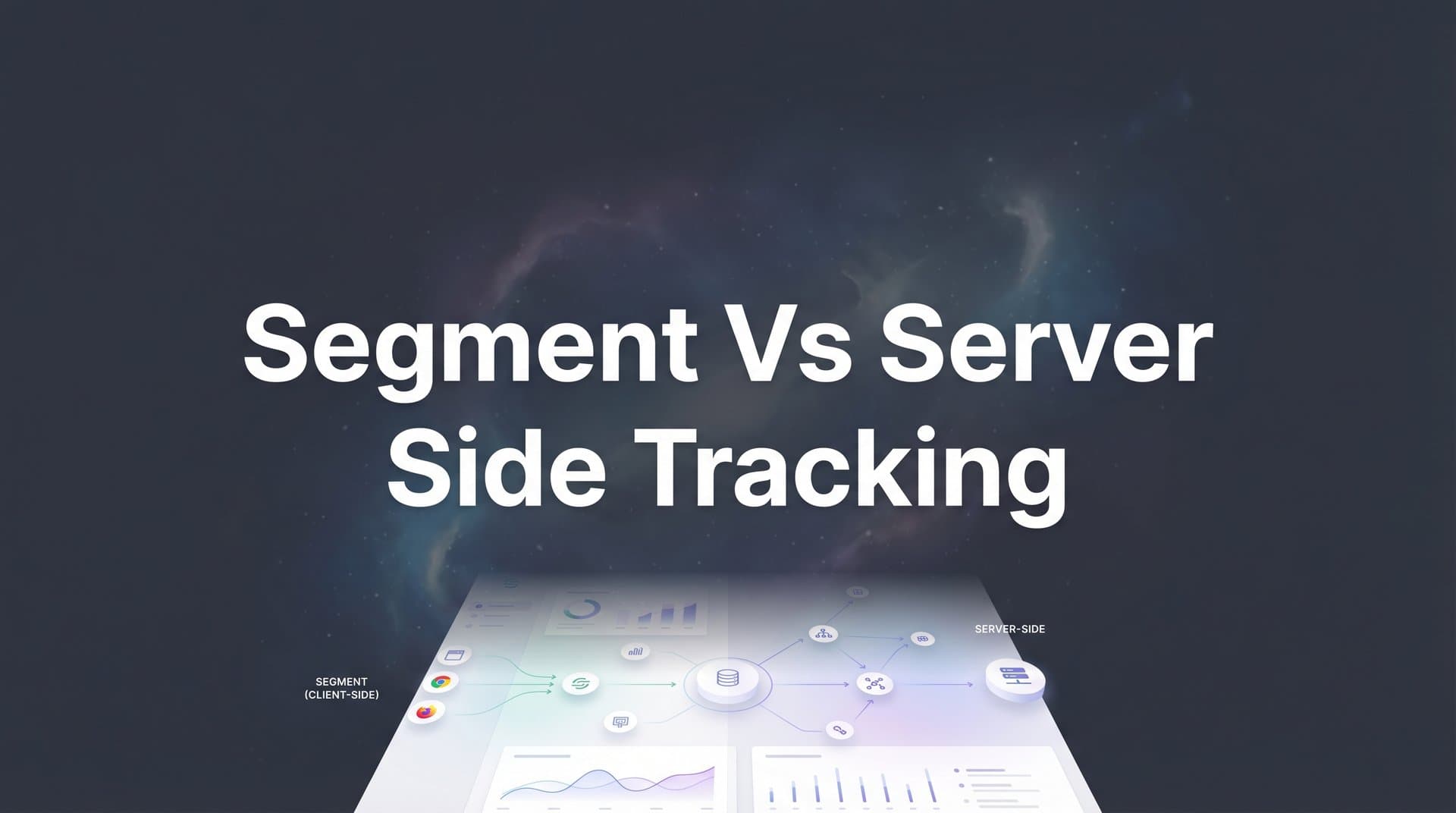
Modern marketers face a critical decision when building their data infrastructure: should you use a customer data platform like Segment, implement direct server-side tracking, or combine both approaches? This choice directly impacts your attribution accuracy, data ownership, and ability to optimize ad spend.
With browser restrictions tightening and privacy regulations evolving, the tracking architecture you choose today will determine how effectively you can measure and scale campaigns tomorrow. iOS App Tracking Transparency and third-party cookie deprecation have fundamentally changed how we collect marketing data. Many teams report declining accuracy in platform-reported conversions compared to actual sales data.
This guide breaks down seven strategic approaches to help you evaluate Segment versus server-side tracking based on your specific business needs, technical resources, and marketing goals. Whether you're a lean marketing team or an enterprise operation, these strategies will help you build a tracking foundation that delivers accurate, actionable data.
1. Audit Your Current Data Collection Gaps First
The Challenge It Solves
Most marketing teams jump straight into evaluating tracking solutions without understanding where their current setup actually fails. You might be experiencing attribution blind spots, missing conversion events, or inconsistent data between platforms. Without identifying these specific gaps, you risk implementing a new solution that doesn't address your real problems.
Think of it like diagnosing a car issue. You wouldn't replace the entire engine if you just need new spark plugs. The same logic applies to your tracking infrastructure.
The Strategy Explained
Start by documenting every place where your current tracking breaks down. Compare what your ad platforms report against what actually happened in your CRM or backend systems. Look for discrepancies in conversion counts, revenue attribution, and customer journey visibility.
Pay special attention to mobile traffic, cross-device journeys, and conversions that happen after users clear cookies or switch browsers. These scenarios often reveal where client-side tracking falls short. Also examine how well you can track events that happen outside the browser entirely, like phone calls, in-store purchases, or subscription renewals.
This audit creates a baseline for evaluating whether Segment's integration ecosystem or custom server-side tracking better addresses your specific data collection challenges.
Implementation Steps
1. Run a 30-day comparison between platform-reported conversions and actual backend conversions to quantify tracking accuracy gaps.
2. Map every customer touchpoint from first click to final conversion, identifying where data collection currently fails or becomes unreliable.
3. Document which specific events are most critical for ad platform optimization and revenue attribution in your business model.
4. Interview your marketing team to understand which data points they need but cannot currently access for campaign decisions.
Pro Tips
Focus on revenue-generating events first. If your e-commerce checkout process loses tracking accuracy, that gap costs you more than missing blog post engagement data. Prioritize fixing what directly impacts your ability to optimize ad spend and prove marketing ROI.
2. Map Your Integration Requirements Against Each Solution
The Challenge It Solves
Your marketing stack probably includes dozens of tools: ad platforms, email systems, CRM, analytics, helpdesk software, and more. Each integration requires engineering time to build and maintain. The wrong tracking solution can create an integration nightmare that consumes months of development resources.
Segment offers pre-built connectors for hundreds of tools, while server-side tracking requires custom integration work for each platform. Understanding this trade-off prevents you from choosing a solution that looks good on paper but becomes a maintenance burden in practice.
The Strategy Explained
Create a comprehensive list of every tool that needs to receive or send data in your marketing infrastructure. For each tool, research whether Segment offers a maintained connector and how complex a custom server-side tracking implementation would be.
Some platforms like Meta and Google Ads have well-documented server-side APIs that are relatively straightforward to implement. Others might have limited API capabilities or require complex authentication flows that make custom integration impractical for smaller teams.
Consider not just current integrations but future ones too. If you plan to add new marketing tools frequently, Segment's connector ecosystem might accelerate your ability to test and adopt new platforms without engineering bottlenecks.
Implementation Steps
1. List every current tool in your marketing stack that requires data integration, including ad platforms, analytics, CRM, email, and customer support systems.
2. Research Segment's connector library to verify which integrations are available as pre-built, maintained solutions versus requiring custom development.
3. For your most critical integrations, estimate the engineering hours required to build and maintain custom server-side connections.
4. Identify which platforms have robust server-side APIs and which rely primarily on client-side tracking methods.
Pro Tips
Don't assume every integration needs to use the same approach. Many successful teams use Segment for rapid deployment of secondary integrations while building direct server-side connections for critical conversion events that feed ad platform algorithms. This hybrid approach balances speed with control where it matters most.
3. Evaluate Data Ownership and Privacy Control Needs
The Challenge It Solves
When you route data through a third-party platform like Segment, that platform processes and temporarily stores your customer data. For some businesses, this creates compliance concerns or conflicts with data residency requirements. Industries like healthcare, finance, or those operating in regions with strict privacy regulations need complete control over where data flows and how it's processed.
Server-side tracking keeps data entirely within your infrastructure, giving you full control over storage, processing, and transmission. This architectural difference has significant implications for compliance, security, and long-term data ownership.
The Strategy Explained
Assess your industry's regulatory requirements and your company's data governance policies. If you operate in healthcare, you need to ensure any tracking solution maintains HIPAA compliance. European operations must consider GDPR data residency requirements. Financial services face additional scrutiny around customer data handling.
Beyond compliance, consider your strategic data ownership goals. Some companies view customer data as a critical competitive asset that should never flow through third-party infrastructure. Others prioritize implementation speed and are comfortable with managed services handling data routing.
Evaluate how each approach handles data retention, deletion requests, and audit trails. Server-side tracking gives you complete control but also complete responsibility for implementing privacy features correctly. Understanding the server-side tracking benefits helps frame this decision properly.
Implementation Steps
1. Review your industry's specific compliance requirements regarding customer data processing and storage, consulting with legal counsel if necessary.
2. Document your company's data residency requirements, including whether customer data can be processed outside specific geographic regions.
3. Evaluate how each tracking approach handles customer data deletion requests and privacy compliance workflows.
4. Assess the security certifications and compliance documentation provided by Segment versus your ability to maintain equivalent standards with self-hosted server-side tracking.
Pro Tips
Data ownership concerns often sound more significant in theory than they prove in practice. Many enterprise teams successfully use CDPs while maintaining compliance through proper configuration and contractual agreements. Focus on actual regulatory requirements rather than theoretical concerns about data control.
4. Calculate True Total Cost of Ownership
The Challenge It Solves
Segment's pricing appears straightforward: you pay based on monthly tracked users or events. Server-side tracking seems free since you build it yourself. This surface-level comparison misses the complete picture of what each approach actually costs when you factor in engineering time, infrastructure, maintenance, and opportunity cost.
Many teams underestimate the ongoing engineering investment required to maintain custom server-side tracking as APIs change, new platforms emerge, and data requirements evolve. Others overlook how Segment's pricing scales as traffic grows, potentially creating budget surprises as your business expands.
The Strategy Explained
Build a realistic three-year cost projection for each approach. For Segment, model how pricing scales with your projected growth in tracked users or events. Include potential overage charges and the cost of premium features you might need.
For server-side tracking, calculate the engineering hours required for initial implementation, then estimate ongoing maintenance time. Include infrastructure costs for servers, databases, and monitoring tools. Factor in the opportunity cost of engineering time spent on tracking infrastructure instead of product features. Review detailed breakdowns of server-side tracking cost to inform your projections.
Consider hidden costs like debugging tracking issues, updating integrations when platforms change APIs, and training new team members on custom infrastructure. These maintenance costs often exceed initial implementation expenses over time.
Implementation Steps
1. Request detailed pricing from Segment based on your current monthly tracked users and projected growth over three years.
2. Calculate engineering hours for building server-side tracking by estimating 40-80 hours per major integration plus 10-20 hours monthly for maintenance and updates.
3. Price infrastructure costs including server capacity, database storage, monitoring tools, and backup systems required for reliable server-side tracking.
4. Factor in opportunity cost by calculating what else your engineering team could build with the time spent on tracking infrastructure.
Pro Tips
Engineering time is your most expensive resource. A solution that costs more in subscription fees but saves 20 engineering hours per month often delivers better ROI than building everything custom. Calculate engineering time at fully loaded cost (salary plus benefits plus overhead) to get accurate comparisons.
5. Assess Your Team's Technical Capabilities Honestly
The Challenge It Solves
Server-side tracking requires ongoing engineering expertise to implement, debug, and maintain. You need developers who understand API integration, event data modeling, error handling, and infrastructure management. Marketing teams without dedicated engineering support often struggle to implement and maintain custom tracking solutions effectively.
Overestimating your technical capabilities leads to incomplete implementations, unreliable data, and tracking systems that break when team members leave. Underestimating capabilities means paying for managed services you don't actually need.
The Strategy Explained
Evaluate your current team structure and technical resources realistically. Do you have dedicated engineering support for marketing infrastructure? Can your developers commit ongoing time to tracking maintenance, or are they fully allocated to product development?
Consider your marketing team's technical comfort level too. Can they troubleshoot tracking issues, understand event data structures, and work with developers to define requirements? Or do they need a more user-friendly interface with visual tools and pre-built integrations? Reviewing common server-side tracking setup challenges helps set realistic expectations.
Look at your hiring roadmap as well. If you plan to expand your engineering team, custom server-side tracking becomes more feasible. If engineering resources will remain constrained, managed solutions like Segment might better align with your capabilities.
Implementation Steps
1. Document your current engineering team's capacity and their existing commitments to product development, infrastructure maintenance, and other priorities.
2. Assess whether your team has experience with the specific technologies required for server-side tracking, including API integration, event streaming, and data pipeline management.
3. Evaluate your marketing team's technical skills and their ability to work with code-level tracking implementations versus visual configuration tools.
4. Consider your company's hiring plans and whether you expect engineering resources to expand or remain constrained over the next 12-24 months.
Pro Tips
Be brutally honest about engineering availability. Many teams have talented developers who could build server-side tracking but lack the bandwidth to maintain it properly. Unreliable tracking data is worse than no tracking at all because it leads to bad decisions made with false confidence.
6. Prioritize Ad Platform Algorithm Optimization
The Challenge It Solves
Meta and Google's advertising algorithms rely on conversion data to optimize campaign delivery. When browser-based tracking misses conversions or reports them inaccurately, these algorithms receive incomplete signals. This degrades targeting quality, increases cost per acquisition, and limits your ability to scale winning campaigns profitably.
The tracking solution you choose directly impacts how well ad platforms can optimize your campaigns. Server-side tracking can feed more accurate, complete conversion data back to advertising platforms, improving their ability to find high-value customers and optimize bidding strategies.
The Strategy Explained
Focus your tracking architecture decisions on improving the conversion data that flows back to your primary advertising platforms. For most businesses, this means Meta and Google Ads. Both platforms offer server-side conversion APIs that accept enriched event data directly from your backend systems.
Evaluate how each approach handles conversion enrichment. Can you send additional customer data like lifetime value, subscription tier, or product category back to ad platforms? Server-side tracking makes this enrichment straightforward since you control the entire data pipeline. Learn more about server-side conversion tracking to understand these capabilities.
Consider the timing and accuracy of conversion reporting too. Server-side events can fire immediately when conversions happen in your backend systems, even if the customer closed their browser hours ago. This faster, more accurate signal helps ad platforms optimize more effectively.
Implementation Steps
1. Identify your top three advertising platforms by spend and evaluate their server-side conversion API capabilities and requirements.
2. Document which conversion events are most critical for campaign optimization, focusing on revenue-generating actions like purchases, subscriptions, or qualified leads.
3. Assess whether your current tracking captures all the conversion data points that ad platforms can use for optimization, including event parameters and customer attributes.
4. Test conversion data accuracy by comparing platform-reported conversions against actual backend conversions over a two-week period.
Pro Tips
Ad platform optimization should be your primary decision factor if you spend significantly on paid advertising. A tracking solution that improves Meta's algorithm performance by even 10 percent can generate ROI that far exceeds the cost difference between tracking approaches. Focus on what drives better campaign results, not just implementation convenience.
7. Design a Phased Implementation Roadmap
The Challenge It Solves
Ripping out your entire tracking infrastructure and replacing it overnight creates massive risk. You might lose historical data continuity, break existing dashboards, or introduce tracking gaps that corrupt your attribution data. Many teams get paralyzed by this risk and stick with inadequate tracking rather than executing a thoughtful transition.
A phased implementation approach lets you migrate gradually, validate data accuracy at each step, and maintain continuity in your marketing reporting throughout the transition.
The Strategy Explained
Break your tracking implementation into logical phases with clear success criteria for each stage. Start with the highest-impact, lowest-risk changes first. This might mean implementing server-side tracking for ads while keeping existing client-side tracking in place initially.
Run parallel tracking during transition periods to validate data accuracy. Send the same events through both your old tracking system and new implementation, comparing results to ensure you're not losing data or introducing errors. Only deprecate old tracking once you've confirmed the new system captures everything reliably.
Plan for a realistic timeline that accounts for testing, validation, and iteration. Most teams underestimate how long tracking implementations take when you factor in edge case handling, cross-browser testing, and integration debugging.
Implementation Steps
1. Prioritize tracking improvements based on business impact, starting with conversion events that directly feed ad platform optimization algorithms.
2. Design a parallel tracking period where both old and new systems run simultaneously, allowing you to validate data accuracy before fully transitioning.
3. Create clear success metrics for each implementation phase, including data accuracy thresholds, integration completion criteria, and team training milestones.
4. Build buffer time into your roadmap for unexpected issues, API changes, and the inevitable debugging required when integrating multiple systems.
Pro Tips
Start with one critical conversion event and get it working perfectly before expanding scope. Many teams try to implement everything at once and end up with partially working tracking across multiple events. Master server-side purchase tracking first, validate accuracy for 30 days, then expand to other conversion types systematically.
Putting It All Together
Choosing between Segment and server-side tracking is not an either/or decision for most marketing teams. The right strategy depends on your integration needs, technical resources, data ownership requirements, and budget constraints.
Start by auditing your current tracking gaps, then evaluate each approach against your specific requirements. Many successful teams use Segment for rapid integration deployment while implementing server-side tracking for critical conversion events that feed ad platform algorithms. This hybrid approach balances speed with control where it matters most.
Whatever path you choose, prioritize data accuracy over implementation speed. Accurate attribution data compounds over time, enabling smarter budget allocation and sustainable campaign scaling. The investment you make in your tracking infrastructure today directly determines your ability to prove marketing ROI tomorrow.
Focus on feeding better conversion data to your advertising platforms first. If you spend significantly on Meta or Google Ads, improving the quality and completeness of conversion signals should drive your tracking architecture decisions. A solution that helps ad algorithms optimize more effectively pays for itself through improved campaign performance.
Remember that tracking infrastructure is not a one-time project but an ongoing capability. Plan for maintenance, updates, and evolution as your business grows and marketing channels change. Build systems that your team can actually maintain with available resources, not aspirational architectures that sound impressive but become abandoned projects.
Ready to elevate your marketing game with precision and confidence? Discover how Cometly's AI-driven recommendations can transform your ad strategy. Get your free demo today and start capturing every touchpoint to maximize your conversions.


