Something quietly broke in marketing data over the past few years, and many teams are still working around it without fully understanding why their numbers don't add up. Reported conversions don't match CRM records. Attribution models point to channels that don't seem to be driving real pipeline. Ad platforms claim credit for deals your sales team says came from somewhere else entirely.
The root cause isn't a misconfigured campaign or a tracking setup that needs tweaking. It's structural. The browser-based pixel tracking system that the industry relied on for years has been steadily undermined by ad blockers, iOS privacy updates, and the gradual erosion of third-party cookies. The result is signal loss at scale: conversion events that simply never reach ad platforms, leaving algorithms to optimize on incomplete data and leaving marketers to make budget decisions with blind spots they can't fully see.
Server side tracking is the modern answer to this problem. By moving data collection off the browser and onto your own server, it routes conversion events through infrastructure you control before sending them to ad platforms via their APIs. The data travels server-to-server, bypassing the browser restrictions and ad blockers that silently kill client-side pixels. For B2B SaaS marketing teams trying to connect ad spend to real pipeline and revenue, understanding the server side tracking advantages isn't just a technical exercise. It's the foundation for having accurate data at all.
How Browser-Based Tracking Became a Broken System
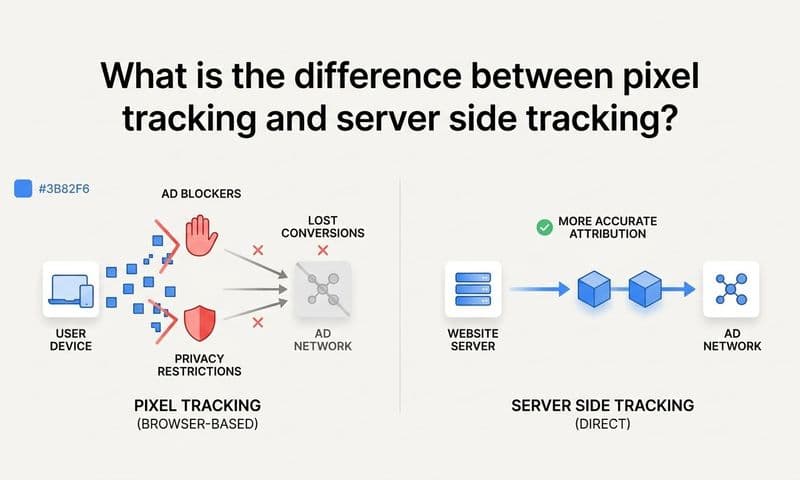
To understand why server side tracking matters, you need to understand exactly how traditional pixel tracking works and where it fails. When a user visits your website and completes an action, a JavaScript snippet fires in their browser. That script collects event data, such as the page URL, the event type, and any parameters you've configured, and sends it directly to ad platforms like Meta or Google. The entire process happens in the user's browser, which means it's entirely dependent on the browser cooperating.
That cooperation is no longer guaranteed. Ad blockers are widely used, particularly among the tech-savvy B2B audiences that SaaS companies are trying to reach. Safari's Intelligent Tracking Prevention (ITP) restricts how long cookies can persist and limits the data that third-party scripts can access. Firefox has its own Enhanced Tracking Protection. These browser-level restrictions don't announce themselves when they block a conversion event. They simply drop it, silently, and your reporting never reflects what was lost.
Then came iOS 14 in 2021, which introduced Apple's App Tracking Transparency framework. For the first time, apps were required to ask users for explicit permission before tracking them across other apps and websites. The opt-in rates were low, and the impact on ad platform signal quality was significant. Meta, in particular, saw a sharp degradation in the conversion data it received from mobile users. Subsequent iOS versions have continued tightening these controls, making the problem worse over time rather than better.
The third-party cookie situation adds another layer. While Google has delayed full deprecation of third-party cookies in Chrome, the direction of travel is clear. Safari and Firefox have already moved aggressively against third-party tracking, and the broader ecosystem is shifting toward privacy-first defaults. If you're looking for a cookieless tracking solution, the answer lies in moving away from pixel-based methods entirely.
Here's the critical insight: this is not a configuration problem. A perfectly set up pixel, implemented correctly on every page, with every event tagged and tested, will still miss a meaningful portion of conversion events in modern browsing environments. The data loss is built into the architecture of client-side tracking. No amount of troubleshooting fixes a structural flaw. That's what makes the shift to server side tracking not just useful, but necessary for any team that wants to work with accurate data.
The Architecture Shift That Changes Everything
Server side tracking doesn't just patch the holes in client-side pixels. It changes the fundamental architecture of how conversion data moves from your website to ad platforms.
In a traditional pixel setup, the data path looks like this: user's browser fires JavaScript, JavaScript sends data directly to Meta or Google. In a server side setup, the path changes: the user's browser sends data to your own server first, and your server then forwards that event data to ad platforms via their APIs. For Meta, this is the Conversions API (CAPI). For Google, it's Enhanced Conversions. TikTok, LinkedIn, and Pinterest all have equivalent server side APIs as well.
Because the data travels server-to-server after leaving your own infrastructure, it completely bypasses the browser layer where all the restrictions live. Ad blockers can't intercept a server-to-server API call. Safari's ITP has no visibility into what your server is sending to Meta's API. The iOS App Tracking Transparency framework doesn't apply to server-side events. The event fires based on what your server knows happened, not on what a browser script was permitted to execute.
This is also where first-party data becomes central to the conversation. Because the data originates from your own server using identifiers you've collected directly from your users, it qualifies as first-party data. You own it. You control it. It isn't subject to the same restrictions as third-party tracking data collected by external scripts. As privacy regulations continue evolving, first-party server side data becomes more durable, not less. You're building on infrastructure that aligns with where the web is going, rather than defending infrastructure that's being actively dismantled.
One important technical consideration when running both client-side pixels and server side events in parallel is event deduplication. Both Meta and Google require you to pass event IDs that allow their systems to identify and discard duplicate events. Running both tracking methods simultaneously is actually recommended during implementation to maximize coverage, but deduplication is what prevents you from double-counting conversions. It's a solvable problem, but it requires deliberate setup. If you're planning to implement this yourself, a step-by-step guide on how to set up server side tracking can help you avoid common configuration mistakes.
The result of this architecture shift is conversion data that reaches ad platforms more completely, more reliably, and with richer signals than browser-based pixels can deliver on their own.
The Core Server Side Tracking Advantages for Marketing Teams
The technical differences between client-side and server side tracking translate directly into measurable advantages for how you measure and optimize marketing. Here's what changes in practice.
More complete conversion data: Server side events capture conversions that browser-based pixels would have silently dropped. Users with ad blockers, Safari users affected by ITP, and mobile users who haven't opted into tracking all generate conversion events that reach your server. That data gets forwarded to ad platforms, closing gaps that previously went undetected. You're not just recovering lost data. You're getting a more accurate picture of how your campaigns are actually performing.
Higher match rates through richer signals: Server side events can include customer data signals that browser pixels typically can't access: hashed email addresses, phone numbers, order IDs, and other first-party identifiers. Ad platforms use these signals to match your conversion events to user profiles in their systems. The match rate, which is the percentage of events the platform can successfully tie to a known user, directly affects how well the platform's algorithms can learn and optimize. Richer data signals sent via server side events improve match rates in ways that client-side pixels fundamentally cannot.
Improved attribution accuracy: When more conversion signals reach ad platforms with higher match rates, attribution models have better data to work with. The gap between what ad platforms report and what your CRM shows as actual pipeline tends to narrow. This matters enormously for budget decisions. If your attribution is working with incomplete conversion data, the channels and campaigns that appear to be underperforming may simply be the ones most affected by signal loss, not the ones actually driving less value. Understanding how to fix conversion tracking gaps is often the first step toward restoring confidence in your attribution data.
Reduced dependence on third-party cookies: Because server side tracking uses first-party identifiers rather than third-party cookies, it isn't vulnerable to cookie deprecation. As browsers continue tightening cookie restrictions, server side infrastructure becomes more valuable, not less. You're building on a foundation that doesn't erode with each new browser update or privacy regulation.
Taken together, these server side tracking advantages don't just improve data quality in the abstract. They change the quality of every decision that downstream marketing analysis produces.
How Server Side Data Improves Ad Platform Optimization
Ad platforms don't just use your conversion data for reporting. They use it to drive their machine learning algorithms. Meta's Advantage+ campaigns, Google's Smart Bidding, and similar automated optimization features all depend on conversion signals to learn which users are most likely to convert and how to allocate budget toward them. The quality and completeness of the signals you send directly shapes how well those algorithms perform.
When signal loss reduces the number of conversion events reaching a platform, the algorithm has less to learn from. It may optimize toward users who look like the conversions it can see, which may not be representative of your actual customer base. When you restore signal completeness through server side tracking, you're giving the algorithm a more accurate representation of who converts, which improves targeting quality and can reduce cost per acquisition over time. Teams looking to improve ad tracking accuracy consistently find that server side implementation is the highest-leverage change they can make.
For B2B SaaS companies, there's an additional dimension to this. Sales cycles are long. The conversion event that actually matters, a closed-won deal or a qualified opportunity, often happens weeks or months after the initial ad click. If you're only sending form-fill events back to ad platforms, you're optimizing for the top of the funnel, not for revenue. Server side infrastructure enables something more powerful: offline conversion tracking.
Offline conversion tracking lets you send CRM-based conversion events back to ad platforms after they happen. When a lead becomes a sales-qualified lead, you can send that event. When an opportunity closes, you can send that event too. These downstream signals travel back to Meta or Google via server side APIs, and the platform's algorithm can use them to understand what a high-value customer actually looks like, not just what a form-filler looks like.
This is a significant shift in how B2B SaaS companies can use ad platforms. Instead of asking Meta to find more people who fill out forms, you're asking it to find more people who become customers. The feedback loop between your actual business outcomes and the platform's bidding strategy tightens considerably. Server side tracking is the infrastructure that makes this possible, because it provides the reliable, low-latency connection between your server and the ad platform's API that offline conversion tracking requires.
Connecting the Full B2B SaaS Customer Journey
B2B SaaS companies face a tracking challenge that consumer brands don't. The journey from first ad interaction to closed revenue involves multiple touchpoints across a timeline that can span months, multiple stakeholders who may interact with different channels, and a conversion event (revenue) that happens entirely outside the ad platform's native visibility.
Server side tracking is what makes it possible to capture and connect this entire journey. When a prospect clicks an ad, that click gets attributed to a session. When they fill out a form, that event fires through your server. When they become an MQL, an SQL, or a closed-won customer in your CRM, those events can be sent back through server side APIs to the platforms that drove the original interaction. The thread from ad click to revenue stays intact. Properly tracking closed-won revenue back to its originating ad source is what transforms attribution from a reporting exercise into a genuine growth lever.
Integrating server side tracking with both your CRM and revenue data creates what's often called closed-loop attribution. Ad spend can be traced not just to form fills or trial signups, but to actual pipeline value and closed revenue. This is the level of insight that lets a marketing team make a defensible case for budget allocation, because the data connects all the way to outcomes that the business cares about.
This also becomes the foundation for accurate multi-touch attribution. Multi-touch attribution models, whether linear, time decay, or data-driven, require reliable event data at every stage of the funnel. If your conversion events are incomplete because client-side pixels are dropping data at the browser level, any attribution model you apply is working with flawed inputs. The model will produce outputs, but those outputs will reflect the gaps in your data as much as they reflect reality. Server side tracking removes that constraint. When the event data flowing into your marketing attribution platform is complete and accurate, the attribution analysis it produces becomes trustworthy.
For growth teams and marketing leaders at B2B SaaS companies, this is the difference between attribution as a reporting exercise and attribution as a decision-making tool. The former tells you a story. The latter tells you where to put your next dollar.
Turning Server Side Data into Revenue Insights with the Right Platform
Server side tracking is infrastructure. It solves the data collection problem, but it doesn't on its own tell you which campaigns are driving pipeline or where to shift budget. To turn server side event data into decisions, you need an attribution platform that can ingest those events, connect them across the full customer journey, and surface insights about what's actually working.
When evaluating what to look for, the key capabilities are native Conversion API integrations with major ad platforms, first-party data handling that respects privacy requirements, multi-touch attribution modeling across the full funnel, and the ability to connect ad data with CRM and revenue data in a single view. Without that last piece, you're still left reconciling data across multiple tools and making judgment calls where you should be making data-driven decisions. Reviewing the best software for tracking marketing attribution can help you identify which platforms are genuinely built for this level of integration.
This is where Cometly fits into the picture. Cometly is built specifically for B2B SaaS marketing teams that need to connect every ad dollar to real revenue outcomes. It captures every touchpoint from the initial ad click through CRM events, connects that data with pipeline and revenue, and uses AI to surface which campaigns are actually driving business outcomes. Rather than giving you a dashboard full of metrics to interpret, it gives you a single source of truth that answers the questions that matter: which channels are generating qualified pipeline, which campaigns are driving closed-won revenue, and where your budget should go next.
Cometly's server side tracking and Conversion API integrations mean that the enriched, complete conversion data you're collecting doesn't just improve your internal reporting. It flows back to ad platforms to improve their optimization as well. The AI layer identifies high-performing campaigns across every channel and surfaces recommendations that help you scale what's working and cut what isn't. And because Cometly integrates with Stripe and CRM data, the attribution runs all the way to revenue, not just to top-of-funnel events.
The Bottom Line on Server Side Tracking
The shift from browser-based to server side tracking isn't a trend or a technical preference. It's a response to a structural change in how the web handles privacy, and it's the only sustainable path to accurate marketing data in a privacy-first environment.
The server side tracking advantages are real and they compound. More complete conversion data means better attribution. Better attribution means smarter ad platform optimization. Smarter optimization means better return on ad spend. And when you extend that infrastructure to connect ad data with CRM and revenue, you get something most marketing teams don't have: a reliable line of sight from the first ad impression to closed revenue.
For B2B SaaS companies managing long sales cycles and complex buyer journeys, that line of sight isn't a nice-to-have. It's what separates teams that can defend their budget with data from teams that are guessing.
If you're ready to close the gaps in your marketing data and start connecting every touchpoint to real revenue outcomes, Get your free demo of Cometly today and see how server side tracking and AI-driven attribution can give your team the clarity it needs to scale with confidence.