You run Snapchat ads, you see conversions in Ads Manager, and then you open your CRM and the numbers look completely different. Sound familiar? This is one of the most common frustrations for marketing teams running paid campaigns on Snapchat, and it is not a sign that you set something up wrong. It is a sign that Snapchat's native reporting and your actual revenue data are speaking two different languages.
The gap between what Snapchat reports and what your CRM shows is not a minor rounding error. For many B2B SaaS teams, it can be the difference between scaling a campaign that is genuinely driving pipeline and pouring budget into a channel that looks good on paper but is not closing deals. Getting Snapchat ads tracking accuracy right is not optional if you care about making smart budget decisions.
What makes Snapchat particularly tricky is a combination of factors that compound on each other: browser-based pixel limitations, default attribution windows that are broader than most marketers realize, view-through attribution that inflates reported performance, and the absence of a neutral, cross-channel view of the customer journey. Each of these issues on its own would be manageable. Together, they can make your Snapchat data significantly misleading.
This article breaks down exactly why Snapchat tracking falls short, how attribution model choices shape the numbers you see, what server-side tracking actually fixes, and how to reconcile Snapchat data against your real revenue outcomes. By the end, you will have a clear framework for improving Snapchat ads tracking accuracy and making confident decisions about where your ad budget belongs.
Why Snapchat Ad Tracking Falls Short of Reality
The core of the problem starts with how Snapchat's pixel works. Like all browser-based tracking pixels, the Snapchat Pixel fires a JavaScript tag when a user lands on your website and completes an action. This approach worked reasonably well before Apple's App Tracking Transparency framework changed the game. Since ATT rolled out, a significant portion of iOS users are no longer trackable through traditional pixel methods, and those conversions simply disappear from your reported data.
It is not just iOS. Browser-level ad blockers, Safari's Intelligent Tracking Prevention, and increasingly strict cookie policies across browsers all chip away at pixel accuracy. Each of these restrictions causes conversion events to go unrecorded or to be attributed to the wrong source. The result is a pixel that captures a fraction of what is actually happening, and that fraction shrinks as privacy restrictions tighten. Understanding how a tracking pixel works is essential before diagnosing where your data breaks down.
Then there is the attribution window issue, which many marketers overlook entirely. Snapchat Ads Manager defaults to a 28-day click and 1-day view attribution window. That 28-day click window means that if someone clicks a Snapchat ad and converts at any point in the following four weeks, that conversion is credited to Snapchat. For B2B SaaS companies with longer consideration cycles, this window can pull in a large number of conversions that were influenced by many other touchpoints along the way, not just that initial Snapchat click.
The 1-day view window adds another layer. Any user who simply saw your Snapchat ad and then converted within 24 hours gets counted as a Snapchat conversion, even if they never clicked the ad and even if they found you through a Google search or a direct visit. This is view-through attribution, and its impact on reported numbers can be substantial.
The result is what the industry calls the platform discrepancy problem. Snapchat, Meta, Google, and every other ad platform each apply their own attribution logic, and they each claim credit for conversions using their own rules. When you add up reported conversions across all your platforms, the total often far exceeds the actual number of conversions in your CRM. This is not a bug. It is the predictable outcome of every platform optimizing its reporting in its own favor.
For Snapchat specifically, this discrepancy tends to be pronounced because view-through attribution is on by default, the attribution windows are generous, and the audience overlap with other platforms like Meta and Google is real. A user who saw a Snapchat ad, clicked a Google retargeting ad, and converted gets counted as a conversion by both platforms. Your CRM shows one deal. Your ad platforms show two.
How Attribution Models Shape What Snapchat Reports
Understanding why your Snapchat numbers look the way they do requires understanding what attribution model is doing the work behind the scenes. Snapchat's default reporting leans heavily on view-through attribution, which credits a conversion to an ad impression even when the user never clicked. This is a fundamentally different signal than a click-through conversion, and treating them as equivalent is where a lot of budget decisions go wrong.
Think about what a view-through conversion actually represents. A user scrolled past your Snapchat ad, may or may not have registered it consciously, and then converted within the attribution window through some other path. Snapchat claims credit for that conversion. In some cases, that credit is legitimate. Brand awareness does influence downstream behavior. But in many cases, that user would have converted regardless of whether your Snapchat ad existed at all. View-through attribution cannot distinguish between those two scenarios.
This is where comparing attribution models becomes essential. Snapchat's last-touch model assigns 100% of the credit for a conversion to the last Snapchat touchpoint before the conversion window closes. A multi-touch attribution model, by contrast, distributes credit across every touchpoint in the customer journey based on each channel's actual contribution. When you run both models side by side, you often see a very different story about Snapchat's role.
Under last-touch, Snapchat might appear to be a top performer. Under linear multi-touch, where credit is split equally across all touchpoints, Snapchat might receive a fraction of what it claimed. Under a time-decay model, which weights recent touchpoints more heavily, Snapchat's contribution depends entirely on where it sits in the journey. None of these models is universally correct, but comparing them reveals the range of Snapchat's plausible contribution, which is far more useful than accepting a single platform's self-reported number.
The deeper problem is that marketers who rely solely on Snapchat Ads Manager are working with a single-platform lens. Snapchat has no visibility into what happened on Google before the user saw your Snapchat ad. It has no visibility into the LinkedIn touchpoint that came after. It can only see the slice of the journey that touched its own ecosystem, and it attributes based on that slice alone.
For B2B SaaS companies, where a prospect might interact with five, ten, or more touchpoints before requesting a demo or signing up for a trial, this single-platform view is especially misleading. A prospect might discover your brand through a Snapchat ad, research your product on Google, read a comparison article, see a retargeting ad on Meta, and then convert through a direct visit. Snapchat, Meta, and Google each report that conversion as theirs. Your CRM shows one pipeline opportunity. Understanding Snapchat's true contribution requires a neutral, cross-channel attribution setup that no individual platform can provide.
The Role of Server-Side Tracking in Improving Accuracy
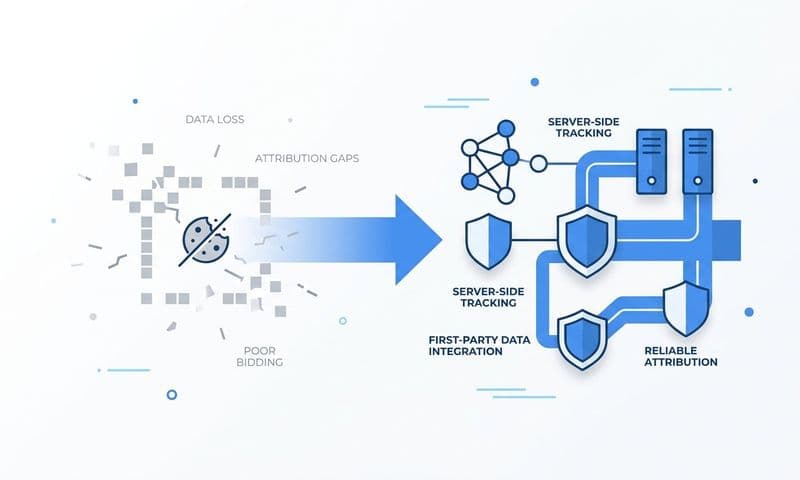
Server-side tracking is the most direct technical fix for the pixel limitations described above. Instead of relying on a browser-based JavaScript tag that can be blocked, intercepted, or lost due to privacy restrictions, server-side tracking sends conversion data directly from your server to Snapchat's API. This approach is called the Snapchat Conversions API, or CAPI, and it is Snapchat's recommended solution for improving signal quality in a privacy-first environment.
The practical difference is significant. When a user completes a form submission or trial signup on your website, your server captures that event and sends it to Snapchat directly, bypassing the browser entirely. Ad blockers cannot intercept a server-to-server call. iOS privacy restrictions do not apply. The conversion event reaches Snapchat regardless of what the user's browser settings look like, which means your reported conversion data becomes more complete and more accurate. This is precisely why server-side tracking is more accurate than pixel-only implementations.
Here is where it gets technically important: most teams run both the Snapchat Pixel and the Conversions API simultaneously, and that setup creates a deduplication challenge. If a browser-based pixel fires for a conversion and your server also sends that same conversion event via CAPI, Snapchat will count it twice unless you configure deduplication correctly. Misconfigured deduplication is one of the most common sources of inflated conversion counts in Snapchat Ads Manager.
Snapchat handles deduplication through event IDs. When you send a conversion event, you assign it a unique event ID. If both the pixel and the CAPI send the same event with the same event ID within a short window, Snapchat deduplicates them and counts only one conversion. This only works if your implementation consistently assigns the same event ID to the same conversion across both tracking methods. If your event IDs are inconsistent or missing, deduplication fails and your numbers inflate.
First-party data enrichment is the other lever that server-side tracking enables. When you pass hashed customer identifiers, such as email addresses or phone numbers, alongside conversion events, Snapchat can match those events to actual user profiles with much higher confidence. This improves what Snapchat calls your event match quality score, which directly affects how accurately conversions are attributed to specific campaigns, ad sets, and audiences.
Higher match quality means Snapchat's algorithm has better signal to work with. It can identify which users actually converted and use that information to optimize targeting toward similar users. Lower match quality means the algorithm is working with incomplete data, which leads to less efficient optimization and less reliable reporting. Passing hashed first-party data is not just a reporting improvement. It is a performance improvement.
The combination of CAPI implementation, correct deduplication, and first-party data enrichment brings Snapchat's tracking accuracy meaningfully closer to reality. It does not solve every problem, particularly the attribution model issues, but it ensures that the raw event data Snapchat receives is as complete and accurate as possible.
Cross-Channel Attribution: Seeing Snapchat's True Contribution
Even with perfect server-side tracking in place, Snapchat's native reporting still cannot tell you how Snapchat fits into your broader customer journey. That requires a cross-channel attribution platform that ingests data from every ad channel, your CRM, and your website, and then applies a consistent attribution model across all of them.
Snapchat ads rarely drive conversions in isolation, especially for B2B SaaS companies. A prospect might see a Snapchat video ad that introduces them to your product, later search your brand name on Google, click a paid search ad, and then convert through a Meta retargeting campaign three weeks later. In this scenario, Snapchat played a real role in the journey. It deserves credit. But it does not deserve 100% of the credit, which is what Snapchat's last-touch or view-through reporting would assign if the conversion fell within its attribution window.
A multi-touch attribution platform solves this by assigning fractional credit to each touchpoint based on its actual position and influence in the customer journey. Snapchat might receive 20% of the credit for that conversion, Google 40%, and Meta 40%. These numbers reflect a more honest picture of how the channels worked together, and that picture is what should drive your budget allocation decisions.
The comparison between Snapchat's self-reported ROAS and the attributed revenue from a neutral third-party platform is often eye-opening. Snapchat might report a 4x ROAS based on its own attribution logic. A multi-touch attribution platform, using the same revenue data from your CRM, might attribute a 1.5x return to Snapchat after accounting for the other channels that contributed to the same conversions. Both numbers are calculated from real data. The difference is in whose attribution rules are being applied.
This discrepancy does not mean Snapchat is a bad channel. It means you need the right lens to evaluate it. For some audiences and some products, Snapchat genuinely drives top-of-funnel awareness that leads to downstream conversions. For others, it may be claiming credit for conversions that were driven primarily by other channels. You cannot know which is true without cross-channel data.
For B2B SaaS marketing teams managing budgets across Google, Meta, LinkedIn, and Snapchat simultaneously, the ability to see each channel's true contribution is not a nice-to-have. It is the foundation of intelligent budget allocation. Without it, you are making scaling decisions based on whichever platform's self-reported metrics look most favorable, which is not a strategy. It is guesswork. Tools built for paid ads analytics across all channels are what close this gap.
Practical Steps to Improve Snapchat Ads Tracking Accuracy
Getting Snapchat tracking accuracy to a level you can trust requires working through a specific set of implementation and configuration steps. Here is a practical framework for doing that.
Audit your Snapchat Pixel implementation first. Before adding new tracking infrastructure, confirm that your existing pixel is working correctly. Check that all key conversion events, including form submissions, trial signups, demo requests, and purchases, are firing. Use Snapchat's Pixel Helper browser extension or the Events Manager in Ads Manager to verify that events are reaching Snapchat and that the event parameters are populated correctly. Look for duplicate events, which often appear when a pixel fires multiple times on the same page load due to tag manager configuration issues.
Implement the Snapchat Conversions API alongside your pixel. Set up server-side event transmission for your key conversion events. This requires either a direct API integration or a partner integration through a tag management platform or a tool like Cometly that handles server-side tracking natively. Once CAPI is live, configure event deduplication by ensuring every conversion event is assigned a consistent, unique event ID that is passed through both the pixel and the CAPI call. Test this setup carefully before relying on the data.
Pass first-party customer data with conversion events. Include hashed email addresses and phone numbers when sending conversion events to Snapchat. This improves your event match quality score and gives Snapchat's algorithm better signal to work with. Hash the data using SHA-256 before sending it, which is Snapchat's required format. This step alone can meaningfully improve ad tracking accuracy across your entire Snapchat account.
Standardize attribution window settings across platforms. If you are comparing Snapchat's reported conversions against Meta and Google, make sure you are comparing equivalent attribution windows. Snapchat defaults to 28-day click and 1-day view. If Meta is set to 7-day click and 1-day view, you are not making an apples-to-apples comparison. Standardize your windows or document the differences clearly so your reporting reflects consistent logic.
Reconcile Snapchat data against your CRM pipeline. Connect your Snapchat attribution data to your CRM so you can track which Snapchat-attributed leads actually moved through the pipeline and closed as revenue. This is the ultimate accuracy check. If Snapchat reports strong conversion volume but those leads are not appearing in your CRM or are not progressing to closed-won, that is a signal that Snapchat's attribution is overclaiming.
Turning Accurate Snapchat Data Into Smarter Ad Decisions
Fixing your tracking setup is not the end goal. The goal is to use accurate data to make better decisions about your Snapchat campaigns. When your tracking is reliable and reconciled against cross-channel data, a completely different set of insights becomes available.
You can identify which Snapchat ad creatives are actually driving pipeline, not just generating clicks or view-through conversions. A video ad that produces a high volume of view-through conversions in Ads Manager but zero pipeline opportunities in your CRM is performing very differently from a creative that generates fewer reported conversions but consistently produces qualified leads. Without accurate tracking, you cannot tell the difference. With it, you can reallocate creative budget toward what is actually working. This is the core principle behind using ad tracking tools to scale with accurate data.
Accurate data also changes how you feed Snapchat's own algorithm. When you send enriched, verified conversion events back to Snapchat via CAPI, the platform's machine learning has better signal to optimize against. Instead of optimizing toward low-quality conversion events that are partially fictional due to tracking gaps, the algorithm can target users who genuinely resemble your actual customers. This is a meaningful performance improvement that compounds over time as the algorithm accumulates better data.
Audience and placement decisions also become more defensible. When you can see that a specific Snapchat audience segment is contributing to pipeline at a measurable rate, scaling spend against that segment is a confident decision backed by real revenue data. When another segment shows strong Ads Manager metrics but no downstream pipeline contribution, pulling back becomes equally confident. This is what marketing analytics data actually looks like in practice.
The broader principle is that accurate attribution data removes the guesswork from scaling decisions. Marketers who are working with inflated or unreliable Snapchat data are essentially flying blind on budget decisions. Those who have reconciled their Snapchat data against CRM pipeline and cross-channel attribution have a genuine competitive advantage: they know what is working, they can scale it confidently, and they can stop spending on what is not.
Putting It All Together
Snapchat ads tracking accuracy is a solvable problem, but it does not have a single fix. It requires addressing the technical layer with server-side tracking and proper deduplication, the attribution layer by understanding how Snapchat's default models inflate reported performance, and the cross-channel layer by reconciling Snapchat data against your CRM and other ad platforms. Each layer on its own improves the picture. Together, they give you a reliable foundation for making real budget decisions.
Relying on Snapchat's native reporting alone will consistently mislead your budget decisions. Every ad platform is incentivized to show its best possible numbers, and Snapchat is no exception. View-through attribution, generous attribution windows, and the absence of cross-channel context all point in the same direction: Snapchat's self-reported metrics overstate its contribution to revenue. That does not mean Snapchat is not valuable. It means you need a neutral, accurate view to know when and how much it is valuable.
This is exactly what Cometly is built for. Cometly connects your Snapchat ad data, along with every other ad channel, your CRM, and your website, into a single source of truth for marketing attribution. It captures every touchpoint in the customer journey, from the first Snapchat impression to closed-won revenue, and applies consistent multi-touch attribution across all channels so you can see each platform's true contribution. Cometly also feeds enriched, conversion-ready event data back to Snapchat's algorithm, improving targeting and optimization with better signal.
If your Snapchat data and your CRM are telling different stories, it is time to get them aligned. Get your free demo and see how Cometly gives you the accurate, cross-channel attribution data you need to scale with confidence.