Picture this: it's Monday morning, and your marketing team is doing what they do every week. Someone is logged into Meta Ads, exporting last week's campaign data. Another person is pulling numbers from Google Ads. Someone else is digging through LinkedIn Campaign Manager, and yet another is exporting CRM pipeline data. By the time everyone's spreadsheet tabs are merged, formatted, and color-coded, it's Tuesday afternoon. The report you're presenting on Wednesday is already describing a world that no longer exists.
This is the reality for a significant number of B2B SaaS marketing teams. Spreadsheets have been the default reporting tool for decades, and for good reason. They're flexible, familiar, and free. But they were designed for financial modeling and static data sets, not for tracking multi-touch customer journeys across six ad platforms in real time.
For B2B SaaS companies specifically, the stakes are higher than in most industries. Pipeline velocity matters. Revenue attribution matters. Knowing whether that LinkedIn campaign influenced three closed-won deals last quarter matters enormously when you're deciding where to allocate next quarter's budget. Spreadsheet marketing reporting problems don't just waste time. They actively distort the decisions that determine your growth trajectory.
This article unpacks the real costs of manual reporting: the time drain, the accuracy failures, the attribution blind spots, the collaboration chaos, and what a purpose-built attribution platform actually solves that spreadsheets structurally cannot.
The Hidden Cost of Manual Marketing Reports
Let's start with time, because the hours add up faster than most teams realize.
A typical B2B SaaS marketing team running campaigns across Meta, Google, LinkedIn, and one or two additional channels needs to pull data from each platform separately. There is no universal export button. Each platform has its own interface, its own date range logic, its own column naming conventions, and its own quirks. Then that data needs to be cleaned, normalized, and merged into a format that makes cross-channel comparison possible.
Before any actual analysis begins, hours have already been spent just collecting and formatting. For many teams, this manual data collection process happens weekly or even more frequently when leadership wants mid-week updates. Multiply that across a full year, and a meaningful portion of your marketing team's capacity is consumed by data plumbing rather than strategic thinking.
The opportunity cost here is what makes this genuinely damaging. Every hour spent formatting a spreadsheet is an hour not spent reviewing which ad creatives are underperforming, not spent adjusting bids based on conversion trends, and not spent analyzing which channels are actually contributing to pipeline. The reporting process displaces the optimization process, and for fast-growing SaaS companies, that displacement has a direct impact on growth.
The compounding problem is scalability. When a company is running two or three campaigns across two channels, manual reporting is annoying but manageable. As the business grows and adds channels, the reporting burden does not grow at the same rate. It grows faster. Each new ad platform adds another export to pull, another format to reconcile, and another potential source of error. The marketing campaign tracking spreadsheet that worked for a lean team at Series A becomes an unsustainable liability at Series B and beyond.
There is also a subtler cost that rarely gets discussed: the cognitive load. When your team knows that every reporting cycle requires hours of manual work, they start making unconscious trade-offs. They pull fewer breakdowns. They report at a higher level of aggregation to save time. They skip the deep-dive analysis that would reveal which specific audience segment or ad format is actually driving qualified pipeline. The spreadsheet does not just cost time. It shapes what questions get asked and which ones get quietly dropped.
The result is a reporting culture built around what is easy to measure rather than what is important to measure. And for B2B SaaS companies trying to scale efficiently, that distinction is everything.
Data Accuracy Breaks Down Across Every Channel
Manual data collection is not just slow. It is structurally prone to errors that compound in ways that are difficult to detect and even harder to trace.
Think about what actually happens when you merge data from four or five different platforms into a single spreadsheet. Each platform uses different attribution windows by default. Meta might be reporting conversions on a seven-day click, one-day view basis. Google Ads might be using a thirty-day attribution window. LinkedIn has its own logic. When you pull these numbers and lay them side by side, you are not comparing apples to apples. You are comparing apples to something that is vaguely fruit-shaped but fundamentally different.
Then there is the human error layer. Copy-paste mistakes happen. Formulas break when new rows are added. Date ranges get misaligned. A column gets sorted without the adjacent columns being sorted alongside it. These are not hypothetical risks. They are the everyday reality of spreadsheet-based reporting, and they introduce inaccuracies that can persist for weeks before anyone notices.
The attribution problem is where accuracy failures become genuinely costly. Spreadsheets have no native mechanism for tracking a customer journey that spans multiple sessions, devices, and channels over a sixty-day sales cycle. So teams default to last-click attribution because it is the only model that is straightforward to implement in a row-and-column format. Last-click gives all the credit to the final touchpoint before conversion, which in B2B contexts is often a branded search or a direct visit.
What last-click attribution systematically hides is the role of every channel that built awareness, generated the initial interest, and kept the prospect engaged throughout the buying cycle. Your LinkedIn thought leadership campaigns, your top-of-funnel YouTube ads, your retargeting sequences: all of these contribute to the eventual conversion, but last-click attribution assigns them zero credit. Teams looking at last-click data routinely conclude that their awareness channels are not working, cut the budget, and then wonder why pipeline dried up six weeks later.
The staleness problem adds another layer. By the time a spreadsheet report is built, reviewed, and shared with leadership, the underlying campaign data has already moved. Bids have changed. Audiences have shifted. A creative that was performing well on Friday might be fatiguing by Monday. Decisions made based on last week's exported data are reactive by definition. You are always optimizing for a campaign environment that no longer exists, which means your adjustments are perpetually behind the curve.
For B2B SaaS teams managing significant ad budgets, this lag is not a minor inconvenience. It is a structural disadvantage that prevents the kind of agile, data-driven digital marketing reporting that separates efficient growth from wasteful spending.
Why Spreadsheets Cannot Handle Multi-Touch Attribution
This is worth stating plainly: spreadsheets cannot do multi-touch attribution. Not with workarounds, not with clever formulas, not with pivot tables. The structural limitations are fundamental, not cosmetic.
Multi-touch attribution requires connecting a specific ad click to a specific person, then following that person through form submissions, email sequences, sales calls, CRM pipeline stages, and eventually a closed-won deal. In B2B, that journey might span sixty, ninety, or even one hundred and eighty days. It involves multiple devices, multiple channels, and multiple decision-makers at the same company. The data needed to model this accurately lives across your ad platforms, your website analytics tool, your CRM, and your payment processor.
A spreadsheet is a grid. It stores rows and columns of static data. It has no concept of a user identity that persists across sessions. It cannot stitch together a LinkedIn ad impression from week one with a Google search click from week four and a demo request from week eight and attribute all three to the same buying journey. To do that, you need a system that tracks at the event level, connects those events to individual records, and maintains that linkage across the entire customer lifecycle.
The downstream impact of this structural limitation is significant. When teams cannot see multi-touch marketing attribution, they make budget allocation decisions based on incomplete data. Channels that drive early-stage awareness and mid-funnel engagement look like poor performers on last-click metrics, so they get underfunded. Channels that capture existing demand, like branded search, look like top performers, so they get over-invested. The budget flows toward the channels that are easiest to measure rather than the channels that are actually driving growth.
This misallocation is particularly damaging in B2B SaaS, where customer acquisition costs are high and the cost of a wrong budget decision compounds over an entire quarter. If you pull back on the LinkedIn campaigns that were generating qualified top-of-funnel interest, you will not see the pipeline impact for sixty to ninety days. By the time the damage is visible, you have already lost a full quarter of pipeline development.
Spreadsheet marketing reporting problems, in this context, are not just operational friction. They are a strategic liability that systematically distorts how marketing budgets get allocated and how channel performance gets evaluated. The teams that recognize this limitation and move to proper digital marketing attribution software gain a compounding advantage over time: they fund the channels that actually work, they defund the ones that only look good on last-click, and they build a clearer picture of what drives revenue with every passing quarter.
Collaboration and Version Control Create Reporting Chaos
Even if a single analyst could produce a perfectly accurate spreadsheet report, the moment that report enters a collaborative environment, new problems emerge.
Version control is the most visible issue. When multiple team members are working with the same data, you end up with copies. Someone downloads the master spreadsheet, makes changes, and saves it locally. Someone else updates the shared version. A third person sends leadership a version they exported last Thursday. Now there are three versions of the same report circulating, and nobody is entirely sure which one is current. When the numbers do not match in a leadership meeting, the conversation shifts from discussing marketing performance to debating which spreadsheet is correct.
This is not a hypothetical scenario. It is a pattern that plays out regularly in growing SaaS companies, and it has a real cost beyond the immediate confusion. When leadership receives conflicting numbers from different team members, their confidence in marketing data erodes. If the marketing team cannot agree on what the numbers are, how can leadership trust those numbers to make budget decisions? The credibility gap that opens up in these moments is difficult to close, and it often results in marketing teams needing to over-justify every spend request because the underlying data infrastructure is not trusted.
The audit trail problem compounds this. Spreadsheets generally do not log who changed what and when. If a formula was modified three weeks ago and that modification introduced an error into every report since, tracing it back is genuinely difficult. You are left with the forensic task of comparing old versions, checking formulas cell by cell, and trying to reconstruct a change history that was never recorded in the first place.
For B2B SaaS companies that need to make fast, confident decisions about where to allocate marketing budget, this kind of reporting chaos is a meaningful drag on organizational velocity. Leadership cannot act on data they do not trust. Marketing teams cannot advocate for budget they cannot clearly justify. And the cycle of manual reporting, version conflicts, and eroded credibility makes the entire marketing function look less rigorous than it actually is.
The single source of truth that modern marketing reporting platforms provide is not just a technical convenience. It is the foundation of organizational trust in marketing data.
What a Modern Attribution Platform Solves That Spreadsheets Cannot
The problems outlined above are not solved by better spreadsheet discipline or more rigorous export schedules. They are solved by replacing the spreadsheet with a system that was actually designed for the job.
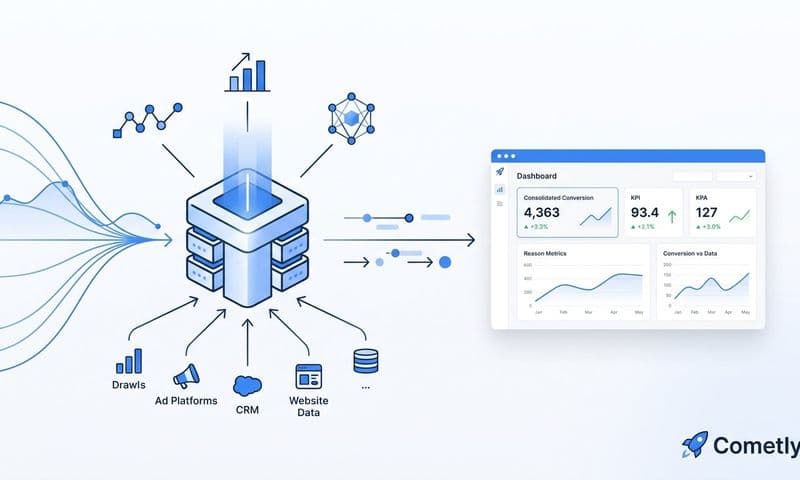
A dedicated attribution platform like Cometly connects directly to your ad platforms, CRM, and website through native integrations and server-side tracking. Instead of manually exporting data from Meta, Google, and LinkedIn each week, the data flows automatically and continuously into a single unified dashboard. There are no exports to pull, no formatting to do, and no reconciliation required. The data is always current because it is always being updated.
With 70+ native integrations, Cometly connects to the full stack that B2B SaaS marketing teams actually use. That means your ad spend data, your CRM pipeline data, and your revenue data from tools like Stripe all live in the same place, linked together at the event level. When a prospect clicks a LinkedIn ad, submits a demo request, moves through CRM pipeline stages, and eventually closes as a customer, every step of that journey is captured and attributed back to the original touchpoint. This is what real pipeline and revenue attribution looks like, and it is structurally impossible to replicate in a spreadsheet.
The server-side tracking component addresses a problem that is becoming increasingly critical. Browser-based tracking via pixels is less reliable than it used to be. Ad blockers, browser privacy settings, and iOS changes have all reduced the accuracy of pixel-based conversion tracking. Server-side tracking and Conversion API integrations, including Meta CAPI and Google Enhanced Conversions, capture conversion events at the server level, where ad blockers and browser restrictions cannot interfere. The result is more complete, more accurate conversion data that gives both your team and the ad platform algorithms a clearer picture of what is actually working.
The AI-driven insights layer changes how teams actually use their data. Instead of manually scanning rows of metrics and trying to identify patterns, marketers receive recommendations on which campaigns and channels are driving the strongest results. When you can see in real time that one audience segment is generating three times the pipeline value of another, you can act on that insight immediately rather than waiting for the next weekly report cycle. This shift from reactive reporting to proactive optimization is one of the most tangible benefits of moving off spreadsheets.
The result is not just better data. It is faster, more confident decision-making. Teams that know exactly which channels are driving revenue can scale those channels with confidence, defund the ones that are not contributing, and present leadership with numbers that are accurate, current, and trustworthy.
From Spreadsheet Chaos to a Single Source of Truth
Making the shift from manual reporting to a unified attribution platform is a practical process, and it starts with clarity about what you actually need to connect.
The first step is identifying your data sources. For most B2B SaaS marketing teams, this means your primary ad platforms (Meta, Google, LinkedIn, and any others you are running), your CRM, your website analytics, and your payment or revenue tracking tool. Each of these represents a data stream that, in a spreadsheet world, requires a separate export and a manual merge. In an attribution platform, each of these becomes a direct integration that feeds data automatically.
The second step is choosing an attribution model that reflects how your buyers actually behave. B2B buying cycles are non-linear. A prospect might discover you through a LinkedIn post, search for your brand two weeks later, attend a webinar, receive a nurture email, and then request a demo after seeing a retargeting ad. A linear or time-decay attribution model will give you a more accurate picture of how each touchpoint contributed to that outcome than last-click ever could. Cometly allows you to compare multiple attribution models side by side, so you can understand how different frameworks change your view of measuring marketing campaign effectiveness.
The first-party data advantage is worth emphasizing here. As browser-based tracking continues to degrade, teams that have invested in server-side tracking and Conversion API integrations will have a significant data quality advantage over those still relying on pixels. This is not a future concern. It is a present reality, and the gap between teams with accurate first-party conversion data and those without it will continue to widen.
The strategic outcome of this transition is a fundamental shift in how marketing operates. When data collection is automated, when attribution is accurate, and when every team member is working from the same real-time dashboard, the reporting conversation changes entirely. Instead of spending the first twenty minutes of a leadership meeting debating whose spreadsheet is correct, you spend that time discussing what the data means and what actions to take next. Marketing moves from a function that explains the past to one that actively shapes the future.
The Bottom Line on Spreadsheet Marketing Reporting
Spreadsheets were never designed for the complexity of modern B2B SaaS marketing attribution. They were built for static data sets, not dynamic multi-touch customer journeys. And the longer a team relies on them for marketing reporting, the more those structural limitations compound into real business costs.
The problems are interconnected. Manual data collection drains the time that should be spent on optimization. Multi-source merging introduces accuracy errors that distort channel performance. Last-click defaults hide the true value of awareness and mid-funnel channels. Version conflicts erode leadership trust in marketing data. And none of these problems are solved by better spreadsheet hygiene. They are solved by using a tool that was actually built for the job.
When marketing data is automated, accurate, and unified in a single platform, something shifts. Teams stop reporting on what happened last week and start optimizing what is happening right now. Budget allocation decisions are made on complete attribution data rather than last-click guesses. Leadership sees numbers they can trust, and marketing earns the credibility that comes with being genuinely data-driven.
That is what becomes possible when you move beyond spreadsheet marketing reporting problems and into a purpose-built attribution platform. If you are ready to make that shift, Get your free demo and see how Cometly connects your ad spend directly to pipeline and revenue, giving your team the single source of truth it needs to grow with confidence.