Running ads on Meta, Google, TikTok, and LinkedIn simultaneously is standard practice for most marketing teams today. But when each platform reports its own version of success, with overlapping conversions, inflated numbers, and inconsistent attribution windows, figuring out what is actually driving revenue becomes a real challenge.
Many marketers end up making budget decisions based on incomplete or conflicting data. One platform claims credit for a conversion. Another platform claims the same conversion. Meanwhile, your CRM shows a completely different number. The result is wasted spend and missed opportunities to scale what is actually working.
The core problem is not that you are running too many platforms. It is that you lack a unified system to track ad performance across networks with consistency and accuracy. Each ad network is built to make itself look good in its own reporting, which means you need an independent layer of measurement that sits above all of them.
This guide walks you through a clear, repeatable process to build exactly that. You will learn how to audit your current tracking setup, implement server-side data collection, connect all your platforms into one dashboard, choose the right attribution model, standardize your KPIs, feed accurate data back to ad platforms, and use AI-powered insights to optimize and scale. Whether you manage ads for your own brand or for clients, these steps will take you from fragmented reporting to a single source of truth for all your paid media performance.
Let's get into it.
Step 1: Audit Your Current Tracking Setup and Identify Gaps
Before you can fix anything, you need a clear picture of where your tracking stands right now. Most teams are surprised by how many gaps they find when they actually sit down and document this systematically.
Start by listing every ad platform you are currently running campaigns on. This typically includes Meta Ads, Google Ads, TikTok Ads, LinkedIn Ads, and possibly others like Pinterest, Snapchat, or programmatic networks. For each platform, document what tracking is currently in place: which pixel or tag is installed, which conversion events are being tracked, and when each was last verified as functioning correctly.
Next, check for the most common tracking gaps that quietly erode data quality:
Missing UTM parameters: If your ad URLs do not consistently include UTM parameters, your website analytics cannot properly attribute traffic to its source. This is one of the most common and easily fixable issues. Following UTM parameter tracking best practices can resolve this quickly.
Broken or outdated pixels: Platform pixels get broken by website updates, theme changes, or developer deployments. Use each platform's diagnostic tools to confirm your pixels are firing correctly on the right pages.
Client-side tracking failures: iOS privacy changes, browser-level cookie restrictions, and ad blockers prevent a significant portion of conversion events from ever reaching platform pixels. If your tracking relies entirely on browser-side tags, you are likely missing a meaningful share of your actual conversions.
Attribution window mismatches: Different platforms use different default attribution windows. Meta might be reporting on a 7-day click and 1-day view window while Google uses a 30-day click window. These differences inflate total reported conversions across platforms because the same customer journey gets counted multiple times.
Once you have documented the technical setup, compare each platform's reported conversions against your CRM or backend sales data for the same time period. If Meta reports 80 purchases but your Shopify store or CRM shows 50 completed orders, you have a 37% discrepancy that is costing you in poor budget decisions. Understanding why your conversion tracking numbers are wrong is essential to diagnosing these issues.
Also document which conversion events you are tracking across each platform: clicks, leads, MQLs, purchases, and revenue. Identify any events that exist in your CRM but are not being passed back to certain platforms.
Success indicator: You have a documented map of every ad platform, its current tracking status, the conversion events being captured, and the specific gaps that need to be resolved before moving forward.
Step 2: Implement Server-Side Tracking for Reliable Data Collection
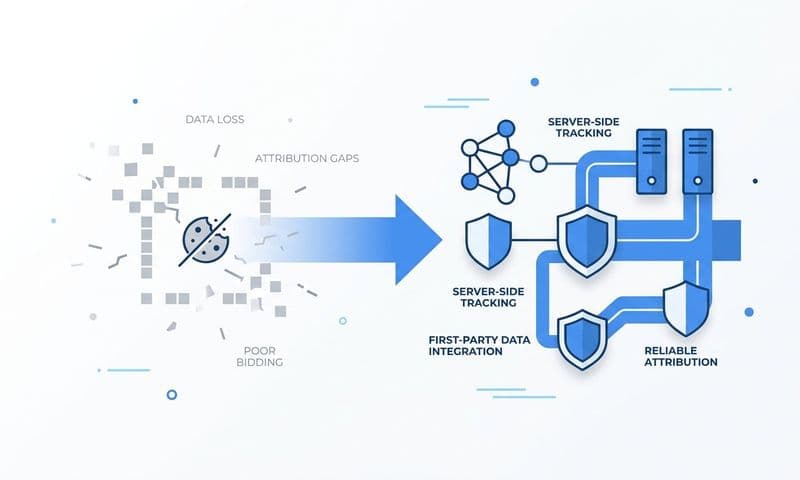
Here is the reality of client-side pixel tracking in 2026: it is no longer sufficient on its own. The combination of Apple's App Tracking Transparency framework, which has been continually expanded since its introduction with iOS 14.5, browser-level cookie restrictions from Safari and Firefox, and the prevalence of ad blockers means that a significant portion of conversion events never reach your platform pixels at all.
When pixels fire from the user's browser, they are subject to every privacy control and blocker that sits between the user's device and the platform's servers. Understanding the differences between server-side tracking vs pixel tracking is critical to building a reliable measurement foundation.
Here is how to approach the implementation:
Identify your conversion events: Start with the events that matter most to your business, typically purchases, lead form submissions, phone calls, and any downstream CRM events like qualified leads or closed deals. These are the events you need to capture reliably regardless of what is happening in the user's browser.
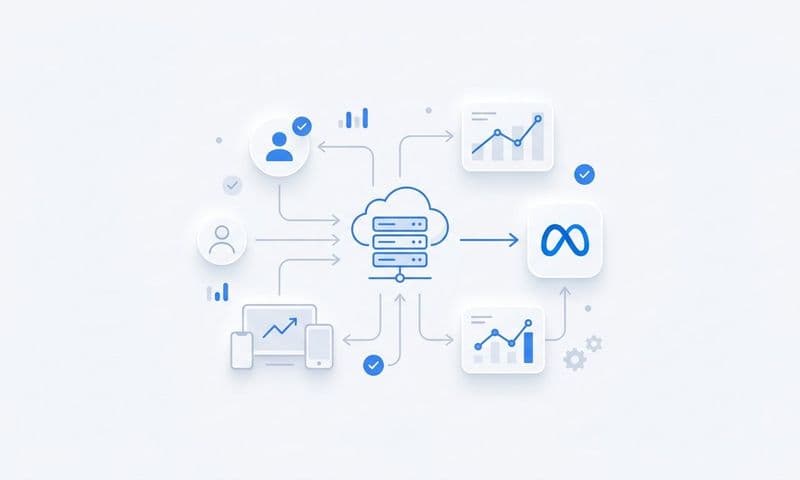
Set up server-to-server event transmission: Rather than relying solely on a browser pixel, your server sends a duplicate or primary conversion event directly to the platform's API (Meta Conversions API, Google Ads Enhanced Conversions, TikTok Events API, etc.) whenever a qualifying action occurs. This ensures the event is captured even if the browser pixel was blocked.
Use first-party data for matching: Server-side events are most powerful when they include first-party identifiers like hashed email addresses, phone numbers, or customer IDs. These help platforms match the server event to an actual user in their system, improving attribution accuracy and the quality of data fed to their algorithms.
Cometly's server-side tracking connects directly to your website and CRM to capture every conversion touchpoint without depending solely on browser cookies or pixels. This means your conversion data remains accurate regardless of a user's privacy settings or browser behavior, giving you a complete picture of what is actually happening in your funnel.
A common pitfall at this stage is implementing server-side tracking for one platform but not others, which creates inconsistency in your cross-network data. Aim to implement server-side event transmission for every major platform you run, so your data quality is uniform across the board. Learn more about the server-side tracking benefits for advertisers to understand the full impact.
Success indicator: Your server-side events are firing correctly and your platform-reported conversions are moving closer to alignment with your CRM data. The gap you identified in Step 1 should begin to narrow.
Step 3: Connect All Ad Platforms and Data Sources Into One Dashboard
With your tracking infrastructure in place, the next step is centralizing everything. Right now, your performance data probably lives in five different browser tabs: Meta Ads Manager, Google Ads, TikTok Ads Manager, LinkedIn Campaign Manager, and maybe a separate analytics tool. Pulling insights from all of these simultaneously is slow, error-prone, and virtually impossible to do consistently.
You need a single hub where data from every ad network, your website, and your CRM flows into one unified view.
Start by integrating each ad platform with your attribution tool. This typically involves connecting via API, which pulls in campaign data including spend, impressions, clicks, and platform-reported conversions. Most modern attribution platforms support native integrations with the major networks, so this process is usually a matter of authenticating your accounts rather than complex technical work.
The integrations you want to prioritize:
Ad platforms: Meta Ads, Google Ads, TikTok Ads, LinkedIn Ads, and any other networks where you are actively spending. Each connection should pull in campaign-level, ad set-level, and ad-level data so you can analyze performance at every granularity.
CRM integration: This is the step most teams skip, and it is the one that matters most for B2B marketers and anyone with a longer sales cycle. Connecting HubSpot, Salesforce, or your CRM of choice allows you to tie ad clicks to actual pipeline stages and closed revenue, not just lead form submissions. This is where you start to see which campaigns are generating leads versus which are generating customers.
Website analytics: Connect your website data so you can track the customer journey across platforms from ad click through website behavior to conversion. This adds context to your campaign data and helps you understand post-click engagement, not just whether someone clicked an ad.
Cometly connects ad platforms, CRM data, and website analytics in real time, giving marketers one place to analyze performance across every network. Instead of manually exporting data from each platform and stitching it together in a spreadsheet, all your campaign data flows into a single dashboard automatically.
The practical benefit here goes beyond convenience. When your data is centralized, you can make comparisons that are simply impossible when you are toggling between platforms. You can see, in one view, that your Google Search campaigns are driving more revenue per dollar than your LinkedIn campaigns, or that a Meta prospecting campaign that looks expensive in isolation is actually contributing to a high volume of conversions that close through other channels.
Success indicator: All your ad networks, CRM data, and website analytics appear in a single dashboard with consistent metrics. You no longer need to manually merge data from multiple sources to get a complete picture of performance.
Step 4: Choose and Apply the Right Multi-Touch Attribution Model
Now that your data is centralized, you need to decide how credit gets distributed across the touchpoints in a customer journey. This is where attribution modeling comes in, and it is one of the most consequential decisions you will make in your cross-network tracking setup.
Here is a quick overview of the main models:
First-touch attribution: Gives 100% of credit to the first ad or channel a customer interacted with. Useful for understanding which channels are best at generating awareness and bringing new prospects into your funnel.
Last-touch attribution: Gives 100% of credit to the last touchpoint before conversion. This is the default for most ad platforms, and it systematically overstates the value of bottom-funnel channels like branded search while understating the contribution of awareness campaigns on Meta or TikTok.
Linear attribution: Distributes credit equally across all touchpoints in the journey. More balanced than first or last touch, but it treats every interaction as equally valuable regardless of its role in the journey.
Time-decay attribution: Gives more credit to touchpoints that occurred closer to the conversion. This model tends to favor retargeting and bottom-funnel channels, which can be appropriate for shorter sales cycles.
Position-based (U-shaped) attribution: Gives the most credit to the first and last touchpoints, with the remaining credit distributed across middle interactions. This model acknowledges both the awareness-driving and conversion-driving roles of different channels.
The model you choose should reflect your sales cycle and marketing mix. If you are running a direct-to-consumer brand with a short purchase cycle, a time-decay or last-touch model may be reasonable. If you are a B2B company where prospects interact with multiple campaigns over weeks or months before converting, tracking conversions across multiple touchpoints with a linear or position-based model will give you a much more accurate picture of what is working.
The most dangerous pitfall here is sticking with default platform attribution and making budget decisions based on those numbers. When every platform defaults to last-click, your top-of-funnel Meta or TikTok campaigns will consistently look unprofitable, even when they are actually driving the awareness that leads to conversions later in the journey. Many teams have cut awareness campaigns based on last-click data, only to see their overall conversion volume drop.
Cometly lets you compare attribution models side by side, so you can see exactly how credit shifts between networks under different models. This makes it straightforward to understand the true contribution of each channel and make budget decisions based on the full picture rather than a single platform's self-reported numbers.
Success indicator: You have selected a primary attribution model appropriate for your sales cycle and can see how credit is distributed across your networks. You understand how the numbers change under different models and can use that context to inform your budget decisions.
Step 5: Standardize Your KPIs and Build Cross-Network Reports
One of the most common frustrations in cross-network reporting is that you cannot directly compare raw metrics from different platforms. Meta defines a conversion differently than Google. TikTok's engagement metrics are not comparable to LinkedIn's. Attribution windows vary. Even the definition of a "click" differs between platforms.
To track ad performance across networks with any accuracy, you need to define a consistent set of KPIs and build a reporting framework that normalizes data before you compare it.
The KPIs that translate most cleanly across networks are:
Cost per acquisition (CPA): The total spend required to generate one conversion, using your own attribution data rather than each platform's self-reported conversions. This is your most reliable cross-network comparison metric.
Return on ad spend (ROAS): Revenue attributed to a channel divided by the spend on that channel. When calculated using unified attribution data rather than platform-reported revenue, this gives you a true read on which networks are delivering the best returns. Accurately tracking marketing ROI across platforms is what separates data-driven teams from those guessing at budget allocation.
Cost per lead (CPL): For lead generation campaigns, the cost to acquire one lead. Standardize your lead definition across platforms so you are comparing the same quality of lead regardless of where it came from.
For a plain-English breakdown, read our explainer on what is cost per lead form completion.
Customer acquisition cost (CAC): The total cost to acquire a paying customer, factoring in all touchpoints across the journey. This is especially important for B2B teams where the path from lead to customer involves multiple platforms and interactions.
Revenue per channel: The actual revenue attributed to each network based on your multi-touch attribution model. This is the metric that ultimately tells you where to invest more and where to pull back. A dedicated approach to revenue tracking across marketing channels ensures these numbers are trustworthy.
Once you have defined these KPIs, build a reporting cadence that keeps your team aligned. A weekly performance review using cross-network data helps you catch issues early and make timely optimizations. A monthly deeper analysis allows you to evaluate trend lines, compare attribution model outputs, and make larger budget allocation decisions.
Cometly's analytics dashboard creates unified reports that show true ROAS and revenue attribution across all channels in one view, eliminating the need for manual data stitching. Instead of spending hours each week pulling numbers from individual platform dashboards and reconciling them in a spreadsheet, your cross-network report is ready whenever you need it.
Success indicator: You have a single weekly or monthly report that shows accurate, comparable performance data for every ad network you run, using consistent KPI definitions and unified attribution data.
Step 6: Feed Accurate Conversion Data Back to Ad Platforms
Here is a step that many marketers overlook even after they have done everything else right: sending your accurate conversion data back to the ad platforms so their algorithms can learn from it.
This matters because platforms like Meta and Google do not optimize based on what you know. They optimize based on what you tell them. Meta's Advantage+ and Google's Smart Bidding are machine learning systems that adjust ad delivery, targeting, and bidding in real time, but they can only do this well if they receive accurate, complete conversion signals.
When your pixel data is incomplete due to browser blocking or privacy restrictions, the algorithm is training on a partial and potentially distorted view of your actual customers. It may be optimizing toward users who are more likely to fire a pixel rather than users who are more likely to actually buy. This leads to degraded campaign performance over time, even when your creative and targeting strategy is sound. Understanding why your ad tracking is inaccurate helps explain how these data gaps compound over time.
The solution is to close the feedback loop by syncing your verified, server-side conversion events back to each platform's API. This means the algorithm receives conversion data that reflects real purchases and real revenue, not just the subset of events that happened to get through browser-level tracking.
The process involves:
Deduplication: When you send both browser pixel events and server-side events, you need to deduplicate them so the platform does not count the same conversion twice. Most platforms handle this through event ID matching, so ensure your implementation includes consistent event IDs across both sources.
Including value data: Where possible, pass the actual revenue value of each conversion back to the platform. This allows value-based bidding strategies to optimize toward higher-value customers rather than just any conversion.
Sending downstream CRM events: If you can pass qualified lead or closed deal events back to Meta and Google, their algorithms can optimize toward users who resemble your actual customers rather than just anyone who fills out a form.
Cometly's Conversion Sync feature sends enriched conversion events back to Meta, Google, and other platforms automatically, improving their targeting and bidding algorithms with better data. The compounding benefit of this is significant: better data fed to platforms leads to better ad delivery, which generates better results, which creates even better data for the algorithm to learn from. It is a virtuous cycle that starts with accurate measurement.
Success indicator: Your verified conversion events are flowing back to each ad platform via API, your event match quality scores are improving, and your platform algorithms are receiving accurate revenue signals to optimize against.
Step 7: Analyze, Optimize, and Scale With AI-Powered Insights
You now have a complete cross-network tracking system in place. The final step is using it to make smarter decisions, faster.
Start by using your unified data to identify which campaigns, ad sets, and creatives are genuinely driving revenue versus which ones are getting false credit from platform-level reporting. You will often find that some campaigns that looked strong in platform dashboards perform much more modestly under accurate multi-touch attribution, while others that appeared weak actually play a critical role in the customer journey.
Use these insights to reallocate budget based on real performance. Shift spend away from channels and campaigns that are not contributing to revenue under your attribution model, and increase investment in those that are demonstrably driving results. This kind of data-driven budget reallocation is where accurate tracking paid ads performance creates the most direct financial impact.
Cometly's AI recommendations help you identify high-performing ads and campaigns across every channel, surfacing insights that would take hours to find manually. Instead of combing through data to find patterns, the AI highlights which campaigns to scale, which to pause, and where your budget will have the highest impact.
Set up ongoing monitoring to keep your system healthy over time. Schedule regular cross-network performance reviews, at minimum weekly for active campaigns and monthly for strategic analysis. As your marketing mix evolves, revisit your attribution model to ensure it still reflects how your customers actually make decisions. A model that worked well when you were running two channels may need adjustment when you add a third or fourth.
The goal is to move from reactive optimization, where you respond to problems after they have already cost you, to proactive optimization, where your data tells you what to do before you waste budget on underperformers.
Success indicator: You are making budget decisions based on unified, accurate attribution data and can confidently scale spend on channels that are proven to drive real revenue. Your team spends less time debating which platform's numbers to trust and more time acting on clear insights.
Putting It All Together
Tracking ad performance across networks does not have to mean juggling conflicting dashboards and guessing which platform deserves credit. The system you have built through these seven steps gives you something most marketing teams do not have: a single, reliable view of what is actually working across your entire paid media operation.
Before you move forward, run through this quick checklist:
1. Audit all platforms and document tracking gaps.
2. Implement server-side tracking to capture complete conversion data.
3. Connect all ad networks, your CRM, and website analytics into one dashboard.
4. Choose and compare multi-touch attribution models appropriate for your sales cycle.
5. Standardize KPIs for true cross-network comparison.
6. Sync verified conversions back to ad platforms to improve their algorithms.
7. Use AI-powered insights to reallocate budget and scale your top performers.
Each step builds on the last. Accurate tracking leads to better attribution. Better attribution leads to smarter budget decisions. Smarter budget decisions lead to better results, which generates better data for your platforms to optimize against. The whole system compounds over time.
Cometly brings all of these steps together in one platform. It captures every touchpoint from ad click to closed deal, shows you what is truly driving revenue, syncs accurate conversion data back to your ad platforms, and uses AI to surface the insights you need to optimize with confidence.
Ready to stop guessing and start scaling based on data you can actually trust? Get your free demo today and start building the cross-network tracking system your campaigns deserve.