TikTok has become one of the most powerful advertising platforms available to marketers today, but it comes with a frustrating blind spot. You can see impressions, clicks, and in-platform conversions inside TikTok Ads Manager, yet the picture it paints is often incomplete. Between iOS privacy restrictions, cookie limitations, cross-device behavior, and sales cycles that stretch across days or weeks, the gap between what TikTok reports and what your CRM actually records can be significant.
Here is the core problem: TikTok can tell you that someone clicked your ad. It struggles to tell you that same person became a lead, entered your pipeline, and closed a $10,000 deal three weeks later. That connection requires infrastructure that goes well beyond dropping a pixel on your landing page.
This guide walks you through exactly how to track TikTok ads all the way to revenue, step by step. Whether you are running lead generation campaigns, driving e-commerce purchases, or promoting a SaaS product, you will learn how to build a tracking system that creates a clear line of sight from ad click to closed deal. The goal is not just to know which TikTok campaigns get clicks, but which ones actually put money in the bank.
By the time you finish this guide, you will have a complete framework covering pixel setup, server-side tracking, CRM integration, multi-touch attribution, conversion sync, and revenue-focused reporting. Each step builds on the previous one, so work through them in order for the best results.
Step 1: Install the TikTok Pixel and Set Up Events Properly
The TikTok pixel is your starting point for tracking ad performance, but it needs to be configured correctly from the beginning. A poorly set up pixel creates data gaps that compound as you add more tracking layers later.
To install the pixel, log into TikTok Ads Manager and navigate to Assets, then Events. From there, create a new Web Event and choose your installation method. TikTok offers two primary options: standard mode, which uses a code snippet you paste into your site's header, and developer mode, which gives you more control over when and how events fire. For most marketers using platforms like Shopify, WordPress, or a tag manager like Google Tag Manager, standard mode is the fastest path to getting started.
Once the pixel is installed, the next decision is which conversion events to track. TikTok supports a range of standard events, including ViewContent, AddToCart, InitiateCheckout, CompletePayment, and SubmitForm. Choose events that align with the actual actions that matter to your business. For e-commerce, CompletePayment is your primary conversion event. For lead generation, SubmitForm is the key signal. For SaaS, you might track both a free trial signup and a subscription purchase as separate events. For a deeper dive into pixel configuration and event accuracy, check out this guide on TikTok ads attribution setup.
Here is where many marketers make a critical mistake: they track events without passing custom parameters. For revenue tracking to work downstream, you need to pass the value and currency parameters alongside your conversion events. Without these, TikTok and your attribution platform have no way to associate a dollar amount with a specific conversion. Make sure your CompletePayment or purchase events include the actual transaction value, not a static placeholder number.
After installation, use TikTok's Pixel Helper browser extension to verify that your events are firing correctly. Visit each key page on your site, complete test actions, and confirm that the right events trigger with the right parameters. A pixel that fires on the wrong page, or fires twice, will corrupt your data from day one.
Keep in mind that pixel-only tracking is a starting point, not a complete solution. Browser-based pixels are vulnerable to ad blockers, browser privacy settings, and iOS restrictions. The next step addresses how to close those gaps.
Step 2: Implement Server-Side Tracking to Close Data Gaps
If you are relying exclusively on the TikTok pixel, you are missing a meaningful portion of your conversions. Browser-based tracking has become increasingly unreliable because of ad blockers, Apple's App Tracking Transparency framework, and browsers that restrict or delete cookies. The result is that some of your real conversions never get reported back to TikTok, and your attribution data becomes incomplete before it even reaches your dashboard.
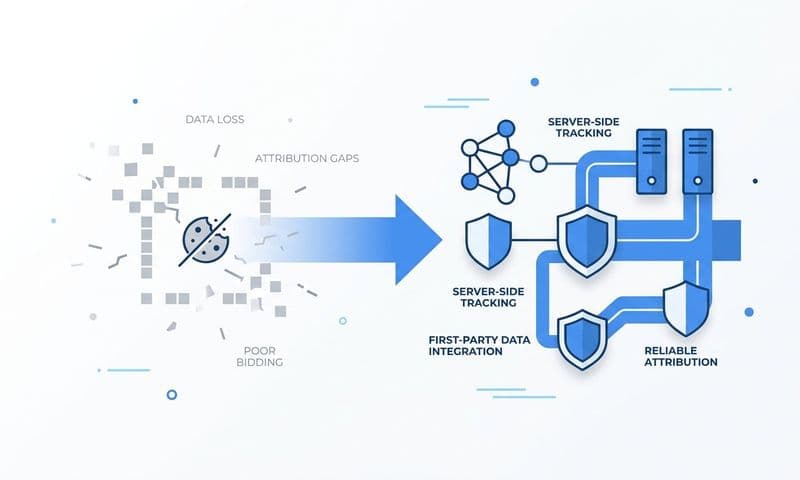
Server-side tracking solves this by sending conversion data directly from your server to TikTok's Events API, bypassing the browser entirely. Instead of relying on a pixel firing in a user's browser, your server sends the conversion event after it occurs, using data you already have, such as email addresses, phone numbers, and the TikTok click ID (ttclid). This means ad blockers and iOS privacy settings cannot interfere with the data reaching TikTok.
TikTok's Events API allows you to send the same events you would track with the pixel, but with higher reliability and better match rates. The key to making server-side tracking work is capturing the ttclid parameter from the landing page URL the moment a user clicks your TikTok ad. This click ID is what TikTok uses to match a server-side conversion back to the original ad, ad group, and campaign. If you do not capture and store the ttclid, you lose attribution accuracy even with server-side tracking in place.
Setting up a direct Events API integration requires technical development work. For most marketing teams, using a platform like Cometly is a far more practical approach. Cometly handles server-side tracking infrastructure for you, capturing conversion data that pixels miss and sending enriched events back to TikTok with proper attribution identifiers. You get the accuracy benefits of server-side tracking without needing to build and maintain a custom API integration.
The success indicator for this step is straightforward: after implementing server-side tracking, you should see your reported conversion numbers increase compared to pixel-only tracking. Higher event match rates mean TikTok's algorithm has better data to work with, and your attribution platform has a more complete picture of what is actually happening in your funnel. Learn more about how iOS changes have impacted ad measurement in this article on tracking paid ads after the iOS update.
Run both the pixel and the Events API in parallel rather than choosing one over the other. TikTok uses deduplication logic to prevent double-counting when the same conversion is reported through both channels. The combination gives you the broadest possible coverage.
Step 3: Connect Your CRM and Revenue Data to Your Attribution Platform
Pixel events and server-side tracking tell you that conversions happened. But for many businesses, especially those with longer sales cycles, a form submission or a free trial signup is not revenue. It is the beginning of a journey that might end in a closed deal weeks later, or it might not convert at all. This is where CRM integration becomes the critical link in your tracking chain.
The goal of this step is to connect your CRM data, where actual revenue lives, back to the TikTok ad that started the journey. When a lead closes and becomes a paying customer, you want to be able to trace that revenue back to the specific TikTok campaign, ad group, and creative that originally drove the click. This process of tracking leads to revenue is what separates basic ad tracking from true performance measurement.
Start by ensuring that UTM parameters are appended to every TikTok ad URL. At minimum, include utm_source, utm_medium, utm_campaign, and utm_content. TikTok also supports dynamic parameters, so you can automatically populate ad group names and creative IDs in your UTMs. When a user clicks your ad and lands on your site, these parameters should be captured and stored, either in a hidden form field or in your CRM contact record, the moment they submit a form or begin a checkout. For a comprehensive overview of how UTMs work, read this guide on UTM tracking and how it helps your marketing.
The ttclid should be captured alongside UTM parameters. Many marketers set up UTMs but forget to capture the click ID, which means they lose TikTok-specific attribution even when UTM data survives. Use a hidden form field or a JavaScript snippet on your landing page to grab the ttclid from the URL and pass it through your form submission.
Once your leads are in your CRM, platforms like HubSpot, Salesforce, or Pipedrive should store the UTM source data and click ID at the contact level. When that contact closes as a customer, the revenue event can be passed back to your attribution platform with the original ad identifiers attached. Tools like Cometly make this connection by integrating directly with your CRM and payment platforms like Stripe, pulling closed-won revenue data and matching it to the TikTok touchpoints that influenced the deal.
The common pitfall to avoid here is a broken UTM chain. This happens when a redirect strips UTM parameters, when a form does not include hidden fields for UTM capture, or when your CRM is not configured to store the source data on contact creation. Audit your entire funnel from ad click to form submission to CRM record to make sure the tracking thread stays intact at every stage.
Step 4: Configure Multi-Touch Attribution for the Full Customer Journey
Here is a pattern that plays out constantly with TikTok advertising: a user sees your TikTok ad, gets curious, and scrolls past. A few days later, they Google your brand name, click a search ad, and convert. Under last-click attribution, Google gets 100% of the credit. TikTok gets nothing, even though it was the channel that introduced the customer to your brand in the first place.
This is why last-click attribution consistently undervalues TikTok. The platform excels at top-of-funnel discovery, but users who discover you on TikTok often convert through a different channel later. If your attribution model only rewards the final click, you will systematically underfund TikTok and overfund channels that capture demand TikTok created. Understanding TikTok ads attribution tracking is essential to solving this problem.
Multi-touch attribution solves this by distributing credit across all the touchpoints in a customer's journey. The right model depends on your business and sales cycle. Here is a practical breakdown of the main options:
First-touch attribution: Gives 100% credit to the first interaction. Useful for understanding which channels drive initial awareness, but ignores the role of nurturing touchpoints.
Last-touch attribution: Gives 100% credit to the final interaction before conversion. Easy to implement but heavily biases toward bottom-of-funnel channels.
Linear attribution: Distributes credit equally across all touchpoints. A balanced starting point for businesses with multi-step journeys.
Time-decay attribution: Gives more credit to touchpoints closer to the conversion. Works well for shorter sales cycles where recent interactions are most influential.
Data-driven attribution: Uses algorithmic modeling to assign credit based on which touchpoints actually correlate with conversion. Requires sufficient conversion volume to be reliable.
For most businesses running TikTok ads alongside Meta and Google, a linear or time-decay model gives a more accurate picture of TikTok's contribution than last-click alone. Cometly's multi-touch attribution lets you view revenue attributed to specific TikTok ad groups and creatives across different attribution models, so you can see how TikTok performs in context of your full marketing mix rather than in isolation. If you need to track performance across platforms, explore how revenue tracking across marketing channels works in practice.
The success indicator for this step is granularity. You should be able to see revenue attributed not just to TikTok as a platform, but to specific campaigns, ad groups, and individual creatives. That level of detail is what makes budget decisions defensible.
Step 5: Sync Conversion Data Back to TikTok for Smarter Optimization
Most marketers think of tracking as a one-way street: data flows from your ads into your analytics. But there is a second direction that dramatically improves campaign performance, and most advertisers underutilize it. Sending accurate, enriched conversion data back to TikTok allows its algorithm to optimize for the outcomes that actually matter to your business.
TikTok's ad delivery algorithm learns from the conversion signals you send it. If you only send top-of-funnel events like SubmitForm or ViewContent, TikTok optimizes for users who are likely to fill out forms. That sounds reasonable until you realize that form fills and revenue are not the same thing. If a significant portion of your leads never convert to paying customers, you are training TikTok's algorithm on a low-quality signal, and it will keep finding you more of the same. This is one of the most common reasons ads show conversions but no sales.
The better approach is to send downstream revenue events back to TikTok through the Events API. When a lead closes as a customer and generates revenue, that event, with the associated revenue value, should be sent back to TikTok tied to the original ttclid. This is what value-based optimization relies on. Instead of optimizing for conversion volume, TikTok can optimize for revenue per user, targeting people who are most likely to generate actual business value.
Setting up conversion sync through a platform like Cometly automates this process. As revenue events occur in your CRM or payment platform, Cometly sends enriched, server-side conversion data back to TikTok with the proper attribution identifiers. You do not have to manually export data or build a custom pipeline. The loop closes automatically.
The practical difference between optimizing for form submissions and optimizing for revenue can be significant. When TikTok's algorithm has access to real revenue signals, it can identify patterns in the audiences that actually convert to paying customers and prioritize showing your ads to similar users. This shifts your campaigns from volume-focused to value-focused, which tends to improve return on ad spend over time. For a broader look at how to track sales back to ads, see how other marketers are closing this loop.
Avoid the common pitfall of only syncing the events that are easiest to track. If your most valuable conversions happen offline or in your CRM after a sales process, those are the events TikTok most needs to learn from. Sending only top-of-funnel data and expecting bottom-of-funnel results is one of the most common optimization mistakes in paid advertising.
Step 6: Analyze TikTok Ad Performance by Actual Revenue Generated
Once your tracking infrastructure is in place, the final step is building a reporting view that reflects reality rather than platform-reported vanity metrics. TikTok Ads Manager will show you its own version of your conversion data, but it operates within its own attribution windows and counting methods. Your attribution platform gives you an independent, cross-channel view that is grounded in actual revenue from your CRM and payment systems.
The primary metrics to focus on in your revenue-focused dashboard are return on ad spend (ROAS), cost per acquisition, and revenue per creative. These metrics tell you whether your TikTok investment is generating real business value. Clicks, impressions, and even in-platform conversion counts are secondary to these numbers. Understanding TikTok ads tracking accuracy helps you interpret where platform-reported numbers diverge from reality.
Start by comparing TikTok's self-reported data against what your attribution platform records. Discrepancies are normal and expected, especially for view-through conversions and cross-device journeys. Understanding where the numbers diverge helps you make better decisions about which data source to trust for which decisions. For budget allocation and creative performance, your attribution platform's revenue data is the source of truth.
Use Cometly's AI-powered recommendations to identify which TikTok campaigns, ad groups, and creatives are driving the most revenue. AI analysis can surface patterns that are difficult to spot manually, such as a specific creative that generates lower click volume but significantly higher average order value, or a campaign that looks strong on cost-per-click but produces leads that rarely convert to revenue.
Pay particular attention to campaigns that perform well on TikTok's native metrics but underperform on revenue. High click-through rates and low cost-per-click can mask poor downstream conversion quality. On the other hand, some campaigns with higher cost-per-click may generate customers with much higher lifetime value. Revenue-focused reporting reveals these distinctions clearly, and using dedicated revenue attribution tracking tools makes this analysis far more efficient.
When it comes to budget decisions, use your revenue data as the primary input. Scale campaigns and creatives where the ROAS and cost per acquisition meet your targets. Cut or pause campaigns where clicks are cheap but revenue per conversion is low. This discipline, applied consistently, is what separates marketers who grow their TikTok investment confidently from those who are always guessing whether it is working.
Your Quick-Reference Checklist: TikTok Click to Revenue Tracked
Here is a summary of the six steps covered in this guide, formatted as a checklist you can reference as you build and audit your tracking setup:
1. Install the TikTok pixel with the correct conversion events and custom parameters, including value and currency. Verify with TikTok's Pixel Helper.
2. Implement server-side tracking using TikTok's Events API or a platform like Cometly to capture conversions that pixels miss. Capture and store the ttclid from every ad click.
3. Connect your CRM and payment platforms to your attribution tool. Ensure UTM parameters and click IDs pass through every form and checkout flow without breaking.
4. Configure multi-touch attribution to give TikTok appropriate credit for its role in the customer journey. Choose a model that reflects your sales cycle and number of touchpoints.
5. Sync downstream revenue events back to TikTok through conversion sync. Enable value-based optimization so TikTok's algorithm learns from real revenue signals, not just top-of-funnel actions.
6. Build a revenue-focused reporting dashboard. Make budget decisions based on ROAS, cost per acquisition, and revenue per creative, not clicks or impressions.
Tracking TikTok ads to revenue is not a one-time setup. It is an ongoing process of refining your tracking infrastructure, adjusting attribution models as your business evolves, and continuously improving the quality of signals you send back to TikTok. The marketers who get the most from TikTok advertising are not those with the biggest budgets. They are the ones with the clearest picture of what their ads are actually producing.
With the right infrastructure in place, you can stop guessing which TikTok ads are working and start making decisions backed by real revenue data. If you are ready to build that infrastructure, Get your free demo of Cometly and see how server-side tracking, multi-touch attribution, and conversion sync work together to connect your TikTok ads to the revenue they generate.