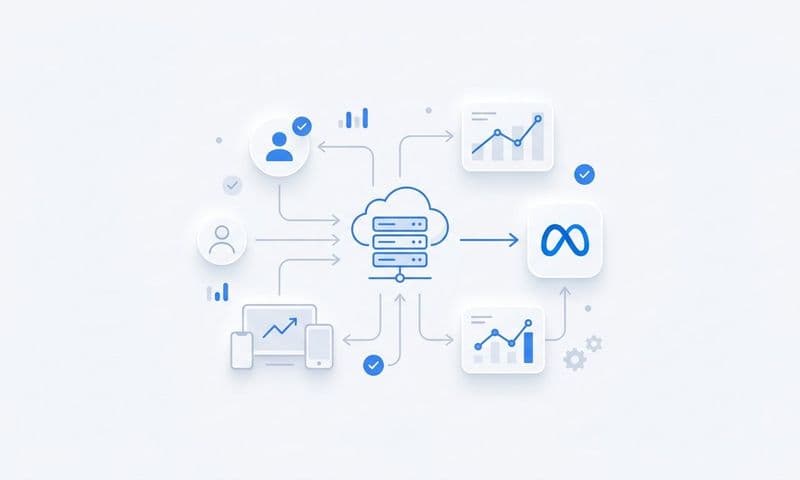
Ad platforms like Meta, Google, and TikTok don't just run your ads. They optimize them. Their algorithms decide who sees your campaigns, when, and at what bid, and they make those decisions based on the conversion data you send them. When that data is incomplete, delayed, or missing entirely, the algorithms work with a distorted picture. Budgets get misallocated, targeting drifts, and ROAS quietly erodes.
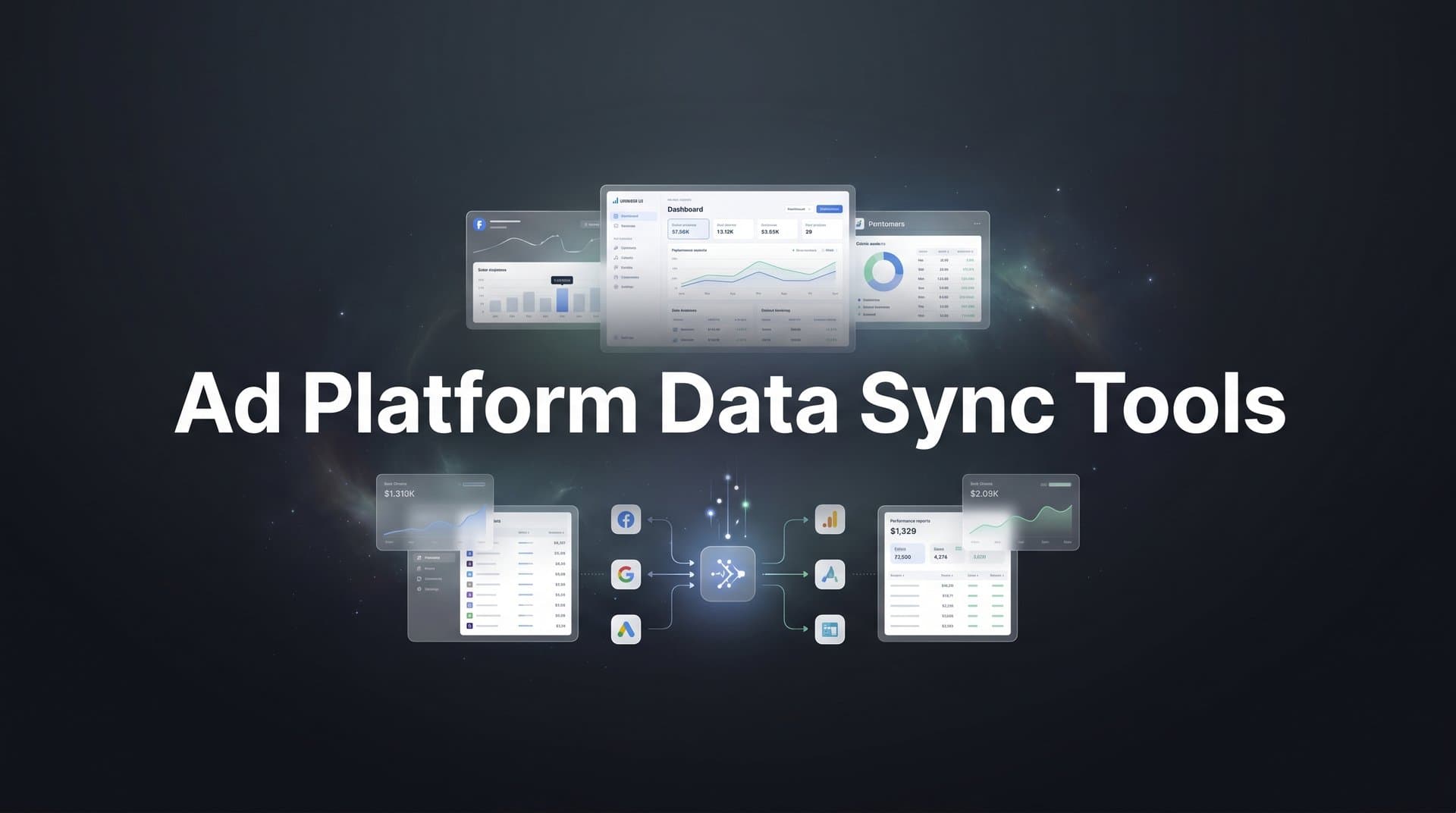
This is the problem ad platform data sync tools are built to solve. By sending accurate, enriched conversion events back to your ad channels in real time, these tools give platform algorithms the signal quality they need to optimize effectively.
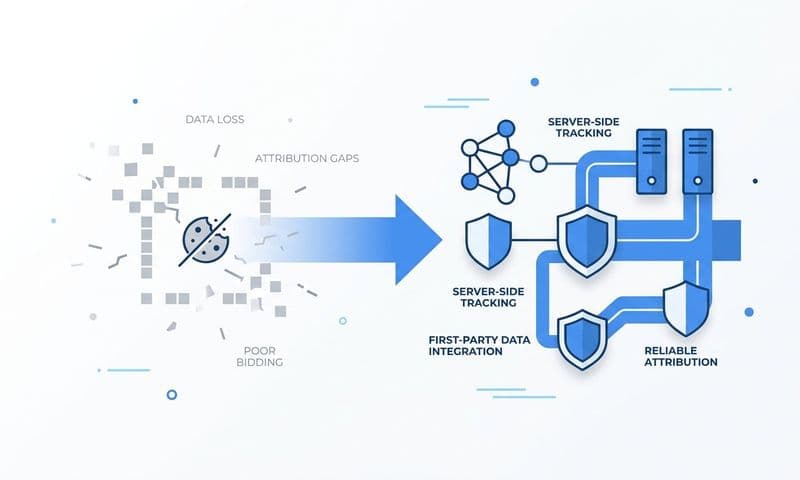
The category has grown considerably as browser-based tracking has become less reliable. iOS privacy changes, cookie restrictions, and ad blockers have made client-side tracking increasingly incomplete. Server-side solutions have moved from "nice to have" to essential infrastructure for serious marketers.
The tools below were selected based on data accuracy, platform integrations, ease of setup, server-side tracking capabilities, and overall value. Whether you need a full attribution platform with built-in sync, a native platform solution, or a lightweight connector, there's an option here for your stack.
1. Cometly
Best for: Teams wanting full-funnel attribution and conversion sync in a single platform
Cometly is a marketing attribution platform that combines server-side tracking, multi-touch attribution, and real-time Conversion Sync to send enriched conversion events back to your ad platforms.
 9 Best Ad Platform Data Sync Tools to Optimize Campaign Performance in 2026
Where This Tool Shines
Most data sync tools move conversion events from point A to point B. Cometly does something more valuable: it enriches those events with attribution context before sending them back to ad platforms. That means Meta, Google, and TikTok receive signals that reflect not just that a conversion happened, but which touchpoints actually drove it.
This matters because ad platform algorithms use conversion data to refine targeting and bidding. Higher-quality signals lead to better optimization. Cometly also captures events that browsers miss entirely, thanks to server-side tracking that operates independently of cookie limitations and ad blockers. The result is a more complete data picture feeding your campaigns.
Key Features
Conversion Sync: Sends enriched, attribution-informed conversion events back to Meta, Google, TikTok, Snapchat, LinkedIn, and other platforms in real time.
Server-Side Tracking: Captures conversion events at the server level, bypassing browser restrictions and improving data completeness.
Multi-Touch Attribution: Maps the full customer journey across paid and organic channels so you know which touchpoints actually contribute to revenue.
AI-Powered Recommendations: Surfaces budget allocation and campaign scaling suggestions based on attribution data across every channel.
CRM and Platform Integrations: Connects with major ad platforms and CRMs to unify your conversion data in one place.
Best For
Marketing teams and agencies running paid campaigns across multiple platforms who want attribution insight and conversion sync working together. Particularly valuable for teams that have struggled with incomplete conversion data affecting ad platform algorithm performance.
Pricing
Custom pricing based on ad spend. A free demo is available to see the platform in action before committing.
2. Meta Conversions API (CAPI)
Best for: Improving Facebook and Instagram ad optimization with server-side event tracking
Meta Conversions API is Meta's native server-side solution for sending web, app, and offline events directly from your server to Meta's ad platform.
 9 Best Cookie Deprecation Solutions for Marketers in 2026
Where This Tool Shines
The Meta Pixel has always had a fundamental vulnerability: it runs in the browser, which means iOS restrictions, ad blockers, and cookie settings can all prevent it from firing accurately. CAPI sidesteps this entirely by transmitting events server-to-server, so the data reaches Meta regardless of what's happening in the user's browser.
When used alongside the Pixel rather than as a replacement, CAPI creates a redundant tracking setup that significantly improves event match quality. Better event matching means Meta can more accurately attribute conversions and optimize delivery toward users most likely to convert.
Key Features
Server-to-Server Transmission: Sends events directly from your server to Meta, bypassing browser-level tracking limitations.
Pixel Redundancy: Works alongside the Meta Pixel to fill gaps and deduplicate events for cleaner data.
Broad Event Support: Handles web, app, offline, and messaging events across the Meta ecosystem.
Event Match Quality: Improves how well Meta can match events to user profiles for better targeting and attribution.
Partner Integrations: Available through Meta's partner ecosystem if you don't want to manage the infrastructure yourself.
Best For
Any advertiser running significant spend on Facebook or Instagram. Essential for businesses experiencing conversion data loss due to iOS changes or ad blockers. Requires technical resources to implement directly, though many platforms and partners simplify the process.
Pricing
Free to use. Infrastructure costs may apply if self-hosting; partner integrations may carry their own pricing.
3. Google Enhanced Conversions
Best for: Recovering lost conversions and improving measurement accuracy in Google Ads
Google Enhanced Conversions is a native Google Ads feature that uses hashed first-party customer data to supplement standard conversion tags and recover conversions lost to tracking restrictions.
 9 Best Ad Platform Data Sync Tools to Optimize Campaign Performance in 2026
Where This Tool Shines
Standard Google Ads conversion tracking relies on cookies, which are increasingly unreliable. Enhanced Conversions takes a different approach: when a customer converts, it captures first-party data like their email address, hashes it for privacy, and sends it to Google. Google then uses that hashed data to match conversions to ad interactions that cookies may have missed.
The result is more complete conversion data without requiring a major infrastructure overhaul. It works with your existing conversion tags and can be implemented through Google Tag Manager, making it accessible even for teams without dedicated developer resources.
Key Features
First-Party Data Matching: Uses hashed customer data to recover conversions that cookie-based tracking misses.
Privacy-Safe Hashing: Customer data is hashed before transmission, keeping it anonymized in transit.
Web and Lead Support: Available for both direct web conversions and lead-based conversion flows.
Tag Manager Implementation: Can be set up through Google Tag Manager without custom API development.
Native Integration: Works seamlessly within Google Ads reporting and Smart Bidding optimization.
Best For
Google Ads advertisers who want to improve conversion measurement accuracy without major technical investment. Especially valuable for businesses with strong first-party data assets like email lists from form submissions or account sign-ups.
Pricing
Free. Included as a standard feature within Google Ads accounts.
4. Segment (Twilio)
Best for: Enterprise teams building a unified customer data pipeline across hundreds of tools
Segment is an enterprise customer data platform that collects events once and routes them to ad platforms, analytics tools, data warehouses, and hundreds of other destinations through a single integration layer.
 8 Best Attribution-Focused Platforms vs Segment: Which Approach Fits Your Marketing Stack in 2026
Where This Tool Shines
Segment's core value is the "collect once, send everywhere" model. Instead of building separate integrations for each ad platform, analytics tool, and data warehouse your team uses, you instrument Segment once and control data routing from a central interface. This dramatically reduces the engineering overhead of maintaining a complex martech stack.
For ad platform data syncing specifically, Segment handles both client-side and server-side event collection, with real-time streaming to destinations like Meta CAPI, Google Ads, and others. Its identity resolution capabilities also help stitch together user journeys across devices and sessions, which improves the quality of data flowing to your ad platforms.
Key Features
400+ Destinations: Routes data to ad platforms, analytics tools, CRMs, and data warehouses from one integration.
Real-Time Streaming: Supports both real-time event streaming and batch data syncing depending on destination requirements.
Identity Resolution: Stitches user identities across devices and channels for more complete customer profiles.
Protocols: Data governance layer that enforces data quality standards and schema consistency.
Server-Side Collection: Supports server-side event tracking for improved data reliability.
Best For
Mid-market to enterprise teams with complex data infrastructure needs and multiple tools to connect. Best suited for organizations with engineering resources to implement and maintain the platform.
Pricing
Free tier available for low-volume use. Paid plans start at $120/month, with enterprise pricing for larger data volumes.
5. Stape
Best for: Affordable, simplified server-side tagging without managing cloud infrastructure
Stape is a server-side tagging platform that makes deploying and managing Google Tag Manager server containers accessible and cost-effective for teams of all sizes.
 9 Best Ad Platform Data Sync Tools to Optimize Campaign Performance in 2026
Where This Tool Shines
Server-side tagging with Google Tag Manager is powerful, but self-managing the cloud infrastructure can be expensive and technically demanding. Stape removes that friction with one-click container deployment and managed hosting that costs a fraction of running your own cloud setup.
Beyond the infrastructure simplification, Stape includes built-in support for Meta CAPI, TikTok, Google, and other platforms, along with a custom loader that improves tracking accuracy by making tracking scripts harder for browsers and extensions to block. For teams that want server-side capabilities without a dedicated DevOps resource, Stape is often the most practical path.
Key Features
One-Click Deployment: Launches Google Tag Manager server containers without manual cloud configuration.
Multi-Platform Support: Built-in templates for Meta CAPI, Google, TikTok, Snapchat, and other ad platforms.
Custom Loader: Improves tracking script delivery to reduce data loss from blockers and browser restrictions.
Managed Hosting: Handles server infrastructure so teams can focus on tagging rather than operations.
GDPR-Friendly Options: Data processing configurations to support privacy compliance requirements.
Best For
Marketing teams and agencies that want server-side tracking capabilities without the cost or complexity of self-managed cloud infrastructure. A practical choice for smaller teams moving away from client-side-only tracking.
Pricing
Plans start at $20/month for basic server-side tagging. Higher tiers available for larger traffic volumes.
6. LeadsBridge
Best for: Syncing CRM data and offline conversions with ad platforms for lead-gen campaigns
LeadsBridge is an integration platform specializing in connecting CRM and marketing data with ad platforms, with particular strength in offline conversion tracking and custom audience syncing.
 9 Best Conversion API Tools to Maximize Your Ad Performance in 2026
Where This Tool Shines
Many lead-gen businesses have a gap between their ad platforms and their CRM: a lead clicks an ad, fills out a form, and enters the sales pipeline, but the ad platform never learns whether that lead became a customer. LeadsBridge bridges that gap by syncing CRM lead stages and deal outcomes back to ad platforms as offline conversions.
This is especially valuable for businesses with longer sales cycles where the conversion that matters most happens days or weeks after the initial click. By feeding downstream CRM data back to Meta, Google, and LinkedIn, LeadsBridge helps ad algorithms optimize toward leads that actually close, not just leads that fill out forms.
Key Features
Offline Conversion Syncing: Maps CRM deal stages and outcomes to offline conversion events in Meta, Google, and LinkedIn.
Custom Audience Automation: Automatically syncs CRM segments to ad platform custom audiences without manual CSV uploads.
380+ Integrations: Connects with a wide range of CRMs, marketing tools, and ad platforms.
Real-Time Syncing: Keeps data flowing continuously rather than relying on scheduled batch uploads.
Meta CAPI Support: Includes pre-built integration for Meta Conversions API alongside standard pixel events.
Best For
Lead-gen businesses and B2B marketers with CRM data they want to feed back to ad platforms. Particularly useful for teams running campaigns on Meta Lead Ads, Google, or LinkedIn who want to close the loop between ad clicks and sales outcomes.
Pricing
Free plan available with limited features. Paid plans start at $22/month, scaling based on the number of integrations and sync volume.
7. Funnel.io
Best for: Aggregating and normalizing marketing data from 500+ sources for unified reporting
Funnel.io is a marketing data aggregation platform that connects to hundreds of data sources, normalizes cross-platform data, and routes it to dashboards, spreadsheets, and data warehouses.
 9 Best Ad Platform Data Sync Tools to Optimize Campaign Performance in 2026
Where This Tool Shines
Funnel.io sits on the reporting side of the data sync category. Rather than pushing conversion events to ad platforms, it pulls performance data out of ad platforms and organizes it into a unified, analysis-ready format. If your challenge is getting a clear view of cross-channel performance rather than feeding better signals to algorithms, Funnel.io is built for that.
Its data normalization layer is particularly useful for teams managing campaigns across multiple platforms with inconsistent naming conventions and metric definitions. Funnel.io standardizes everything so you can make meaningful comparisons across channels without manual data cleaning.
Key Features
500+ Connectors: Pre-built integrations covering major ad platforms, marketing tools, and data sources.
Data Normalization: Automatically standardizes metrics and naming conventions across platforms for consistent reporting.
Flexible Destinations: Sends unified data to Google Sheets, Looker Studio, BigQuery, and other BI tools.
Historical Data Storage: Retains historical data and supports backfilling for long-term trend analysis.
No-Code Transformations: Allows teams to apply data transformation rules without writing code.
Best For
Marketing teams and agencies that need a reliable, scalable way to centralize cross-platform reporting. Best suited for organizations with significant ad spend across multiple channels who need clean, unified data for analysis and stakeholder reporting.
Pricing
Custom pricing based on data volume and connectors. Typically starts around $1,000/month, making it better suited to mid-market and enterprise teams.
8. Zapier
Best for: Quick, no-code automation for lightweight conversion event syncing
Zapier is a no-code automation platform that connects thousands of apps, enabling lightweight conversion event syncing between CRMs, form tools, and ad platforms without developer resources.
Where This Tool Shines
Zapier isn't purpose-built for ad platform data syncing, but it can handle simpler use cases effectively. If you need to send form submission data from your CRM to a Google Ads offline conversion import, or trigger a custom conversion event when a deal closes in your pipeline, Zapier can wire that together quickly with no engineering support.
The tradeoff is that Zapier operates at the automation layer rather than the data infrastructure layer. It's excellent for connecting discrete events between apps, but it isn't designed for high-volume, real-time event streaming or the kind of enriched data syncing that meaningfully improves ad platform algorithm performance.
Key Features
7,000+ Integrations: Connects virtually any app combination, including major ad platforms and CRMs.
No-Code Builder: Visual workflow editor lets non-technical users build event-triggered automations.
Multi-Step Zaps: Supports complex workflows with multiple actions, filters, and conditional logic.
Data Formatting: Built-in tools to format and transform data before it reaches its destination.
Quick Setup: Most integrations can be configured in minutes without technical knowledge.
Best For
Small teams and solo marketers who need simple, event-triggered data flows between tools and don't have developer resources. Best for lightweight use cases rather than high-volume or real-time conversion syncing at scale.
Pricing
Free tier available with limited Zaps. Paid plans start at $19.99/month, scaling with task volume and feature needs.
9. Supermetrics
Best for: Pulling ad platform data into spreadsheets and BI tools for performance reporting
Supermetrics is a data connector that extracts marketing performance data from ad platforms and pushes it into spreadsheets, BI tools, and data warehouses for analysis and reporting.
Where This Tool Shines
Like Funnel.io, Supermetrics operates in the reporting direction of data flow rather than the conversion syncing direction. Its strength is making it easy to pull granular ad performance data out of platforms like Meta, Google, TikTok, and LinkedIn into the tools analysts and marketers already use, particularly Google Sheets and Excel.
For teams that live in spreadsheets and need reliable, scheduled data pulls from multiple ad platforms, Supermetrics is one of the most straightforward solutions available. It's not the right tool if your goal is feeding better conversion signals to ad algorithms, but it's well-suited for building cross-platform performance reports and dashboards.
Key Features
100+ Platform Connectors: Pulls data from major ad platforms, social media tools, and marketing analytics sources.
Flexible Destinations: Supports Google Sheets, Excel, Looker Studio, BigQuery, Snowflake, and other BI tools.
Scheduled Refreshes: Automates regular data pulls so reports stay current without manual exports.
Custom Query Builder: Allows granular data extraction with custom metrics, dimensions, and date ranges.
Cross-Platform Reporting: Combines data from multiple ad platforms into unified reports for side-by-side analysis.
Best For
Marketing analysts and agencies that need efficient, automated reporting across multiple ad platforms. Best for teams focused on performance analysis and client reporting rather than improving real-time conversion data quality.
Pricing
Plans start at $39/month per destination, with pricing scaling based on the number of data sources and destinations connected.
Choosing the Right Tool for Your Situation
The tools on this list serve different purposes, and the right choice depends on what problem you're actually trying to solve. Here's a quick way to think through it.
If you want attribution insight and conversion sync working together in one platform, Cometly is the strongest option. It doesn't just move conversion data to your ad platforms. It enriches that data with full-funnel attribution context before sending it, which gives ad algorithms higher-quality signals to work with. For teams running paid campaigns across multiple channels who want to understand what's driving revenue and improve algorithm performance at the same time, this unified approach is hard to replicate by stitching together separate tools.
If you're focused on a single platform, the native solutions are the most direct path. Meta Conversions API for Facebook and Instagram advertisers, and Google Enhanced Conversions for Google Ads, are both free and purpose-built for their respective ecosystems. They're the baseline any serious advertiser should have in place.
For server-side infrastructure: Stape makes server-side tagging accessible without managing cloud infrastructure yourself, at a price point that works for smaller teams.
For enterprise data pipelines: Segment is the most flexible option for organizations with complex multi-tool stacks and engineering resources to support implementation.
For lead-gen and CRM syncing: LeadsBridge specializes in closing the loop between CRM data and ad platforms, making it the strongest choice for businesses with longer sales cycles.
For reporting and analysis: Funnel.io and Supermetrics both excel at pulling data out of ad platforms for unified reporting, with Funnel.io better suited to larger teams and Supermetrics offering a more accessible entry point for spreadsheet-focused workflows.
For quick automation without code: Zapier handles lightweight use cases well, though it isn't designed for high-volume or real-time conversion syncing at scale.
The clearest dividing line in this category is whether a tool simply moves data or enriches it before syncing. If improving ad platform algorithm performance is the goal, enriched conversion data wins every time. Get your free demo of Cometly to see how attribution-informed conversion sync can improve the quality of data feeding your campaigns.