Email remains one of the most direct channels for reaching buyers in B2B SaaS, but most marketing teams are flying blind when it comes to understanding what their campaigns actually produce. Open rates and click-through rates tell you about engagement. They do not tell you whether a subscriber became a pipeline opportunity or a paying customer.
That gap between email activity and revenue outcome is where attribution breaks down. The real question is not whether someone clicked your email. It is whether that click contributed to a closed deal.
Answering that question requires a structured approach to conversion tracking that connects email behavior to downstream revenue events. In B2B SaaS, this is especially complex because buying cycles are long, multiple stakeholders are involved, and email often functions as a nurture channel rather than a direct conversion driver. A last-click model will systematically undervalue everything email contributes to pipeline.
This guide walks you through exactly how to build a working system. You will learn how to define what a conversion actually means for your email program, how to instrument your links and landing pages, how to connect email data to your CRM and attribution platform, and how to analyze results in a way that informs real budget and strategy decisions.
Whether you are running nurture sequences, product announcements, or trial activation campaigns, these steps apply. By the end, you will have a repeatable framework that ties email touchpoints to the metrics that matter most: leads, pipeline, and revenue.
Step 1: Define Your Email Conversion Goals Before You Build Anything
Before touching a single UTM parameter or pixel, you need to be precise about what you are actually trying to measure. Skipping this step is the most common reason email attribution data ends up useless.
Start by identifying the specific actions that count as conversions for each email type. A demo request email has a different goal than an onboarding sequence or a re-engagement campaign. Treating all of them the same way produces numbers that look impressive but mean nothing strategically.
It helps to distinguish between micro-conversions and macro-conversions. Micro-conversions are intermediate actions: clicking through to a landing page, starting a form, or downloading a resource. Macro-conversions are the outcomes that connect directly to revenue: a trial signup, a demo request submitted, or a CRM opportunity created. You want to track both, but you should never confuse one for the other.
Here is how to map conversion goals by email type:
Nurture emails: The macro-conversion is typically a demo request or a sales conversation booked. Micro-conversions include content engagement and return visits to your pricing or product pages.
Onboarding and activation emails: The macro-conversion is feature adoption or a specific in-product milestone. Micro-conversions include logging in, completing setup steps, or visiting key feature areas.
Re-engagement emails: The macro-conversion is renewed product activity or a conversation with your team. Micro-conversions include any click that brings a dormant user back into your product.
Promotional or product announcement emails: The macro-conversion is a plan upgrade, a trial start, or a purchase event depending on your model.
Once you have mapped these goals, document them in a shared tracking plan. This document should define each conversion event by name, describe the trigger condition, and note which team owns it. When marketing, sales, and ops align on definitions before any technical setup begins, you eliminate the downstream arguments about whether the numbers are right.
One pitfall to avoid here: treating every link click as a conversion. This inflates your numbers and makes it impossible to identify what is actually driving revenue. A click is an engagement signal. A form submission that creates a CRM record is a conversion. Keep those categories separate from the start. For a deeper look at how to structure this correctly, the best practices for tracking conversions accurately provide a solid foundation before you move into technical setup.
Step 2: Set Up UTM Parameters on Every Email Link
UTM parameters are the foundation of email conversion tracking. Without them, traffic from your emails appears as direct traffic in your analytics platform, which means you lose visibility into one of your most active channels.
The standard UTM structure for email looks like this:
utm_source: email
utm_medium: newsletter, nurture, onboarding, or re-engagement depending on the campaign type
utm_campaign: a descriptive name that identifies the specific campaign, such as q2-nurture-sequence or trial-activation-june
utm_content: the specific link or CTA identifier within the email, such as primary-cta, footer-link, or inline-text-link
The utm_content parameter is particularly valuable for email because it lets you see which specific links within a single email are driving conversions. If your primary CTA and a footer link both point to the same destination, utm_content tells you which one actually gets clicked and converts. If you want a thorough breakdown of how UTM tracking works and why it matters, understanding UTM tracking and how it helps your marketing covers the full picture.
Building a UTM naming convention document is not optional if you want reliable data. Inconsistent naming is one of the most common failure modes in email attribution. When one team member tags a campaign as "Email_Newsletter" and another uses "email-newsletter," your analytics platform treats those as two different sources. Over time, this fragments your channel data and makes trend analysis unreliable.
Create a shared document or spreadsheet that defines your exact naming conventions and use a UTM builder tool to generate links consistently. Enforce this at the campaign planning stage, before emails are built, so tagging is never an afterthought.
Tag every link in the email body. This includes your primary CTA, any inline text links, navigation links if present, and footer links. Capturing the full click distribution across an email gives you a more accurate picture of how subscribers interact with your content.
Before any campaign goes out, verify your UTMs are firing correctly. Click a test link yourself and confirm the parameters appear correctly in your analytics platform. Check specifically for broken characters, spaces, or encoding errors that can silently break tracking.
One pitfall to watch for: using spaces or special characters in UTM values. Spaces get encoded as "%20" in URLs, which can create inconsistencies in your reporting. Use hyphens instead of spaces, keep values lowercase, and avoid punctuation other than hyphens and underscores.
Step 3: Configure Conversion Events on Your Landing Pages and Thank-You Pages
Getting someone to click your email is only half the equation. What happens after the click determines whether that engagement becomes a conversion. This step is where most email tracking setups fall apart.
Every email CTA should point to a dedicated landing page with a single conversion goal. Sending email traffic to your homepage or a general product page dilutes intent and makes it nearly impossible to attribute conversions accurately. A dedicated landing page gives you a clean environment where the only action available is the one you are trying to measure.
Place your conversion tracking pixel or event code on the thank-you page or confirmation step that fires only when the desired action is completed. This is the critical distinction: the conversion event should fire when someone submits a form and reaches the confirmation state, not when they land on the page.
Configure form submission events as distinct conversion events in your analytics platform. This allows you to count actual completions rather than page visits, which is a meaningful difference when you are reporting on email-driven pipeline.
For B2B SaaS teams tracking high-value conversions like demo requests or trial signups, server-side tracking meaningfully improves data accuracy. Browser-based pixel tracking is increasingly unreliable due to ad blockers, privacy-focused browsers, and device-level privacy settings. Server-side event tracking and Conversion API integrations send form submission events server-to-server, which provides higher signal fidelity and ensures your conversion data is as complete as possible.
Set up distinct conversion events for different campaign goals. A demo request conversion event and a trial signup conversion event should be tracked separately. This allows you to segment performance by email type in your attribution reports rather than combining all conversions into a single undifferentiated number. Understanding how to track offline conversions and close the attribution gap is also worth exploring if your sales process involves any touchpoints outside the browser.
Before launching any campaign, test each conversion event by completing the form yourself and confirming the event fires correctly in your tracking platform. Check that the event name, parameters, and values all appear as expected.
The most common pitfall here is placing the conversion pixel on the landing page itself rather than the confirmation page. When the pixel fires on page load instead of form completion, every visit to the landing page gets counted as a conversion. This overstates your results dramatically and makes your email program look far more effective than it actually is.
Step 4: Connect Email Touchpoints to Your CRM and Attribution Platform
UTM data and pixel fires tell you about anonymous behavior. Connecting email clicks to named leads and pipeline opportunities requires bridging that anonymous data to your CRM. This is where email attribution becomes genuinely useful for B2B teams.
The most reliable method for passing UTM data into your CRM is through hidden form fields. When a visitor arrives on your landing page from an email link, the UTM parameters are present in the URL. Hidden form fields capture those parameters automatically when the visitor submits the form. The result is a CRM lead record that carries the originating campaign data: utm_source, utm_medium, utm_campaign, and utm_content.
This approach requires a small amount of JavaScript to read the URL parameters and populate the hidden fields, but most marketing automation and form platforms support this natively or through simple configuration. Once it is in place, every form submission from an email campaign creates a lead record with complete source attribution attached. Teams managing this process at scale often benefit from dedicated marketing campaign tracking software that handles source mapping automatically.
In your attribution platform, map email as a distinct channel so email-influenced leads and pipeline are reported separately from paid, organic, and direct sources. Without this mapping, email touchpoints get absorbed into broader channel categories and their contribution becomes invisible in your reports.
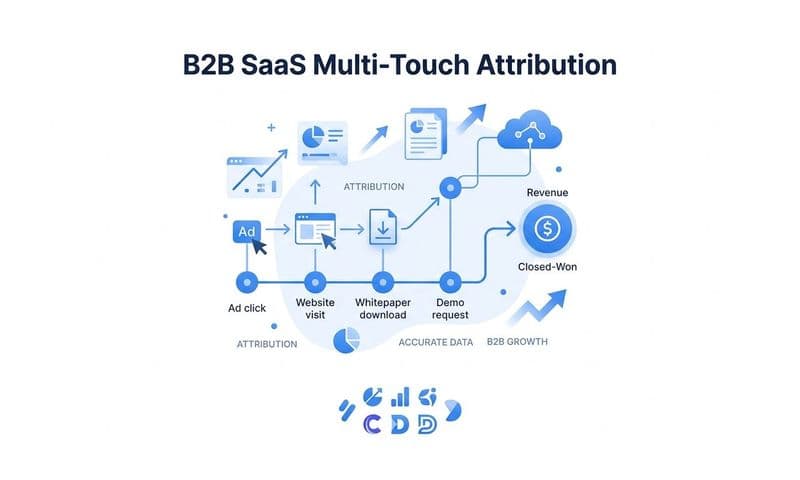
Multi-touch attribution is essential for B2B email programs. In a typical B2B SaaS buying journey, a prospect might receive several nurture emails, visit your website multiple times, engage with a paid ad, and then request a demo after a final email. A last-click model gives all the credit to the last touchpoint and erases everything email contributed earlier in the journey. Linear or time-decay attribution models distribute credit across all touchpoints and produce a far more accurate picture of email's role in driving pipeline. Reviewing the best software for tracking marketing attribution can help you identify which platform fits your team's needs.
Platforms like Cometly are built specifically for this kind of multi-channel attribution. Cometly connects your email touchpoints alongside your ad platform data, CRM events, and website behavior to give you a complete view of the customer journey from first email click to closed-won revenue. Instead of stitching together data from separate tools, you get a single source of truth that shows exactly how email is contributing to pipeline relative to every other channel in your mix.
After completing the integration, verify it by creating a test lead through an email CTA and confirming that the lead source data populates correctly in both your CRM and your attribution dashboard. Check that the campaign name, medium, and content fields all carry through accurately before you rely on the data for reporting.
Step 5: Build a Reporting Framework That Connects Email Activity to Revenue
Once your tracking infrastructure is in place, the next step is building reports that actually answer the questions your leadership team cares about. Open rates and click rates belong in your campaign performance view. Revenue attribution belongs in your marketing reporting.
Build a conversion funnel report that tracks the full path from email send to lead to opportunity to closed revenue. This report should show you where subscribers are dropping off so you can identify whether the problem is in the email itself, the landing page experience, the sales follow-up, or the product fit.
The key metrics to include in your email attribution reporting are:
Email-influenced leads: The number of new leads where email was one of the tracked touchpoints in the journey.
Email-influenced pipeline value: The total value of open opportunities where email played a role, regardless of whether it was the first or last touch.
Email-influenced revenue: Closed-won revenue from deals where email was part of the attributed journey.
Click-to-conversion rate: The percentage of email clicks that result in a form submission or desired conversion action.
Email-attributed cost per lead: If you factor in platform and content costs, this metric helps you benchmark email against paid channels.
Segment your reports by campaign type, audience segment, and sequence step. Aggregated email performance data often hides more than it reveals. A nurture sequence targeting enterprise prospects may perform very differently from one targeting SMB trials, and those differences should inform how you allocate resources and which sequences you invest in expanding.
Use attribution models strategically based on the question you are trying to answer. Linear attribution shows email's contribution across a long nurture sequence where multiple emails all played a role. First-touch attribution reveals which email campaigns are most effective at introducing new prospects to your pipeline. Neither model is universally correct. The right one depends on what decision you are trying to make. A structured approach to measuring marketing campaign effectiveness helps ensure you are asking the right questions of your data.
Set a reporting cadence that matches the decision-making rhythm of your team. Weekly reporting works well for active campaign optimization. Monthly reporting is appropriate for channel-level performance reviews. Quarterly reporting should feed into budget allocation decisions and program strategy.
Connect your email attribution data to your central B2B marketing dashboard so leadership can see email ROI alongside paid channel performance without switching between tools. When email data lives in a separate system from your paid media data, the comparison never happens and email's contribution goes underreported in strategic conversations.
One common pitfall: reporting only on email-originated conversions while missing email-assisted conversions. In B2B SaaS, email rarely drives a conversion entirely on its own. It contributes to journeys that include multiple channels and multiple visits. If your reporting only counts conversions where email was the first and only touchpoint, you are significantly undercounting what your email program actually produces.
Step 6: Optimize Based on Conversion Data, Not Vanity Metrics
With a working attribution system in place, you now have the data to make optimization decisions that actually improve pipeline rather than just improving surface metrics. This is where the real value of conversion tracking shows up.
Use your conversion data to run structured tests. Compare subject lines, CTAs, send timing, and audience segments based on downstream conversion rates rather than open rates. An email with a lower open rate but a higher conversion rate is more valuable to your pipeline than one with a high open rate that nobody acts on.
Identify which email sequences produce the highest lead-to-opportunity conversion rates and prioritize scaling those sequences. When you can see which specific messages in a nurture sequence are driving the most downstream pipeline value, you know exactly where to invest in additional content, more personalized variations, or expanded audience targeting. Teams running sophisticated nurture programs often rely on SaaS email marketing strategies that are purpose-built for long B2B buying cycles.
Use AI-driven insights from your attribution platform to surface which campaigns are producing the highest revenue contribution. Rather than manually reviewing every campaign, tools like Cometly can analyze patterns across your entire email and ad portfolio and surface the campaigns and touchpoints that are most reliably connected to closed revenue. This allows you to replicate high-performing patterns rather than relying on intuition. Exploring AI marketing automation capabilities can further accelerate how quickly you act on those insights.
Suppress or redesign email campaigns that generate high click volume but low conversion rates. These campaigns waste list health, inflate your engagement metrics, and distort your attribution data by adding noise to the customer journey. A campaign that drives clicks to a landing page where nobody converts is not a success, regardless of what the click-through rate looks like.
Feed enriched conversion event data back to your ad platforms using server-side integrations. When your email-confirmed conversion signals are sent back to Meta, Google, and other ad platforms, those platforms can use that data to improve targeting and optimization for your paid campaigns. Email attribution data does not just improve email decisions. It improves the performance of your entire marketing mix.
Review your UTM naming conventions and conversion event setup on a quarterly basis. As your campaign portfolio grows, naming conventions drift and new team members introduce inconsistencies. A quarterly data quality audit keeps your attribution system accurate and prevents the kind of silent data degradation that makes reports unreliable over time.
Putting It All Together
Tracking email marketing conversions is not a one-time setup task. It is an ongoing system that connects your email program to the revenue outcomes your business actually cares about.
The framework in this guide gives you a repeatable process: define your conversion goals before building anything, tag every link with consistent UTM parameters, configure conversion events on your pages and thank-you steps, connect email touchpoints to your CRM and attribution platform, build revenue-focused reports that show the full funnel, and optimize based on what the conversion data shows rather than what the vanity metrics suggest.
When this system is working, you stop guessing about whether email is contributing to pipeline and start making decisions grounded in actual attribution data. For B2B SaaS teams managing complex buying journeys across multiple channels, that level of clarity is what separates high-performing marketing programs from ones that rely on intuition and hope.
Cometly is built to make this kind of attribution work without requiring a data engineering team. It connects your email touchpoints, ad platforms, and CRM into a single source of truth so you can see exactly which campaigns are driving leads and revenue. You get multi-touch attribution across every channel, AI-driven recommendations that surface your highest-performing campaigns, and the ability to feed enriched conversion signals back to your ad platforms to improve performance across your entire marketing mix.
If you are ready to move beyond open rates and build a real conversion tracking system, Get your free demo today and start capturing every touchpoint to maximize your conversions.