Most marketing teams pour budget into campaigns across Meta, Google, TikTok, and other platforms, yet struggle to answer a deceptively simple question: where exactly are prospects dropping off? Without clear visibility into how leads move from awareness to conversion, budget decisions become educated guesses at best.
Tracking marketing funnel performance means connecting every touchpoint, from the first ad click to the final purchase or closed deal, and measuring how efficiently each stage converts. When done right, it reveals which channels actually drive revenue, where friction slows your pipeline, and how to reallocate spend for maximum ROI.
This guide walks you through a practical, repeatable process to set up funnel tracking that gives you genuine confidence in your data. You will learn how to define your funnel stages, choose the right metrics, implement tracking across platforms, and use attribution insights to optimize every step.
Whether you run campaigns for an ecommerce brand, a SaaS company, or a marketing agency managing multiple clients, these steps apply directly to your workflow. By the end, you will have a clear system for monitoring funnel health and making faster, smarter decisions about where your marketing dollars go.
Step 1: Map Your Funnel Stages to Real Customer Actions
Before you can track marketing funnel performance, you need to agree on what your funnel actually looks like. This sounds obvious, but many teams skip it and end up with data that nobody trusts because everyone has a different mental model of what each stage means.
The key is to define funnel stages that match your actual buyer journey, not a textbook model. Generic awareness-consideration-decision frameworks are fine as starting points, but they fall apart when you try to attach real tracking events to them.
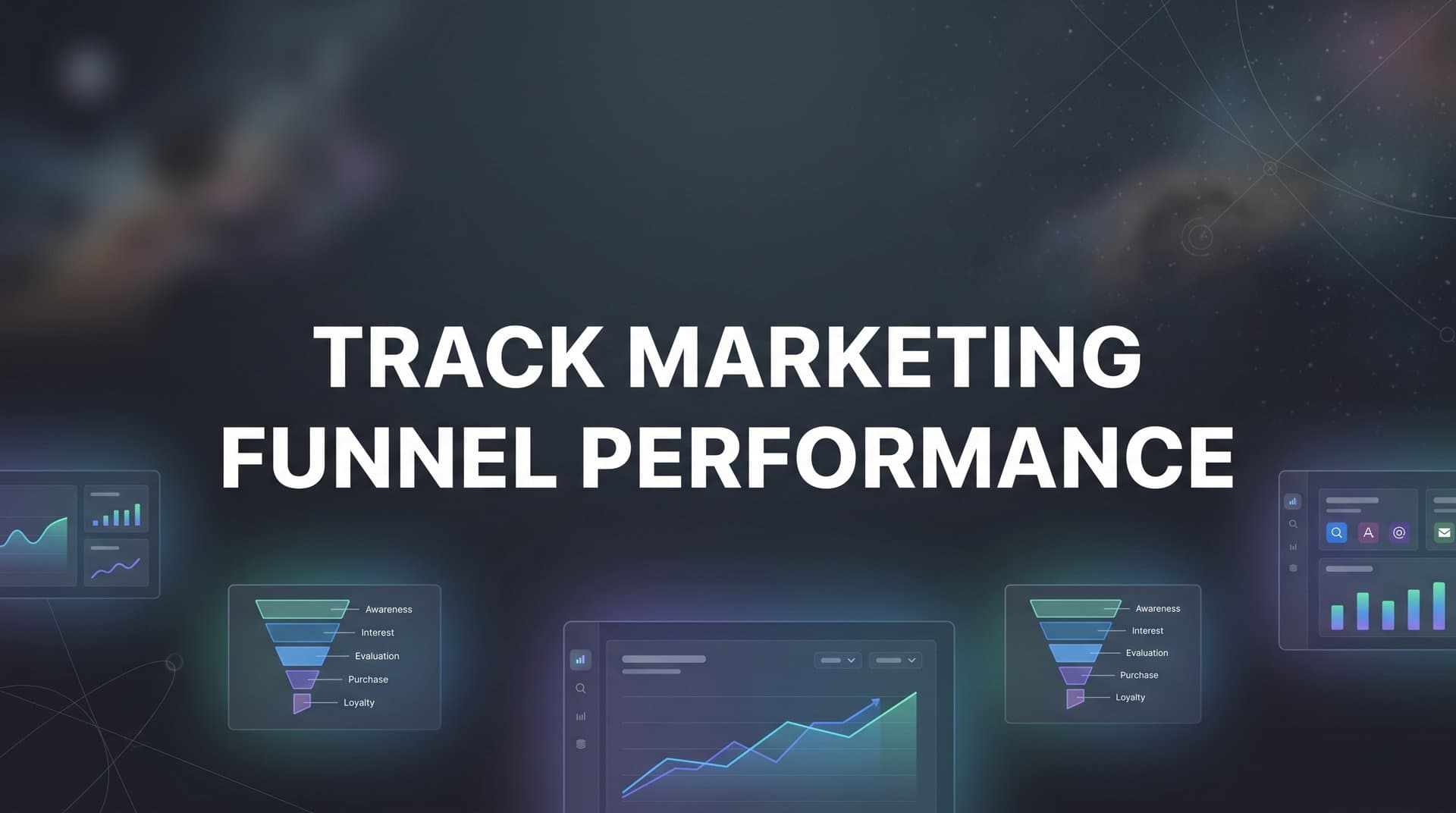
For ecommerce, your funnel might look like this: Ad click, product page view, add to cart, checkout initiated, purchase completed. Each of these is a discrete, trackable event with no ambiguity about when a prospect moves from one to the next.
For B2B SaaS, it often looks more like this: Ad click, landing page visit, demo request submitted, sales call completed, deal closed in CRM. Notice that the funnel extends well beyond the marketing team's traditional scope, which is exactly why CRM integration matters so much. For a deeper look at how these stages work in practice, our guide on the B2B SaaS marketing funnel breaks down each phase in detail.
Once you have your stages defined, assign a specific, trackable event to each one. "Engaged with our brand" is not a trackable event. "Submitted the contact form on /demo" is. That level of precision is what separates reliable funnel data from fuzzy reporting.
Document your funnel map in a shared spreadsheet or project management tool so your entire team, including sales, product, and any agency partners, agrees on the definitions. Misaligned stage definitions are one of the most common reasons funnel data becomes unreliable over time. When the marketing team counts a "lead" differently than the sales team, your conversion rates will never reconcile.
Do not overlook micro-conversions. If email signups, content downloads, or free trial activations play a meaningful role in how prospects progress toward a purchase, include them as mid-funnel stages. They give you earlier warning signals about funnel health and help you understand which nurturing paths actually lead to revenue.
Think of this step as drawing the map before you start navigating. Everything that follows, your metrics, your tracking setup, your dashboards, depends on having a clear and agreed-upon map of the journey you are trying to measure.
Step 2: Identify the Metrics That Matter at Each Stage
With your funnel stages defined, the next question is: what do you actually measure at each one? The answer depends on what decisions you need to make, and it changes depending on where in the funnel you are looking.
Top of funnel metrics tell you whether your ads are reaching and engaging the right audience. Focus on impressions, click-through rate, cost per click, and landing page visit rate. These numbers reveal whether your creative and targeting are doing their job of pulling the right people into the funnel in the first place.
Mid-funnel metrics reveal whether your messaging and offers resonate after the initial click. Lead conversion rate, cost per lead, pages per session, and time on site all indicate how well your content and landing experiences are holding attention and building intent. A high click-through rate paired with a low lead conversion rate is a clear signal that your ad promise and your landing page experience are misaligned.
Bottom-of-funnel metrics connect marketing activity directly to business outcomes. Conversion rate, cost per acquisition, average order value or deal size, and revenue per conversion are the numbers that ultimately justify your budget. For a comprehensive breakdown of which numbers to watch, our article on digital marketing performance metrics covers each category in depth.
Here is where many teams go wrong: they focus on vanity metrics. Raw impressions or total clicks without context can make a campaign look successful while the actual business impact is minimal. What matters is stage-to-stage conversion rates, because those show you exactly where prospects stall. A funnel with strong top-of-funnel numbers but a 2% mid-funnel conversion rate has a very different problem than one where top-of-funnel is weak but mid-to-bottom conversion is strong.
Beyond single-touch metrics, consider how assisted conversions fit into your analysis. A prospect might click a Facebook ad, visit your site, leave, search for your brand name a week later, and convert through a Google search. Last-click attribution gives all the credit to Google. But the Facebook ad started the journey. Multi-touch attribution metrics surface that contribution and give you a more complete picture of how your funnel is actually working.
Build a simple metrics matrix: list each funnel stage in one column and the primary metric you will track for that stage in the next. This becomes your measurement framework and keeps your team focused on what actually signals progress rather than what is easy to pull from a dashboard.
Step 3: Set Up Cross-Platform Tracking and Data Collection
Defining stages and metrics is strategy. This step is where you make it real. Setting up tracking across multiple platforms is often the most technically demanding part of the process, but it is also the most important because without accurate data collection, everything downstream is unreliable.
Start with server-side tracking. Traditional pixel-based tracking has become increasingly unreliable due to iOS App Tracking Transparency changes, browser-level privacy features, and the broader deprecation of third-party cookies. Server-side tracking sends conversion data directly from your server to ad platforms rather than relying on a browser pixel, which means it is far less susceptible to being blocked or degraded. For any team that is serious about accurate funnel data, server-side tracking is no longer optional.
Next, connect your ad platforms to a centralized marketing tracking system. When Meta, Google, TikTok, and LinkedIn each live in their own dashboard, you end up with siloed data that is nearly impossible to reconcile. Each platform has its own attribution window and counting methodology, which means the numbers will never add up cleanly if you try to compare them side by side without a unified layer on top. A centralized system pulls all that data into one place so you can see total funnel performance across channels rather than fragmented snapshots.
CRM integration is critical, especially for B2B and SaaS funnels with longer sales cycles. Your funnel does not end when someone fills out a form. It ends when a deal closes or a customer churns. Connecting your ad data to CRM outcomes, like pipeline value and closed revenue, lets you trace a conversion all the way back to the specific campaign, ad set, and creative that generated it. Without this connection, you are optimizing for leads rather than revenue, which often leads to very different decisions.
UTM parameters remain a foundational requirement regardless of how sophisticated your tracking setup becomes. Use a consistent naming convention across all campaigns so that source, medium, campaign, and content data passes cleanly through every system. You can find detailed guidance on UTM tracking and how UTMs help your marketing to ensure your naming conventions are airtight, and the Google Analytics documentation also covers UTM parameter setup in depth.
This is exactly where a platform like Cometly makes a meaningful difference. Cometly connects your ad platforms, CRM, and website data to track the entire customer journey in real time. Instead of stitching together data from five different tools, you get a unified view of funnel performance with server-side tracking built in, so your data stays accurate even as browser privacy restrictions tighten.
Step 4: Build a Funnel Dashboard That Tells the Full Story
Data without visibility is just noise. A well-built funnel dashboard transforms raw tracking data into a clear picture of where your pipeline is healthy and where it needs attention. The goal is to make drop-off points immediately obvious so you can act on them quickly.
Start by building a view that shows conversion rates between each funnel stage, not just top-line totals. Knowing that you generated 10,000 clicks last month tells you very little. Knowing that 10,000 clicks turned into 800 landing page visits, 200 leads, and 12 closed deals tells you exactly where the funnel is leaking. That stage-by-stage breakdown is the core of any useful funnel dashboard.
Segment your data by channel, campaign, and audience. Aggregate funnel numbers can hide enormous variation in performance. A campaign on Google might convert mid-funnel prospects at three times the rate of a campaign on Meta, but if you only look at blended numbers, you will never see it. Our guide on building a marketing performance dashboard walks through how to structure these side-by-side channel comparisons effectively.
Include time-based views. Daily, weekly, and monthly trend lines help you spot patterns and seasonal shifts that snapshots miss entirely. A sudden drop in mid-funnel conversion rate on a Tuesday might be a one-day anomaly or the start of a serious problem. Trend data helps you tell the difference.
Set up automated alerts for key metric thresholds. If your cost per lead spikes above a defined threshold or your mid-funnel conversion rate drops below a baseline, you want to know immediately rather than discovering it during a monthly review. Early detection gives you time to diagnose and fix problems before they compound into significant budget waste.
Cometly's analytics dashboard is built specifically for this kind of funnel visibility. And when you want to dig deeper without building a custom report from scratch, Cometly's AI Chat feature lets you ask plain-language questions about your data and get instant insights. Instead of spending an hour building a pivot table, you can ask "which campaign has the lowest cost per acquisition this month?" and get the answer in seconds. That kind of speed matters when you are managing campaigns across multiple platforms and need to make decisions quickly.
Step 5: Apply Attribution Models to Understand What Drives Conversions
Here is one of the most important insights in funnel analysis: last-click attribution, which is still the default in many reporting tools, gives you an incomplete and often misleading picture of how your marketing actually works.
Last-click attribution assigns 100% of the conversion credit to the final touchpoint before a purchase or form fill. In practice, that usually means search and branded campaigns get all the credit while awareness campaigns on Meta, YouTube, or TikTok appear to contribute nothing. The result is that teams systematically underfund top-of-funnel activity and over-invest in bottom-of-funnel channels, which eventually dries up the pipeline. To understand the full range of options available, our comparison of attribution modeling vs marketing mix modeling explains when each approach makes sense.
Understanding different attribution models helps you see the full picture. Each model tells a different version of the same story:
First-touch attribution gives all the credit to the first interaction. This is useful for understanding which channels are best at generating initial awareness and pulling new prospects into your funnel.
Last-touch attribution gives all the credit to the final interaction before conversion. It is useful for understanding which channels close deals but tends to undervalue everything that happened before that final click.
Linear attribution distributes credit equally across every touchpoint in the journey. It acknowledges that multiple interactions contributed without making assumptions about which ones mattered most.
Time-decay attribution gives more credit to touchpoints that occurred closer to the conversion. This reflects the intuition that a prospect who visited your pricing page yesterday was more influenced by that visit than by an ad they saw three weeks ago.
Data-driven attribution uses machine learning to assign credit based on actual conversion patterns in your data. It is the most sophisticated model but requires sufficient data volume to produce reliable results.
The most practical approach is to compare multiple models side by side. When you do, you will often find that top-of-funnel campaigns are significantly more valuable than last-click data suggests. That insight alone can justify rebalancing your budget in ways that improve overall funnel efficiency.
Cometly's multi-touch attribution connects every touchpoint to conversions so you can see which sources actually move prospects through the funnel at each stage. For a deeper dive into how different models work and when to use each one, exploring Cometly's attribution marketing tools is a strong starting point.
Step 6: Optimize Your Funnel Based on What the Data Reveals
Tracking is only valuable if it leads to action. Once your dashboard is live and your attribution models are giving you a clearer picture, the next step is using that data to make targeted improvements that move the needle on conversion rates and revenue.
Start with your biggest drop-off point. This is almost always the highest-ROI place to focus because improving the weakest stage unlocks value from all the spend that already brought people to that point. If you are losing 80% of prospects between landing page visit and lead form submission, fixing that leaky stage is worth far more than squeezing another 5% out of your click-through rate. Our article on improving marketing campaign performance covers specific tactics for diagnosing and resolving these bottlenecks.
The right optimization depends on where the drop-off is happening:
Top-of-funnel drop-offs usually point to creative fatigue, poor audience targeting, or a mismatch between your ad message and the audience's awareness level. Test new ad creatives, refresh your targeting, or experiment with different messaging angles to see what generates better engagement and click quality.
Mid-funnel drop-offs often indicate that your landing page or nurturing sequence is not delivering on the promise your ad made. Look at page load speed, offer clarity, and how well your content addresses the specific objections or questions your audience has at that stage. Sometimes a simple headline change or a clearer call to action is enough to meaningfully improve conversion rates.
Bottom-of-funnel drop-offs are typically about friction or trust. Checkout complexity, pricing objections, slow follow-up from sales, or unclear next steps can all cause prospects who were ready to convert to fall away at the last moment. Reducing steps, adding social proof, or improving follow-up timing can have a significant impact here.
Conversion sync is a powerful tool for improving funnel performance over time. By feeding accurate, enriched conversion data back to ad platforms like Meta and Google, you help their algorithms understand what a high-quality conversion actually looks like for your business. This improves targeting and optimization at the platform level, which means you attract better-fit prospects into the top of your funnel from the start. Learning how to measure marketing campaign effectiveness ensures you are evaluating these improvements against the right benchmarks.
Cometly's AI Ads Manager takes this further by surfacing AI-powered recommendations across all your channels. Instead of manually reviewing performance data across five platforms to figure out which campaigns to scale, the AI identifies high-performing ads and campaigns and tells you where to put more budget. That kind of insight is especially valuable when you are managing large campaign portfolios and need to make fast, confident decisions.
Finally, set a regular cadence for reviewing funnel data and making incremental optimizations. Weekly or biweekly reviews are far more effective than waiting for a quarterly report. Small, consistent improvements compound over time, and catching a problem early is always cheaper than discovering it after weeks of wasted spend.
Putting It All Together: Your Funnel Tracking Checklist
Tracking marketing funnel performance is not a one-time setup. It is an ongoing practice that improves as you collect more data, refine your definitions, and layer in more sophisticated analysis over time. Here is a concise checklist to keep you on track:
Map your funnel stages: Define each stage based on your actual buyer journey and assign a specific, trackable event to every transition.
Define your metrics: Choose the right KPIs for each funnel stage, focusing on stage-to-stage conversion rates rather than vanity metrics.
Implement cross-platform tracking: Set up server-side tracking, connect your ad platforms to a centralized system, integrate your CRM, and use consistent UTM parameters across all campaigns.
Build a funnel dashboard: Create a single view that shows stage-by-stage conversion rates, segmented by channel and campaign, with trend lines and automated alerts for key thresholds.
Apply attribution models: Compare multiple models side by side to understand how different channels contribute at each funnel stage, and avoid over-relying on last-click data.
Optimize continuously: Identify your biggest drop-off point, run targeted experiments to improve it, use conversion sync to feed better data back to ad platforms, and review funnel performance on a regular cadence.
If you are just getting started, focus on the first three steps and build from there. Getting your stages defined, your metrics agreed upon, and your tracking implemented correctly creates the foundation everything else depends on. Multi-touch attribution and AI-powered recommendations are powerful additions, but they work best when the underlying data is clean and consistent.
Cometly is built to make this entire process faster and more accurate. It connects your ad platforms, CRM, and website into a single source of truth, tracks the full customer journey with server-side precision, and gives you AI-driven insights to help you scale what works. Get your free demo today and start capturing every touchpoint so you can make every marketing dollar count.