
Picture this: you review your ads dashboard, see a campaign generating a handful of conversions at a high cost per acquisition, and make the logical call to cut its budget. Two months later, your sales team mentions that several recently closed deals came from a LinkedIn campaign you paused. The revenue was real. The attribution was not. That is underreporting conversion metrics in action, and it costs B2B SaaS marketing teams far more than they realize.
Underreporting is not a minor data hygiene issue you can clean up on a slow Friday afternoon. It is a strategic threat that quietly shapes how you allocate budget, evaluate channels, and judge campaign performance. When your tracking systems miss conversions or misattribute them, every downstream decision inherits that error. You end up doubling down on channels that look efficient because they happen to sit at the end of the funnel, while pulling back on channels that actually started the conversation.
This article breaks down what underreporting conversion metrics really means, why B2B SaaS funnels are especially exposed to it, and what a complete fix actually looks like. By the end, you will have a clear picture of where your data is leaking and how to seal it.
The Hidden Gap Between Real Conversions and Reported Ones
Underreporting conversion metrics refers to the gap between conversions that actually occurred and the conversions your tracking systems captured and attributed. That gap can take two distinct forms, and understanding the difference matters when you start diagnosing your own setup.
The first is a hard gap: events that were never tracked at all. A prospect calls your sales team after clicking a LinkedIn ad, books a demo over the phone, and eventually signs a contract. Unless you have a system deliberately connecting that phone call back to the original ad click, that conversion simply does not exist in your reporting. It happened in the real world and vanished from your data.
The second is a soft gap: events that were tracked but attributed incorrectly, or not counted due to deduplication errors, attribution window mismatches, or model limitations. A lead might be recorded as a conversion in your CRM but credited to direct traffic because the original paid social click fell outside the attribution window. The event is technically in your data, but it is telling the wrong story.
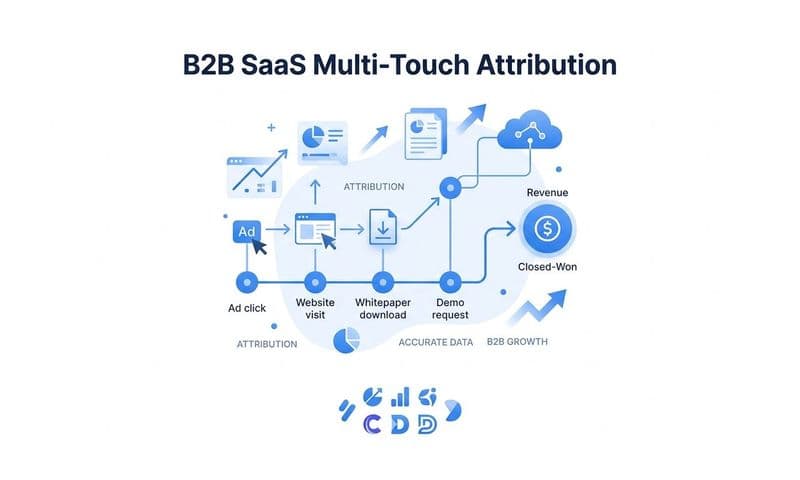
B2B SaaS funnels are particularly vulnerable to both types. Consider what a typical conversion journey looks like: a prospect sees a LinkedIn ad, clicks through, reads a blog post, leaves, returns via a Google search a week later, downloads a guide, gets nurtured by email for three weeks, then books a demo through a sales development rep who found them in the CRM. That journey involves at least five distinct touchpoints across four different channels, and the final handoff happens offline inside your sales process.
Each of those transitions is a potential tracking failure point. Browser-side pixels can miss the initial click. Email attribution often breaks when links are opened in native clients. The CRM handoff rarely syncs back to the originating ad platform. And the closed-won revenue, the metric that actually matters, almost never flows automatically back to the campaign that started it all.
This structural complexity is what makes underreporting so common in B2B SaaS specifically. Consumer funnels are short, often single-session, and easy to track end to end. B2B funnels are long, multi-stakeholder, cross-channel journeys where the gap between first touch and final conversion can span months. Every day that passes is another opportunity for tracking to break down.
Six Reasons Your Conversion Data Comes Up Short
Understanding where underreporting originates is the first step toward fixing it. There are several common failure points, and most B2B SaaS teams are dealing with more than one simultaneously.
Browser-side pixel limitations: Client-side tracking pixels fire inside the browser, which means they are subject to whatever restrictions that browser imposes. Safari's Intelligent Tracking Prevention (ITP) and Firefox's Enhanced Tracking Protection actively limit third-party cookies and restrict the lifespan of first-party cookies set via JavaScript. For a B2B SaaS audience that skews technical, ad blocker adoption is also notably high. The result is that a meaningful portion of conversion events simply never fire, and your ad platform never learns about them.
Attribution window mismatches: Different ad platforms use different default attribution windows. A conversion that happens 30 days after a click might fall inside your CRM's view of the journey but outside Meta's default seven-day click window. That conversion gets counted in one system and missed in another, creating a discrepancy that looks like underperformance when you compare the two. Understanding conversion window attribution is essential for reconciling these gaps across platforms.
Last-click attribution as the default: Many ad platforms default to last-click attribution, which assigns 100 percent of conversion credit to the final touchpoint before conversion. In a long B2B sales cycle, the last click is often a branded search or a direct visit, not the LinkedIn ad that introduced the prospect to your product three months earlier. Upper-funnel channels end up looking unproductive even when they initiated the majority of journeys that eventually converted.
CRM and offline conversion gaps: When a lead enters a sales cycle, the story moves from your website into your CRM, and most tracking setups are not built to follow it there. The form fill gets tracked. The sales qualification call does not. The proposal sent does not. The closed-won deal does not. Unless you have deliberately configured offline conversion imports or a server-side CRM integration, that entire downstream journey is invisible to your ad platforms.
Cross-device and cross-browser fragmentation: A prospect might first encounter your brand on a work laptop, research further on a phone during their commute, and convert on a different laptop entirely. Without first-party identity resolution, these sessions look like three separate anonymous users, and the conversion gets attributed to the last device rather than the full journey.
Deduplication failures: When teams add server-side tracking on top of existing browser pixels without configuring deduplication, the same conversion event can be reported twice. This inflates conversion counts in the opposite direction, but it also creates confusion that leads teams to distrust their data and make inconsistent decisions about which numbers to act on.
How Underreporting Distorts Marketing Decisions
Data gaps do not just sit quietly in your reporting. They actively shape the decisions you make, and those decisions compound over time in ways that are difficult to reverse.
The most direct impact is budget misallocation. When a channel appears to generate fewer conversions than it actually does, the rational response is to reduce spend on it. But reducing spend on a channel that was genuinely contributing to pipeline means you generate fewer leads from it, which produces fewer visible conversions, which makes the channel look even less effective. The channel gets cut further, or eliminated entirely, based on a picture that was never accurate to begin with.
This cycle is particularly damaging for upper-funnel channels like LinkedIn advertising, content marketing, and display retargeting, all of which tend to initiate journeys rather than close them. Under last-click attribution, these channels almost never get credit for the conversions they influenced. Teams interpret the low reported conversions as evidence that the channels do not work, cut them, and then wonder why their pipeline dried up three months later.
Underreporting also distorts your cost-per-acquisition and return on ad spend calculations. If a campaign actually drove 40 conversions but only 25 were tracked, your reported CAC is artificially high. You might conclude the campaign is inefficient and pause it, when in reality it was performing well. The inverse is also true: a campaign that sits at the bottom of the funnel and captures last-click credit for conversions it did not initiate will appear artificially efficient, drawing more budget than it deserves.
The impact on ad platform optimization is another layer of the problem that often goes unrecognized. Meta's Advantage+ and Google's Smart Bidding both rely on the conversion signals you send them to train their bidding algorithms. These systems are designed to find more of the users who behave like your converters. When your conversion data is incomplete, you are feeding the algorithm an inaccurate picture of what a converter looks like. The algorithm optimizes toward the wrong audience, targeting users who resemble your reported converters rather than your actual converters. Over time, this degrades campaign performance in ways that are hard to diagnose because the root cause is invisible inside the platform's own reporting.
The compounding nature of these distortions is what makes underreporting so strategically dangerous. It is not a one-time error. It is a systematic bias that shapes every budget decision, every channel evaluation, and every optimization signal your ad platforms receive, month after month.
Server-Side Tracking and First-Party Data as the Foundation of Accurate Reporting
The most reliable fix for browser-side tracking limitations is moving conversion event reporting to the server. Server-side tracking sends conversion data directly from your server to the ad platform via an API, bypassing the browser entirely. This means browser restrictions, ad blockers, and ITP have no effect on whether the event is reported.
Meta's Conversion API (CAPI) and Google's Enhanced Conversions are the two primary implementations of this approach. With CAPI, your server sends web events, app events, and offline events directly to Meta's servers, matching them to user profiles using first-party identifiers like hashed email addresses, phone numbers, or customer IDs. If you have never implemented this before, a step-by-step Conversion API implementation tutorial can help you recover attribution data that browser pixels have been missing. Google's Enhanced Conversions works similarly, supplementing your existing conversion tags with hashed first-party data to improve match rates and recover conversions that browser-side tags missed.
The practical advantage of this approach extends beyond simply recovering missed events. Server-side tracking also enables you to enrich conversion signals with CRM data that would never be available to a browser pixel. When a lead progresses through your sales pipeline and eventually closes, your server can send that closed-won event back to Meta or Google with the same first-party identifiers used earlier in the journey. The ad platform can then match that revenue event back to the original ad click, giving you a complete picture of which campaigns are actually driving revenue, not just form fills.
First-party data enrichment is what makes this approach particularly powerful for B2B SaaS. Instead of relying on anonymous cookie-based tracking, you are using durable identifiers that persist across devices and sessions. A lead who first clicked a Google ad on their work laptop and later converted via a sales call can be matched back to that original click because both events share the same email address or CRM ID.
One technical requirement that is easy to overlook when implementing server-side tracking alongside existing browser pixels is deduplication. If both your browser pixel and your server-side integration report the same form fill, your ad platform will count it twice. Meta provides an event_id parameter specifically to handle this: when the same event_id is sent by both the browser pixel and the server, Meta deduplicates them and counts the conversion once. Configuring this correctly from the start prevents inflated conversion counts that can be just as misleading as underreporting.
Server-side tracking is not a replacement for thoughtful attribution. It is the data foundation that makes accurate attribution possible. Without it, you are working with a subset of your actual conversion data, and every analysis you build on top of that subset inherits its gaps.
Choosing the Right Attribution Model to Surface Hidden Conversions
Even with complete conversion data flowing through your tracking stack, the attribution model you apply determines which channels get credit and which appear to underperform. Different models tell fundamentally different stories about the same underlying data.
Last-click attribution assigns all credit to the final touchpoint before conversion. It is simple and easy to understand, but in a long B2B sales cycle it systematically undercredits every channel that contributed before the final interaction. First-touch attribution does the opposite: it assigns all credit to the channel that first brought the prospect into your funnel, which is useful for understanding awareness but ignores everything that happened between introduction and conversion.
Linear attribution distributes credit equally across every touchpoint in the journey, which is more honest about multi-channel influence but treats a quick retargeting ad the same as the whitepaper that first convinced a prospect your product was worth evaluating. Time-decay attribution gives more weight to touchpoints closer to the conversion, which can make sense for short sales cycles but still undervalues upper-funnel channels in B2B contexts.
Data-driven attribution uses algorithmic weighting based on actual conversion path data to assign credit. Rather than applying a fixed rule, it analyzes which touchpoints appear more frequently in journeys that converted versus those that did not, and weights credit accordingly. This approach requires sufficient conversion volume to be statistically meaningful, but when that volume exists it tends to produce the most accurate picture of channel contribution.
The important insight for B2B SaaS teams is that no single model is universally correct. The value of understanding multiple models is in comparing them side by side. A channel that looks weak under last-click attribution might show strong influence under linear or first-touch, which is a signal that the channel is contributing to pipeline even if it rarely closes deals. Dismissing it based on a single model means cutting something that is actually working.
Multi-touch attribution is the most complete framework for long B2B sales cycles because it connects every touchpoint from first ad click to closed-won revenue rather than crediting only one interaction. Understanding multi-touch conversion value requires more sophisticated data infrastructure, specifically the ability to tie CRM events back to original ad touches, but it produces the kind of channel-level insight that allows marketing teams to allocate budget with real confidence rather than guesswork.
Building a Tracking Stack That Closes the Reporting Gap
Fixing underreporting conversion metrics is not about adding one tool or flipping one setting. It requires building a deliberate tracking architecture with four core components working together: server-side event tracking, CRM integration, ad platform Conversion API connections, and a central attribution layer that unifies all data sources into one view.
Server-side event tracking handles the browser-side limitations described earlier. CRM integration ensures that post-form-fill events, qualification, pipeline progression, and closed-won revenue, are captured and connected back to the originating ad touch. Ad platform Conversion API connections feed enriched, matched conversion signals back to Meta, Google, and other platforms so their algorithms are optimizing on accurate data. The central attribution layer is where all of this comes together: a single place to analyze the full customer journey, compare attribution models, and evaluate channel performance against actual revenue rather than proxy metrics.
Before building or rebuilding your stack, it is worth auditing what you have. Following best practices for tracking conversions accurately starts with comparing reported conversions in your ad platforms against actual pipeline and revenue in your CRM. If your ad platforms report 50 form fills from a campaign and your CRM shows 80 leads from that same period with the same UTM source, you have a gap. Trace where events are falling out of the funnel by checking whether your server-side integration is firing, whether CRM events are syncing back to the ad platform, and whether your attribution windows are aligned across systems.
Common gaps to look for include form fills that are tracked but not enriched with CRM data, demo bookings that happen through a scheduling tool not connected to your tracking stack, and closed-won revenue that lives in your CRM but has never been mapped back to a campaign. Each of these represents a point where real conversions are happening and your reporting is silent.
This is precisely the problem Cometly is built to solve for B2B SaaS teams. Cometly connects your ad platforms, CRM, and website into a single attribution platform that captures every touchpoint from first ad click to closed-won revenue. It feeds enriched, conversion-ready events back to Meta and Google, improving the quality of signals those platforms use to optimize campaigns. Its AI surfaces which campaigns and channels are actually driving pipeline and revenue, not just the ones that happen to sit closest to the conversion event. And because it is purpose-built for B2B SaaS, it handles the structural complexity of long sales cycles, multi-stakeholder journeys, and CRM handoffs that generic analytics tools were never designed for.
The result is a tracking stack where the gap between real conversions and reported ones closes significantly, and every budget decision you make is grounded in a complete picture of what is actually working.