Most B2B SaaS marketing teams are optimizing for a journey they can't actually see. A prospect clicks a LinkedIn ad, reads a blog post three days later, watches a competitor comparison video, joins a Slack community where someone recommends your product, and then books a demo weeks after that. By the time they convert, your analytics tool credits the last Google search. The LinkedIn ad that started everything? Invisible.
This is the core problem with how most teams approach marketing measurement. The customer journey in B2B SaaS is long, nonlinear, and spread across more channels than any single analytics tool can capture. Yet budget decisions, channel strategies, and campaign optimizations are routinely made as if buyers convert on their first touch and leave a clean, traceable trail behind them.
Understanding the customer journey, truly understanding it, is the foundation of every smart marketing decision you'll make. It determines where you invest, which channels you scale, and how you interpret your results. Without that foundation, you're optimizing a fraction of reality and wondering why your best efforts don't compound the way they should.
This guide is built for B2B SaaS marketers who want to move past surface-level analytics and build a real picture of how buyers move from awareness to closed-won revenue. We'll cover how the journey actually works, where traditional tools break down, how to choose the right attribution model, and how to track everything accurately in 2026.
The B2B Buyer Journey Is Not a Straight Line
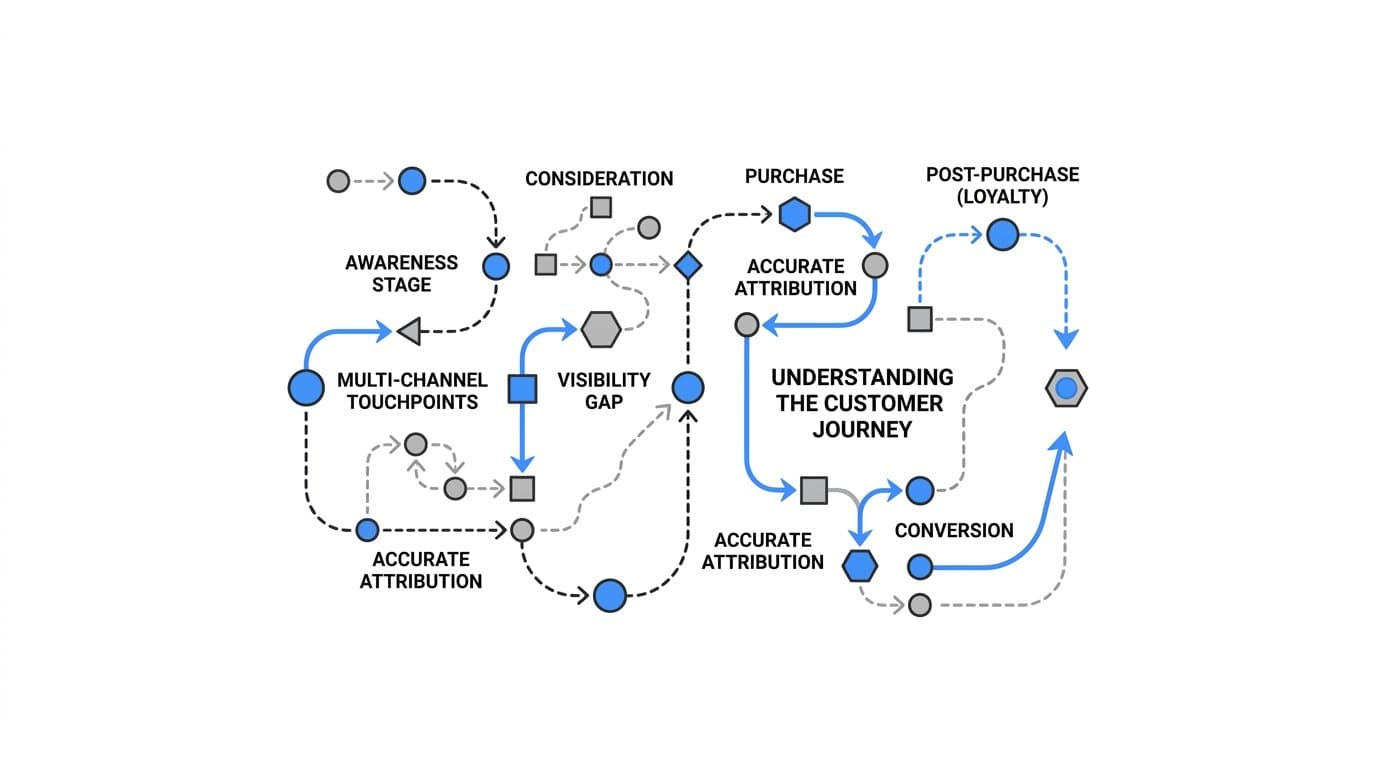
Every marketing textbook will show you a clean funnel: awareness, consideration, decision. It's a useful mental model, but it doesn't reflect how B2B SaaS buyers actually behave. In practice, buyers loop back. They enter at the consideration stage, retreat to awareness, go dark for two weeks, re-engage via a retargeting ad, and then convert after a peer recommendation they never told you about.
The journey is not a funnel. It's a web.
And that web gets more complex when you account for the reality of B2B purchasing: multiple stakeholders are involved in almost every significant software decision. An end user discovers your product and becomes an internal champion. An IT lead evaluates your security documentation. A finance director reviews the pricing page. An executive signs off after a brief demo. Each of these people has their own touchpoints, their own concerns, and their own path through your content and channels. The "customer journey" is actually a convergence of several individual journeys, all arriving at a single purchase decision.
This multi-stakeholder dynamic has a direct impact on how you should think about attribution. When a deal closes, which journey gets the credit? The champion who clicked your first ad six weeks ago? The IT lead who downloaded your technical documentation? The executive who read a case study the day before signing? Traditional attribution models are not built to handle this kind of complexity, and most teams don't account for it at all.
Then there's the time dimension. The gap between a prospect's first touchpoint and closed-won revenue in B2B SaaS can span weeks or months depending on deal size and organizational complexity. That gap creates enormous pressure to misattribute credit. When a long sales cycle finally closes, the natural instinct is to credit whatever happened most recently: the last email, the last ad click, the final demo. But that framing erases everything that built the trust and intent that made the close possible in the first place.
Understanding the customer journey starts with accepting that it's genuinely messy. Buyers don't follow your funnel. They follow their own curiosity, their internal processes, and the recommendations of people they trust. Your job is to map that reality as accurately as possible, not to impose a cleaner narrative on top of it.
The Touchpoints That Actually Shape a Purchase Decision
Not all touchpoints are created equal. Some channels build awareness and plant the seed. Others nurture intent over time. A few drive the final action. Understanding which channels do which job is what separates teams that scale intelligently from teams that chase the wrong metrics.
Paid social, particularly LinkedIn for B2B SaaS, tends to operate at the top of the journey. It introduces your brand to buyers who weren't actively searching for you. These impressions rarely convert immediately, but they prime the audience for everything that follows. Organic search, by contrast, captures buyers who are already in motion: they're researching solutions, comparing options, and looking for answers to specific problems. Content that ranks well for the right queries intercepts buyers at a high-intent moment.
Email sequences and direct outreach play a different role. They maintain presence during the long gaps between active research sessions, keeping your brand in the consideration set when a buyer resurfaces. Retargeting ads serve a similar function: they re-engage prospects who visited your site, watched a video, or engaged with earlier content, pulling them back into the journey at the right moment.
Then there's dark social. This is the portion of the B2B buyer journey that happens in channels you cannot track: private Slack communities, LinkedIn DMs, peer recommendations over coffee, word-of-mouth referrals from colleagues. A meaningful share of B2B software decisions are influenced by conversations that leave no trackable signal. Someone in a Slack group asks for a recommendation, three people mention your product, and the prospect books a demo the next day. Your analytics shows "direct traffic." The real driver was invisible.
Dark social is not a reason to give up on attribution. It is a reason to be humble about what your data can and cannot tell you, and to build your attribution strategy around capturing as much signal as possible from the touchpoints you can measure.
The practical implication here is that you need to distinguish between touchpoints that drive pipeline and touchpoints that close deals. A top-of-funnel blog post may influence dozens of eventual customers, but it rarely appears in last-click attribution reports. A demo request page will appear constantly. Neither tells the full story on its own. Separating first-touch influence from late-stage conversion signals requires a multi-touch view of the journey, and that requires the right tools and the right attribution model.
Why Traditional Analytics Tools Fall Short
Most marketing teams are working with analytics infrastructure that was built for a simpler era of digital advertising. The assumptions baked into those tools, particularly around attribution, create systematic blind spots that distort your understanding of the customer journey.
Last-click attribution is the most common default. It assigns all conversion credit to the final touchpoint before a form fill or demo request. On the surface, this seems logical: the last thing someone did before converting must have been important. But in a long B2B sales cycle, the last click is often the least interesting part of the story. It's the final step in a journey that was shaped by many earlier interactions, most of which receive zero credit under this model.
The result is predictable: teams systematically undercount the channels that build awareness and nurture intent. Paid social looks underperforming. Content marketing looks like a cost center. Brand campaigns are hard to justify. Meanwhile, branded search and bottom-of-funnel retargeting look like the heroes, because they're the ones showing up last. Budget follows the data, and the data is telling an incomplete story.
Cookie-based tracking compounds the problem. Browser-level restrictions from Safari's Intelligent Tracking Prevention, Firefox's Enhanced Tracking Protection, and Chrome's evolving cookie policies, combined with widespread ad blocker adoption, mean that a growing portion of user sessions go untracked by traditional JavaScript-based analytics. Every untracked session is a gap in your journey data. Over time, those gaps accumulate, and the picture your analytics tool shows you becomes increasingly disconnected from reality.
The third failure mode is data silos. Your ad platforms hold impression and click data. Your CRM holds lead and deal data. Your website analytics holds session and behavior data. In most organizations, these three data sources live in separate systems and are rarely connected. That means you can see what someone clicked, or what they did on your site, or whether they became a customer, but you almost never see all three in sequence for the same person.
Without that end-to-end view, understanding the customer journey at the level that actually drives decisions is nearly impossible. You're working with fragments instead of the full story.
Choosing the Right Attribution Model for Your Journey
Attribution models are not one-size-fits-all. Each model makes different assumptions about which touchpoints matter most, and each produces a different distribution of credit across your channels. Choosing the right model depends on what question you're trying to answer.
First-touch attribution gives all credit to the channel that introduced the buyer to your brand. It's useful for understanding which channels are best at generating net-new awareness, but it ignores everything that happened after that first interaction, including all the nurturing that moved the prospect toward a decision.
Last-click attribution does the opposite: it credits the final touchpoint before conversion. As discussed, this model systematically undervalues top-of-funnel channels and is a poor fit for long B2B sales cycles where the journey involves many meaningful interactions before the close.
Linear attribution distributes credit equally across all tracked touchpoints. It's more balanced than first-touch or last-click, and it gives you a clearer sense of which channels are consistently present throughout the journey. The limitation is that it treats every touchpoint as equally important, which is rarely true in practice.
Time-decay attribution weights touchpoints more heavily as they get closer to the conversion event. This model reflects the intuition that recent interactions are more influential, but it can still undervalue the awareness-stage channels that initiated the journey.
Multi-touch attribution is the approach that tends to serve B2B SaaS teams best. By distributing credit across all touchpoints in a way that reflects their actual influence, multi-touch models give you a more honest view of which channels contribute at each stage of the funnel. Position-based models, which give extra weight to the first and last touch while distributing the remainder across the middle, are a practical starting point for many teams.
Data-driven attribution goes further, using machine learning to assign credit based on patterns across many customer journeys rather than a fixed formula. This approach produces the most accurate picture, but it requires sufficient data volume to generate reliable models.
The most important principle for B2B SaaS companies is this: the right attribution model is one that connects ad spend to pipeline and revenue, not just to form fills or demo requests. Optimizing for top-of-funnel conversions without understanding which of those conversions actually close into revenue is a common and costly mistake. Your attribution model should trace the full arc of the journey, from first ad click to closed-won deal.
How to Track the Customer Journey Accurately in 2026
Given the signal loss created by browser restrictions and cookie deprecation, the baseline for accurate journey tracking in 2026 is server-side data collection. Instead of relying on JavaScript tags that fire in the browser and can be blocked or degraded, server-side tracking sends event data directly from your server to ad platforms and analytics systems. The result is more complete, more reliable data that doesn't depend on browser permissions or user settings.
Conversion API integrations, such as Meta's Conversion API and Google's Enhanced Conversions, are the practical implementation of this approach. They allow you to send first-party event data directly to the ad platforms that need it to optimize targeting and bidding. When your conversion signals are more complete, the platform algorithms perform better, and your attribution data becomes more trustworthy.
The next layer is CRM integration. This is where understanding the customer journey moves from tracking clicks to tracking revenue. By connecting your CRM to your ad data, you can follow a lead from their first ad interaction through every subsequent touchpoint, all the way to a closed-won opportunity. This end-to-end view is what allows you to answer the question that actually matters: which campaigns and channels are generating revenue, not just leads?
Platforms like Cometly are built specifically to create this connective layer. Cometly integrates with over 70 ad platforms, CRMs, and data sources, including Stripe for revenue data, to give B2B SaaS marketing teams a single source of truth for their customer journey data. Instead of toggling between ad dashboards and CRM reports and trying to manually connect the dots, you get a unified view of every touchpoint and its contribution to revenue.
Real-time journey analytics add another dimension. When you can see how prospects move through your funnel in real time, you can identify where they drop off, which channels re-engage them after a period of inactivity, and which sequences consistently produce pipeline. This is the difference between understanding the customer journey in theory and using that understanding to make daily operational decisions.
The combination of server-side tracking, CRM integration, and real-time analytics closes most of the gaps that traditional tools leave open. It won't capture every dark social interaction, but it gives you a dramatically more complete picture than cookie-based, last-click attribution ever could.
Turning Journey Insights Into Smarter Marketing Decisions
Data about the customer journey is only valuable if it changes how you act. The goal is not a prettier dashboard. The goal is better decisions about where to spend, what to scale, and what to cut.
The most immediate application is budget reallocation. Once you can see which touchpoints and channels actually contribute to closed-won revenue across the full journey, you can move budget toward the channels that close deals rather than just the channels that generate clicks. This often means increasing investment in top-of-funnel channels that last-click models had made look ineffective, while pulling back from bottom-of-funnel tactics that were getting credit for conversions they didn't actually drive.
AI-powered recommendations take this further. When you have clean, complete journey data flowing through a platform like Cometly, AI can surface patterns across thousands of customer journeys that would be impossible to identify through manual analysis. Which ad creative combinations consistently appear in the journeys of your highest-value customers? Which sequences of touchpoints correlate with shorter sales cycles? Which channels tend to re-engage prospects who went dark? These are the kinds of insights that compound over time, helping you build campaigns that are systematically better rather than incrementally tweaked.
There's also a feedback loop that directly improves your ad platform performance. When you send enriched, accurate conversion data back to Meta and Google through Conversion API integrations, you're giving those platforms' algorithms a better signal to optimize against. Instead of optimizing for form fills, the algorithm can optimize for the events that actually predict revenue. Over time, this improves targeting, reduces wasted spend, and increases the quality of the leads your campaigns generate.
This is the compounding advantage of accurate journey tracking. Better data leads to smarter decisions, which leads to better campaigns, which generates better data. Teams that build this loop early create a structural advantage that's difficult for competitors to replicate.