Most B2B SaaS marketing teams are doing something that feels completely rational but is actually costing them real money. They optimize individual ads, channels, and campaigns in isolation, measuring each one as if it operates in a vacuum. The problem is that buyers don't behave that way. Not even close.
A potential customer might discover your product through a LinkedIn ad, read three blog posts over the following two weeks, visit a competitor comparison page, go dark for a month, then return through a branded Google search before finally booking a demo. Which channel gets credit? If you're relying on last-click attribution, Google gets all of it. Every other touchpoint that shaped that decision becomes invisible.
This is the core tension in modern B2B SaaS marketing: buyers rarely convert on first touch, yet most teams measure as if they do. The customer journey is the sequence of interactions a potential buyer has with your brand from the moment they first become aware of you through to becoming a paying customer and, ideally, an advocate for your product. Understanding that journey is not an academic exercise. It is the foundation of every attribution decision, every budget allocation, and every campaign you run.
By the end of this article, you will understand each stage of the customer journey, why it matters for your marketing strategy, how to track it accurately, and how to connect it directly to revenue. Let's start with the reality of what that path actually looks like.
The Path Your Buyer Actually Takes Before Signing Up
Picture a B2B SaaS buyer researching a new analytics tool. They might encounter a paid social ad on a Tuesday morning, click through and read your homepage, then close the tab because they have a meeting. Three days later, they find one of your blog posts through a Google search. A week after that, they see a retargeting ad on LinkedIn and visit a G2 review page to compare you against two competitors. Then nothing for three weeks. Then a direct visit to your pricing page, followed by a demo request.
That is not an unusual journey. That is a typical one. The modern B2B SaaS buyer interacts with multiple touchpoints across weeks or even months before converting. Those touchpoints span paid ads, organic content, review platforms, email sequences, and direct site visits. Each one plays a role in building the trust and understanding required to make a purchase decision.
Here is what makes this genuinely complex: the journey is not linear. Buyers loop back. They revisit content they already read. They compare competitors mid-funnel. They go dark and re-engage weeks later after an internal conversation or budget approval. Understanding this non-linear reality is what separates data-driven marketers from those flying blind on platform-reported metrics alone.
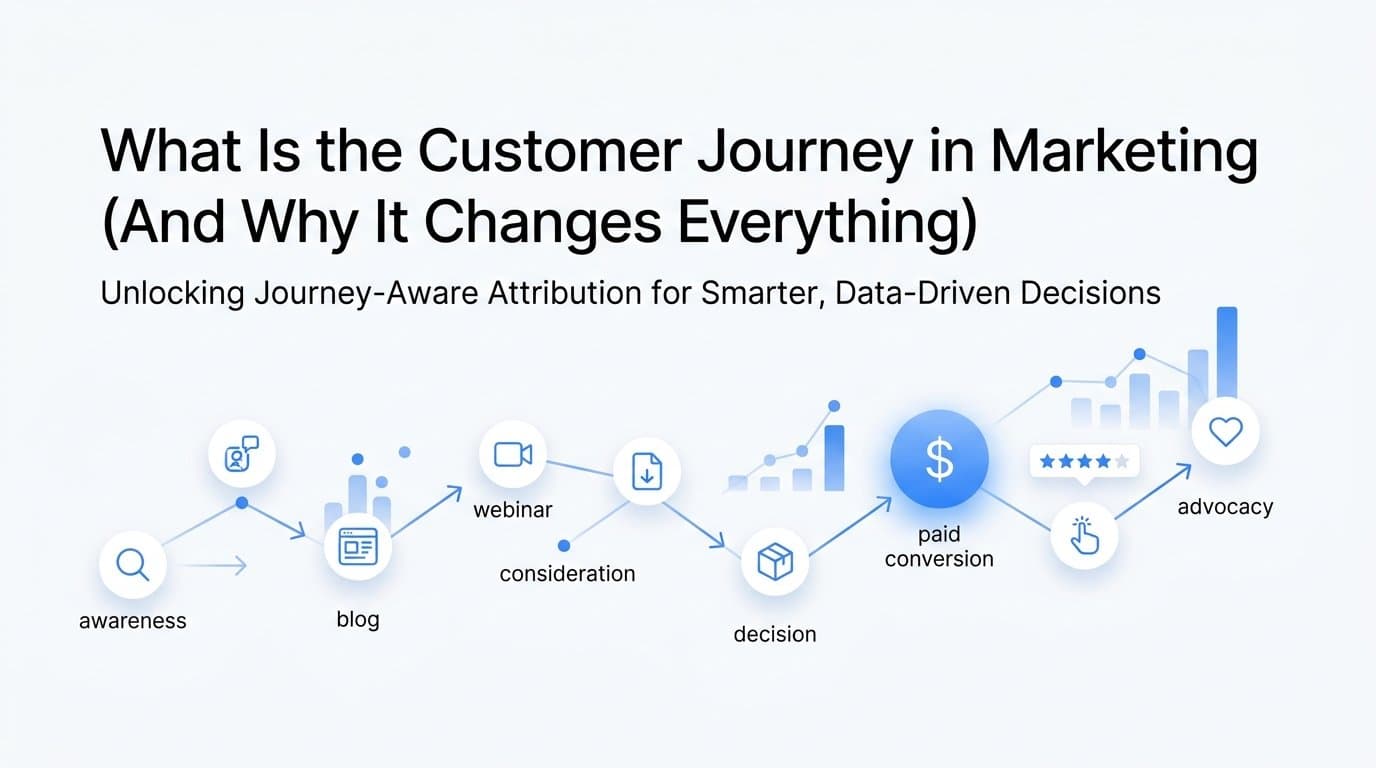
Within this complexity, there is a useful framework that organizes the journey into distinct stages, each with its own marketing responsibilities and measurement needs.
Awareness: The buyer does not yet know your product exists. They may be searching for information about a problem they have, not a solution. Your job is to get in front of them with relevant content, paid reach, or organic visibility.
Consideration: The buyer is now aware of solutions like yours and is actively evaluating options. They are comparing, reading reviews, watching demos, and building an internal case. This is where most B2B SaaS deals are shaped.
Decision: The buyer is ready to act. They need the final push: a compelling demo, a strong pricing conversation, a well-timed offer. Friction here is costly.
Post-Purchase (Retention and Advocacy): The journey does not end at conversion. Customers who see value quickly become advocates, and those advocates generate new Awareness for future buyers. The loop continues.
Treating these stages as distinct marketing responsibilities changes how you build campaigns, allocate budget, and measure success across the entire funnel.
Breaking Down Each Stage and What Marketers Are Responsible For
Each stage of the customer journey demands a different approach. The mistake many teams make is applying the same tactics and the same success metrics across all of them. That creates misalignment between what the buyer needs and what the marketer is delivering.
Awareness Stage: At this point, the buyer does not know your product exists. They may not even have fully articulated the problem they need to solve. Paid social, content marketing, SEO, and display advertising do the heavy lifting here. The goal is reach and relevance, not conversion. Measuring this stage by demo requests or signups will always make it look underperforming. The right metrics are impressions, reach, organic traffic growth, and brand search volume over time. Awareness is an investment in future pipeline, not a direct revenue driver you can measure in a 30-day window.
Consideration Stage: This is where the real competition happens. The buyer is actively evaluating options, building a shortlist, and trying to understand the difference between you and your competitors. Retargeting campaigns, comparison content, case studies, product demos, and email nurture sequences are the primary tools here. Your job is to be present, credible, and differentiated at every evaluation touchpoint. If your mid-funnel content is weak or absent, buyers will fill that gap with your competitor's narrative instead.
This stage is also where multi-touch attribution becomes most valuable. A buyer might engage with a retargeting ad, read a comparison blog post, watch a product walkthrough video, and open three nurture emails before requesting a demo. Each of those touchpoints contributed to the decision. Giving all the credit to the last click erases that entire story.
Decision Stage: The buyer has chosen a shortlist and is ready to make a move. Sales enablement content, personalized outreach, free trials, and frictionless onboarding experiences define this stage. The marketing team's role shifts toward supporting the sales conversation and removing any remaining barriers to commitment. Speed matters here. A buyer who is ready to decide and hits friction will often choose the competitor who makes it easier.
Post-Purchase Stage (Retention and Advocacy): Onboarding sequences, customer success touchpoints, and in-product education determine whether a new customer becomes a long-term one. This stage is often treated as a customer success responsibility, but marketing has a meaningful role in shaping the early experience and creating advocacy loops. Customers who achieve fast time-to-value are far more likely to write reviews, refer colleagues, and expand their usage. That advocacy feeds directly back into the Awareness stage for new prospects, completing the cycle.
Understanding which stage a prospect is in at any given moment allows you to match your message, your channel, and your metric to where they actually are in their decision process.
Why Most Teams Struggle to See the Full Picture
If the customer journey framework is well understood, why do so many marketing teams still operate with incomplete or misleading data? There are three interconnected problems that make full journey visibility genuinely difficult.
The Attribution Gap: When teams rely on last-click attribution or platform-native reporting, they systematically undervalue the early-stage channels that initiate the journey. A LinkedIn awareness campaign that introduces your brand to hundreds of qualified prospects gets zero credit when those prospects eventually convert through a branded Google search six weeks later. Over time, this creates a distorted picture where bottom-of-funnel tactics appear to drive all results, leading to budget cuts in awareness and over-investment in channels that only capture demand rather than create it.
Platform-native attribution compounds this problem. Google Ads attributes conversions to Google. Meta attributes conversions to Meta. Each platform is reporting from its own perspective, often claiming credit for the same conversion. Without an independent attribution layer, you are looking at overlapping, self-serving data rather than a unified view of what actually happened.
Data Fragmentation: Ad platforms, CRMs, website analytics tools, and email platforms each hold a piece of the customer journey. But they rarely communicate with each other in a unified, reliable way. The result is that your paid media team sees one number, your CRM shows another, and your web analytics reports something different entirely. There is no single source of truth, and decisions get made based on whichever data set is most convenient rather than the most accurate.
This fragmentation makes it nearly impossible to answer simple but critical questions: Which channels are starting the most journeys? Which touchpoints appear most often in high-value conversions? Where are prospects dropping off in the consideration stage? Without unified data, these questions remain unanswered.
Signal Loss from Privacy Changes: Browser-level tracking limitations, iOS App Tracking Transparency, and the ongoing deprecation of third-party cookies have created significant gaps in journey data for teams relying on pixel-based tracking alone. When a buyer clicks an ad on their iPhone and then converts on their laptop three weeks later, browser-based tracking often fails to connect those two events. The result is a journey map with missing chapters, leading to decisions based on incomplete information.
These three problems do not exist in isolation. They reinforce each other. Fragmented data makes attribution harder. Attribution gaps distort budget decisions. Signal loss makes fragmentation worse. Solving for the full customer journey requires addressing all three at once.
How to Map and Measure the Customer Journey with Attribution
Attribution is the mechanism that assigns credit to touchpoints across the customer journey. The model you choose determines which channels appear to be working, which appear to be underperforming, and ultimately how you allocate budget. Getting this right is not a technical detail. It is a strategic decision with real financial consequences.
First-Touch Attribution: All credit goes to the first touchpoint in the journey. This model is useful for understanding which channels are best at initiating journeys and building awareness. The limitation is that it ignores everything that happened between the first touch and conversion, which in a complex B2B SaaS sales cycle is often the most important part of the story.
Last-Touch Attribution: All credit goes to the final touchpoint before conversion. This is the default for most ad platforms and is deeply misleading for B2B SaaS companies with long sales cycles. It over-rewards channels that capture existing demand, like branded search, while making awareness and consideration investments look ineffective.
Linear Attribution: Credit is distributed equally across all touchpoints in the journey. This is a significant improvement over single-touch models because it acknowledges that multiple interactions contributed to the conversion. The limitation is that it treats a brief homepage visit the same as a 20-minute product demo, which does not reflect real influence.
Data-Driven Attribution: This model uses machine learning to assign credit based on the actual contribution of each touchpoint to conversion outcomes. It requires sufficient data volume to function accurately but produces the most realistic picture of how your marketing actually works. For B2B SaaS companies with longer sales cycles, data-driven multi-touch attribution is the most valuable approach.
Choosing the right model depends on your sales cycle length, your data volume, and your business goals. A company with a 90-day average sales cycle needs a fundamentally different attribution approach than one with a 7-day self-serve funnel.
Beyond model selection, the infrastructure for capturing journey data has become more critical than ever. Server-side tracking and Conversion API integrations from Meta and Google are now essential for accurate journey measurement in a privacy-first environment. Instead of relying on browser-based pixels that get blocked or degraded by iOS restrictions and ad blockers, server-side tracking sends conversion events directly from your server to the ad platform. This ensures that touchpoints are captured reliably, first-party data is preserved, and your attribution data reflects what is actually happening rather than what the browser was able to report.
First-party data collection, meaning data you own and control from your own website, CRM, and product, is the foundation of a durable journey measurement strategy. It is not affected by third-party cookie deprecation and gives you a complete, persistent record of customer interactions that you can use for attribution, segmentation, and optimization.
Turning Journey Insights Into Smarter Campaign Decisions
Mapping the customer journey and building accurate attribution is not the end goal. The goal is to make better decisions with the data you now have. Once the full journey is visible, the insights it surfaces are genuinely actionable.
Budget Allocation Based on Journey Role: With full journey visibility, you can identify which channels most often start journeys, which channels most often close them, and which touchpoints appear most frequently in the paths of your highest-value customers. This changes the budget conversation entirely. Instead of allocating spend based on last-click conversions, you can invest proportionally in channels that create demand at the top of the funnel, knowing that their contribution will eventually show up in pipeline and revenue.
Identifying Content Gaps: Journey data reveals where prospects are dropping off. If a significant portion of your potential customers engage with awareness content but consistently disengage during the consideration stage, that is a clear signal. Your mid-funnel assets, comparison pages, demo content, detailed use-case guides, and nurture sequences are not doing enough work. The journey map shows you exactly where the gap is, so you can build the content that fills it rather than guessing.
Optimizing Channel Sequencing: Not all channel combinations perform equally. Journey data can show you which sequences of touchpoints are most likely to lead to conversion. Perhaps buyers who see a paid social ad and then engage with organic content within two weeks convert at a much higher rate than those who only see paid ads. That insight changes how you think about your content strategy and your retargeting approach.
AI-Powered Pattern Recognition: The volume of data in a full customer journey is too large for manual analysis at scale. AI-powered analysis can surface patterns that humans would miss, such as which ad creative consistently appears in the journeys of customers who generate the most pipeline, or which combination of touchpoints predicts long-term retention. These insights go beyond campaign optimization and inform product positioning, messaging strategy, and resource allocation at a higher level.
Journey insights also improve the feedback loop to your ad platforms. When you can identify which conversions are genuinely high-value, you can send enriched conversion signals back to Meta and Google, training their algorithms to find more buyers who look like your best customers rather than optimizing for volume alone.
How Cometly Connects Every Touchpoint to Revenue
Understanding the customer journey conceptually is one thing. Having the infrastructure to actually track it, analyze it, and act on it in real time is another. This is the problem Cometly is built to solve for B2B SaaS marketing teams.
Cometly tracks the full customer journey from the first ad click through CRM events and all the way to closed-won revenue. Instead of looking at fragmented data across five different platforms, you get a single, unified view of how your marketing actually performs across every channel and every stage of the journey. That single source of truth changes the quality of every decision your team makes.
With 70+ native integrations, Cometly connects your ad platforms, CRM, and website data so that every stage of the journey is captured and attributed accurately. Server-side event tracking via Conversion API ensures that touchpoints are not lost due to browser limitations or privacy restrictions. Your journey data stays complete even as the tracking environment continues to evolve.
Cometly's AI analyzes your journey data to surface which ads and campaigns are driving real pipeline and revenue, not just clicks and impressions. It identifies high-performing creative and campaigns across every ad channel, so you can scale what is working with confidence rather than intuition. And by feeding enriched, conversion-ready events back to Meta and Google, Cometly improves ad platform targeting and optimization at the source, helping their algorithms find more buyers who match your best customers.
For B2B SaaS teams managing complex, multi-touch sales cycles, this level of visibility is not a nice-to-have. It is the difference between marketing that scales intelligently and marketing that keeps spending money without knowing why some of it works and most of it doesn't.
Putting It All Together
The customer journey is not a theoretical framework designed for marketing textbooks. It is the operating map for every budget decision, campaign strategy, and channel investment your team makes. When you understand how buyers actually move from first awareness to closed-won revenue, you stop optimizing in isolation and start building a marketing system that compounds over time.
The progression is clear: understand each stage of the journey and what it demands from your marketing, map the touchpoints that move buyers through it, apply attribution models that reflect the full complexity of your sales cycle, address signal loss with server-side tracking and first-party data, and then act on the insights that journey data reveals. Each step builds on the last.
The teams that win in B2B SaaS marketing are not the ones with the biggest budgets. They are the ones who can see what is actually working, allocate resources accordingly, and improve with every campaign cycle. That visibility starts with the customer journey.
If you are ready to stop guessing and start seeing the full picture, Get your free demo and discover how Cometly gives you a real-time, unified view of your customer journey from first touch to closed-won revenue.