Picture this: it's Monday morning, and you're trying to answer a simple question. Which channels drove the most pipeline last month? To find out, you open Google Ads, pull a report, then switch to Meta Business Manager, then LinkedIn Campaign Manager, then your CRM. By the time you've collected all the numbers, you realize they don't add up. Google claims credit for conversions that Meta also claimed. LinkedIn shows a ROAS that looks great in isolation but tells you nothing about actual revenue. You're drowning in data and still can't answer the question.
This is the daily reality for most B2B SaaS marketing teams running paid campaigns across multiple channels. The data exists. There's actually too much of it. But it lives in silos, reported through different lenses, measured by different logic, and optimized for each platform's own definition of success. The result is fragmented visibility that makes confident budget decisions nearly impossible.
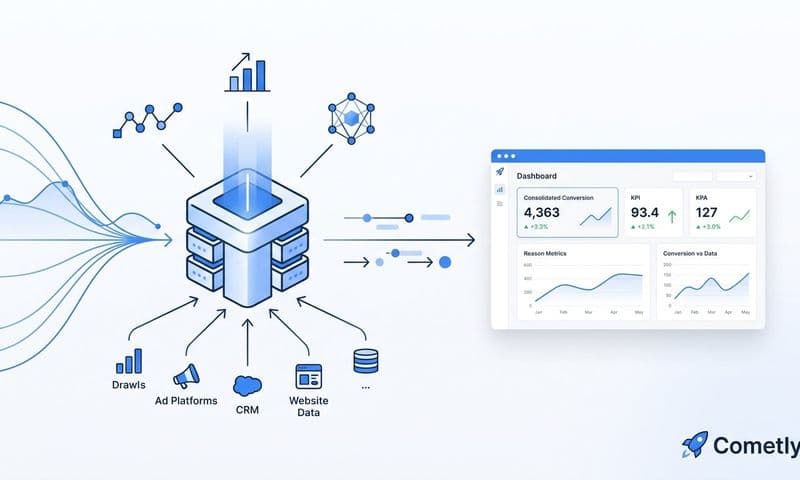
Unified ad analytics is the answer to this problem. It's the practice of consolidating cross-channel ad data, CRM data, and website behavior into a single environment where everything is normalized, comparable, and connected to real business outcomes. When you have unified ad analytics in place, you stop guessing which channels are working and start knowing. This article breaks down exactly how that works, what it requires technically, and how it changes the way growth teams operate.
The Fragmented Data Problem Costing Marketers Real Budget
Running ads across multiple platforms is standard practice for B2B SaaS companies. Google Ads captures intent-driven search traffic. Meta reaches broader audiences through social. LinkedIn targets by job title, company size, and industry. Each channel plays a role. But each channel also lives in its own reporting world, and that's where the trouble starts.
Every ad platform uses its own attribution logic. Google Ads might default to data-driven attribution within its ecosystem. Meta reports view-through conversions by default, meaning a user who simply saw an ad and later converted elsewhere still gets counted. LinkedIn uses its own click and impression windows. None of these models are wrong on their own terms. The problem is that they're incompatible with each other, and when you try to add up results across platforms, you're not adding apples to apples.
The most visible symptom of this incompatibility is conversion double-counting. A single customer might click a Google ad, later see a LinkedIn ad, and then convert after clicking a Meta retargeting ad. All three platforms will likely claim that conversion. Your actual revenue from that customer is counted once in your CRM. Your reported conversions across platforms might count it three times. This inflates ROAS figures across the board and makes every channel look more effective than it actually is.
The downstream consequences are significant. Budget allocation decisions get made based on whichever platform reports the best numbers in its own dashboard, not based on which channels are actually driving revenue. Channels that appear strong in native reporting get more budget. Channels that appear weak get cut. But if those assessments are based on incompatible, biased data, the decisions are flawed from the start.
There's also a structural incentive problem worth naming directly. Every ad platform has a financial interest in showing its own contribution as favorably as possible. Platform-native reporting is not neutral. It's designed to justify continued spend on that platform. Relying on it exclusively means accepting a version of performance that serves the platform's interests, not yours. Ad platform data discrepancies like these are exactly why unified ad analytics removes that bias by applying consistent measurement logic across all channels from a neutral vantage point.
What Unified Ad Analytics Actually Means
The term "unified ad analytics" gets used loosely, so it's worth being precise about what it actually means and, just as importantly, what it doesn't mean.
At its core, unified ad analytics is a system that pulls data from every ad platform you run, your CRM, and your website into a single environment. Within that environment, metrics are normalized so they're directly comparable. Attribution logic is applied consistently across all channels. And performance is connected not just to ad-level metrics like clicks and impressions, but to actual business outcomes: leads, opportunities, pipeline, and closed-won revenue.
This is meaningfully different from a simple dashboard aggregator. Many tools can pull spend data from multiple platforms and display it in one place. That's useful, but it's not unification. True unified analytics doesn't just aggregate numbers. It connects the dots across the entire customer journey, from the first ad click through every subsequent touchpoint, through the lead form submission, through the sales process, and ultimately to whether that lead became a paying customer.
For B2B SaaS companies, this distinction matters enormously. Your sales cycles are long. A prospect might first encounter your brand through a LinkedIn ad, research you via organic search, attend a webinar, click a Google remarketing ad, and then book a demo weeks later. A system that only looks at last-click attribution will give all the credit to the Google remarketing ad and none to LinkedIn, organic search, or the webinar. That misrepresents how the conversion actually happened and leads to systematic underinvestment in top-of-funnel channels.
Unified analytics solves this by enabling consistent attribution model application across all channels. When all your data lives in one place, you can apply first-touch, linear, time-decay, or multi-touch attribution to the same dataset and see how the channel performance picture changes under each model. You're no longer forced to accept each platform's default attribution logic. You choose the model that best reflects your business reality, and you apply it everywhere. Understanding the full scope of a unified marketing analytics platform makes clear why this flexibility is so valuable for growth teams.
This creates a level playing field for budget decisions. Channels are evaluated by the same rules. Credit is assigned by your logic, not each platform's self-serving default. And the performance picture you're working from is built on consistent data rather than a patchwork of incompatible reports.
The Technical Building Blocks That Make It Work
Unified ad analytics doesn't happen by accident. It requires a specific technical foundation that ensures data is captured accurately, connected properly, and reported reliably. There are three core components worth understanding.
Server-side tracking and Conversion API integrations: Browser-based pixel tracking has become increasingly unreliable. Ad blockers prevent pixels from firing. iOS privacy changes limit the data that browser-based tracking can capture. Third-party cookie deprecation has further degraded signal quality. Server-side tracking analytics addresses this by capturing conversion events directly from your server rather than relying on a user's browser to fire a pixel. Conversion API integrations with platforms like Meta and Google allow you to send these server-side events directly to the ad platform, ensuring your conversion data is as complete and accurate as possible regardless of browser settings or privacy restrictions. This is the foundation of data completeness in a unified system.
CRM integration as the revenue bridge: For B2B SaaS companies, the conversion that actually matters is a closed-won deal, not a lead form fill. Lead form fills are a proxy metric. They're useful, but they don't tell you whether the leads that came from a particular campaign were qualified, moved through the pipeline, or became customers. CRM integration is what closes that gap. When your ad platform data connects to your CRM data, you can trace a campaign back to actual revenue. You can see which campaigns generated pipeline, which generated qualified opportunities, and which generated closed deals. Without this connection, your analytics stops at the lead level and you're optimizing for a proxy rather than the outcome that matters.
UTM parameter consistency and event normalization: Data from different platforms arrives in different formats with different naming conventions. If your UTM parameters aren't applied consistently across all campaigns and channels, combining that data produces noise rather than insight. Similarly, if conversion events are defined differently across platforms (a "lead" in Google Ads versus a "lead" in your CRM might refer to different things), your unified reporting will be unreliable. Establishing a standardized taxonomy for UTM parameters and event names across all channels is essential groundwork. It's not glamorous, but it's what makes the unified data actually trustworthy. Reviewing the key marketing analytics metrics you need to track is a useful starting point for defining that taxonomy.
These three components work together to ensure that when data is consolidated into a unified environment, it's complete, connected, and consistent. Without all three, you're unifying noise rather than signal.
How Unified Analytics Changes Campaign Decision-Making
The real value of unified ad analytics isn't the reporting itself. It's what the reporting enables. When all your channel data is visible in one place, the way your team operates changes fundamentally.
The most immediate shift is from reactive to proactive optimization. In a fragmented environment, performance review is a backward-looking exercise. You check each platform after the fact, piece together a picture of what happened, and make adjustments based on incomplete information. With unified analytics, you can compare performance across channels in real time, see which channels are over- or under-delivering against targets, and reallocate budget with confidence because you're working from a consistent, complete view of performance.
Multi-touch attribution also becomes genuinely actionable within a unified system. In theory, multi-touch attribution is straightforward: assign credit to every touchpoint that contributed to a conversion based on its role in the journey. In practice, it's only useful if all those touchpoints are visible in the same place. A unified system lets you see that a prospect first engaged through a LinkedIn thought leadership ad, later clicked a Google branded search ad, and finally converted after a Meta retargeting ad. You can see the full sequence and understand how your top-of-funnel channels are supporting bottom-of-funnel conversions, even when they never receive last-click credit. Touchpoint tracking analytics is the mechanism that makes this full-journey visibility possible.
This changes how you evaluate channel performance. A channel that looks weak under last-click attribution might be a critical part of the conversion path under linear or time-decay models. Without unified analytics, you'd never know. With it, you can make the case for investing in awareness and consideration channels based on their actual contribution to revenue, not just their last-click performance.
AI-powered recommendations also become possible when data is unified and clean. With a complete, enriched dataset covering every channel, every touchpoint, and every conversion outcome, AI can surface patterns that would be invisible in fragmented reporting. Which specific ad creatives are driving the highest-quality pipeline? Which audience segments convert at the highest rate across channels? Which campaigns are generating volume but not revenue? These are the questions that move the needle on efficiency, and they require unified data to answer reliably. Exploring AI marketing analytics capabilities reveals just how much optimization leverage becomes available when your data foundation is solid.
Feeding Better Data Back to Ad Platforms
Unified ad analytics doesn't just improve how you see your data. It also improves how ad platforms use your data to optimize on your behalf. This feedback loop is one of the most underappreciated benefits of a unified approach.
Ad platform machine learning algorithms optimize toward the conversion signals they receive. If you're only sending lead form completion signals to Meta or Google, those platforms optimize for volume of lead form completions. They'll find the audiences most likely to fill out a form, which may or may not be the audiences most likely to become paying customers. The two groups are often quite different, especially in B2B SaaS where lead quality varies significantly.
When you have unified analytics connected to your CRM, you can send enriched conversion signals back to ad platforms via server-side events. Instead of just signaling "this person filled out a form," you can signal "this person filled out a form, became a qualified opportunity, and closed as a customer with a contract value of X." When the ad platform's AI trains on that richer signal, it learns to find more people who look like your actual customers, not just people who look like form-fillers.
Sending offline conversion data and CRM-qualified lead signals back to platforms like Meta and Google improves targeting precision over time. The ad platform AI becomes progressively better at identifying high-intent audiences because it's learning from higher-quality outcome data. This compounds: better signals produce better targeting, which produces higher-quality leads, which produce better signals.
The practical impact is a shift from optimizing for cost-per-lead to optimizing for cost-per-revenue. Campaigns that generate expensive leads who close at high rates become more attractive than campaigns that generate cheap leads who rarely convert. That's a fundamentally more efficient use of ad budget, and it's only possible when the feedback loop between your CRM, your analytics, and your ad platforms is closed. This is one reason why performance marketing analytics software has become essential infrastructure for data-driven B2B teams.
Building Toward a Single Source of Truth for Marketing
The end goal of unified ad analytics is a single source of truth: one platform where every stakeholder on the marketing team, from the CMO reviewing overall performance to the paid media manager optimizing individual campaigns, is looking at the same numbers and making decisions from the same data.
In practice, this eliminates a significant amount of wasted time and internal conflict. When different team members are pulling data from different sources, disagreements about performance are inevitable. The paid media manager sees strong ROAS in Google Ads. The CMO sees weak pipeline contribution in the CRM. Both are looking at real data, but they're looking at different slices of an incomplete picture. A unified marketing analytics dashboard resolves this by ensuring everyone is working from the same complete, consistent dataset.
Getting there requires addressing a few common implementation challenges. Data latency is one: some integrations update in real time while others have delays, which can create inconsistencies if not managed carefully. Integration gaps are another: not every tool in your stack will have a native connector, and filling those gaps requires planning. Team adoption is often the most underestimated challenge. Even the best unified analytics platform only delivers value if the team actually uses it and trusts it.
A practical approach is to prioritize integrations by spend volume. Connect your highest-spend channels first, get those working reliably, and build from there. This ensures you're getting value from the system quickly while you work through lower-priority integrations.
This is exactly the use case Cometly is built for. Cometly connects your ad platforms, CRM, and website data to deliver real-time attribution, AI-powered insights, and revenue-level reporting in a single platform designed specifically for B2B SaaS marketing teams. With more than 70 native integrations, server-side conversion tracking, and Conversion API support for major ad platforms, Cometly provides the technical infrastructure and the analytical layer that transforms fragmented ad data into a coherent, actionable view of marketing performance. It captures every touchpoint from first ad click to closed-won deal, so you can see not just which campaigns are generating leads, but which ones are generating revenue.
Putting It All Together
Fragmented ad data is not just an inconvenience. It's a budget problem and a growth blocker. When each platform reports through its own lens with its own attribution logic and its own incentive to look good, the picture you're working from is systematically distorted. Decisions made on that data are decisions made with incomplete information, and the cost shows up in misallocated budget, undervalued channels, and missed opportunities to optimize toward what actually drives revenue.
Unified ad analytics solves this by creating a consistent, connected view of performance across every channel. It normalizes data so channels can be compared fairly. It connects ad-level activity to CRM outcomes so you can see which campaigns drive revenue, not just leads. It enables consistent attribution model application so credit is assigned by your logic rather than each platform's default. And it closes the feedback loop so your ad platforms can optimize toward the outcomes that actually matter to your business.
The goal isn't better reporting for its own sake. It's better decisions, faster optimization, and more efficient ad spend. When your data is unified, you stop reacting to platform reports and start driving strategy from a position of clarity.
If you're ready to move from fragmented dashboards to a single source of truth for your marketing data, Get your free demo and see how Cometly brings all of this together in one platform built for B2B SaaS marketing teams.