
You open your analytics dashboard on a Tuesday morning and the number is wrong. Conversion rates are down, noticeably, and nothing obvious changed last week. No major site updates, no budget cuts, no campaign pauses. Just a quiet, unexplained decline that is now sitting in your pipeline forecast like a slow leak.
For B2B SaaS marketing teams, this is one of the most disorienting situations you can face. Unlike e-commerce, where a conversion rate drop might mean fewer purchases today, a SaaS conversion rate decline compounds over time. Fewer qualified leads entering the funnel today means fewer opportunities next month and compressed revenue three months from now. The stakes are real and the pressure to diagnose quickly is high.
The problem is that most teams react to conversion rate drops the wrong way. They change the landing page, pause a campaign, or blame the algorithm, all before actually understanding what changed. This article is a diagnostic guide, not a list of quick fixes. It moves from surface-level symptoms to root causes, and it puts accurate attribution data at the center of the process. Because guessing without data does not just waste time. It often makes the underlying problem worse.
Is It a Real Decline or Just Noise?
Before you change anything, you need to answer one question: is this a meaningful, sustained decline or normal statistical variance? Conversion rates fluctuate. Even a well-optimized funnel will show week-to-week variation, especially in B2B SaaS where deal cycles are long and sample sizes at each funnel stage can be relatively small.
The first step is establishing a reliable baseline. What is your typical conversion rate over a rolling 30, 60, or 90-day window? If you are comparing last week to the week before, you are almost certainly looking at noise. A meaningful decline shows up consistently across multiple weeks and holds when you look at it against a longer historical baseline.
Date range selection matters more than most teams realize. Comparing a holiday-adjacent week to a normal week, or a period after a major product launch to a quiet period, will produce misleading conclusions. Seasonal patterns, external news cycles, and industry events all affect B2B buying behavior. If your baseline does not account for these rhythms, your alarm threshold is set wrong.
Traffic volume is another variable that distorts conversion rate calculations in ways that are easy to miss. If you recently scaled a paid campaign significantly, you may have added a large volume of lower-intent clicks that drag down your overall rate, even if your core funnel is performing exactly as it was. Conversely, if organic traffic dropped and paid stayed flat, your blended conversion rate might look artificially higher or lower depending on the relative conversion rates of each channel.
The practical test: segment your conversion rate by channel before drawing any conclusions. If the rate held steady in organic and email but dropped sharply in paid, you have a paid-specific problem, not a site-wide one. That distinction changes everything about how you respond.
Traffic Quality: The Most Overlooked Culprit
Here is a scenario that plays out regularly in B2B SaaS marketing. You scale a paid campaign, clicks go up, cost per click stays reasonable, but conversion rates start sliding. The landing page did not change. The offer did not change. So what happened?
The traffic changed. Specifically, the quality of the traffic changed. When you increase budget on a paid channel, ad platform algorithms need to find more users to show your ads to. To do that, they gradually broaden their targeting reach, pulling in users who are progressively less similar to your original converting audience. This is a well-documented behavior on platforms like Meta and Google, where optimization algorithms are designed to maximize volume within your bid constraints, not necessarily to protect the intent level of your audience.
The result is audience targeting drift. Over time, the people clicking your ads are less qualified than the people who clicked them when the campaign launched. Your click-through rate might stay stable or even improve as the algorithm finds users who respond to your creative. But those users are not converting because they were never a strong fit for your product in the first place.
A shift in channel mix creates a similar effect without any algorithm involvement. If your organic search traffic drops due to a ranking change and paid traffic fills the gap, your blended site-wide conversion rate will likely fall, because organic search typically delivers higher-intent visitors than most paid channels. The landing page did nothing wrong. The funnel did nothing wrong. The traffic composition changed.
This is why blended, site-wide conversion rate is one of the least useful metrics for diagnosing performance problems. It hides the signal inside an average. Channel-level and campaign-level conversion rate analysis is where the actual diagnostic work happens.
When you break conversion rates down by source, medium, campaign, and audience segment, patterns emerge quickly. You might find that branded search is converting at its normal rate while a broad-match prospecting campaign has fallen sharply. Or that one ad set is driving most of the volume but almost none of the conversions. These are actionable insights. A blended rate gives you none of them.
Funnel Friction Points That Kill Conversions Silently
Not every conversion rate problem is a traffic problem. Sometimes the traffic is fine and the funnel itself is the issue. Funnel friction is particularly dangerous in B2B SaaS because it often accumulates gradually and goes unnoticed until the compounding effect becomes significant.
Think about the math. If your funnel has four stages and each stage loses two percentage points more than it used to, the individual changes might look minor in isolation. But the cumulative impact on end-to-end conversion rate can be substantial. Small friction increases across multiple touchpoints do not add, they multiply.
Common friction sources include form length, page load speed, unclear value propositions, and messaging misalignment between ad copy and landing page. That last one deserves attention. If your ad promises a specific outcome or speaks to a specific pain point, and the landing page delivers a generic product pitch, visitors experience a disconnect. They arrived expecting one conversation and found another. That gap costs conversions.
Changes to the customer journey itself are another frequent culprit that teams overlook because the changes feel like improvements. Adding a step to the signup flow to collect more qualification data, restructuring the pricing page, or introducing a new gating mechanism on a content offer can all cause conversion rate drops that look, on the surface, like traffic problems. If you did not track the timing of these changes against the conversion rate trend, you will miss the connection entirely.
Page load speed is worth calling out specifically. In B2B SaaS, where buyers are often evaluating multiple vendors simultaneously, a slow-loading page is a quiet conversion killer. Users with high intent will sometimes wait, but marginal visitors will not. As mobile usage in B2B research continues to grow, load speed has become a more significant factor than many teams account for.
The diagnostic approach here is straightforward but requires discipline. Map your funnel stages explicitly, measure the conversion rate at each stage independently, and compare current rates to your historical baseline at each step. The stage where the drop is most pronounced is where you investigate first. This is more precise than guessing at the overall rate and hoping a landing page tweak fixes it.
Tracking Failures That Make Conversions Disappear
This is the scenario that causes the most unnecessary panic: your conversion rates dropped, but your actual conversions did not. The performance is fine. The measurement broke.
Tracking failures are more common than most teams want to admit, and they have become significantly more likely over the past several years as browser privacy changes have eroded the reliability of client-side, pixel-based tracking. A broken pixel, a misconfigured conversion event, a tag that stopped firing after a site update, any of these can cause reported conversions to fall sharply while real business performance stays flat.
The impact of Apple's App Tracking Transparency framework, introduced with iOS 14 and continuing to evolve, is well-documented across the paid media industry. It significantly reduced the ability of platforms like Meta to track conversions that occur after an ad click, particularly for users on iOS devices. The result is that reported conversion data from pixel-based tracking increasingly undercounts real conversions. Teams that rely solely on platform-reported numbers are working with an incomplete picture.
Browser-level cookie restrictions compound this problem. Safari's Intelligent Tracking Prevention, Firefox's Enhanced Tracking Protection, and the ongoing evolution of Chrome's privacy model have progressively degraded the accuracy of third-party cookie-based attribution. A conversion that happens after a user switches browsers, clears cookies, or uses a privacy-focused browser may never be recorded at all in a client-side tracking setup.
Server-side tracking and Conversion API integrations were built specifically to address these gaps. Instead of relying on a browser pixel to fire and report back to the ad platform, server-side tracking sends conversion data directly from your server to the platform's API. This approach is far more reliable because it does not depend on browser behavior, user consent for cookies, or pixel load success.
For B2B SaaS teams, the practical implication is significant. If your conversion tracking is still primarily pixel-based, a portion of your real conversions are almost certainly going unreported. This creates two problems simultaneously: your reported conversion rate is artificially low, and the ad platform's optimization algorithm is working with incomplete data, which leads it to make worse decisions about who to target and which bids to place.
Before you investigate any other cause of a conversion rate drop, verify your tracking integrity. Check that your conversion events are firing correctly, confirm that server-side tracking is in place, and compare your reported conversions against CRM data to identify any gap between what your ad platforms are reporting and what is actually entering your pipeline. Reviewing conversion tracking gaps systematically is one of the highest-leverage diagnostic steps you can take.
Attribution Blind Spots That Distort the Full Picture
Even when tracking is technically intact, the way you attribute conversions can create a distorted picture of what is actually working. This is a particularly acute problem in B2B SaaS, where the buying journey typically spans multiple touchpoints across weeks or months before a prospect converts to a lead, let alone to a closed deal.
Single-touch attribution models, whether first-touch or last-touch, assign all conversion credit to one interaction in a journey that may have included a dozen. Last-touch attribution, which is still the default in many analytics setups, credits the final click before conversion. This systematically undervalues the channels that create awareness and drive early-stage engagement, like content, social, and display, while overvaluing the channels that capture demand at the moment of decision, like branded search.
The practical consequence is that if you are diagnosing a conversion rate drop using last-touch data, you may be looking at the wrong channels entirely. A campaign that appears to be underperforming in a last-touch model might be playing a critical role in warming up prospects who later convert through a different channel. Switching to a linear or time-decay model, or comparing models side by side, can surface these contributions and change your diagnosis completely.
Attribution model choice also affects how you measure the impact of upper-funnel investments. If your team recently increased spend on content syndication or LinkedIn awareness campaigns, last-touch attribution will make those investments look like they produced almost nothing. A multi-touch model will show their actual contribution to the pipeline. Without that visibility, teams often cut the channels that are doing the most important work.
The deeper issue in B2B SaaS attribution is the gap between lead conversion and revenue conversion. Many teams measure conversion rate at the lead or form submission stage and stop there. But a drop in lead conversion rate is a different problem from a drop in lead-to-opportunity rate, which is a different problem from a drop in close rate. If you are only measuring the top of the funnel, you cannot tell which stage is actually breaking down.
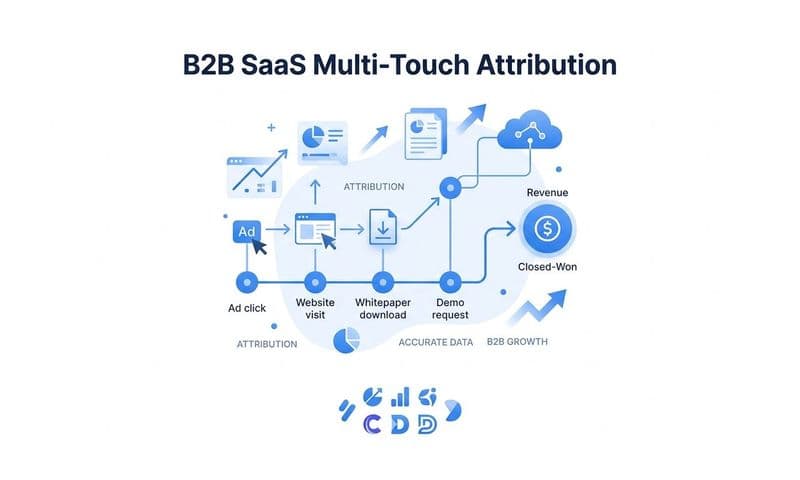
Connecting ad spend data to CRM pipeline events and closed-won revenue gives you a complete picture. You can see whether the leads coming from a particular campaign are actually converting to opportunities and deals, or whether they are high-volume but low-quality leads that are clogging the pipeline without generating revenue. That distinction is critical for making the right decision about where to invest and where to pull back.
A Diagnostic Framework for Finding the Real Cause
At this point, you have a clear picture of the major categories of causes: statistical noise, traffic quality shifts, funnel friction, tracking failures, and attribution blind spots. The question is how to move through them systematically rather than randomly testing hypotheses.
Start with tracking integrity. This is the first step because everything else depends on it. If your conversion data is incomplete or inaccurate, every conclusion you draw from it is suspect. Check that your conversion events are firing correctly across your key pages, verify that server-side tracking is active and passing data to your ad platforms, and cross-reference your reported conversions against CRM records. Following best practices for tracking conversions accurately will help you identify any gap and close it before moving forward.
Once you have confirmed that your data is reliable, segment by channel and campaign. Pull conversion rates for each traffic source independently and compare them to their own historical baselines, not to each other. A drop in paid social that coincides with a budget increase is a different diagnosis from a drop in organic that coincides with a Google algorithm update. Segment-level analysis tells you where to focus.
Next, analyze funnel stage drop-off. Map the conversion rate at each stage of your funnel and identify where the decline is most pronounced. If top-of-funnel click-to-lead conversion is holding but lead-to-opportunity rate has dropped, the problem is likely in how your sales team is working leads or in the quality of leads being generated, not in your ad creative or landing page. If the drop is happening at the click-to-lead stage, you are looking at a traffic quality or on-page friction problem.
Then review audience and creative changes. Look at what changed in your paid campaigns in the weeks before the conversion rate decline began. Audience expansions, creative refreshes, bid strategy changes, and match type adjustments all have the potential to shift traffic quality. If you can correlate a specific campaign change with the timing of the decline, you have a strong hypothesis to test.
This is where AI-driven analytics tools become genuinely valuable. Manual analysis of this diagnostic sequence across multiple channels, campaigns, and funnel stages is time-consuming and prone to the cognitive bias of confirming your first hypothesis. AI-powered platforms can surface anomalies automatically, flag campaigns where conversion rates have deviated significantly from their baseline, and identify patterns across large data sets that would take hours to find manually.
Platforms like Cometly are built specifically for this kind of analysis. By connecting your ad platforms, CRM, and website tracking into a single attribution layer, Cometly gives B2B SaaS teams the ability to see exactly which touchpoints are driving conversions at every stage of the funnel, from first ad click to closed revenue. When conversion rates drop, you can pinpoint whether the issue is in your paid campaigns, your funnel, your tracking, or your attribution model, and act on real data rather than assumptions. The AI layer surfaces underperforming campaigns and anomalies faster than manual review, and the enriched conversion data fed back to ad platforms improves the quality of algorithmic optimization signals over time.
Putting It All Together
A conversion rate drop is rarely the result of a single cause. In most B2B SaaS situations, it reflects a combination of factors that interact in ways that are hard to untangle without structured diagnostic thinking and reliable data.
The teams that recover fastest are not the ones who move quickest to make changes. They are the ones who verify their data first, segment before drawing conclusions, and follow a disciplined sequence from tracking integrity through funnel analysis before touching their campaigns. Reactive changes made without that foundation often fix the wrong thing and create new problems in the process.
Accurate, end-to-end attribution is the foundation of this entire process. Without it, you are diagnosing in the dark. You cannot tell whether a drop in reported conversions reflects a real performance decline or a measurement failure. You cannot see which channels are contributing to pipeline and which are generating volume without value. You cannot connect the ad spend decisions you make today to the revenue outcomes that appear three months from now.
Cometly gives B2B SaaS marketing teams that foundation. It connects every touchpoint from the first ad click to closed-won revenue, tracks the full customer journey in real time, and surfaces the insights needed to act with confidence when conversion rates move in the wrong direction. If your team is navigating an unexplained drop right now, the first step is getting your data right. Get your free demo and see exactly where your conversions are breaking down.